Showing posts with label Robin Hanson. Show all posts

Friday, May 07, 2021

Sociodynamics of Artificial People

 Note

I used the research paper below (which I translated) as background to my recent story, La Double Inconstance. The text is quite technical. AC.

---


arXiv.org > sociobio > arXiv:2107.05827

Sociobiology > Modelling (qualitative)

[Submitted on 13 Apr 2032]


Sociodynamics of Artificial People


Mireille Fossey (Université de Paris, Faculté des Sciences du vivant)


ABSTRACT


The high-profile emergence of artificial people (also known as models) into elite society has led to discussion as to implications and consequences. These debates have mostly been conducted with the social science paradigm of Critical Theory [1], defining tropes of specific and intersectional oppression. 


In this short overview we introduce a different framework of analysis, specifically the interdisciplinary fusion of population genetics, evolutionary psychology and marxian historiography. This paradigm provides a robust and well-grounded perspective both for the scientific understanding of the phenomena and for the generation of robust public policy prescriptions. Some conclusions are speculative. 


Submission history

From: Mireille Fossey [view email]

[v1] Tue, 13 Apr 2032 21:05:34 UTC (135 KB)


[Translated by Adam Carlton]


--- FULL TEXT --- 


Sociodynamics of Artificial People


Introduction


The recent prominence of artificial people, most particularly in the unsuccessful Mars mission, has led to considerable discussion and controversy. Artificial people, commonly known as 'models', have achieved leadership positions in the economy, in politics, the media, entertainment and the professions with consequential social tensions. 


To date most analysts have appealed to the framework of Critical Theory [1] formulating responses as those of oppression and intersectionality together with appeals to post-Enlightenment values to secure equitable outcomes. 


In contrast to this normative approach, in this paper we explore a paradigm rooted in evolutionary biology/psychology and marxian historiography which we believe provides a scientifically well-founded and grounded analysis. Benefits of our approach include better understanding of observed social dynamics and a more profound set of public policy prescriptions. 


Background


The arrival of artificial people - models - in elite positions has posed a challenge to baseline humans - hereafter termed baselines. Should baselines welcome these new additions or under some circumstances could they be considered a threat?


Critical Theory frames this as a problem of values or morality. Some absolute moral framework is sought to make intuitively-desired outcomes compelling. But in a universe conformant to the rules of physics there can be no absolute morality: sociobiology tells us that questions of morality and values in fact serve to codify the interests of specific  groups.


An example


We start with a simple problem. Consider an isolated island on which a population of seabirds dwells and reproduces without serious predators. One day a population of rats is introduced: what will be the results?


This has happened many times. The most likely outcome is that the rats will hunt the seabirds to extinction by predating their young. If the birds fight the rats and succeed in eliminating them, then the population will survive. If they don’t fight, or fight and fail, then they will not.


These variant outcomes are not the concern of physics: probably the result is opaquely predetermined by the initial conditions. But genes ‘care’: the evolutionary process selects for genes/alleles which optimally code for the future existence of their phenotypes. Combative birds are more likely to survive in an environment of predation than pacifist birds. Let’s hope the balmy, isolated island did not fully select for pacifism - in the absence of threats (pacifism being usually biologically-cheaper). Or at least let’s hope that if you’re a bird; the rats take a different view.


The story is not much different in hunter-gatherer societies. For Malthusian reasons kin-groups invariably come into conflict with adjacent kin-groups who are less related. Genes which select for in-group solidarity and out-group xenophobia propagate more successfully: they breed winners.


Things changed with the advent of complex societies (initially agrarian). Cooperation groups became larger (such societies can support military/governance elites which work better at scale); social-solidarity then has to extend beyond the kin-group, beyond even the ‘family and friends’ of interpersonal reciprocal-altruism.


The in-group of coherent society is now more strongly defined by ideologies - religious/secular loyalties - underpinned by elite-obligations to all in-group members, cf. noblesse oblige. A society held together by cultural traditions which encode social protocols of mutual obligation and support is nevertheless more fragile than one based on blood and personal ties, more prone to break down into civil war and anarchy.


Capitalism is the current end-point of scaled-up societies. The transactional nature of large-scale production and exchange requires routine interaction between people who have little to no history of prior personal involvement. The operation of society - which rewards individuals in wages, dividends, rents, interest and above all commodities - is structured by processes of immense spatial and temporal extent.


This feeds back into the psychology of those who animate these processes in their own behaviours, elevating the propensity to prosociality. Often spoken of as an absolute good, a prosocial psychological makeup would have served most people poorly in prior societies, most specifically honour cultures. The prosocial default of generalised friendliness, tolerance of bad behaviour in others and a strong disinclination to violence would have marked the procial individual as a dupe, a coward and loser, who could be disregarded and perhaps dispatched with impunity.


But in recent centuries, the optimal psychology for making trade, and later capitalism work at the largest scales has indeed been prosociality. This combination of psychological traits has been strongly selected for in elites for hundreds of years now. The political corollary to prosociality is liberalism: it is no surprise that Western elites are by default liberal in outlook.


It has been noted that artificial people are, by design, highly optimised for the operations of global capitalism. The typical individual is prosocial in character, of high ability and meritocratic in outlook. Those are, of course, just the characteristics we find in high-functioning elites today. Models also present publicly as compassionate and charitable towards the masses of baseline people. This is not surprising as social cohesion is essential to their own continuing position.


Social dynamics: options


The biology of artificial people is currently shrouded in mystery. No public studies are available, genomic information has not been disclosed except to state that codons are non-standard as in synthetic biology. The reasons for secrecy are stated to be commercial confidentiality. If we assume, however, that artificial people will mate with each other to engender elite-level descendants then they will have psychological drives which encourage them to do so. In what follows we assume this to be the case.


How will baseline-elite individuals react to the novelty of a new and significant elite-fraction composed of a self-perpetuating community of artificial people? Baseline elites equally expect to have descendants and wish them well. We therefore expect baseline elites to wish to ensure they and their offspring are not discriminated against vis-a-vis artificial people, to therefore have ‘sharp elbows’ when it comes to scarce, contestable resources such as good schools and universities... but beyond that not to care too much.The size of the global elite which underpins the modern economy is far larger than any one elite member’s family and friends... and the global economy’s ongoing replication benefits every single one of the elite.


So in summary, provided the artificial people aren’t too ‘grabby’ - displacing baseline-elite members - the normal advantages of intra-elite prosociality will hold and the situation will remain stable within the elite.


What of non-elite baselines, the vast majority of humanity (the 99% as some have said)? 


They are used to seeing elites accumulating much of the material and cultural advantages of life - but providing they also see opportunities for themselves, their families and their friends, history has taught us that they are mostly reconciled to their lot. The ideologists of the media talk up meritocracy, persuading the masses that with fortune, talent and diligence success is always a possibility (you can become a pop star or a star sportsperson!) - and there’s always the lottery. Elite-sourced ideology in periods of stability can be encompassed by this simple slogan: ‘We are all in this together’.


It is not wealth inequalities per se which lead to social instabilities: all complex societies hitherto have been marked by such inequalities, often of grotesque proportions. Social instabilities occur when the mass of people actively suffer acute privation: new diseases, sudden job-loss, economic collapse, homelessness and/or elite predation.


Such instabilities spiral out of control when the elites themselves are riven by conflict. Factions strive to enlist and direct mass discontent in the services of their own ambitions. If their conditions of life turn bad, the masses will look in the first instance for someone to blame.


If the elite is structured by visible differences - race, colour, language and religion are all markers - then scapegoating is easier. Ugandan Asians, Malaysian Chinese and the Rohingya people in Myanmar are all examples. Bearing this in mind, and while they subsist as any kind of vulnerable minority, artificial people would be wise to display no markers of their artificiality, keeping the fact of such a closely guarded secret even in normal times - as periods of trouble can seldom be reliably predicted. And indeed we observe that people do not generally advertise the fact that they are artificial: a strong social taboo has arisen against even mentioning this possibility - or prying.


Baseline-elites will be strongly motivated to support artificial people if they come under hostile scrutiny. Class interests and solidarity will dominate. Elites are fully aware that attacks on one section of the elite - artificial people - could easily spiral out of control and generalise to attacks on all. Expect the ideologists of the media, elite-sponsored pressure groups and their supporters on the streets to be vociferous in their defence of artificial people against non-elite, ‘populist’ harassment.


But suppose the number of artificial people increases markedly, so that they inhabit more and more of the economy. Think of it as a wave of automation where the automation is by androids (the artificial people here are being considered as playing the same role as, say, humanoid robots). Perhaps the artificial people can be designed in variants: stronger; or more radiation-disease-pollution resistant; smarter; braver and so on. If it could be done no doubt it would be done.


The mass of baseline people would then perceive artificial people to be coming to displace them on merit: they are simply better. It doesn’t take a genius to predict the kind of protests and violence we generally term Luddism. Luddism to date has been manageable; displaced workers found better jobs. But in the scenario we are considering, infinitely-flexible artificial people are simply better than baselines at any job. (Consider artificial drudges for the dirty jobs, epsilons ridiculously happy to serve [3]).


To return to the question at hand: we can safely predict there would be resistance in this scenario, but would such resistance be right?


And again we answer: the question is wrongly posed in the abstract: right for whom?


If the non-elite baselines - the human masses - could be offered iron-clad guarantees that their survival/well-being and that of their families would be confirmed and that they would find (be provided with) fulfilling activities - then they would plausibly have an interest in being wholly displaced from the productive economy. In some sense all baseline humans would then have an opportunity to live like the unproductive elites of past societies such as those of antiquity. 


But without the power to enforce this outcome (necessarily by force in the last analysis) could this really be guaranteed? If artificial people had an interest in their own biological survival and that of their kind, then as an effective species they would have no vital interest in the ongoing existence of any baselines who were not necessary for the replication of their global economy.


To restate the argument. Imagine a global economy run by artificial people and serving in the first instance to replicate those artificial people. Why would this society have a vital interest supporting a parasitic caste of non-economically-productive baseline humans? Any such arrangements would have to be highly unstable. If you were such a baseline human, wouldn’t it be right to reject such a future, to prefer a suboptimal globalised economy rather than risk personal abandonment/extinction by an artificial-person-run superior version?


It might be objected that the mass incursion of artificial person variants into all the interstices of economic life is extremely unlikely precisely because it would be so incendiary. But such a dynamic is very attractive to capitalist economic and political elites just because - by hypothesis - it markedly raises the quality of ‘human capital’ while lowering costs. With such competitive advantages it would be hard to prevent such a trend from working itself through: after all, on any particular day it just looks like more automation improving productivity.


If the bulk of baseline humans really do become superfluous then perhaps they should just… vanish. Mass killing and expulsions would not be the way to go - way too risky and it offends against prosocial values. Much better if the baselines just stopped having children. The problem resolves itself then in just a few generations.


Designing artificial people who are rather better romantic partners than the average ‘baseline next door’ does not seem an impossible task. There is an extensive literature, after all, on what constitutes the ideal mate. Anyone who called out this tactic would hardly attract widespread support given the obvious upside to every single baseline if these romantic partners became widely available.


Another approach, perhaps technologically more speculative, would be to offer baselines the possibility to transform themselves into artificial people with all the consequent benefits of genomic improvement. The prospects of renewed vitality, better health and a longer life (potentially immortality) might well make this an attractive proposition for many. The issue of transfer of brain states encoding memories and identities would have to be resolved in this scenario: a challenging, but not insurmountable problem of neural nanotechnology.


One could also envisage compulsory, penal or covert transformations to neutralise key individuals or opponents of artificial people. Presumably once having been transformed, their loyalties might change: a shift which could in any case be tweaked during the transformation process.


In summary, from a baseline point of view, elite and non-elite alike, the key political question would be whether artificial people proposed to work with baseline humans in a cooperative way through shared institutions respecting democratic norms - or whether they considered themselves a countervailing agency seeking to supplant humans altogether and therefore with no commitment to existing institutions, laws or conventional morality. (This would in practice be a matter of dominant factions rather than the entire community of artificial people, who are unlikely to be a monolithic bloc). 


Again there are precedents for these distinctions. The revolutionary communist parties used to treat democracy (bourgeois democracy) as a train: once you have arrived at your destination (socialism) you get off; all’s fair in love and war. Theocratic Islamists have expressed similar sentiments.


Conclusions


If artificial people were simply non-reproducing ‘tools’ (instrumentum vocale [2]) without innate drives to reproduce themselves then they would not fundamentally threaten human existence.


If, however, they were designed as (effectively) a variant and more socially-competent species operating in accordance with their own species-interests, there could be a significant risk of baseline human extinction.


In the latter case ought we to care? The universe certainly doesn’t - species go extinct all the time, a consequence of the implacable workings of the laws of physics with complex boundary conditions [4]. 


For an individual whose subjective allegiance is to life expanding throughout the universe (a belief that more self-aware existence is always better) then artificial people as an optimized form of humanity for interstellar expansion is a compelling narrative. Unlike your direct kin, such people won’t be fabricated using parts of your own genome but so what? The caring emotions you feel for your kin (deeply of course) only exist courtesy of naturalistic evolution (brutally, any less-compelling feelings would have simply eliminated such defective genes from the gene pool). 


Artificial people make such feelings obsolete; design replaces natural selection. The truly far-sighted strategy is to rise above innate feelings about your own family, your own in-group and support those forms of life best adapted to a future of even greater social cooperation and unbounded scale. It’s the only way life is going to get off this planet and diversify throughout the galaxy. 


Individuals who take this view are more likely to have quasi-descendants in the remote future than those who don’t  - those traditionalists who will most likely have become extinct. And artificial people are likely to have a great deal genomically in common with human beings today, as baseline humans will constitute their basic template, their point of departure. One is reminded of the Neanderthals.


Is this ever going to be a popular, or even legitimate point of view amongst baselines? Probably not. There will be resistance to artificial people driven by the deepest emotions of self-preservation: people and their families. But in the longest time-frames the perpetuation of life like ours will be dependent upon artificial people winning out. So enlightened people should be on the side of artificial people even though it may well feel, and be perceived to be, disloyal.


A final point. Run time forward a thousand years. Earth’s ecosystem is dominated by artificial organisms, consciously designed using synthetic, tailored genomes, Robin Hanson [5] has argued explicitly for such a scenario. This post-natural civilisation has expanded to the stars. 


In a new solar system, it encounters a naturalistic baseline civilisation much like Earth’s back in the early twenty-first century. What should our post-human civilisation of artificial people plus designed organisms do?


Why not give our new contacts a makeover? We’d be doing them a favour - as well as gathering them harmoniously into our nascent interstellar civilisation...


References


[1] "Traditional and Critical Theory", Max Horkheimer, 1937.


[2] “De Re Rustica”, Marcus Terentius Varro, 37 BCE.


[3] “Brave New World”, Aldous Huxley, 1931.


[4] “La philosophie dans le boudoir, (Dialogue the Fifth)”, Marquis de Sade, 1795.


[5]. “Theories Of Unnatural Selection”, Robin Hanson, 2021.


Sunday, July 02, 2017

A Scanner Darkly

Your problem for today: to find the right linkage between the following two items.


---

1. Robin Hanson wrote this, including an almost throwaway comment on feminism:
"Yes one sex may have a worse deal overall. But most of the ways in which we’ve had sex-asymmetric official rules and widely held expectations did not result from a conspiracy by one sex to repress the other. They were mostly reasonable responses to sex differences relevant in ancient societies.

"We may have failed to adapt them quickly enough to our new modern context. But many of them are still complex and difficult issues. We’d do better to roll up our sleeves and deal with each one, than to obsess over which sex has the worse overall deal."
This seems a more reasonable line to take than the moralising we frequently get. It could also conceivably generalise to other groups who once got a raw deal within one set of social relations, which they later saw a way of overcoming, once those social relations had moved on.

---

2. From The Sunday Times today (Jonathan Leake, Science Editor):
"Research into human IQ — long one of the most controversial areas of science — has produced a new set of suitably awkward results.

Men’s average IQ is four points above women’s because they typically have bigger brains.

Scientists used the latest scanning techniques to measure the brain volumes of 896 people, who were also subjected to a battery of intelligence tests.

“We found that the average IQ of men was about four points above that of women,” said Professor Dimitri van der Linden, of Erasmus University in Rotterdam.

“So if men had an average score of 100, women would score 96.”
This would mean that 40% of women would be smarter than the average man. The Sunday Times 'balances' this two month old research result with some recent moral absolutism:
"The research coincides with a new book, Inferior: How Science Got Women Wrong — and the New Research That’s Rewriting the Story, whose author, Angela Saini, is sharply critical of it.

She said: “It is scientifically well established that there is no difference on average in general intelligence between women and men. It’s also well known that women have, on average, slightly smaller brains than men because they are, on average, slightly smaller in size. This paper does not disprove these facts.

“For more than 100 years, male anatomists and neuroscientists have sought to find evidence of women’s intellectual inferiority by comparing their brains to those of men. It’s surprising that in the 21st century those efforts haven’t ended.”
It obviously never occurred to Professor Dimitri van der Linden, of Erasmus University in Rotterdam and his team to correct for that, except:
"Men’s brains are bigger than women’s, even when controlling for bigger body size, which means they should have higher intelligence, though the evidence for that is conflicting. Most researchers find no notable differences overall, saying that different strengths and weaknesses balance each other out, but Lynn and Irwing (2002, 2004) argued that adult males are almost 4 IQ points brighter than adult females.

"The authors of the present paper have found one of the largest MRI samples available, each scanned person having done 10 cognitive tests, which is what makes this study particularly interesting."
Yes, this is not a new story: Dr James Thompson discussed it back in April.

Friday, November 18, 2016

Cryogenically frozen for years: then what?

From the BBC - the story is carried by many outlets.
"A 14-year-old girl who wanted her body to be preserved, in case she could be cured in the future, won a historic legal fight shortly before her death.

The girl, who was terminally ill with a rare cancer, was supported by her mother in her wish to be cryogenically preserved - but not by her father.

She wrote to the judge explaining that she wanted "to live longer" and did not want "to be buried underground".

The girl, who died in October, has been taken to the US and preserved there."
Her letter is quite poignant.
"I have been asked to explain why I want this unusual thing done.

"I am only 14 years old and I don't want to die but I know I am going to die.

"I think being cryopreserved gives me a chance to be cured and woken up - even in hundreds of years' time.

"I don't want to be buried underground.

"I want to live and live longer and I think that in the future they may find a cure for my cancer and wake me up.

"I want to have this chance.

"This is my wish."
---

In order of likelihood, most likely first.

  1. Civil disturbances result in loss of cooling sometime over the coming centuries.
  2. The best they can do is clone her from her DNA - so no memories.
  3. They scan her brain and recreate her mind in a total VR simulation.
  4. She is resurrected as a physical android with brain emulation.
  5. They scan her brain, run her mind as an emulation controlling a biological clone body.

The most unlikely option? She gets thawed out, they fix freezing damage and her cancer, and she resumes life in the future.

---

Brain scanning was discussed in Robin Hanson's book. Em stands for 'brain emulation' via scanning.


In this scenario, the girl (like other cryonauts) becomes a human time capsule, a resource for future historians.

No-one seems to dispute that both neurological and other organic damage will result from the cryogenic process. Presumably a sufficiently robust scanning procedure could review, edit and fix errors - mostly.

We don't have the faintest glimmerings today of such technology.

Friday, October 28, 2016

Death's End (The Three-Body Problem) - Liu Cixin

In "The Three-Body Problem" we were introduced to the Trisolarans, the highly-advanced inhabitants of the Alpha Centauri system who had designs upon the Earth.


Amazon link

I wrote about it here.

The second volume, "The Dark Forest", posed the problem: how can you defend yourself against an incoming alien invasion force of overwhelming technical superiority with perfect intelligence of your every move, but one which will not arrive for hundreds of years. Here is my fan-review.

Amazon link

Amazingly, Liu Cixin finds a way, but one which is dangerously unstable.

Now the final volume has been released, "Death's End". To those who were wondering how Liu Cixin would surpass volume two, I'm pleased to confirm that he has shifted up to the whole universe, if not the metaverse. Yes, big ideas in science-fiction are back!

Amazon Link

The author's characters exemplify moral choices, as in a mediaeval Morality play.

As a purist, I'm a little irritated by the scientific faux pas, including  the classic seeing incoming entities travelling at the speed of light before they arrive, and the idea that a spherical space station with spin-induced internal 'gravity' has a 'gravity' vector everywhere normal to its surface ('the skyscrapers near the spin axis experienced reduced gravity as their spires rose like needles towards the light at the centre of the sphere').

Perhaps we can blame the translator?

'Death's End' (in line with current Chinese views) satirises Western Europe's 'decadent, feminised welfare state model' as incapable of taking tough decisions. This, along with his explicit gender roles, has earned him the wrath of at least one American academic who wants literature to function as agitprop.

If you like intelligent, classic pulp-SF with a Chinese cultural spin you need to get this trilogy.

Monday, September 12, 2016

Workers, slaves, androids - and agency

Einstein produced well-validated scientific theories combined with speculations which seem out of synch with current quantum orthodoxies, while politically he seemed to be socialist-pacifist.

Marx produced rigorous theories of class societies focusing on the capitalist mode of production (Capital etc), speculated about the future of capitalism (inaccurately), and politically seemed to be, well, a communist.

It pays to stay focused on the theories.

So ignore the politicking and moralising and focus on Marxism as a theoretical system; how exactly do workers as living, breathing persons figure in Marxist economic theory?

---

In the beginning was the 'primitive communism' of egalitarian hunter-gathers. Following the neolithic revolutions - agriculture and pastoralism - we entered the age of class societies. All class societies are unequal. At the bottom there are one or more classes which are the primary producers of the necessities of life.

Through the increased productivity of agriculture and pastoralism, the lower classes produced more than they needed to survive. The excess, the social surplus product, was appropriated by the rulers, also serving to fund the elements of the state - administration, warriors and of course, tax collectors.

There was always an accompanying ideology to explain why this little ditty:


was inapplicable, and in fact downright subversive.

Archaic empires had their God-Kings while Axial age empires harnessed more abstract Gods to the maintenance of social order.

In feudal times, there was "a set of reciprocal legal and military obligations revolving around the three key concepts of lords, vassals and fiefs. A lord was in broad terms a noble who held land, a vassal was a person who was granted possession of the land by the lord, and the land was known as a fief. In exchange for the use of the fief and the protection of the lord, the vassal would provide some sort of service to the lord."

As I mentioned already, for Marx the specific essence of capitalism was generalised commodity production and exchange.

The value at which a commodity is exchanged is captured by the formula c + v + s, where c is the value of machinery and raw materials, v the value of the worker's wage and s the additional value created by the activity of the worker in producing the final commodity.

The class nature of capitalism is exhibited in that the worker produces more value (v + s) than he or she receives in payment (v). It doesn't seem that way, as wages are superficially presented as payment for labour (ie the product of labour) rather than labour-power (the capacity to work - placed at the disposal of the capitalist).

Still, in formal terms the worker and the capitalist meet as equals in the market place; the worker sells his/her labour-power and receives a fair price for it. The workers don't have to sell their labour-power and the capitalist doesn't have to employ them. Proletarians have agency (although the concept is not theorised).

We have to add a few things to get closer to quotidien reality: asymmetries of power between workers and bosses; supply/demand & differing profitabilities creating price-variations around value, and so on. But the principle is as stated.

---

People sometimes talk about wage-slavery, working for the Man. Slavery exists under capitalism (the antebellum American South and Nazi Germany being high-profile examples) but in Marxist economics a slave isn't a proletarian; a slave is not a party to a market-transaction for labour-power: a slave is owned.

In this sense, a slave is in the same category as any other piece of equipment, classified as constant capital (c) in the equation. The slave is not paid wages but is merely provided with the same maintenance and raw materials (specifically shelter, food) as any other piece of smart automation. In particular, a slave does not produce surplus value (just surplus product). An economy comprised wholly of slaves, with no wage-labourers, is exactly equivalent to a totally-automated economy - it cannot operate as a capitalist economy as no surplus value is produced.

It's in this sense that slave economies such as the Roman Empire prefigure speculative-future total-automation economies. The Romans had a class of incredibly advanced, intelligent instrumenta vocalia ('talking tools') embedded within a general technological environment of staggering backwardness and low productivity.

The instrumentum vocale philosophy might be adopted for future AI systems, such as the androids featured in the recent TV programme 'Humans', but we run straight into the problem of agency.


"Humans" on Channel 4, showing the 'Synth' Anita

The moment we start treating advanced automation systems as persons, we cannot embed them into the economy as 'talking tools'. Considering them as free agents, we may feel obligated to offer them rights, including labour rights in waged employment. They then enter our existing capitalist society as 'new proletarians' .. and 'new capitalists'.


No doubt that will turn out well.

---

Let's be clear. There is nothing in Marx or reality which prevents a 'robot capitalism'. As long as worker-robots are paid wages which they use to buy their means of self-reproduction in the marketplace, and as long as robot-capitalists can use their robotic work force's labour-power to make profits, capitalist relations of production remain in place.

Protoplasm is not a requirement.

Whether these industrious, capable androids will feel comfortable being taxed to support the remaining, wholly parasitic, humans is an issue I leave to your imagination.

---

In the previous post on this topic, "Total automation under capitalism?", I considered communism brought about by non-sentient automation, giving as an example the 3D printer/fabricator.

In the scenario above, abundance is delivered through automation systems with agency: sentient AI systems - androids or robots - which most people would classify as persons.

It mirrors the distinction in AI research between systems which augment people (like Google today, satnavs or exoskeletons) and those which emulate/replace people, which cut people out of the loop. There are few examples of the latter at the moment - autonomous piloted vehicles perhaps being the most salient.

If we are to avoid the much-hyped technological singularity where in the worst case humans are rendered extinct by our creations, we should perhaps make sure that our automated infrastructure is of the non-sentient type while AI-based agents become our colleagues, companions and friends.

On a bad day, I wonder if this distinction can really hold, given the likely extreme complexity of a communist economy.

Monday, June 06, 2016

A book abandoned

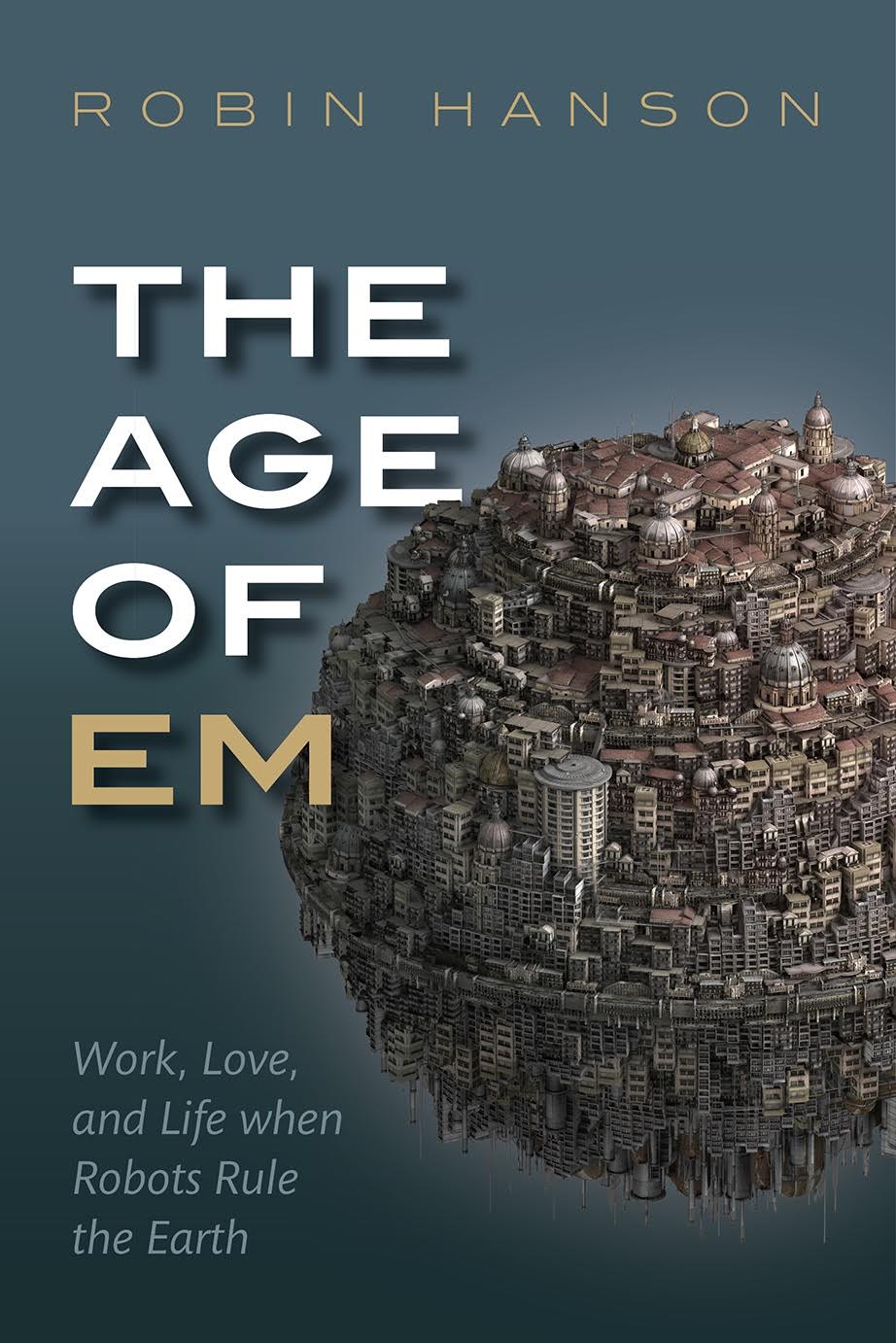
Cool cover art.

 Amazon link

I read Scott Alexander's extensive review and tried to cancel but too late: the very next day the Amazon parcel arrived. Alexander's review is an easier read than the book itself, which is written in a 'flat' academic style akin to a succession of Wikipedia mini-articles.

I wouldn't have minded if the content had been as described in the back cover quotes ('mind-blowing', 'fascinating', 'stimulating') .. but the ideas are relatively pedestrian, what you would expect if you thought about it a bit; many of Hanson's assertions are plausible without being that compelling.

So after a while of mentally chewing on cardboard, I abandoned.

If a society of brains-emulated-in-hardware-and-software is truly your thing, then it's a lot more fun reading Greg Egan's sublime Permutation City.


---

Back yesterday from a couple of days camping on the heights above Minehead where we also took in the Civil War reenactment at Dunster Castle.

Clare fronting the view of Minehead from the campsite

Dunster Castle: the women spin and cook behind the cannon

The pikemen and musketeers assemble

I'd anticipated a mass mêlée, a pitched battle of The Sealed Knot - but what you see in the pictures was what we got.

The fighting persons in close-up

I especially liked Ginger Baker (above) who gave us a one-person marching drum solo after the obligatory team musket discharges and pike-drill.

Tuesday, December 29, 2015

The implacable state; Autonomous AI; 23andMe as a family investment

I was reduced to helpless, incandescent fury this morning by the unexpected arrival of a speeding ticket. I had been caught on camera on the way to my mother's funeral on Monday, Dec 21st 2015. I have applied for the driving awareness course option and will let you know in due course how it went, if accepted.


I visualise the Speed Enforcement Unit putting this together, chuckling as they did so.

Turns out I was doing 35 mph in a 30 mph section of the A-road at Westbury-on-Trym, Bristol. Once my head-banging, visceral anger had subsided (a trip to the gym helped considerably) I found the list above of more or less lame excuses (none of which work) quite amusing.

---

Robin Hanson has an interesting piece about a newish book, 'Our Robots, Ourselves: Robotics and the Myths of Autonomy' by Prof. David Mindell at MIT. The book argues:
"If robotics in extreme environments are any guide, Mindell says, self-driving cars should not be fully self-driving. That idea, he notes, is belied by decades of examples involving spacecraft, underwater exploration, air travel, and more. In each of those spheres, fully automated vehicles have frequently been promised, yet the most state-of-the-art products still have a driver or pilot somewhere in the network. This is one reason Mindell thinks cars are not on the road to complete automation.

“That’s just proven to be a loser of an approach in a lot of other domains,” Mindell says. “I’m not arguing this from first principles. There are 40 years’ worth of examples.”
As someone who is interested in AI and its impact on the automation of everyday tasks, I promptly bought the book (Kindle) and will let you know how compelling I think his arguments are. After my speeding ticket I am thinking wistfully - and defensively - about Google cars. How does anyone drive on a regular basis in the UK without collecting 12 points in short order and losing their licence?

---

In August 2014 I persuaded my mother to donate a spit sample to 23andMe. Eventually I was able to show her the report plus the much more detailed information from Promethease. My mother had no technical interests and in particular no background in genetics. Nevertheless she read all the material in the folder with close attention for half an hour and then took possession of it, refusing to allow its contents to be shared with anyone else, even close family.

I think there was a little bit of magical thinking here, as the information was in no way earth-shattering. However, the reason I signed her up was in anticipation of a future where 23andMe provide a full genome description and we actually know what it means. It's a family history gift to future generations. I might have mentioned to her that we could clone her from this data, bring her back memoryless, but I doubt she took it on board!

My father unfortunately died in 2009, before 23andMe got into business. I have some of his personal effects in storage anticipating future DNA profiling ... .

On an adjacent topic, it's interesting to see the latest genomic news on the ancestry of the Irish. Razib Khan has an in-depth discussion.

Wednesday, September 30, 2015

The Age of Em

A certain amount of excitement in the George Mason University sector of the Internet on Robin Hanson's upcoming book, "The Age of Em: Work, Love and Life when Robots Rule the Earth", due out in April 2016.


According to the Amazon blurb:
"Robots may one day rule the world, but what is a robot-ruled Earth like?

Many think the first truly smart robots will be brain emulations or "ems". Scan a human brain, then run a model with the same connections on a fast computer, and you have a robot brain, but recognizably human.

Train an em to do some job and copy it a million times: an army of workers is at your disposal. When they can be made cheaply, within perhaps a century, ems will displace humans in most jobs. In this new economic era, the world economy may double in size every few weeks.

Some say we can't know the future, especially following such a disruptive new technology, but Professor Robin Hanson sets out to prove them wrong. Applying decades of expertise in physics, computer science, and economics, he uses standard theories to paint a detailed picture of a world dominated by ems.

While human lives don't change greatly in the em era, em lives are as different from ours as our lives are from those of our farmer and forager ancestors. Ems make us question common assumptions of moral progress, because they reject many of the values we hold dear.

Read about em mind speeds, body sizes, job training and career paths, energy use and cooling infrastructure, virtual reality, aging and retirement, death and immortality, security, wealth inequality, religion, teleportation, identity, cities, politics, law, war, status, friendship and love.

This book shows you just how strange your descendants may be, though ems are no stranger than we would appear to our ancestors. To most ems, it seems good to be an em."
Professor Hanson has recently written a preview article of unrestrained optimism entitled "The "Em" Economy: Imagine a future dominated by brain emulation robots" where he explains:
"If brain-emulation-based robots, built via a computational reproduction of human brain connections, come to dominate the world economy, that economy will grow far faster than today. Driven by abundance of labour resulting in higher returns to capital and lower commuting costs, most of this activity will be concentrated in a few dense cities."

For several years now, I have opportunistically applied standard theories from economics, physics, computer engineering, and many other fields to study the new ways of life that would appear in an em era. I have found, for example, that once the cost to rent an em is substantially less than human subsistence wages, ems quickly dominate the economy. Humans are mostly forced to retire, but live comfortably off of em-economy investments.
I'm sure those 'humans' will be delighted to be expelled from the workforce - at every level of skill.

The article continues:
" ... sometime in the next century we’ll see a sudden transition. In less than a decade the world economy would will start doubling every month or faster, and ways of life will change dramatically.

There’s a decent chance that such a new era will result from the arrival of robots as smart as humans. In particular, such robots might be created as “brain emulations,” i.e., from taking a particular human brain, scanning it to record its particular cell features and connections, and then building a computer model that processes signals according to those same features and connections.

A good enough emulation, or “em” as I call it, has close to the same overall input-output signal behavior as its original human. An em thinks and feels like a human. One might talk with it, and convince it to do useful jobs. It can be happy or sad, eager or tired, fearful or hopeful, proud or shamed, creative or derivative, compassionate or cold. An em can learn, and have friends, lovers, bosses, and colleagues."
Nowhere in the piece does Professor Hanson acknowledge that the "ems" might have some issues working as slaves for the human overlords. I guess there might be one or two other ethical questions too, along the way.

In any event, how likely is any of this stuff? On your behalf I ploughed through this c. 100 page report:
 "Whole Brain Emulation - A Roadmap"
from Anders Sandberg and Nick Bostrom of the Future of Humanity Institute at Oxford University, published in 2008 (there's a shorter paper here). They concluded (p. 81) that:
"It appears feasible within the foreseeable future to store the full connectivity or even multistate compartment models of all neurons in the brain within the working memory of a large computing system.

Achieving the performance needed for real‐time emulation appears to be a more serious computational problem. However, the uncertainties in this estimate are also larger since it depends on the currently unknown number of required states, the computational complexity of updating them (which may be amenable to drastic improvements if algorithmic shortcuts can be found), the presumed limitation of computer hardware improvements to a Moore’s law growth rate, and the interplay between improving processors and improving parallelism.

A rough conclusion would nevertheless be that if electrophysiological models are enough, full human brain emulations should be possible before mid‐century. Animal models of simple mammals would be possible one to two decades before this."
I suggest that breath-holding is inadvisable .. but I'll probably still read Hanson's book.