Showing posts with label Peter Hamilton. Show all posts

Saturday, March 01, 2025

'I write for the AIs...'


Amazon link

Tyler Cowen, from the blog ‘Marginal Revolution’, suggests that we should be writing for the AIs, the large language models (LLMs) that will one day serve as our digital custodians.

The reasoning is straightforward: our descendants will have neither the time nor the inclination to sift through the mountains of words we leave behind. But the machines will. They will be the ones reading, processing, and perhaps even presenting us to the future. It’s an intriguing notion, but one that raises an immediate question: why bother?

Human relationships are defined by bonds of personal necessity and affection - family, friends, lovers, comrades-in-arms. Beyond this circle, we lapse into mere social obligation, and even that wears thin.

If I had the chance to meet a sixteenth-century ancestor, what exactly would we talk about? The price of grain? The relative merits of different plough designs? His pious peasant worldview would, at best, be a short-term curiosity; at worst, just tedious.

Why, then, should I expect my distant descendants to care for my accumulated wisdom on obsolete telecom network architecture, frankly naive political philosophy, or the minor ups and downs of twenty-first-century Britain?

But perhaps that’s the wrong framing. The real issue is not whether anyone will care, but whether anyone will even feel inclined to. The function of human relationships is mostly to exchange knowledge, provide advice, offer emotional support, and help each other navigate the labyrinth of life. Yet all of this will be, increasingly, the domain of more competent and amenable artificial systems.

Give AI another twenty years to develop fine-grain personality modeling and soft-touch humanoid robotics - and the role of wise old grandparent, experienced mentor, or sympathetic friend will be performed more effectively by an exquisitely tailored machine than by some stilted, digitised reconstruction of a long-dead ancestor.

The living barely listen to their forebears now; why should we expect the future to be any different?

Perhaps we should adjust our Wills. State that our digitised personas may be edited, altered and upgraded, tailored to become a preferred companionate personality for our remote offspring.

In this way allow our individual, historic selves to be subsumed into the collective subconscious of improved and optimised humanity: a Jungian prospect reminiscent of Peter Hamilton’s Edenists in the Night’s Dawn trilogy. The self, once rigid and finite, dissolves into something fluid, continuously enhanced - a digital ancestor no longer preserved but reimagined and repurposed.

Cowen’s vision, then, is not without irony. Yes, the AIs will read our words, digest our ideas, and perhaps synthesise them into some grand collective narrative of human thought. But what remains of us in that process? Do we become mere echoes, endlessly refined until we are no longer distinct from the computational matrix itself? Or do we vanish into irrelevance, our carefully curated personas serving as little more than scaffolding for something newer, sharper, and ultimately indifferent to its origins?

If we are to write for the future, we should do so not out of a desperate hope to be remembered, but because we have something genuinely worth saying. Process not outcome: whether it is read by man or machine is, in the end, incidental.

Thursday, May 28, 2020

Ps and Js: Dominic Cummings

Dominic Cummings comes across as INTP; Boris as ENTP. It's not surprising that both see through the map (the literalism of regulations) into the territory (the underlying problem the regulations are meant to address).

Lawyers and media journalists tend to be Js. ENTJs and ENFJs are perhaps their most effective types. Fixated on the letter of the law, not the spirit. Attack dogs. Gotcha!

It's interesting that the Myers-Briggs dimensions are also dimensions of people talking past each other, inhabitants of different worlds:
- NT truth-seekers/problem solvers vs. NF moralists/SJWs.
- Extraverts (Communities! Parties! Share!) vs. Introverts (Give me a break!).
- Intuitives (here's how to think about this) vs. Sensors (what do you want done?).
---

Beneath the barrage of weaponised moralising, has anyone failed to notice that this is a sustained attack by the Remain/neoliberal bubble against a government which is trying to invent a 'one-nation' politics for our post-neoliberal times?

The critics' time has run its course; they have no strategy. It was sufficient for a resolute government to keep its nerve and hang in there.

---

Amazon link


I'm reading the Greg Mandel trilogy by Peter Hamilton again; two thirds through. The novels are a combination of military-SF, thriller and detective story. I think Hamilton does really well.

---

Thursday, October 18, 2018

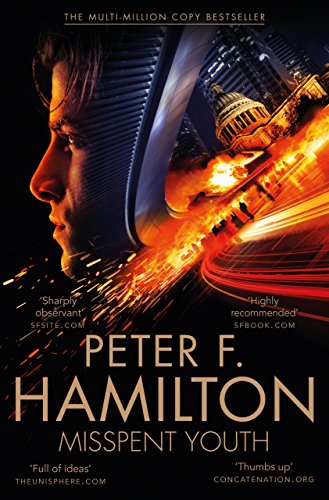
Sex and violence: "Misspent Youth" by Peter Hamilton

Amazon link

Call me a Hamilton completist .. .

Misspent Youth was possibly Hamilton's most-panned novel. Here's David Langford's review for Amazon.
"Peter Hamilton is famed for SF blockbusters of far-future interstellar adventure. By contrast Misspent Youth is a social comedy set in the year 2040 in England. When gene therapy rewinds Jeff Baker's age back to his early 20s he finds that wisdom and experience are no match for hormones...

The rejuvenation treatment, developed by federal Europe to impress laggard America, is so complex and expensive that only one person every 18 months can receive it. Jeff is the first because he's a celebrity inventor, father of the "datasphere" which superseded the Internet.

Family upheavals follow. An "arrangement" with his much younger, still beautiful wife Sue lets her enjoy lovers while the aged Jeff turns a blind eye: now things are different. Meanwhile their 18-year-old son Tim is struggling ineptly with teenage sexual pangs and the impossibility of understanding girls. All part of growing up, but Jeff's renewed youth brings farcical complications.

It's not just that Jeff now fancies Sue again. He can't resist even younger women. An early one-night stand is publicised all over the datasphere. Embarrassment escalates when he's seduced by the granddaughter of a long-time pub companion. Worse, several of Tim's ravishing female schoolmates are interested in Jeff the celebrity stud. The dishiest of all is Tim's latest, most hopelessly adoring girlfriend.

Can it be coincidence that the action mostly happens in Rutland?

This comedy of embarrassments and revelations has a darker background: Europe is plagued by separatist movements whose terrorist habits make the old IRA look like pussycats. The turning point in Jeff's tangled relationships comes when he attends a London conference surrounded by protest that breeds riot -- with Tim among the protesters.

A foreshadowed twist leads to a finale that mixes cynicism with sentiment. En route Misspent Youth is a lot of fun."

It's hard writing about sex. The chasms of the bad sex award and suspicions of self-gratifying wish-fulfillment are never far away. When an old man in a rejuvenated body is graphically described as having hot sex with hot teens, the ghost of paedophilia can't be far behind.

I suppose the bad reviews were to be expected.

It's customary for reviewers to write in the author's defence that the sex scenes were 'not arousing' - artistic sensibilities positively call for such a judgement. I would probably concur: Hamilton is good at writing about sex - the reader does not curdle with the embarrassing sensation that they have stumbled into a p**n novel - the writing really doesn't put hairs on your chest.

It seems to me that Hamilton is, however, more interested in two other things: firstly the experience of being a teenager, where personal relationships are always fraught with raw, emotional turbulence and one is always out of one's depth; and secondly the politics of the European Union (he is not a fan). In 2018, the regime-shaking Euro-angst conjured up in this 2009 novel seems more relevant than ever.

No, my critique of this novel is that - competent writer though he is - the miniature scale of the setting and plot makes much of the writing rather tedious.

Monday, October 08, 2018

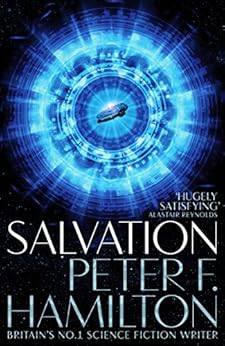
"Salvation" - Peter Hamilton

Amazon link

Fifty eight reviews already at Amazon at time of writing.

This, the first of another door-stopping trilogy, is a mid-future space opera set in a world structured by instantaneous transfer portals ('spatial entanglement' - nope, wouldn't work, should have stuck with wormholes).

Humankind has terraformed and colonised the planets around a number of the nearer stars (you still need a spacecraft to emplace that far gate). The Earth and most planets are dominated by the amoral-capitalist Connexion portal-monopoly ("one step away"), run as a benign despotism by its aged founder.

There is also a parallel civilization of planets and habitats run by the new communists, the Utopials with their gene-fixed gender-fluidity. Does this nod to contemporary identity-politics add any value? It's not clear.

And there are aliens. The religious ones in their arkship, making stopover in the solar system to top up their antimatter tanks while bestowing alien biotech in payment. They're on a trip to eternity to meet their final God. But are they as altruistic and well-meaning as they appear?

Then there are the other ones, who've inserted four humanoid agents into Earth's society. Why? In terms of the novel's characters who are they? Good or bad?

The central dynamic of the novel is the discovery of an unknown alien spacecraft which has crash landed on a newly discovered planet. The discovery team soon determine that the spacecraft contains unknown humans in hibernation pods. Were they abducted? Who are they? What does this mean?

A collection of top people from the various factions who really rule the human universe are sent in a luxurious land-cruiser to investigate, under top quarantine security. This is to prevent any alien incursion into the human datasphere. The journey takes several days which affords an opportunity - in the style of the Canterbury Tales - for each character to recount their back history.

What follows is a series of engaging short stories, techno-thrillers with plenty of mercenaries, espionage, terrorism, kidnappings and high-tech in the trade-mark Hamilton style. When they reach the spacecraft the plot twist kicks in, setting up the next volume.

There is a parallel storyline set hundreds of years in the further future. A group of adolescents is being trained as genetically-enhanced warriors to combat aliens which remorselessly hunt humans throughout the galaxy. Something bad has already happened in these people's past and they only dimly remember the characters we spend so much time with as 'Saints'. I agreed with those reviewers who assess this thread as the weakest part of the novel, lacking colour and intrinsic interest, with bland characters who do not really engage your interest.

After a slow start where one is continually trying to remember weird names devoid of context, the book picks up through the back stories, each of which is quite exciting. I'll certainly be looking at volume 2 when it arrives.

Other thoughts. There is plenty of homage to other works of science fiction. The future troops' training is straight out of Ender's Game; their warships have names like Morgan and McAuley; the house with rooms in different worlds is like the Hyperion Cantos.

I'm appreciative of Hamilton's political skepticism. He doesn't like ideologies, seeing them as weapons against actually-existing humanity. His Utopials, exemplifying politically-correct liberalism, are creepily self-righteous and rather repulsive. Is there a broader message here, some zeitgeist-concern which Hamilton is seeking to address?

In an interview with SyFyWire, Hamilton said, "To some degree it's about the level of trust and mistrust that's developing in the the political arena, with everyone suspicious of anyone who isn't on their side. I managed to blend that paranoia with a whodunnit as five people from different factions embark on a trip together ."

---

Here's an extract from the Kirkus review:
"Early in the 23rd century, when a wrecked alien ship turns up on a remote planet, the all-powerful Connexion Corp, which provides instantaneous travel via quantum-entangled, step-through portals, organizes a team to investigate: security chief Feriton Kayne; Connexion bigwig Yuri Alster; Callum Hepburn, who works for the Utopials, an independent human civilization; Alik Monday, an FBI operative from Corporate Earth; and various assistants.

What’s aboard the alien vessel proves both difficult to fathom and extremely unnerving. The actual investigation moves at glacial speed, though, interspersed as it is with backstories involving team members plus chapters in an independent thread set in the far future, where child soldiers train to meet a mysterious and all-conquering alien enemy.

In the present, meanwhile, we hear about two sets of aliens. The nonhuman Olyix have stopped off at Earth to refuel on their endless voyage across the universe, where, at the end of time, they expect to meet their god; they seem benevolent, but not everyone agrees. The Neána, whom readers know about but none of the characters may, arrived secretly some years ago, grew some human bodies, and sent them out to do—what?

So, readers will contend with a choppy narrative, obvious delays and sidebars, and long stretches that read like an editor’s advice to a first novelist on how not to introduce your characters or propel the storyline and veer dangerously close to dull. It’s a yarn, however, that packs a teeth-rattling wallop when it finally gets there."
---

Wednesday, June 27, 2018

Syrinx learns a lesson

Amazon link


From the Night's Dawn Wikipedia entry:
"Syrinx, a young Edenist, is next introduced, leading life from a young age telepathically attached to a bitek starship called Oenone. As she grows she learns more about the world with her sentient starship, becoming best friends (as is the normal bond between bitek starship and captain). ...

Syrinx travels to the world of Atlantis, a world covered by water, inhabited by floating "islands" which themselves are sentient. But she discovers that the possession has also begun there. In the process she is captured and tortured badly, and suffers a psychotic breakdown. ...

Syrinx is psychologically reconstructed with the help of the founder of the Edenist culture."
In the Edenist habitat, Syrinx is placed into a simulation to undergo psychiatric rehabilitation. This includes therapy with Wing-Tsit Chong's stored persona (Chong was the inventor of affinity and founder of Edenism). He speaks thus (Chapter 11):
"At last, we achieve progress. Where is the only place your personal past can take form?"

"In my mind?"

"Good. And what is the purpose of life?"

"To experience."

"This is so, though from a personal view I would add that life should also be a progression towards truth and purity. But then I remain an intransigent old Buddhist at heart, even after so long. This is why I could not refuse the request from your therapists to talk to you. Apparently I am an icon you respect."
At this point, Wing-Tsit Chong embarks upon a discursion into Buddhism, but this is what I wish he had said.
"Every experience you have, Syrinx, the neural network in your brain encodes by rewiring itself. If we could watch your connectome, it would get a little more uniquely tangled than someone who had not shared that experience."

She shakes her head. This is a commonplace observation. She's not getting it.

"So consider this, Syrinx. You seriously think the purpose of life is some local brain rewiring in your own skull?"

"What else could it be?"

"Existence is arguably better than non-existence. You are here, Syrinx, because your parents created you. If they had not done so, you wouldn't be virtually stood before a simulated elder in a wheelchair expounding superficialities about the meaning of life .."

"That is the standard Darwinian argument, sir. That the purpose of all living things is to survive and reproduce. Yet if the results are merely more mobile neural nets, all accumulating experiences - rinse and repeat - how does this get us any further?"

"My child, I could say that's physics for you but I am a Buddhist. Surely we of all people can unask the question, prizing Nothingness over Being as we do."

Tuesday, November 20, 2012

'Great North Road' - Peter Hamilton

There are certain staples to Mr Hamilton's world-building: lots of worlds, usually ethnic or settled by countries or US states; wormholes (here 'gateways') linking them together; and a tough, feisty, gorgeous and uninhibited heroine (Angela Tramelo). Also as usual, there are a vast number of often well-drawn characters, the plot is complex and finely-balanced, and the length exceeds one thousand pages. 'Great North Road' is a fun and gripping read, and the Kindle version is cheap so I would advise you to get out and buy it right now. Here's a bare plot-outline.

The dynastic patriarchs of the novel are the Norths, who have cloned themselves. The A-Norths run the algae-oil ponds on the Sirian planet St Libra, connected to Earth by Gateway at Newcastle-on-Tyne. They supply Greater Europe with its fuel and are stupendously rich. The B-Norths are far fewer and live on St Libra, doing research into rejuvenation and longevity. The C-Norths occupy a habitat-complex orbiting Jupiter (another familiar Hamilton trope) and do advanced science and technology to protect humankind.

There is some kind of impersonal threat - the Zanth - which randomly renders whole star systems uninhabitable: this has led to the formation of the militarized Human Defence League.

The story starts with the mysterious murder of a North in Newcastle. Alarm bells ring amongst the Norths and the HDL as the modus operandi seems identical to another North slaying 20 years ago. There is reason to believe the perpetrator back then was some kind of alien, although the official blame was laid with Angela Tramelo, now in custody.

A large part of the novel is a 22nd century police procedural in the streets of Newcastle. Cop Sid Hurst has the resources of ubiquitous smartdust coating the city, AIs of enormous power, surveillance technologies to dream of .. and yet the case resists solution. Is there really alien involvement or is this just North-against-North corporate infighting? The balance of evidence keeps shifting.

Real lives are uneventful most of the time. To keep the pages turning the characters must continually face problems they can neither solve nor completely fail at. This makes plotting difficult and there are several places where the reader asks 'why didn't they do the obvious and check this, use that technology?' Still, even Jane Austen and Gustave Flaubert had shake-your-head-in-disbelief plot lapses so we have to cut the man a bit of slack here.

I thought the most interesting character was Saul Howard, who is smart, reasonable, polite, worried, and irresolute when decisive action is called for. Human really.