Showing posts with label The Socialist System. Show all posts

Tuesday, November 27, 2018

Government as a stationary bandit

Amazon link

I would call this cynical, except it's economics:
“Consider a roving bandit who roams from village to village, looting village residents. The roving bandit will take as much as he can before moving on to his next target. The bandit gets no advantage from leaving anything behind for the people who are plundered. The roving bandit must continually be on the move to find new targets, and resources are wasted on both sides as the bandit uses force to try to plunder the villagers and the villagers use force to try to repel the bandit.

An alternative strategy would be for the bandit to occupy a location permanently, becoming a stationary bandit, periodically taking resources from those in the village.

The incentives are different for the stationary bandit, who would then want to cultivate the productivity of those he plunders, so there is more to plunder in the future.

Because the income of the stationary bandit comes from the productivity of those under him, the stationary bandit also has an incentive to protect them, both from opportunistic individuals in their own village and from outside predators. It is easy to imagine that a productive village would attract the attention of other predators who might be inclined to attack and plunder the village. So, the stationary bandit has an incentive to protect those who provide the stationary bandit’s income.

It is easier to gain compliance from people when they agree to comply than when they are forced, so the stationary bandit has an incentive to get those under him to view his activities as legitimate: to present himself as a benevolent leader rather than a bandit.

If he can convince citizens to recognize him as a king, and can convince them that it is to their advantage to pay him taxes in exchange for the protection he offers, it will be less costly for him to maintain a system in which citizens view the transfer of resources to him as legitimate taxation rather than plunder.

The stationary bandit has an incentive to establish institutions such that citizens view it as advantageous to transfer resources to the ruler in exchange for protection.

The ruler also has an incentive to produce public goods if they enhance the productivity of citizens, because greater productivity means there is more to tax. And, the ruler has an incentive to place constitutional limits on his power to tax, to maintain incentives for citizens to be productive. If the ruler is perceived as a threat to confiscate everything the citizens have, they will not have much of an incentive to accumulate wealth.

Establishing a council of citizens who must approve any tax increases could work to the mutual advantage of both the ruler and the citizens, making citizens more productive and ultimately tendering more tax revenue from their increased productivity.

If a stationary bandit envisions remaining in place for a long time, he will have an incentive to establish institutions that would be very similar to what citizens might agree to from behind a veil of ignorance. Thus, when thinking about optimal constitutional rules, there may not be that much difference between the types of rules people would voluntarily adopt and those which might be imposed by a conquering group.

This public choice approach to constitutional rules offers an interesting contrast to the public goods theory that economists often use to explain government production.

For example, public goods theory suggests that government produces national defense because it is a public good that would be underprovided in the market.

This public choice approach says that government produces national defense because it benefits those in government by protecting the productivity of those who pay taxes to government. Public goods theory depicts government as a benevolent provider of a good that the selfish private sector will underprovide to themselves.

Are people in government really more benevolent than people in the private sector? This public choice approach depicts the production of national defense as a mutually advantageous exchange in which everyone acts to further their own interests, so is more consistent with the assumptions economists typically assume about individual behavior.” (pp. 131-133).
This is not such a new idea. Razib Khan recounted how:
"During the Mongol conquest of Northern China Genghis Khan reputedly wanted to turn the land that had been the heart of the Middle Kingdom into pasture, first by exterminating the whole population.

Part of the motive was to punish the Chinese for resisting his armies, and part of it was to increase his wealth. One of his advisors, Yelu Chucai, a functionary from the Khitai people, dissuaded him from this path through appealing to his selfishness.

Chinese peasants taxed on their surplus would enrich Genghis Khan far more than enlarging his herds. Rather than focus on primary production, Genghis Khan could sit atop a more complex economic system and extract rents."
Public choice theory is a lot better than the soppier humanities, which assume everyone is endlessly caring and benevolent (and should therefore be punished if they are not). But in starting from the fiction that society is simply a uniform set of individual, selfish, rational agents making more-or-less informed utilitarian choices, it abstracts from the historical evolution of class relations, the conditions of social reproduction, and human nature itself.


That's not to say that under certain localised conditions of stabilised atomisation, it can't be quite accurate and predictive, as János Kornai documented.

Tuesday, August 14, 2018

The Virus of Marxism

A lot of people - ex-Marxists - talk about having caught 'the virus of Marxism' in their youth. They always seem less clear as to how they recovered from their complaint.

---

Marx thought that the selfishness and egotism so obvious in the people around him were the product of capitalist relations of production. Under communism selflessness would be the norm, the benevolence of a society of abundance.

This is an empirical claim, yet one which Marxists are strangely unwilling to explore. Everything we know about human beings suggests such a prospect is false. There are strata of society which are currently very well off. The pages of 'Hello' magazine suggest that saintliness does not come naturally. Why not? They're not all evil oppressors.

We know from biology that (for good genetic reasons) most animals are either in it for themselves or at most for their close kin. It's considered noteworthy that some evidence has been uncovered for reciprocal altruism in chimpanzees.

Humans exhibit adaptations for living in large groups*, and for symbol-mediated cooperation: loyalty to causes, countries and empires (provided such causes sufficiently align with personal self-interest of course). Despite much effort however, in-group/out-group tribalism has never been close to eradication. It's a bit airy-fairy to blame those famed (and reified) 'capitalist relations of production' for that historical universal.

Rich societies in a state of formal peace fragment into tribes which pick intense fights on secondary issues, spearheaded by young males. Who'd have thought it? (Apart from evolutionary psychologists).

---

Where does this leave the Marxist project? A clue can be found in the extreme unwillingness of Marxist theoreticians to engage with these issues. Their uneasiness is palpable: such research is neither acceptable nor refutable - a sheepish turning away of the head changes the subject.


Mediated of course by the social relations of production and exchange, it's new tech which opens the door to historical progress. The future presents as a branching tree: genomic experimentation in humans combined with social-agency in robots (cf replicants).

It's really hard to predict how things will turn out: there are many scenarios. Why suppose that Marx and Lenin tediously had the future nailed down more than a century ago?

The thing which scares Marxist intellectuals is that if humans can't make a collectivised society work - and they can't - then we seem to be stuck with capitalism indefinitely. That does seem a bit of a capitulation to bourgeois ideology. But private ownership of the means of production has a lot more flexibility than historical observers had imagined. Those dark satanic mills so graphically denounced in Capital Vol 1 have long since vanished in the west. Capitalism keeps getting richer (on trend) and more capable, with ever greater reserves. Its own dynamic will in the end utterly transform it .. I suspect.

Why is capitalism so bad, anyway?

We shouldn't ask the question this way. It's not the job of science to take sides on ethical questions. Marxists above all should not be appealing to platonic ethical absolutes. Yet they err in seeking ethical judgements about capitalism only in social relations.

If human beings didn't have a human, biological nature, if they didn't care whether they ate or starved, lived or died, then who could complain about social formations since the dawn of time where such 'bad' outcomes were the norm?

Of course, human beings very much subscribe (for obvious biological reasons) to something like Maslow's hierarchy of needs.

Maslow's hierarchy of needs

In Marx's day (and Lenin's too in Russia) capitalism was bootstrapping itself through primitive accumulation. It was a brutal time and every one of Maslow's levels was violated for the newly-emergent working class. The communists were vitriolic in their anger and hatred against capitalism - the new bourgeoisie were certainly not starving in their mansions.

But as Stalin showed in the 1930s, forced accumulation is inherently a brutal business.

A richer contemporary capitalism is less polar, more stratified. Large segments of the population - proletarian in that they own no means of production and need to sell their labour power to survive - find themselves not badly paid and doing socially-necessary work of deep intrinsic interest. They may well attain all of Maslow's levels in their occupations.

Marxists like to say that capitalism is irrational, not being centrally planned. This is a rather pejorative way of describing a decentralised economy composed of discrete, competing companies each trying to maximise its own profit. Companies may be legal persons, but in a dog-eat-dog capitalist economy their psychologies are psychopathic.

Still, self-centeredness is a common feature in natural ecosystems: we observed above that generalised altruism is rare to non-existent. Though corporates-gone-bad are a staple of dystopian fiction, in a healthy capitalist state there exist legal mechanisms to ensure rule-based behaviour, recognising that social-responsibility is not intrinsic to the capitalist firm.

Bad corporate behaviour is  often contested - see any newspaper.

The Marxist economist will then turn to crisis theory as evidence of capitalist inefficiency. The dynamics are not disputed (except by bourgeois equilibrium economists!) but given the inability to predict future demand, competitive overshoots will happen and in modern times the effects of downturns are somewhat mitigated.

It is claimed that capitalism has an inherent alienation, anomie caused by the fundamental deception of capitalism, that ordinary folks' efforts only serve to produce more profits for the bourgeoisie. We're all in it together, suckers! When things are going well, and capitalist corporations are achieving great outcomes (in construction, healthcare, new technologies) things don't seem that discordant. It's hard to identify "the Man" who sits in his top hat chortling at the efforts of his deceived minions.

Capitalism certainly has an ideology of 'atomism': the free individual contracting with an employer. But once in work, nothing much gets accomplished without the team .. and teamwork is pretty core to human nature. Outside of work there are associations in plenty for those who want them - even revolutionary communist parties.

We're down to the bottom line. In a class society, the rich and powerful tend to get their own way. What did you expect?

---

* Less aggression and more self-control, but varies with population group.

Getting capitalism to work successfully is the most difficult task humanity has ever set itself. Success correlates with national IQ, as Professor Garett Jones describes in his book "Hive Mind".

From "Hive Mind" by Garett Jones

Sunday, February 18, 2018

"The Socialist System" - János Kornai

Amazon link


'The Socialist System' presents itself as a daunting read: a 600 page, somewhat dry analysis of the detailed workings of the socialist (ie post-capitalist) system in all its aspects. Kornai was trained as a philosopher, becoming an economist and then a journalist in socialist Hungary, in the period after the second world war.

His book identifies three phases of socialism: the 'heroic' period of the revolutionary-transitional system (think 'War Communism'), the classical system of totalitarian bureaucratic control (prototypically Stalinism) and the reform period (NEP; the Gorbachev reforms). The historical order is usually (but not always) as written - with occasional reversions.

---

It is commonplace to review the political horrors of socialism: the great famines of the thirties in Russia and the Gulag, the 'Great Leap Forward' in China. But underlying such political episodes of class struggle and bureaucratic consolidation are deeper issues, those associated with the consequences of bureaucratic coordination of the economy.

Bureaucratic coordination just doesn't work that well. Kornai is forensic in considering how the dictates of forced growth (due to the regime's often-justified sense of their encirclement by more advanced and hostile capitalist states) generates aggressive, top-down 'tight plans' incapable of fulfillment even in principle.

It's simply impossible to centrally-plan a modern economy with any degree of success. All layers of the bureaucracy see it in their interests to organise outputs against static, inflexible and ignorant plan-objectives, regardless of the real needs they plainly see around them. Indeed they will be rewarded for plan-fulfillment and punished for failure.

Hoarding, shortages, poor quality goods and lack of motivation are endemic. The system works, after a fashion, but once the extensive phase of development has been achieved progress slows and the centrally-planned economy falls further behind advanced capitalist countries.

Kornai is especially good on the organic and protean nature of the bureaucracy. Industrial societies are just too interdependent: they must be coordinated. In the absence of market (price) mechanisms, top-down bureaucratic coordination is the only alternative and its daily failures lead to further bureaucratic growth. Anything which is not being centrally controlled is potentially dangerous to the achievement of the plan.

Eventually, though, something must be done. Reforms are called for. Wherever market mechanisms are introduced - in agriculture or in small business - productivity soars. Yet the market is anathema to the plan: the two organising principles cannot cohere. In one place capitalism is allowed to advance and the communist party's monopoly of power begins to falter; in another place the party strikes back and property rights begin to to look shaky causing investment collapse.

The masses are conflicted. On the one hand they welcome the lessening of repression, the chances for higher incomes in the private sector and the greater availability of higher-quality goods. On the other hand, their innate and indoctrinated sense of egalitarianism is offended by capitalism's inequities and meritocratic qualities let alone the elements of price-gouging and rip-offs attendant upon the reemergence of private property and market relations.

Nowhere does the Trotskyist model of a socialised economy under the democratic control of workers' councils get a look-in. Somehow, there's a disconnect between the operation of the economy as a whole and the specific interests of individual workers and their families. The principal-agent problem at all scales is just too overarching, too ubiquitous.

---

For a while, China has seemed a counter-example to Kornai's thesis. We are told that the Chinese Communist Party leadership has studied and learned from the collapse of the Soviet Union. It may be too early to say but the story on China in 2018, as growth continues to slow, suggests that Kornai's prognosis will again be proven correct.

Amazon link

If this book, rich in details and experience were made into a TV series, could it transform the illusions of western leftists who still believe a planned economy could be made to work? I was studying Kornai's book while also reading Vasily Grossman's 'Life and Fate' and it was extraordinary how Kornai's general principles were exactly replicated in the experiences of Grossman's characters.

Yet I have no illusions. The myth of the benevolent centrally-planned economy is probably written in our genes: every generation has to painfully learn better, hopefully through works such as this.

---

Let us return to the intriguing question of China. Andrew Batson writes:
"I put János Kornai’s The Socialist System: The Political Economy of Communism on my best books list for last year, but I’ve been slow in writing something longer about it. It’s taken some time for me to think through how to understand China in the context of his arguments.

Kornai’s book is brilliant in its diagnoses of the internal conflicts and problems of “market socialism” or “reform socialism”, in which market mechanisms are permitted but the Communist Party maintains political primacy and a large public sector. This is a still a pretty accurate definition of China’s system. There were so many moments while reading when I wanted to shout out loud in recognition: “Yes! That’s exactly how it is!”

Yet the book finally concludes that market socialism is an inherently unstable and unsustainable system that cannot last. Essentially Kornai argues that the combination of a weakened version of state intervention and the half-hearted embrace of market competition enjoys the vices of both systems and the virtues of neither.

A government that no longer truly believes in socialism cannot enforce its plans, while market forces are allowed to operate only inconsistently, so that they amplify rather than alleviate distortions. The inevitable accumulation of economic problems means that the public and officials get fed up with the system and eventually decide to jettison it entirely."
Batson then continues to the key question: So what did Kornai miss?

Saturday, January 27, 2018

János Kornai and Ann Lee's take on China

Amazon link

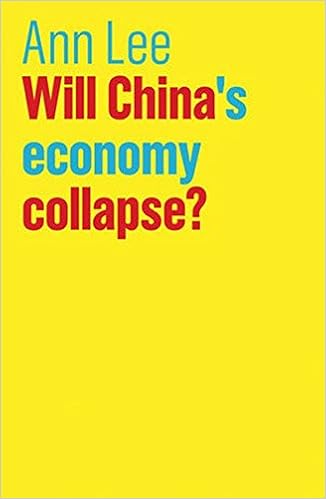
The Amazon Vine system seems to be running down. Fewer and fewer interesting items appear in my input queue. But Ann Lee's recent short book seems to be an exception.

Professor Lee is a somewhat-typical member of the global elite. She was educated at U.C. Berkeley, Princeton University and Harvard Business School (1995). After working for two investments banks, she became a hedge fund partner and a trader in credit derivatives. In 2007-2008 she was a visiting professor at Peking University.

BTW, whenever an article or book has a question in the title, the answer is always "No".

---

I'm interested in the political and economic evolution of China. Part of that is the global significance thing, but the underlying dynamics are equally intriguing. We observe a centrally-planned economy belatedly - and apparently - transitioning to capitalism.

Is China even capitalist? Most economists would say yes, but Michael Roberts on his blog has been steadfastly contrarian.

It would help to have a conceptual framework to assess Ann Lee's thinking.

---


Amazon link

I turn to János Kornai, the noted Hungarian economist who has written extensively on the experience of the bureaucratic-socialist states, both in their operational dysfunction and their subsequent collapse.

At the heart of Kornai's critique of socialist (centrally-planned) economies is the notion of soft budget constraints leading to what he calls the shortage economy. Has China found a way round these structural problems?

The Chinese leadership has watched the Eastern-European and Russian experiences with care and has plainly learned something from the outcomes. So Andrew Batson considers whether Kornai's account still holds true.

Update: Here's my Ann Lee review.