It's to easy to reify capitalism. To see it as the capitalist class (hiss!) bearing down upon the downtrodden proletariat.
Expropriate them!
---
1. The inner-truth of capitalism
Let's do the analysis right.
Consider the vast mass of people who cannot live by their own efforts (they have no land, no resources, they are not self-sufficient). The proletariat.
Add a minority who own the land, the factories, the machines, the tools, the raw materials and all the other means of economic production. Ownership guaranteed by law and state. The capitalists.
If the owners hire workers (their capacity to work, actually) at a rate which can reproduce them for work next day, week, year .. while the amount produced by said workers exceeds their wages in value, well the surplus will be owned by the capitalists. They will get consistently richer. We have a technical name for this: it's called profit and it's a good thing. It means social needs are being addressed efficiently.
Note: if you work for the state rather than a private-sector employer, your wages are paid out of taxes: value contributed ultimately by the capitalist sector.
2. What do the capitalists do with their ever-increasing riches?
An insignificant relative proportion goes into luxury apartments and super-yachts (although this conspicuous consumption is a powerful human motivator and source of envy and resentment). The statistics show that most capitalist profits are re-invested to secure another round of expanded reproduction. Or in these stagnating times, financing debt.
M - C - M' in Marx's formula. Money makes money through the intermediary of surplus value production.
Gratuitous consumption is always a missed opportunity under capitalism. An opportunity cost.
In the nutshell, it is the way production is organised which creates the classes .. they are both a precondition and a consequence of the relations of production.
3. Capitalism really pushes the social-surplus product
No moralism. We're none of us going back to living off the land. Noble hunter-gatherers, trapped in the deepest well of unproductive subsistence.
Nor are we going back to the agrarian life, another low-productivity hell-hole where almost everyone is tied to mediocre, hard, tedious life on the land.
We all agree that human affairs are improved when we have a better constructed-environment, one which suits our diverse needs. The way we do that is by a global division of labour where projects of the most ambitious scope can be realised. I like modern medicine.
That's going to take a lot of social-surplus product going forwards. It's going to continue to require people to personally consume only a small fraction of the value they themselves produce.
Any one individual is going to look at projects on all scales up to the fully global and subjectively feel like a small cog in a vast machine.
I wonder though whether they'll really care. Nobody asks me about NASA but I can still get excited.
Who decides what projects should be done, if not individual capitalists who have succeeded in attracting investment capital? I refer you to the pessimistic literature on traditional post-capitalist organisational forms well-documented here.
4. A post-capitalist economic organisation we might expect
Suppose we get the miracle of total automation. Cognitive robots replace workers. But in the end, without wage-labour, profits can't be obtained.
Under capitalism, the capitalist who automates gets a short-term advantage but then overall profits fall. Competition means that in the steady-state the capitalist cannot charge more than will cover his costs. Without wage-labour creating additional value, sale-prices are simply bid down to the costs of robots, overheads and materials. As a consequence, profits tend to zero.
The capitalists don't invest. It's like an economic crisis which never abates.
5. The Roman Empire redux
An economy of petty-commodity production is what still works. Like the Roman Empire of antiquity. The slaves have been switched out for robots. Units of production produce lots of goods which are sold at their value, like in a village marketplace.
The Roman Empire was economically complex and vast in space and time. It was not very productive, not very dynamic - which may have been due to its agrarian character. And slaves are not the ideal robot - far from it. Not biddable at all.
Some people think the answer is for everyone to own personal robots. In antiquity most of the elite fraction of society had at least a few household slaves. But that isn't commensurate with distributing widely the benefits of a sophisticated global economy.
If I had to guess, I would say that the automation-heavy future is essentially robot-powered petty-commodity production combined with a very generous guaranteed income for everyone. Add in genetic enhancement to exploit the possibilities of an improved humanity and we'll not be in a bad place.
At least until the AIs decide we're a waste of their space!
---
Note: the Marxist economist Michael Roberts has written extensively about the consequences of total automation under capitalism. Here's a good place to start.
Showing posts with label Slavery in the Late Roman World. Show all posts
Showing posts with label Slavery in the Late Roman World. Show all posts
Thursday, March 21, 2019

Wednesday, November 07, 2018
Slavery after the fall of empire
 |
| Amazon link |
From "Conclusion. After the fall: Roman slavery and the end of antiquity" - (my emphasis).
"The transition from Roman to post-Roman societies in the west was not a shift from one mode of production to another (slave, feudal, or peasant). The transition was from an unusually complex society to much simpler forms of social and economic organization.
The fall of the empire saw a dramatic loss of structural complexity. Roman society, with its exceptional levels of commerce and urbanism, fostered an unusually complex stratification of wealth. Roman society knew a staggering, tripartite hierarchy of wealth; not only were the rich unimaginably rich, but beneath them was a social element — modest by modern standards, exceptional by pre-modern measures — living above subsistence.
In the post-Roman centuries, the decisive middle was gradually lost, and a simpler, binary division of wealth asserted itself. The process of social simplification asserted itself at both the top and bottom of society. Post-Roman aristocracies changed as much as the lower classes.
Wickham has highlighted the structural, economic importance of the change. The Roman aristocracy was unusual in being a civilian aristocracy; the upper tiers of the status hierarchy were based, quite nakedly, on wealth. The Roman elite was an agro-commercial elite. There were changes already in the long fourth century — the rise of an imperial service elite (whose salaries, however, provided them with capital) and, even more fatefully, the rise of an ecclesiastical elite.
After the fall of Rome, it is the civilian, commercial aspect of the aristocracy which suffered most; the military and ecclesiastical castes were pushed to the fore. This is the elite we can follow in the colorful pages of Gregory of Tours' history, with its Roman bishops clinging to a civilized past and its violent Merovingian overlords roaming the landscape.
What we need to imagine, behind the new, vividly drawn social figures, is the different relation between the aristocracy and agricultural production which lies behind the story.
The fate of the lower classes in the post-Roman west is a more difficult problem. We should resist the temptation to compress all laboring dependents into a single undifferentiated mass. The idea of a centuries-long "merger" among the lower classes, leading eventually to serfdom, has occupied a place in the historiography that is neither empirically nor analytically justified." (pp. 500-501).
"... The successor societies of the post-Roman west, from ca. AD 450-650, inherited sizeable slave populations, and the violence of the age continually created new captives, new slaves. But the reduction in the demand for slaves was ultimately the decisive secular trend. The recession of exchange-oriented production [ie of luxury, non-subsistence goods] undermined the demand for higher-risk, controllable forms of estate labor. [ie slaves]
The demise of the towns obliterated the premature middling element of Roman society, along with its slave-owning habits. The status system rooted in Roman civil law lost its moorings but never totally collapsed. Germanic forms of dependence surely had an impact.
Men and women also came to think of their identity in religious and not just civil terms. The slaves in the post-Roman sources — on papal estates, in the will of Remigius, in the letters of Gregory the Great or the histories of Gregory of Tours — are slaves, and it would be unwise to deny this fact.
But slaves and slave-owners were increasingly exceptional, marginal. The archaeological record provides incomparable testimony to the slow recession of commercial exchange and the consequent slacking of elite control over agriculture. Yet, these were truly post-Roman societies in a way that societies of the Carolingian era were not. [Carolingian Empire: 800-888]
This is of primary significance for the history of slavery, and for the history of labor and dependency in general. After a long arc of decline, by the seventh century the basic vocabulary of status was capable of undergoing radical change. This change was possible only because slavery had been in decline now for two centuries." (pp. 502-503).
The key idea here is the economic regression after the collapse of the effective Roman state in the west (described with precision by Kyle Harper in his book, "Climate collapse and pandemics: the fall of Rome").
It was the Roman state which guaranteed the social position of the commercial elites with their enormous effective demand for specialised luxury goods. It was the Roman state which secured trade routes and the inviolability of commercial contracts. And it was the state which stabilised the inherently volatile social formation of institutionalized slavery.
Absent this state all those things declined and then collapsed. The new mode of production which rose from the ashes of the dark ages was based on fundamentally different production relations: the feudal relations of honour and obligation between nominally free individuals.
See also: "Semper timere .." for more about the violence required to reproduce the institution of slavery. When slavery is woven into the the very fabric of elite life (every wealthy household had slaves) it requires a continual pervasive miasma of patronal violence. Slaves not kept in a chronic state of abject fear will shirk, overstep their social bounds, escape or rebel. As property they have little stake in the status quo.
Such systematised, chronic despotism fundamentally conditions laws, culture and the very nature of the slave-state itself. It's difficult to image a feudal society in which slavery was an essential institutionalised layer (although there were plenty of slaves in feudal societies). I suspect that like capitalism, institutional slavery is hard to get started.
Sunday, November 04, 2018
Semper timere ..
|
| Amazon link |
From Chapter 5.
"Lashing caused excruciating physical pain. The lacerations were visible for days, as slaves bore the "marks of cruelty" on their bodies. Chrysostom warned masters they should not tear through the tunic when they beat their slaves, and he chided masters whose cruelty was evident on the slave's body when the slave was at the public bath.Thanks to modern genetics and/or AI we'll be so much more enlightened. Our android slaves will live to do our bidding - there will be little reason to starve them or beat them to a pulp.
Jerome called it an "everyday custom" for a slave to use the time between blows to ask for death as a reprieve. Basil of Caesarea, criticizing the rich, said they could see their wicked deeds all around them, including the "slaves whom you have ripped to shreds."
The violence of lashing could of course be chaotic and disorderly. The incentive model should not lead us to forget that the actors involved were human beings, with all that implies about fallibility and passion and unpredictability, in which one party possessed extreme power over another.
Iamblichus said that philosophers never lashed their slaves while they were still in a state of anger — implying that the average man did. Masters might chase their slaves around the house punishing them.
Arnmianus reported that a slave who was slow to serve received 300 lashes. The context is clearly one of exaggeration, but the point to notice is that the blows were numbered. Chrysostom spoke of thirty or fifty lashes as a high number. A really bad whipping was one in which the blows were "countless." ...
Fear was perhaps the primary strategy of mastery in the Roman slave system. In the corpus of late antique writings, no attribute was more often associated with slavery than fear. It was the most keenly felt element of the relationship.
"To fear is the symbol of slavery."Semper timere. We hear so much of this emotion because it was precisely what masters sought from their slaves.
"Who does not know that the one who is a slave by nature and employed in a master's power cannot be without the emotion of fear?"
"To fear was in the nature of slaves."
"Nothing is more particular to slavery than the eternal fear."
"If a slave is under fear and the lash, and immediately trembles when anything is said to him by the master, lest he hear he is to be beaten, certainly the master rejoices in this situation."Fear was a means of maintaining the constant labor and subjective annihilation demanded of slaves. Violence commuted into its potential, spread out into all corners of the relationship, tinged all interaction between masters and their human property.
Physical punishment was not the only means of corporal control over slaves, and psychological manipulation was not limited to the threat of violence. Perhaps nothing breaks down the strict dichotomy between pain and positive incentives like the use of food as a tool of domination in the Roman slave system.
With a few important exceptions, the use of hunger and the promise of dietary satisfaction have been terribly neglected by ancient historians. ..."
Semper amare.
Isaac Asimov tried to do it with cognitive rules .. but emotions are so much more reliable.
---
See also: "The Economics of Roman Slavery - Kyle Harper".
Wednesday, October 24, 2018
The Economics of Roman Slavery - Kyle Harper
|
| Amazon link |
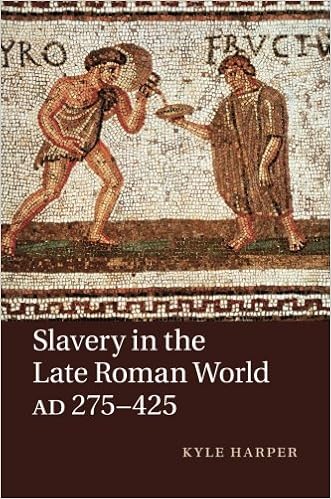
After reading Kyle Harper's excellent "The Fate of Rome" I was motivated to read this earlier book (an edited version of his doctoral thesis) on the nature of slavery in the late empire. I'm some way into it and the book is filled with astonishing detail.
Harper brings an economist's eye to modelling late Antiquity. Some of his neoclassical micro- and macroeconomic concepts are jarringly anachronistic - but despite his criticisms of dogmatic, mechanistic and dated Marxist analyses of Roman slavery his empirically-based research is very assimilable to a more sophisticated Marxist approach. Yes, Roman society integrated multiple modes of production into its interlaced agrarian-mercantile economy.
In Harper's working model, the late Roman empire comprises around 50 million people, of whom 5 million (10%) are slaves. The bulk of the slaves are owned by the top 600 or so senatorial families and the next 1.3% of super-rich aristocratic families beneath them. But the next 10%, professional/artisanal households in the cities and landowner holdings in the countryside, would have owned a few slaves (1-5) each. The remaining 80% of free citizens are the (mostly agrarian) poor working their little subsistence (often leased) plots.
There was little free labour in the western empire: population densities were low and there were other occupational calls for poor freemen, particularly the military. In Egypt, where poor labourers were in abundance, wage labour was much more central.
Slavery endured over a number of centuries. Routine supply-demand calculations show naive assumptions that the supply of slaves was provided solely, or mostly, by war captives are simply untenable. Slaves were expensive and valuable pieces of capital equipment - with the additional utility that female slaves could produce more of them. Slaves were bred just as cattle were. Slave families were a thing.
From pages 150-151:
"Scheidel argues that slave labor emerged in classical Athens because it was cheap while wages were high and that similar conditions perhaps existed in the late Roman republic.I wouldn't recommend the book as a beach read, it's dense and academic. But it's marvellously informative and raises this question: if we ever develop the robotic analogues of slaves, would our society evolve into anything like that of the late empire?
In the empire, by contrast, slaves were dear but their labor was profitable, so that slavery persisted in a high-equilibrium state. Indeed his model is a corrective against one of the most persistent illusions about slave labor: that slaves are necessarily cheap labor.
What matters is the ability to employ slave labor at a profit - the marginal value of labor against the costs of a slave, which are often high. The emphasis on supply is necessary and even obvious; no critique of the conquest thesis should deny that the supply side was always an economic constraint, as important as the demand side.
But the dynamics of demand are, analytically, more interesting and more challenging. Scheidel's model begins by proposing that slave labor and free labor are in more or less direct competition. Landowners used slave labor not just because free labor was institutionally unavailable, as per Finley, but because it was expensive. It was expensive because it was in short supply. It was in short supply due to high levels of political/military commitment among the free population or because of low population levels.
This model explains why slave labor is so prominent in late republican Italy (with its military mobilization) and so exiguous in Roman Egypt (with its dense population). Scheidel's model adds an important variable complicating the proposition that free and slave labor were in perfect competition in some sectors of agriculture.
He adopts Hanes' arguments about the role of transaction costs in the employment of slave labor. The risk of being unable to find labor at sensitive times in the agricultural cycle, the time and effort spent contracting labor, and the turnover costs of retraining workers were all salient considerations. Slave labor was effectively an involuntary lifetime contract.
Transaction costs, then, should be accounted for along with the raw market price of wage labor. Transaction costs amplified the effects of the demographic context, for "thick" labor markets like those in Egypt not only drove down wages, they reduced the risks and costs of the open labor market for land-owners.
This model also explains why slave labor was adaptive to certain types of Mediterranean agriculture, such as grape and olive cultivation, that required both effort and care in the nature of the labor performed. It thus represents an important advance in the application of institutional economics to ancient slavery by taking seriously the nature of the work regime and the type of labor employed. "
Subscribe to:
Posts (Atom)