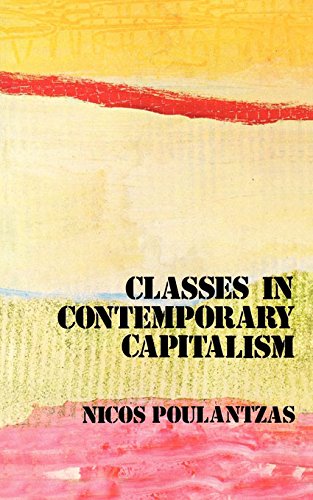
Classes in Contemporary Capitalism
From the preface:
"The book starts with a general theoretical essay that for the first time seriously explores the distinction between the “agents” and “positions” of capitalist relations of production, and seeks to avoid the typical errors of either functionalism or historicism. It also provides a polemical reconsideration of the problem of the “nation state” as a political unit today, and its relationship to the internationalization of capital.
Finally, and most originally, Poulantzas develops a long and powerful analysis of the much-abused concept of the “petty-bourgeoisie.” In this, he scrupulously distinguishes between the “traditional” categories of petty-bourgeoisie—shopkeepers, artisans, small peasants—and the “new” categories of clerical workers, supervisors, and salaried personnel in modern industry and commerce. At the same time he demonstrates the reasons why a unitary conceptualization of their class position is possible. The difficult question of the definition of “productive” and “unproductive” labor within Marx’s own account of the capitalist mode of production is subjected to a novel and radical reinterpretation. The political oscillations peculiar to each form of petty-bourgeoisie and especially their characteristic reactions to the industrial proletariat, are cogently assessed.
Poulantzas ends his work with a reminder that the actions and options of the petty-bourgeoisie are critical to any successful struggle by the working class, which must secure the alliance of important sections of the petty-bourgeoisie if the fateful experience of Chile is not to recur elsewhere tomorrow."
These are really critical issues when trying to understand the kind of class dynamics underlying the
recent events in France, the left and right populist movements everywhere and specifically the SJW phenomenon. It's also relevant to any incoming Labour government here in the UK.
---
State, Power, Socialism
This is Poulantzas's great exposition of the anatomy and dynamics of the various forms of the capitalist state, and the implications for the transition to socialism. I already read "
The State and the Transition to Socialism" (Chapter 14 "
The Poulantzas Reader" - PDF) where Nicos Poulantzas debates with the (at that time) Trotskyist Henri Weber (of the
LCR) as to whether the Leninist model of a proletarian revolution/state based on federated soviets is really viable in modern Western Europe.
Poulantzas further questions whether the power of the bourgeois state can really only be overthrown by dual-power soviet structures as in the Bolshevik revolution (that
was Trotskyist orthodoxy at the time of the interview, 1977). A kind of head-on assault.
My sympathies align with Poulantzas here, insofar as he at least thought about the nature of the state unlike the
FI which had not moved beyond "
The State and Revolution".
Weber is right against Poulantzas that the state is too strong and - in extremis - too focused to be subverted/reused from within. But they are both wrong to think that modern capitalism is vulnerable to the
revolutionary imposition of a post-capitalist mode of production led by the massed ranks of the industrial proletariat.
That isn't the failure mode.
Update 23rd February 2019:
I've just read Ellen Meiksins Wood's book, "
The Retreat From Class", where she devotes a chapter to Poulantzas. She takes him to task for assigning white-collar workers to the 'new petty-bourgeoisie' (rather than the working class) and also for assuming this category is equivalent to the Marxist (technical) distinction between
productive and
unproductive workers (productive of surplus value, that is).
Poulantzas was undoubtedly wrong about this, and Wood has him nailed.
---
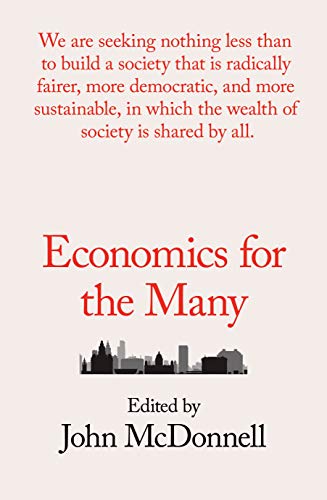
Economics for the Many
I'm expecting this book to be a bunch of left-Keynesians arguing that an incoming Labour government should put more demand into the economy through deficit spending and increased transfer payments in order to stimulate investment and productivity.
I'm completely with Michael Roberts here:
good luck with that.
Still, no sense in prejudging. Let's listen to what Mr McDonnell's favourite economists have to say.