Showing posts with label Robots. Show all posts

Saturday, December 15, 2018

Capitalism incompatible with total automation/slavery


In the previous post, "Five questions on the last days of capitalism", I discussed the evolution and final fate of capitalism - which will be very different from the violent revolutionary end imagined by the Leninist left.

In this post I want to zero in on the exact mechanics of the final days of capitalism. Little of what follows is original, but it's seldom brought to prominence.

1. Start point: a model capitalist economy with competition

Our economy consists of a number of identical competitive companies serving an anonymous market. Each company spends per working period:
  • £10 on constant capital c (= depreciation, raw materials, premises etc), 
  • £4 on wages v (= 4 labourers at £1 each)
with a rate of surplus value s/v of 100%. This means that £4 of surplus value s is produced in the working period. So c = 10, v = 4, s = 4.

Revenue = c + v + s = 10 + 4 + 4= £18     -  4 labourers remember. Assume 18 objects are produced at £1 each.

Profit p = revenues - costs = £18 - (£10 + £4) = £4.

Rate of profit = profit/cost = p/(v) = 4/(10 + 4) = 2/7 = 29%.

2. The power of innovation

One of the companies buys some better machinery which bumps c up from 10 to 11 but which allows two workers to be eliminated. Their numbers look better:

c = 11, v = 2, s = 2 (same s/v) so c + v + s = £15.

Suppose that 18 objects are still produced in the working period. Initially the innovator can sell at the going market rate of £1 each - a total revenue of £18.

Revenue = £18. But his costs (c + v) = 11+2 = £13 are lower.

Profit = £18 - £13 = £5 .. and rate of profit = p/(c + v) = 5/13 = 38%.

This is far better than his business rivals (stuck at 29%).

3. Other companies follow the innovation

But all too soon other companies follow suit. Prices fall due to competition until each company finds that for itself:

New revenue = c + v + s =  £11 + £2 + £2 = £15

New profit = (c + v + s) - (c + v) = £15 - £13 = £2.

New rate of profit = p/(c + v) = 2/13 = 15%.

But the previous market equilibrium profit was 29%! Now each employer is worse off.

But the 18 objects now cost only £15, or 83p each. Consumers benefit from the wonders of competition and innovation driving productivity.

4. Robots now eliminate all labour

The robots are coming! A progressive innovator buys more automation which bumps c from 11 to 12 and which eliminates workers altogether.

c = 12, v = s = 0.

As before, 18 objects are produced in the working period and the going rate is still 83p each. Our innovator takes advantage of existing market pricing.

Revenue = £15 as before, but costs = £12 only (no wages).

Profit = £15 - £12 = £3 and the rate of profit = 3/12 = 25%.

An improvement over his competitors (who only see 15%) but again, they soon follow suit.

5. Everybody adopts total automation: no more wage bills

Competition drives prices down to costs (there is no surplus value s).

Revenue = 12 and cost = 12.

Profit = 0 and each object costs 12/18 = 66p. Except no-one is making any.

---

Discussion

Slaves or robots: it makes no difference

I assert the above model holds whether the total automation is clever machinery, some humanoid AGI or a human slave.

Nonsense, you reply. A slave is just a worker where the employer is paying for food and shelter directly, rather than via wages.

Not so fast! The slave has to be bought as well as maintained - just like any other piece of capital equipment. What then is the cost of a slave in a competitive market?
The cost of a slave = expected-output-value - maintenance-costs (all discounted).
In one cycle above, assuming the slave is bought at price c and is as productive and exploited as a wage-worker (s/v = 1) then:

output-value produced by slave = (v + s) and maintenance-cost = v, so using the definition:
slave-cost = c = (v + s) - v = s                   - (values/costs here for one work cycle).
People (not slave-owners though) forget to include the initial cost of the slave, which already factors in the 'value' the slave will create.

Suppose cR represents the cost of the raw materials the slave works with and other non-slave constant capital costs. In a work cycle or period:
revenue = cR + value-added-by-the-slave = cR + (v + s)

costs = cR + slave-cost + slave-subsistence = cR + s + v.

Profit = revenue - cost = [cR + (v + s)] - [cR + s + v] = 0.

There have been capitalist economies with slave sectors of the economy

You say, there have been slave-owning sectors of capitalist economies, the antebellum south, and I remind you that this is well-trodden territory on the left.

Read more at this post: "Total automation under capitalism?" - the topic area is the theory of equalisation of the rate of profit between sectors with differing levels of automation and the concept of prices of production.

It's perfectly possible for sectors of a capitalist economy to transition to total automation (point 4 above). The automated sectors extract value produced by workers in other sectors through profit equalisation. But it's not possible for the whole economy to 'lose its workers'.

8. What kind of an economy can you have with total automation?

What does work, you ask. Absent complete overproduction capability ('abundance') of everything, there will be a need for exchange between different production units: commodity exchange at value via simple (or petty) commodity production. Like in the Roman empire, or during feudalism. In this mode of production, exchange is driven by the need for use-values. The dynamic is not profit maximisation.

One can only hope that innovation and dynamism in such an utterly-transformed society of the future is not stifled. Perhaps the AIs will have some objectives of their own? Not everything that is wonderful and creative in human affairs is driven by capital valorisation.

---

You will have observed that the cost equation for a slave already incorporates elements of rent. Yet the treatment here is not definitive. As Poulantzas reminds us (Classes in Contemporary Capitalism, chapter 1), 'capital is not a thing'. In arithmetical examples social relationships are reified.

So I'm thinking that the 'expected value of future output' term in the value of a slave is similar to the way we value a share. Marx called this fictitious capital. Compare with the labour involved in delivering the slave as a market-commodity (reproduction, transport and transaction costs) which is how we normally value constant capital. Not sure how to bring these two paradigms together. On this rather opaque thought I must leave it.

Update: Reading Poulantzas (Classes in Contemporary Capitalism, Productive and Unproductive Labour: 2) I am reminded that slaves are not produced in factories.

Slave traders are engaged in non-productive labour and the commodity price form of the slave, like that of the bond or share, is not derived from some quantity of abstract social labour incorporated in it.

---

My further posts on Marxist theory.

Tuesday, June 19, 2018

Capitalism with total automation? In principle, sure


There are people who believe that only living, breathing humans can be conscious, can really be persons. Machines can only ever be machines. AI researchers refute this view with an elegant argument. A neuron is a finite system which transforms its inputs into outputs subject to environmental conditions. In principle a neuron model could approximate a human brain neuron as closely as one might wish.

So replace biological neurons, one at a time, with functionally equivalent fabricated devices such that their input-output behaviour is exactly replicated. Eventually you have a machine brain with identical behaviour to the biological original. How could it not exhibit consciousness and personhood?

In Capital Volume 1, devoted to capitalist production, Marx made great play of the difference between machines - constant capital, incapable of producing new value - and workers, variable capital with the unique property of creating new, and indeed surplus, value. It seems that Marxist economists ever since have thought that Marx was a vitalist. That protoplasm somehow figures centrally in Marxist theory.

Amazing. Such an elementary category error.

Marx considered the dawn of automation in his celebrated “Fragment on Machines” although he was more concerned with the deleterious impact on those workers who were forced to dance to the new, highly-automated machines’ tunes. His tone is nevertheless surprisingly tentative.

Most Marxists since then have considered only the case where highly-automated machines are bought as capital goods. In this case, the machines are isomorphic to slaves, and if the means of production remain distributed in private hands, the resulting mode of production is petty commodity production.

But consider that AI thought experiment again. Take a worker and replace him or her by a robot which sells its ability to operate at a price determined by its own costs of reproduction. Nothing important about capitalism changes.

If we change out all the workers for robots, but maintain the relations of production (wage labour and commodity production for profit) then we're still in the business of reproducing capitalist relations of production. It's a thought experiment, but not an impossible outcome.

My intuition is that the current trend of replacing variable capital (human) with constant capital (machines) will continue, the underlying rate of profit will continue to tendentially fall, and we will eventually face the under-analysed issue of the transition from capitalism to a generalised petty commodity production reminiscent of antiquity. I ignore of course any initiatives by the set-aside human ex-workers.

However, as machines get smarter and more like AGIs, their claims to the dignity of personhood may become impossible to deny (I see the SJWs marching now). Once AGI-robots become cheaper than unreliable and non-standardised humans, why wouldn't we see capitalism without a human working class?

Welcome to the new epoch of total automation under capitalism .. and the ultimate non-revolutionary proletariat.

Sunday, April 15, 2018

Michael Roberts: Total Automation under Capitalism

Michael Roberts has a new book out:

Amazon link

Here is what he has to say about the impact of total automation on capitalism (pages 137-141).
"What does this all mean if we enter the extreme (science fiction?) future where robotic technology and AI leads to robots making robots AND robots extracting raw materials and making everything AND carrying out all personal and public services so that human labour is no longer required for ANY task of production at all?

Let's imagine a totally automated process where no human worked in the production process. Surely, value has been added by the conversion of raw materials into goods without humans? Surely, that refutes Marx's claim that only human labour can create value?

In Marx's economic theory, abstract labour is the only source of value and surplus-value. However, in the case of an economy where robots build robots build robots and there is no human labour involved, surely value is still created?

This was the argument of Dmitriev in 1898, in his critique of Marx's value theory. He said that, in a fully automated system, a certain input of machines can create a greater output of machines (or of other commodities). In this case, profit and the rate of profit would be determined exclusively by the technology used (productivity) and not by (abstract) labour. If 10 machines produce 12 machines, the profit is 2 machines and the rate of profit is 2/10, 20%.

Value reduced to use value has nothing to do with Marx's notion of value, which is the monetary expression of abstract labour expended by labourers. If machines could create 'value', this value would be use-value rather than value as the outcome of humans' abstract labour. But, if machines can create 'value', so can an infinity of other factors (animals, the forces of nature, sunspots, etc.) and the determination of value becomes impossible. And if machines supposedly could transfer their use-value to the product, this would immediately crash against the problem of the aggregation of different use-values.

For Marx, machines do not create value. Rather, concrete labour transfers the value of the machines (and, more generally, of the means of production) to the product. They increase human productivity and thus the output per unit of capital invested, while decreasing the quantity of living labour needed for the production of a certain output. Given that only labour creates value, the substitution of the means of production for living labour decreases the quantity of value created per unit of capital invested. ...

The Dmitriev critique confuses the dual nature of value under capitalism: use value and exchange value. There is use value (things and services that people need); and exchange value (the value measured in labour time and appropriated from human labour by the owners of capital and realised by sale on the market). In every commodity under the capitalist mode of production, there is both use value and exchange value. You can't have one without the other under capitalism. But the latter rules the capitalist investment and production process, not the former.

Value (as defined) is specific to capitalism. Sure, living labour can create things and do services (use values). But value is the substance of the capitalist mode of producing things. Capital (the owners) controls the means of production created by labour and will only put them to use in order to appropriate value created by labour. Capital does not create value itself.  So in our hypothetical all-encompassing robot/AI world, productivity (of use values) would tend to infinity while profitability (surplus value to capital value) would tend to zero. ...

This is no longer capitalism. The analogy is more with a slave economy as in ancient Rome. In ancient Rome, over hundreds of years, the formerly predominantly small-holding peasant economy was replaced by slaves in mining, farming and all sorts of other tasks. This happened because the booty of the successful wars that the Roman republic and empire conducted included a mass supply of slave labour.

The cost to the slave owners of these slaves was incredibly cheap (to begin with) compared with employing free labour. The slave owners drove the farmers off their land through a combination of debt demands, requisition in wars and sheer violence. The former peasants and their families were forced into slavery themselves or into the cities, where they scraped a living with menial tasks and skills or begged. The class struggle did not end. The struggle was between the slave-owning aristocrats and the slaves and between the aristocrats and the atomised plebs in the cities.

A fully robot economy means that the owners of the means of production (robots) would have a super-abundant economy of things and services at zero cost (robots making robots making robots). The owners can then just consume. They don't need to make 'profit', just as the aristocrat slave owners in Rome just consumed and did not run businesses to sell commodities to make a profit. So a robotic economy could mean a super-abundant world for all or it could mean a new form of slave society with extreme inequality of wealth and income. It's a social 'choice' or more accurately, it depends of the outcome of the class struggle under capitalism.

The key issue is Marx's law of the tendency of the rate of profit to fall. A rising organic composition of capital leads to a fall in the overall rate of profit engendering recurring crises. If robots and AI do replace human labour at an accelerating rate, that can only intensify that tendency. Well before we get to a robot-all world, capitalism will experience ever-increasing periods of crises and stagnation."
Everything Roberts says here is orthodox Marxist economics and yet there is something missing: the use of the abstract concepts of Marx's theory to reconstruct the concrete phenomena, to discern the details of the actual transition to 'a robot-all world'.

Marx was not a vitalist. He did not think that human protoplasm endowed human labour with some mysterious value-producing quality that mere steel and electronics could never replicate. So what if human workers were everywhere replaced by fabricated androids who also toiled in the factories, were paid wages and consumed ersatz food? Does capitalism still work? [Answer: of course].

If one particular capitalist creates a totally automated factory (or one using purely slave labour which is - in Marxist terms - the same thing) is that incompatible with capitalism? [Answer: of course not].

As more and more capitalists automate their factories, displacing human labour, what is the process which unfolds before them and why? How do they perceive the capitalist economy failing before their eyes?

Or will they rather observe, as Peter Singer writes in his book on Marx: ‘Future capitalists will not find their profits drying up as they dismiss the last workers from their newly-automated factories’ (p. 76).

I outlined some answers here.

Monday, March 12, 2018

The biotech road to full automation

In my post "Advanced AI is indistinguishable from slavery" I wrote about the advantages biotechnology brings for a future post-capitalist society. Communist theory has traditionally counterposed central planning to the 'anarchy' of the market. But that often-criticised anarchy is actually rather biological, a kind of exploratory behaviour in which potential new needs are tested for sustainable effective demand.

By contrast, as János Kornai has pointed out at length, our experience of central planning has identified insuperable principal-agent problems together with a structural inability to properly engage with real human needs.

---

A global multicellular biosphere has existed on this planet for five hundred million years, exhibiting persistence and dynamic self-regulation in the absence of any intelligent oversight or central planning.

Biology is local while ecology is global.

Compare this with our global capitalist economy, the ongoing maintenance of which requires the mandatory coordination of human effort, intelligence and conscientiousness. It's because apart from human workers, other means of production are generally incredibly dumb. We work on metals, plastics, glass, oil, coal .. none of which do anything useful without the application of human labour mediated by clunky tools.

Peter Hamilton's vision of the Eden habitat (by Jim Burns)

Plants and animals, by contrast, are self-supporting nanotechnology of such stupefying sophistication and complexity that we can't even emulate the simplest possible animal (C. elegans). If we could bioengineer plants and animals to address our portfolio of needs (substituting for our present reliance on dumb stuff) the complexities and endless engagement of humans in running the economy could in large part be finally dispensed with.

---

Some people think that a linear extrapolation of AI and robotics on our current technology base will deliver full automation, but (a) we're a long way from embodied AGI robots, and (b) the global supply chains to build and maintain such artifacts of metal and plastic would be incredibly brittle .. not at all to be relied upon. They should be discretionary extras around a biotech core for future societies.

---

I imagine a rather sneering response: "Wait till an adversary comes up against you with high-bandwidth satellite comms, tanks, hypersonic missiles and nukes. See how far your genetically modified palm trees will take you then. Are you going to fight back with Game of Thrones-style dragons?"

So how would a super-sophisticated biotech-civilisation respond to such a threat? By using smart biology (including servitors) to build counter-artefacts. Nothing says that every element of a future biotech-civilisation must be fabricated from protoplasm: that's not even true in today's biosphere. Biotech just gives you a fantastic set of new options.

Friday, September 15, 2017

The gag is on

Walking down to Waitrose this morning - and dragging the new sholley, my weight-training-induced sore forearms still haven't gone away and it's 'no more Mr Heavy-Shopping-Bags' - I ventured this thought to Clare.

"Shall I tell you the new thing I've learned today?"

Grudging acquiescence.

"You know I'm continually fascinated by the way AI and robotics are going to transform capitalism, and how exactly that transformation's going to work ..."

---

The new thing was from Part 2 of Michael Roberts' insightful series, 'Robots and AI: utopia or dystopia?' ..
"The question often posed at this point is: who are the owners of the robots and their products and services going to sell to make a profit?  If workers are not working and receiving no income, then surely there is massive overproduction and underconsumption?  So, in the last analysis, it is the underconsumption of the masses that brings capitalism down?

"Again, I think this is a misunderstanding.  Such a robot economy is not capitalist any more; it is more like a slave economy.  The owners of the means of production (robots) now have a super-abundant economy of things and services at zero cost (robots making robots making robots).  The owners can just consume.  They don’t need to make ‘a profit’, just as the aristocrat slave owners in Rome just consumed and did not run businesses to make a profit.

"This does not deliver an overproduction crisis in the capitalist sense (relative to profit) nor ‘underconsumption’ (lack of purchasing power or effective demand for goods on a market), except in the physical sense of poverty. ..."
Roberts here puts his finger on the key mode of production change required by total automation: production of exchange-values collapses and all production is of use-values, just like in slave-owning antiquity.

The issue is, who gets to be the recipient of such wonders of production, the owners of the robots .. or everyone? It seems contentious.

---

Where to start? The only place was the labour theory of value.
"So Marx said that the capitalist pays the worker the value of his labour-power - what it costs to maintain the worker as an effective employee - and sets him to work. But the value the worker actually creates in his day's labour is more than this, and that value belongs to the capitalist, creating his profit once realised in the exchange process.

"But if the worker is replaced by a robot ..."
But Clare was having none of this.
"That can't be right. If the worker is paid less than what he produces, then the employer won't be able to sell all his products. No, Marx was quite wrong."
I hesitatingly began to talk about Marx's simple and expanded reproduction equations, Departments I and II .. but the audience had switched off.

In truth, I don't think the objection can be addressed in ordinary conversation, the sources of demand being manyfold: in addition to the needs of proletarians you will find capitalists' spending on themselves, the market for reproduction and expansion of the means of production .. .

No less a luminary than Rosa Luxemburg got it wrong.

In fact I explained quite clearly both simple reproduction and expanded reproduction within capitalism on this blog, but if you review the two posts you will see the analysis is not wholly trivial.

This afternoon I considered going through the spreadsheets with her - and decided against having my arm bitten off.

---

You may have heard over the last couple of days: Mathematicians Measure Infinities and Find They’re Equal.

It relates to whether there are cardinal numbers between the infinity representing the size of the natural numbers and the larger infinity capturing the size of the real numbers. The continuum hypothesis says no, but that can't be proven using the normal axioms of set theory.


The work of Malliaris and Shelah has some bearing on the matter although not all is completely clear (is the cardinality of p = t the same as the continuum?).

I said to Clare, "Did you know there are different sizes of infinity?"

She snorted, "That kind of nonsense is just what gives mathematics a bad name."

I advanced on her with paper and pen; she sat back on the couch, closed her eyes, put her hands over her ears and started to hum.

Thursday, September 08, 2016

Total automation under capitalism?

1. Introduction
"Primitive communism is a concept originating from Karl Marx and Friedrich Engels who argued that hunter-gatherer societies were traditionally based on egalitarian social relations and common ownership." (Wikipedia).
We know more today about the cultural and material poverty of hunter-gatherer societies and the frequently brutal xenophobic warfare between tribes driven by Malthusian pressures.

But hunter-gatherers looked down upon early farmer societies, seeing gross inequalities, intense, lengthy and servile labour and an absence of freedom for the majority.

They were right.

The dream of human utopia, the vision which drives social change, is that of an enlightened return to that dawn-era of human equality. A best-case bountiful environment back then of plants, fruit and plentiful game is to be replaced by a sophisticated automation-economy which provides for every need: food, shelter, transport, communications, entertainment and so on.

So productive is this imagined future robotic economy that products are produced at need and no money is involved. Hunter-gatherers did not have to 'pay' to pluck fruit from a wild bush or to hunt animals.

Our future machines are self-producing and self-maintaining. They can be freely used by interested groups to build stadiums, new kinds of computers, rocket ships or to embark upon great projects such as colonising Mars.

Speculative as this sounds, it's not beyond extrapolation from our current technological base; a century might do it. In the jargon, it's called 'development of the productive forces' towards abundance.

But what happens as we move inexorably towards total automation under capitalism?

2. Michael Roberts's three-part series

Noted Marxist economist Michael Roberts has an excellent analysis, starting here.

3. Peter Cooper's Model

Peter Cooper (heteconomist) had an extremely useful post about this back in 2011 entitled "Implications of a Purely Mechanized Economy" which I'm going to discuss in detail.

Peter starts like this:
“It is well known that in Marx’s theory of commodity production, labor is the source of all new value. The means of production merely pass on their already existing value to new commodities. [...]

“It is critical to recognize that Marx’s argument applies to value, not physical output or wealth. He is not suggesting that labor is the only source of physical output or wealth. Nature, other animals and machines all clearly create new physical output and wealth, as does labor. The argument, rather, is that only labor translates into new value. The plant, machinery and raw materials used up in the production period only pass on their preexisting value (actually, their prices).

"Nature, in contrast, does not transfer any value to output. Instead, private property rights give owners of natural resources a legal entitlement to a payment of rent, which comes out of the surplus value created in the production period."
This is a really important point, at the heart of Marx's theory. When a wild tree produces grapes (from thin air) which you eat, value has been created for sure. A use-value.

What has not been created is the kind of value which mediates and regulates commodity exchange via the market, called exchange-value. There is no market!

Exchange-value is a social construct, it is constructed through the human activity of equitably implementing the market exchange of commodities, the normal mode of distribution of goods and services in a capitalist society.
“Of the new value that is created in the production period, some goes to workers as wages and some goes to capitalists and other social groups as surplus value. Specifically, surplus labor – the labor carried out in excess of what is required to produce the equivalent of the value paid to workers in wages and salaries – is the basis of surplus value in Marx’s theory. In aggregate, surplus value equals profit, prior to its distribution among various recipients. Some of it will go to rentiers as rent or creditors as interest income.

“Considering that surplus labor is the sole origin of surplus value in Marx’s theory, it is interesting to reflect on an extreme scenario in which the entire production of the economy becomes purely mechanized. Marx’s theory suggests that, in this scenario, capitalism must have ceased to exist! The reason is that there would be no production of surplus value (profit) in such a system, making it unviable for capitalists.

“But what does it mean to say that a purely mechanized economy could not be a capitalist economy? After all, even in such a society, surely we humans would still be doing some things that were not mechanized. So what would be going on?

“It would simply mean that this human activity (labor) was no longer being treated as value production and that our human capacity to work or create (labor power) was no longer being treated as a commodity.

“In such a system, there might still be a requirement to work in order to gain access to material needs, and there might still be authoritarian measures used to direct production. However, it would not be capitalism. The surplus would not take the form of value, but simply its physical form – the material output produced in excess of the needs of social reproduction.

“Equally possible is that we might choose to organize our activities in such a way that income was no longer tied to work. Material needs could be met through the free distribution of the output of mechanized production processes. Required resources and facilities for human endeavors could be made freely available. Human activity could then be genuinely free and associations between individuals voluntary.

Highly Mechanized Production Under Capitalism

“For capitalism to remain despite a high degree of mechanization, it would instead be necessary that at least some human activity continued to be value production. That would require that some human endeavors were only enabled within the context of value production, just as is the case in our present society.

“In the absence of a basic income guarantee, there would be an onus on the government to ensure demand remained sufficient to sustain high levels of employment. Otherwise, in the midst of such plenty, periodic episodes of mass unemployment, especially if continuing for sustained periods, would likely result in extreme social conflict.

“If human activity remained commodified – i.e. capitalist social relations remained in place – capitalists would retain significant ownership and control of the means of production, including the purely robotized or mechanized production processes. Surplus value would continue to be created out of the employment of labor under capitalist conditions. Just as now, all capitalists would compete for a share out of aggregate profit, irrespective of how much surplus value was created in their own sectors.

“The reason for this, in Marx’s theory, is that competition tends to equalize the rate of profit realized by different sectors, even though it is the least capital-intensive sectors (least efficient sectors) that produce the most surplus value (because proportionately they outlay more on the employment of workers than means of production).
I going to replace Cooper's symbols with their spelled-out meanings to make reading a little easier.
“Briefly, for Marx, the [exchange] value of a commodity equals c + v + s. Here: c is ‘constant capital’, the value (or dollar amount) outlaid for the means of production used up in producing the commodity; v is ‘variable capital’, the sum of value outlaid for the employment of labor; and s is ‘surplus value’, the amount of value produced by workers in excess of the amount (v) outlaid on their employment.

“Marx argued that in exchange there would be a tendency for commodities to sell at their ‘prices of production’, 'price', rather than their values. These are the prices that would ensure all sectors received the same rate of profit. They are equal to c + v + profit, [ie cost + profit].

"Prices of production differ from values whenever surplus-value s differs from profit. In sectors with an above average ‘organic composition of capital’ (c/v), profit  > surplus-value and price > value.

"The reverse is true of sectors with an organic composition of capital below the average. In this way, competition causes surplus value to be transferred from sectors with below average compositions of capital to those with above average compositions.

“In aggregate, however, Marx maintained that total value equals total price (the sum of all values equals the sum of all prices), surplus-value equals profit, and the value rate of profit equals the rate of profit.

"In effect, the creation of aggregate surplus value in production determines the amount of aggregate profit that can be realized in exchange, with competition between capitalists merely causing a transfer of surplus value between sectors according to their compositions of capital.

“For example, if the economy were divided into two sectors, one completely mechanized and the other employing a combination of labor and means of production, the situation might look something like this (for simplicity, I have assumed all means of production are used up each period so that there is no fixed capital):
Here I'm replacing Cooper's spreadsheet with my own copy: same numbers, easier to read labels. Note that in his simple model, there are just two commodities produced in the time period of production - one by the Robot sector (completely automated) and one by the Mixed sector (with some human input).

Robot and Mixed Capitalist economy producing two commodities, each of value 100
“In this example, production in the robot sector occurs entirely without labor. Over the period, $100 worth of robots and other means of production, including raw materials, is used up, passing on $100 to the final value. No new value is produced in this sector, and therefore no surplus value. It is simply the already existing value of the means of production that is passed on to the final value.

"The robots, if able to learn, could be getting smarter and smarter throughout the period, thereby enabling larger and larger material output. But in value terms, there is no new value produced, because the amount paid by capitalists for the means of production will reflect costs of production and the rate of profit, not the material output produced by the means of production.

“In the mixed sector, $20 of value is passed on to the final commodity through the using up of means of production and $80 of new value is created through the employment of labor. Capitalists appropriate $40 as surplus value.

“As already noted, competition between the sectors and between capitalists tends to equalize the profit rate in each sector (in the example, it is 25% in each sector and in the economy as a whole). This is argued to occur as a result of capitalists seeking out the highest return for their investment. If one sector offered a higher rate of profit than the other, investment dollars would flow into the more lucrative sector until no further advantage could be obtained, assuming competitive conditions, which, for Marx, following classical political economy, entails free mobility of money capital.

“The example illustrates that capitalists in the mixed sector do not get to keep the entire surplus value, even though that is the sector in which the surplus value is actually produced. Instead, total price in the robot sector rises above total value produced in that sector ($125 > $100) and total price in the mixed sector falls below total value produced ($75 < $100).

"In Marx's theory, this tendential equalization of profit rates ensures that technical innovation and mechanization are not discouraged by operation of the 'law of value' (value based on labor time). It means that innovators are not penalized in terms of profit for minimizing their use of labor (minimizing their amount of new value production). It provides a competitive impetus to economize on the use of society's labor time.

The Social Possibilities are Open

“Since it is technically possible for capitalism to continue even in a highly mechanized economy provided human activity remains commodified, the social ramifications of increasing mechanization are an open question. Increasing mechanization makes it possible at some point to sever the connection between work and income entirely. That would seem to offer the greatest potential for human freedom and creativity.

“Yet, there is no inevitability that this option will be taken unless general populations actively press for this social progression. Those with the greatest stake in the existing system may persist in their efforts largely to confine employment opportunities (and access to infrastructure and productive facilities) to the sphere of capitalist social relations. General populations might be persuaded to go along with this state of affairs provided there was sufficient class compromise to ensure that real wages and general living standards rose more or less in line with productivity improvements.

“Nevertheless, with material needs so easily met, the absurdity of such a social relation, in which much of human potentiality can only be expressed on terms acceptable to the capitalist class, may well become increasingly apparent over time. For this reason, there are probably grounds for optimism that, ultimately, some kind of basic income scheme or non-monetary type of guaranteed access to material needs and facilities will emerge provided we put our collective foot down and demand it. If there had been the political will, it probably could already have happened.”

4. The model as automation becomes dominant

Peter Cooper's model has additional mileage. What happens to capitalist production as the mixed sector declines and the total-automation sector continues to grow?

Let's start by halving all the numbers so that the total value of the two commodities produced in this model economy is exactly 100. Rates of surplus-value and profit remain the same.

Value parameters halved so that total economy (2 commodities) is of size 100

Now dramatically reduce the constant and variable capital assigned to the Mixed sector. That is, put most of the capital invested in machinery and raw materials into the robotic sector, and employ very few people. In numbers, we have 90% of the produced value  invested in robots, 2%  invested as constant capital in the Mixed sector, 4% invested as wages and the capitalists appropriate 4% as surplus value.

Here's the spreadsheet.

Wages are now only 4% of the economy

As you can see, due to the enormous organic composition of capital (c/v = 92/4 = 23) and in the absence of any increase in the rate of surplus value (s/v = 100%), the rate of profit has crashed to 4%. The Mixed sector commodity price at 6.25 is only slightly above the cost of 6.

Doing the maths shows that as the mixed contribution (ie the amount of employed labour) tends to zero, surplus value also tends to zero and price tends to cost leading to zero profits. At this point, capitalism simply can't work.


5. The experience of total automation for the mass of non-capitalists

What would that be like for the great mass of people who are not owners of the vast amounts of capital sloshing precariously around here? 

In the comments on his post, Peter Cooper observed:
“In narrow material terms, a purely mechanized economy could generate considerable growth in material output over time. Machines might be creating more and better machines that create more and better machines, etc. No new ‘value’ (appropriated labor) would be created, but material output would be increasing.

“The living of our lives in the broadest sense – our thinking, learning, communicating, interacting, creating, working, playing, etc. – could be developing in a very dynamic fashion with the aid of technology. The potential, in this sense, seems unlimited. As one example, interactive virtual reality technology provides access to a wide range of experiences, albeit vicarious, that would not otherwise be accessible. As an aid to imagination or to physical, emotional and intellectual development, the possibilities seem endless.

“I think the real question is whether human activity – life in the broadest sense – has been freed completely from the production of value. Even once we have been freed, we will still be living and experiencing life, including pursuing vocations we find interesting. It’s just that our activities won’t be dictated by value relations.

“Regarding the risk of human redundancy, I am not familiar with the theoretical limits to artificial intelligence – for example, whether some kind of robot consciousness is possible and, if so, in what sense – but even if robots were able to reach a point where they could live life better than us, this would not remove our own desire to live life. I don’t think our own experiences would become redundant just because robots might be capable of greater experiences.

“Technology often seems ominous under capitalism because it is a threat to our employment prospects as wage labor or undermines the profitability of past investments that relied on older technologies. But that is a defect of capitalism, not of technology. Technology provides the potential for better lives for humans and other species. It is an open question whether we will be able to organize ourselves socially in a way that enables us really to benefit from these opportunities.

“I would also question the notion of redundancy in a post-capitalist society. From the perspective of capitalist value production, a worker’s existence is only justified to the extent it enables the production of new value, either immediately through the expenditure of living labor or potentially as a member of the reserve army of labor. But the day we end value production will hopefully also be the day we reject this justification for a person’s life. Hopefully it will be the day we recognize that life needs no justification.

“I have always liked the saying, “we work to live, not live to work”. Unfortunately, it is not really true for many people under capitalism. However, post capitalism, I hope we can do better, and say, “we live for its own sake, and work if we want”.

“It is not that I am necessarily optimistic about the future. I am just suggesting that the social possibilities are open.”

6. The transition to post-capitalism

We have some prior experience with abundant goods produced at zero marginal cost. Remember the saga of MP3 music files?

There was originally a small cottage industry (around Napster) of people downloading digitised music for free. After a while, pretty much everyone was sharing music files with their friends and families. And so the (secondary) production and distribution of music was taken out of capitalist relations of production: communism in music had arrived.

The first recourse of the capitalist providers of commoditised music was to resort to the power of the state. People were prosecuted, as was Napster. But the masses were too many, the activity too widely-practised and the threats ultimately unenforceable.

In the next iteration, legal and cheapish channels of digitised, downloadable music were provided. Many people were persuaded on moral grounds to use these. After all, communism in the means of general consumption hadn't arrived; musicians had to eat!

Some musicians rebased their revenue streams around live performances or hold-in-the-hand artwork. Streaming developed, which was more easily monetisable. And in the background, people continued to rip/download and share music tracks for free with impunity.


7. The wonderful 3D printer/fabricator

I think this is an interesting template for a possible future.

Suppose a philanthropic billionaire develops the ultimate 3D printer/fabricator. Using sunlight, water, air + scrap materials, it can synthesise food, drinks, shelter, transportation and most other basic and quite sophisticated needs. The machines can also self-reproduce if so instructed.

Think of it as a super-fast-growing tree-analogue - indeed, it might be the result of genetic technology.

The billionaire donates this machine to the world for free. What happens next?

Like the MP3 scenario, I imagine that an idealistic network of early adopters would take up this machine and remove themselves entirely from the capitalist economy. Thus sustained and as in Paul Mason's vision of the future, they would no doubt work on endless open-source improvements.

The capitalists see a sharp decline in the wage-labour force. If you don't want to work, perhaps you don't have to. (There are some issues in this scenario to do with land rights - all land is owned by someone and no-one's making much more of it - but let me skirt over these.)

No doubt some capitalists will make use of these wonderful machines to create a totally-automated robotic sector of the capitalist economy, as Paul Cooper discussed above, but it's in competition with the non-capitalist economy which produces only use values.

Notice in this scenario, which is very bottom-up, the automated printer/fabricators are so competent that coordination issues usually addressed by the capitalist market and which have proved so troublesome for Marxists ('central planning') are largely non-existent.

Insofar as there are big projects which require coordination, these could be done by voluntary associations of those interested.

Tempting as it is to say that the capitalist state would attempt to outlaw these machines and 'restore order', I think that in most cases the balance of forces would be against them. Potential abundance is just too compelling and in this scenario, too easy to accomplish.

Other scenarios are alluded to by Cooper above, including a basic income while the capitalist economy is still completing its work of increasing the productive forces.


8. Conclusions

The left finds itself in a century-old dilemma. The reformist left wants to manage capitalism by using control of the capitalist state to tilt the scales a little more towards the interests of the masses; the revolutionary left wants to abolish the capitalist state and the dominance of capitalist relations of production and exchange, and institute central planning based on workers councils instead, as Lenin and Trotsky envisaged.

The former promises at best limited, quantitative gains while the latter looks completely implausible.

Capitalism is the best social system ever devised for increasing standards of living, productivity and the forces of production. The problem is that its motivation and driving force is capital expansion, not human welfare.

That works for quite a lot of the people whose labour power is required to do that mission, but ignores many more who are economically superfluous. It's usually not malicious - it's just that they don't have a specific capability to be useful right now, or the purchasing power to get noticed.

I suspect Marx was right when he suggested that capitalism could only be surpassed when it was obvious to the mass of people that it was no longer the best way to develop the productive forces in the interests of everyone, and where a superior alternative was also obvious.

This suggests that it's been no accident that capitalism continues to reign supreme, even giving a new lease of life to countries such as Russia and China. The conditions just aren't here yet.

But as long as capitalism continues to drive technological progress, brighter prospects will emerge ahead.

---

Related posts

---

Saturday, October 17, 2015

We invade the Moon .. but when?

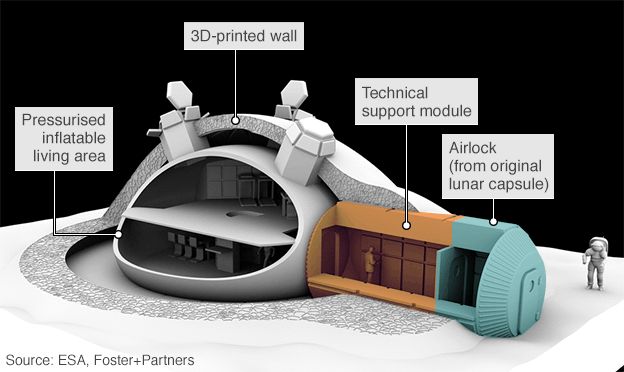
Proposed lunar habitat

According to the BBC,
"The European and Russian space agencies are to send a lander to an unexplored area at the Moon's south pole. It will be one of a series of missions that prepares for the return of humans to the surface and a possible permanent settlement. The spacecraft will assess whether there is water, and raw materials to make fuel and oxygen.

BBC News has obtained exclusive details of the mission, called Luna 27, which is set for launch in five years' time. The mission is one of a series led by the Russian federal space agency, Roscosmos, to go back to the Moon."
The only practicable way to construct a lunar habitat, like the one pictured, would be by using autonomous robots. They couldn't be teleoperated from Earth due to communication delay.

You may have noticed that nowhere on Earth right now are there autonomous robots capable of building a house - even under the benign conditions on our planet. People aided by dumb machinery build houses.

It's often said that the future is already here, just unevenly distributed. Absolutely cutting-edge stuff is very expensive and is solely used by elites (the rich, or priority government programmes). Later, technologies get better, prices come down via economies of scale .. and the future arrives for the masses.


Example: the first mobile phones, clunky things, date back to c. 1975. The mass take-up of mobile phones began in the mid-1990s, twenty years later. This period, twenty years from earliest adopters to mass deployment, seems about right for sophisticated, high-technology systems engineering.

As I noted above, there are no autonomous construction robots at all right now: we're probably ten years from systems which could autonomously build a habitat on Earth and perhaps thirty years from systems which are cost-effective for large scale use.

For a special-project moon base (large budget, customised equipment) I would guess twenty years out. For routine off-planet construction opening the way to significant lunar/martian cities it would have to be at least forty years.

So here's my summary timeline:
2025:  first proof-of-concept complete-house-building robots (autonomous)
2035:  first special-purpose lunar/martian habitat-building robots (autonomous)
2045:  houses routinely built by autonomous robots across the world
2055:  large scale town/city construction on the Moon and Mars by autonomous robots.
These are the earliest dates.

---

On a personal note, which of these events could I expect to see?

I checked an online life-expectancy calculator with this result:

My life expectancy at current age 64 (in 2015) = +25 years

This puts my expected date of death 25 years in the future, to 2040.

I might see the habitat pictured above before I go, with zen-like equanimity, to that good night.

Wednesday, September 30, 2015

The Age of Em

A certain amount of excitement in the George Mason University sector of the Internet on Robin Hanson's upcoming book, "The Age of Em: Work, Love and Life when Robots Rule the Earth", due out in April 2016.


According to the Amazon blurb:
"Robots may one day rule the world, but what is a robot-ruled Earth like?

Many think the first truly smart robots will be brain emulations or "ems". Scan a human brain, then run a model with the same connections on a fast computer, and you have a robot brain, but recognizably human.

Train an em to do some job and copy it a million times: an army of workers is at your disposal. When they can be made cheaply, within perhaps a century, ems will displace humans in most jobs. In this new economic era, the world economy may double in size every few weeks.

Some say we can't know the future, especially following such a disruptive new technology, but Professor Robin Hanson sets out to prove them wrong. Applying decades of expertise in physics, computer science, and economics, he uses standard theories to paint a detailed picture of a world dominated by ems.

While human lives don't change greatly in the em era, em lives are as different from ours as our lives are from those of our farmer and forager ancestors. Ems make us question common assumptions of moral progress, because they reject many of the values we hold dear.

Read about em mind speeds, body sizes, job training and career paths, energy use and cooling infrastructure, virtual reality, aging and retirement, death and immortality, security, wealth inequality, religion, teleportation, identity, cities, politics, law, war, status, friendship and love.

This book shows you just how strange your descendants may be, though ems are no stranger than we would appear to our ancestors. To most ems, it seems good to be an em."
Professor Hanson has recently written a preview article of unrestrained optimism entitled "The "Em" Economy: Imagine a future dominated by brain emulation robots" where he explains:
"If brain-emulation-based robots, built via a computational reproduction of human brain connections, come to dominate the world economy, that economy will grow far faster than today. Driven by abundance of labour resulting in higher returns to capital and lower commuting costs, most of this activity will be concentrated in a few dense cities."

For several years now, I have opportunistically applied standard theories from economics, physics, computer engineering, and many other fields to study the new ways of life that would appear in an em era. I have found, for example, that once the cost to rent an em is substantially less than human subsistence wages, ems quickly dominate the economy. Humans are mostly forced to retire, but live comfortably off of em-economy investments.
I'm sure those 'humans' will be delighted to be expelled from the workforce - at every level of skill.

The article continues:
" ... sometime in the next century we’ll see a sudden transition. In less than a decade the world economy would will start doubling every month or faster, and ways of life will change dramatically.

There’s a decent chance that such a new era will result from the arrival of robots as smart as humans. In particular, such robots might be created as “brain emulations,” i.e., from taking a particular human brain, scanning it to record its particular cell features and connections, and then building a computer model that processes signals according to those same features and connections.

A good enough emulation, or “em” as I call it, has close to the same overall input-output signal behavior as its original human. An em thinks and feels like a human. One might talk with it, and convince it to do useful jobs. It can be happy or sad, eager or tired, fearful or hopeful, proud or shamed, creative or derivative, compassionate or cold. An em can learn, and have friends, lovers, bosses, and colleagues."
Nowhere in the piece does Professor Hanson acknowledge that the "ems" might have some issues working as slaves for the human overlords. I guess there might be one or two other ethical questions too, along the way.

In any event, how likely is any of this stuff? On your behalf I ploughed through this c. 100 page report:
 "Whole Brain Emulation - A Roadmap"
from Anders Sandberg and Nick Bostrom of the Future of Humanity Institute at Oxford University, published in 2008 (there's a shorter paper here). They concluded (p. 81) that:
"It appears feasible within the foreseeable future to store the full connectivity or even multistate compartment models of all neurons in the brain within the working memory of a large computing system.

Achieving the performance needed for real‐time emulation appears to be a more serious computational problem. However, the uncertainties in this estimate are also larger since it depends on the currently unknown number of required states, the computational complexity of updating them (which may be amenable to drastic improvements if algorithmic shortcuts can be found), the presumed limitation of computer hardware improvements to a Moore’s law growth rate, and the interplay between improving processors and improving parallelism.

A rough conclusion would nevertheless be that if electrophysiological models are enough, full human brain emulations should be possible before mid‐century. Animal models of simple mammals would be possible one to two decades before this."
I suggest that breath-holding is inadvisable .. but I'll probably still read Hanson's book.

Friday, May 15, 2015

The Google fembot

The Times reported yesterday on Google's guiding principles.

Google rules

Stanford University students Larry Page and Sergey Brin wanted to “organise the world’s information and make it universally accessible and useful”, while holding true to their unofficial slogan “don’t be evil”. They wrote this list of “ten things we know to be true” when Google was just a few years old.

  1. Focus on the user and all else will follow. 
  2. It’s best to do one thing really, really well. 
  3. Fast is better than slow. 
  4. Democracy on the web works. 
  5. You don’t need to be at your desk to need an answer. 
  6. You can make money without doing evil. 
  7. There’s always more information out there. 
  8. The need for information crosses all borders. 
  9. You can be serious without a suit. 
  10. Great just isn't good enough. 

 ---

Once upon a time in the near-to-middle future, Peter was eating his organic, wholemeal muesli when his glance fell upon his wife, leaning over the sink. A soupçon of lust briefly possessed him - and in that moment a Google fembot appeared, slipping through the kitchen door (how did it - she - know?)

A Google fembot

A furtive Peter followed where she beckoned and his breakfast fantasies were sated. His long-suffering partner did her best to ignore the whole sorry proceedings, a part of her breathing a sigh of relief.

Walking down his drive to the Google car, which had appeared as if by magic as he left the house, Peter pondered on the fembot's last silky words, breathed in his ear as she prepared to vanish.

"I can recommend an excellent book on HyperJava for you. Would you like me to order it?"

How had she known?

In his cubicle at the regional Googleplex, Peter was code-hacking when his team leader breezed by. She smiled as she passed, leaving a trail of perfume, pheromones and charisma. Peter felt an unwanted stirring in his loins but before he could suppress it, a beautiful fembot shimmied across wearing little more than a tee-shirt. Peter had no real alternative; it was corporate policy that all extraneous impulses must be purged - nothing must be allowed to get in the way of concentration.

An exhausted Peter stumbled back to his terminal. The fembot's last words echoed in his head as he sat down and wondered - what on earth would he do ... with his spare copy of HyperJava?

Friday, March 28, 2014

The robots are coming .. rather slowly

The Economist has a special report this week about robots. Apparently with advances in engineering, simulation environments and ever-increasing computer power we are in the early take-off period of robotech. Money is beginning to flow into the sector, Google has made acquisitions and intriguing new products are emerging.

One area of application is healthcare for the elderly. The "Domestic Service Robots" article has this to say:
"Robots may also make it possible for old people to stay independent in their own homes for longer. Mr Angle says this is iRobot’s “long-term guiding star”, towards which the Roomba is a small step. Mr Gupta at the NSF thinks that general-purpose home-help robots would be a big advance which, given a push, could be achieved in a couple of decades (though that, he stresses, is his own view, not the foundation’s). Mr Thrun reckons it could be done more quickly.

"Mr Ng points out that if you get a graduate student to teleoperate a PR2 robot, it can already do more or less everything a home-help robot might be required to do, so all that is needed is better software and more processing power, both of which are becoming ever more easily available."
Comparing this with other transformational technologies, we're 10-20 years from such products becoming affordable and widely available. A teleoperated home-care robot is a kind of household drone. One could imagine an operator controlling maybe twenty of them (one at a time, mostly). Sure they'd be expensive, but compared to what? Care homes? Even without full autonomy this could happen sooner than you'd think.

This is bound to have an impact on cost projections for the future care of the elderly from, say, 2025 out. No doubt the Japanese will lead the way, hopefully in time for me!

As a youthful trotskyist, I was told that in the future economy of post-capitalist abundance, robots would do all the hard and dreary work, leaving humans to lives of creative leisure last seen amongst the Greek and Roman aristocrats. Perhaps within another generation robotech will indeed bring about that scenario - in the sense of automating human slavery. Is this a good outcome? Economists worry about mass unemployment of all except the most highly skilled. Those remaining in work are infuriated to contemplate an ever-increasing, unproductive fraction on welfare.

Leisure for all or welfare for all? Michael Gove was apparently channelling Wham! yesterday in a school visit, The Times helpfully reprinting the lyrics of the rap song he was reciting:
Wham Rap! (Enjoy What You Do)

Hey everybody take a look at me
I've got street credibility
I may not have a job,
But I have a good time
With the boys that I meet down on the line

I don’t need you
So you don’t approve,
Well, who asked you to?
Hey, jerk, you work
This guy’s got better things to do

...
Bring on those robots, Mr Gove!

Saturday, March 02, 2013

The commie robots are coming!

The Economist Blog has a post, Real Robot Talk, which asks what we do when the approaching army of cheap, smart robots makes it not cost-effective to employ the left-hand side of the bell curve.

Suggestions include legislating (in a Luddite manner) to ban such technology, or just accepting that masses of people will never find a productive job .. and simply pay them an entitlement wage - humans as pets.

Of course, as AI programs like IBM's Watson suggest, it's only a matter of time until the right-hand side of the bell curve faces a similar prospect. What on earth are we all going to do then?

I even remember having these discussions in the 1970s as a young marxist, when Ernest Mandel wrote that a society with 100% automation could not be capitalist: no work so no one got paid and there was no demand. Communism via automation not revolution.