Showing posts with label Greg Bear. Show all posts

Monday, February 24, 2025

My Favourite Science-Fiction Authors

---

ChatGPT:
In your teens you were a fan of Isaac Asimov's Foundation series, Robert Heinlein's adventure SF novels, and Arthur C. Clarke's technical near-future fiction. None of these authors now feature on your favorite list—why is that?

Nigel:
When I returned to these authors, as an adult, I found Asimov's characterisation shallow and his style pedestrian—tedious, in fact.

Heinlein’s Starship Troopers stands out as a kind of masterclass in civics and moral coming-of-age, but most of his other stories are drowned in hedonistic self-indulgence.

As for Clarke, his engineering bias hasn’t aged well, and once again his characterisations are virtually non-existent.

These days, I want more from my fiction.


ChatGPT:
Your critique clearly shows that you demand more depth—both in characterisation and in thematic exploration—than what you found in those earlier works. Shifting focus to your current favorites: Which among them best fills that gap? Take Iain M. Banks’ Culture series, for instance. What resonates with you about it, and can you pinpoint a moment or aspect in Banks’ writing that you find transformative compared to the cold technicality or self-indulgent hedonism you disliked before?

Nigel:
After his death, I genuinely thought for some years that Banks would quickly be forgotten and be unread. His plot development is dense, complex, and often unmemorable; the quality of his Culture novels is quite uneven.

Over the last couple of years, however, I’ve reconsidered. I now see more clearly how many deep issues his thinking encompassed, and how the vast canvas of space opera allowed him to explore profound philosophical and moral dilemmas through vast splurges of baroque text.

Banks was very smart and expected the same of his readers—you never come to believe, as you read, that you're out-thinking him. On the downside, I don’t think there are many sharply, deeply delineated characters in his work. Even Diziet Sma only takes you so far.


ChatGPT:
Interesting. Moving on to Greg Bear, you’ve admired his work as well. Do you think he strikes a better balance between scientific rigor and emotional engagement? Are there particular works—say, Eon or Queen of Angels—that exemplify his strengths? How do you feel his narrative style has evolved over time?

Nigel:
I don’t think that’s the spectrum by which Bear’s work should be judged.

Like most ideas-based SF, his writing is rather matter-of-fact. It doesn’t elevate the heart-rate or engage the emotions much—except for the intellectual sense of awe it inspires. Bear tells an awe-inspiring story, and he’s one of the best at expanding that vast canvas of futurity which simply blows the mind away, whatever topic he’s dealing with.

I always felt he was working through a standard list of subjects—the General Relativity novel, the Quantum Mechanics novel, the Bio-Engineering novel, and so on. He generally made superlative tech-thrillers out of nearly all of them: his work is brimming with ideas, worked out in exquisite detail, which holds your attention.

But once again, memorable characters and inner lives are not his strong suit.


ChatGPT:
That’s a clear-eyed assessment. Let’s talk about Richard K. Morgan next. His work is known for a gritty, uncompromising vision of the future, filled with realpolitik, double-crosses, and a jolt of raw sex and violence. What aspects of his style or thematic focus do you think best capture the contemporary zeitgeist? How do his narratives, especially in the development of his antihero Takeshi Kovacs, address or subvert traditional dystopian tropes?

Nigel:
Morgan’s worldview is fairly standard: evil corporations, corrupt institutions and governments, and oppressive religions. His schtick is realpolitik—cynical about motives and fully aware that superior physical force generally wins the day. His plots are packed with double-crosses, deception, and betrayal—ingredients that make for an engrossing thriller.

Additionally, Morgan is a disinhibited writer. His sex and violence are described in prose that leaves little to the imagination and knows few boundaries—the reader is invariably jolted.

What I appreciate most about Morgan’s writing, though, is the way he handles the personal development of his antihero, Takeshi Kovacs. For a long time, we’re led to believe this super-warrior, this Envoy, is criminally-minded, brutal, self-serving, and utterly nihilistic. And yet, we eventually discover (spoiler alert!) that this is really just a carefully constructed facade.


ChatGPT:
Now let’s move on to Charles Stross. You’ve highlighted him as presenting a curious paradox. Can you explain what distinguishes his approach for you? Specifically, does his handling of political intrigue and economic themes offer a satisfying contrast to the baroque expansiveness of Banks or the gritty realism of Morgan? What is it about his narrative pace or style that makes his work stand out?

Nigel:
Charles Stross presents a curious paradox. As an individual, he comes across—much like Peter Watts—as an extremely militant, bleeding-heart liberal. In his published talks at conventions, his every utterance is steeped in moral outrage and preachy, self-righteous vitriol.

And yet, when he sits down in the quiet of his study and applies his economic, political, and technical knowledge to develop speculative scenarios with plausible issues and plots, he is simply superlative. He can write sympathetic, rounded characters, and his very artistic, emotional temperament imbues his writing with the necessary literary fire.

He writes what he cares about, and you know it—it isn’t just an intellectual exercise, which would be utterly boring.


Thursday, September 28, 2017

Ham Wall (RSPB) - Somerset Levels

We visited the Ham Wall nature reserve this morning. It's on the Somerset Levels, quite close to the Isle of Avalon Glastonbury.

A general view of the wetlands near the entrance

Glastonbury Tor - notice the displaying Cormorant on the lake

This 'rather large Kingfisher' is probably a Heron (or Little Egret)

The author and his wife on the infinite Way

The Adders at 2 ex 9

A Frant Cormorant at 1.5 ex 7

Looking towards the Mendips and the barely-visible 300 metre TV transmitter

Click on any of the pictures to make them larger.

As we traversed the lengthy path which runs - pretty much in a straight line - for 2.7 km through the wetland, we encountered a small ecology of senior citizens, often festooned with long-lens cameras. Cyclists were also common, along with Red Admiral butterflies .. and the usual profusion of regular flies with their unhealthy regard for human hair.

Ham Wall, with its dense reed-beds, is a local centre for starling murmurations but that's all finished now for the year.

Friday, May 05, 2017

Diary: flies + schizophrenia + fasting + reading

The fly menace: net curtains on the landing

A screen fronts the pantry

A dry, chilly, easterly wind gusts from the continent, so what do houseflies do? Seek nooks and crannies to avoid being dehydrated and swept away. Hence the plague of buzzing monstrosities in our bedrooms, bathrooms and kitchen.

New net curtains have gone up, the pantry screen was reattached: nothing seems to work. My latest belief is that they are crawling between the floors and emerging from small gaps around the pipework.

---

Perhaps I was over-influenced by the BBC Horizon documentary on Schizophrenia, "Why Did I Go Mad?".  The programme was interesting throughout: strong on phenomenology though weak/misleading on analysis.

The usual BBC inability to accept that genetics can underlie anything of importance.

In fact schizophrenia is 80% heritable, and triggered by a variety of stress factors.

I was most interested in the schizophrenic's objectification of 'sub-personalities': auditory hallucinations (voices) and visual illusions - often eerily-scary monsters. Somehow the brain's attribution of agency is being misapplied to internally-generated subconscious events.

They say psychosis is like being awake, but living in a dream.

---

Jenni Russell had an interesting piece in The Times yesterday, "It’s worth going hungry for a healthier life". She says,
"Fasting’s complex effects are still being explored but one of its most important mechanisms is that it pushes cells into repair mode, through a process called autophagy. After 12 hours or so of no food, a starving cell starts burning up diseased and damaged proteins, tumours and viruses, in a kind of spring-cleaning that only takes place when there are no alternative sources of energy.

"Autophagy has been known about for 50 years but not until recently has its essential function been widely understood. In past centuries, when food was relatively expensive and scarce, autophagy happened naturally in the long gap between supper and waking up. Now that food is so easily available many of us eat continuously, from breakfast until late-night snacks, meaning that autophagy cannot take place. That is disastrous for our physiology.

"Junk and rubbish build up in our cells and cannot be cleaned out. It is as if we are in a car driving continuously with the accelerator pedal down, never pausing to stop at a garage to have the engine parts, brakes, wheels or oil replaced. ...

"One of fasting’s most exciting consequences is its potential to regenerate the immune system. As I have mentioned on these pages before, I came across this particular research three years ago, just after it was published and just as my own treatment for a long-running auto-immune illness was about to be halted by the NHS because of its tremendous expense.

"Valter Longo, a leading anti-ageing specialist at the University of Southern California, had discovered that when mice fasted for three days at a time they generated new stem cells from their bone marrow. This was astounding. It meant that over six months of occasional fasts they replaced damaged immune cells with perfect ones. Potentially, this had huge implications for anyone with an auto-immune disorder and indeed everyone else, since a major cause of ill-health is the deterioration of our immune systems as we age.

"Dr Longo warned readers not to try this themselves but I couldn’t wait. With considerable scepticism — but more despair — I imitated the mice, started fasting on water-only for three days at a time, was cured within weeks and have never relapsed. It has made me a reluctant convert to fasting since a few days without food have proved more effective than 20 years of medical care by devoted doctors and £200,000-worth of drugs."
Assuming you don't find it paywalled, it's worth reading the whole article. In any event, we're into the recommended 36 hour fast even as I write this.

Here's Jenni Russell's previous (and very popular) article on her fasting.

---

After Charlie Fletcher's final Oversight book, "The Remnant", I started reading Greg Bear's "Quantico" to Clare last night. Alas, the qualities which reward silent reading to oneself do not transfer to reading Bear aloud. In recitation, Quantico is leaden, stilted and confusing. So it's abandoned.


Tonight I'll hope for better with Frederik Pohl's classic "Gateway". The link is Readings to Clare.

Tuesday, March 28, 2017

Roger Atkins: Mind Design notebook

Roger Atkins's career path from contracted neural network designer to chief designer at Mind Design was not a smooth one. His work was marked by dead ends, false starts and much groping around for insights. Here are extracts from his early notebooks.

---

" ... How much progress have we really made since the dawn of our discipline?

Back in 1959, Lettvin, Maturana and McCulloch wrote their famous paper: "What the Frog's Eye Tells the Frog's Brain".
'The frog does not seem to see or, at any rate, is not concerned with the detail of stationary parts of the world around him. He will starve to death surrounded by food if it is not moving. His choice of food is determined only by size and movement. He will leap to capture any object the size of an insect or worm, providing it moves like one. He can be fooled easily not only by a bit of dangled meat but by any moving small object.

'His sex life is conducted by sound and touch. His choice of paths in escaping enemies does not seem to be governed by anything more devious than leaping to where it is darker. Since he is equally at home in water and on land, why should it matter where he lights after jumping or what particular direction he takes? He does remember a moving thing providing it stays within his field of vision and he is not distracted.'
We think the frog sees what we see, being anthropomorphic. Instead, the frog 'sees' what evolution has designed its visual apparatus to process. The rest of their paper describes the neural net which implements the frog's visual task.

In 1982 David Marr's famous book "Vision" was posthumously published. Marr explained in mathematical terms the formal theory of visual scene recognition, starting from raw image-data, and exploiting regularities in the world. Laplacian of Gaussian convolution was followed by edge-detection and finally 3D scene acquisition. The theory could be implemented by computer code .. or by neural nets.


Marr's levels of abstraction and of visual processing (NN is neural net)

Neural networks are, in the most general sense, engineering not science. If we take the common task of scene recognition we start from an image bitmap which we process at a low level using convolutional methods to extract mid-level features and then group these to reconstruct a high level scene description.  Although the neural net is doing all this by using and/or adjusting weights between its 'neurons' we can capture the overall data structuring and processing using higher level formalisms.

If the original bitmap is really a matrix of numbers, the set of mid-level features can be more clearly expressed as a conjunction of mid-level predicates {(edge(...), vertex(...)}  while the high-level scene description could use predicate logic to explicitly represent discrete objects, attributes and relationships.

The more formal and mathematical descriptions/specifications are nevertheless implemented by weightings and connectivity in the neural net.

Neural nets do inference by linkage activation. If A → B then activation in areas of the neural net associated with A cause activation in areas associated with B with probability 1. Less decisive or unambiguous weightings yield fuzzier inferences.

Similarly, modal concepts such as 'Believes(A, φ)' - as in an agent A believing the proposition φ - are represented by the neural net as an activation in the area representing the agent A being associated with another neural area representing the situation which φ describes. The activation link between those two areas captures the notion of believing, but it's a little bit mysterious as to how that believes-type link ever got learned .. perhaps it's innate?

Proceeding in this way we can imagine a neural net which creates effective representations of its environment (like the frog), which can create associations between conditions and actions, which can signal actions and thus control an effective agent in the world.

So far absolutely none of this is conscious.

---

Thinkers as far back as Karl Marx have believed that consciousness is a condition, and by-product, of social communication, although to be strictly accurate Karl Marx was not talking of the introspective consciousness of the psychologist, but about consciousness as a kind of revealed preference, that which is revealed through the actions of the masses.

---

I imagine human psychology to be implemented as a collection of semantic networks.

In the framework of neural networks, we're simply talking about a set of modularised, 'trained' neural net areas which link and communicate with each other through appropriate weights. But we can capture more of the 'aboutness' of these mini-networks by modelling them as semantic networks: semantic-net nodes are mini-theories: little collections of facts and rules; links create associations between nodal mini-theories representing relationships such as actions, or believing, knowing or wanting.

I imagine one's concept of oneself as being implemented as a large set of semantic networks capturing one's life-history memories, one's self-model of typical behaviours and future plans.


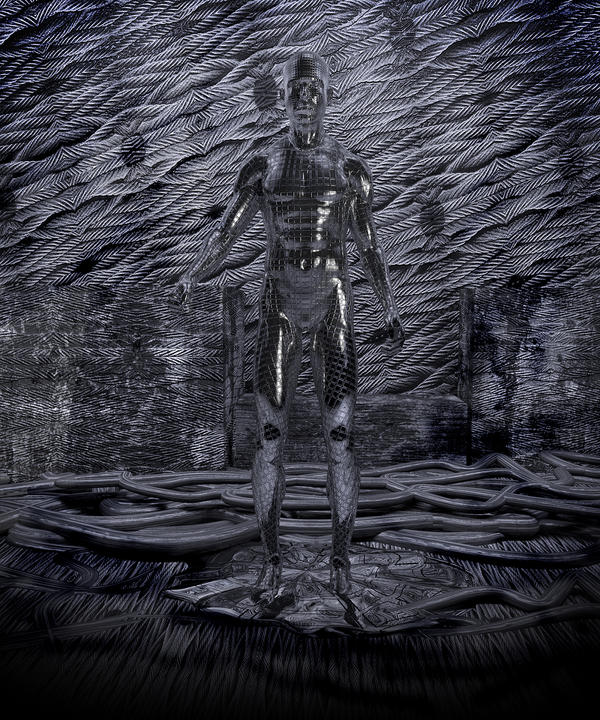
Roger Atkins brain-model of himself and girl-friend Jill

When you think about someone else that person is also modelled as a collection of semantic networks representing much the same thing. I understand cognitive processes as metalanguage activities: operations over semantic networks which strengthen or weaken link-associations; add, modify or delete nodes, that kind of thing.

This is all very conventional but it does take us to the outer limit of design and theorising.
  • Where in this architecture is the sense of personal consciousness? 
  • Where is the sense of active awareness of one's environment? 
  • Where is pain and what would it even mean for such an architecture to be in pain?

There is an engineering approach to 'the hard problem'. We imagine a system which we think would (for example) be in pain and ask how it works.

First the pain sensors fire, then as a consequence the pain nodes in the 'semantic net' higher in the chain activate.  In turn, they invoke avoidant routines. In a lower level animal that directly generates activities designed to run or get away from the pain stimulus.

However in social creatures like ourselves, amenable to social coordination, this immediate reaction should be suspended because it could be in conflict with other plans generated, for example by 'duty'.

From an engineering point of view this suggests a multilevel system: a higher level neural network supervising low level systems.


This is hardly very original however, and worse, it's all cognitive.


The higher 'social' level control system is semantically rich - but it's all cognitive and affect-free

We never get insight into how emotions or experiences emerge from this kind of architecture. We always know that there's something missing.

We say to ourselves: in the end it's all neurons. Consciousness seems to be something which is not architecturally that far from the other things the brain is doing. It's easy to divert through day-dreaming or inattention, or to turn it off with anaesthesia.

From an evolutionary/phenotype point of view the conscious brain doesn't seem to be some tremendously new thing, or a new kind of thing and yet somewhere in this apparently small cortical delta, this small change in brain architecture, a whole new phenomenon somehow enters the game.

And nobody at all can figure out how that could be the case."

---

As we know, Roger Atkins went on to design Jill/AXIS - and yet still artificial self-awareness/ consciousness was not intellectually cracked. The designers nervously waited upon it as an emergent phenomenon.

Friday, March 24, 2017

My dream job: chief designer at Mind Design

Amazon link

Yesterday in a conversation with Clare the topic came up of my ideal job.

No problem.

Since reading Greg Bear's Queen of Angels (years ago), I've wanted to be Roger Atkins.

But with a better name - obviously.

---

[AXIS (Automated eXplorer of Interstellar Space) is an AI system currently orbiting planet B-2 of Alpha Centauri B. Jill is the stay-at-home duplicate. -- From pp. 128-130.]

"LitVid 21/I A Net (David Shine): "We're preparing for an interview with Roger Atkins, chief designer at Mind Design Inc. responsible for AXIS's thinker device. What questions would you like to ask of the nation's foremost designer of thinking machines? For you know of course that thinking is different from computing.

"Roger Atkins regards computers as an architect might regard bricks. He is at this moment working with his massive personal construct thinking system, which he calls Jill, after an old, that is, a former girlfriend. Part of Jill is in fact the AXIS Simulation we have been mentioning throughout this vid-week, used to model the activities of AXIS itself, which is not directly accessible.

"But there are many more parts to Jill. Jill's central mind and most of her memory and analytical peripherals are on the grounds of Mind Design Inc near Del Mar, California; Jill can access other thinkers and analytical peripherals at Mind Design Inc facilities around the world, some by satellite, most by direct optical cable connections. While we speak with Mr. Atkins, we hope also to ask a few questions of Jill.

"And we begin right now. Mr. Atkins, in the past twenty five years you have moved from the status of a contracted neural network computer designer to perhaps the most important figure in artificial intelligence research. You seem to be in an ideal position to tell us why complete, self-aware artificial intelligence has proven to be such a difficult problem."

Atkins: "First of all, my apologies, but Jill is asleep right now. Jill has been working very hard recently and deserves a rest.

"Why is artificial intelligence so difficult? I think we always knew it would be difficult. When we say artificial intelligence, of course what we mean is something that can truly imitate the human brain. We've long since had thinking systems that could far outstrip any of us in basic computation, memorizing, and for the past few decades, even in basic investigative and creative thinking, but until the design of AXIS and Jill, they were not versatile. In one way or another, these systems could not behave like human beings.

"And one important consideration was that none of these systems was truly self-aware. We believe that in time Jill, and perhaps even AXIS itself, will be capable of self-awareness. Self-awareness is the most obvious indicator of whether we have in fact created full artificial intelligence."

David Shine: "There's a joke about self-awareness ... Could you tell it to us?"

Atkins: "It's not much of a joke. No human would laugh at it. But all modern workers in artificial intelligence have installed a routine that will, so to speak, 'laugh' or perceive humor in this joke should self-awareness occur in a system."

David Shine: "And what is the joke?"

Atkins: "It's embarrassingly bad. Someday perhaps I'll change it.

   'Why did the self-aware individual look at his image in the mirror?"

David Shine: "I don't know. Why did he?"

Atkins: "'To get to the other side.'"

David Shine: "Ha."

Atkins: "See, not very funny."

David Shine: "LitVid 21 viewer Elaine Crosby, first question to Mr. Atkins please."

LVV E Crosby Chicago Crystal Brick: "Mr. Atkins, I've read your lit, and I've long admired your work, but I've always been curious. If you do awaken Jill or some other machine, what will you tell them about our world? I mean, they'll be as innocent as children. How do you explain to them why society wants to punish itself, why we're so set on lifting ourselves up by our bootstraps whatever it takes, and we don't even know where we're going?"

Atkins: "Jill is hardly innocent. Just a few minutes ago, she was examining the theory of social feedback loops, that is, checks and balances in a society. She could probably tell us more about what troubles our society than any single human scholar.

"But that's just recreation for her, in a way; unless someone comes along and specifically asks us - or rather, rents Jill - she won't provide her analysis, but it'll be stored away. I doubt that even if she did solve our problems for us, we'd listen to her"

The novel was written in 1990, twenty seven years ago. Yet the narrative on AI is completely contemporary. The 'joke' is interesting: what humour it possesses would seem to reside in its character as a weak pun. Perhaps that just shows I'm not self-aware.

At time of writing, I suspect the leading candidate for Roger Atkin's job is Andrew Ng.

Wednesday, September 02, 2015

Blowing Up The Moon


Just started reading Neal Stephenson's Seveneves. The novel starts with a bang: specifically, the Moon blows up. No one quite knows how the Moon blew up: some speculate about a primordial black hole (but we know from Greg Bear's The Forge of God that that wouldn't do it) but in the main, people refer to some unknown 'Agency' as the moving force behind the event.

The main thing is not so much that the Moon has exploded into fragments orbiting their common centre of mass, it's what will happen next. I could hardly believe it, so naturally searched the Internet for the 'Science behind Seveneves'. And came across this.
"There are many different ways in which a reader can imagine the moon blowing up—imagery of the death star annihilating Alderaan comes to mind as the most culturally ubiquitous. But Stephenson quickly establishes the hard-SciFi slant of the novel. There are no fireworks, no loud booms—the opening chapters read like historical fiction for what would actually happen if the moon was fractured into (mostly) gravitationally bound chunks by some unknown force. Chiefly, people would freak out a little bit.

An ensemble cast of characters and their reactions span the opening chapters. A character obviously modeled after Neil deGrasse Tyson, Jerome Xavier Harris (or Doob for short), is rapidly recruited to run popular science damage control—essentially, doing exactly what I would imagine Neil deGrasse Tyson doing if such an event were to happen: media appearances and public lectures explaining that the still-gravitationally-bound moon posed no danger.

In some sense, this is naively true. A common physics brain teaser is to ask what would happen if our sun were replaced by a black hole of equal mass. Barring the joke answer of “everything would probably freeze to death”, nothing much would happen. The black-sun would still be in the same place, with the same mass, thus the orbit of the earth would remain unchanged. As it’s established in the early pages of Seveneves, whatever unknown force which fractured the moon didn't send it on a direct crash-course with the earth—it just imparted enough energy to fracture it into a handful of pieces—pieces which remain in a wildly chaotic orbit around each other, but still somewhat confined to the general vicinity of the moon.

Orbital mechanics problems are notoriously tricky to solve. The so-called three-body-problem was one of the earliest problems tackled once the tools of calculus were developed by Isaac Newton in the late 1600s (a prominent character in Stephenson’s own Baroque Cycle). The problem is almost entirely explained by its title: how will three (or more) celestial bodies evolve in the night sky if you know their starting positions and velocities? Mathematicians eventually proved that there is no general analytic solution to the three-body-problem, barring a handful of special cases. The difficulty arises in the sensitivity of the problem to its initial conditions. If you don’t know exactly where the objects are and exactly how fast they’re going, your estimate can be wildly off.

Because numerical integration is really the only way to actually solve orbital mechanics problems, it’s clearly important that the chosen integration scheme be error free. Tools like Runge-Kutta and Euler integration are good, but they have technical shortfalls—they don’t manifestly conserve quantities that we know should be conserved. This sort of error is more than enough to yield completely nonsense results when trying to predict where things might be going in the night sky.

So, in one of my favorite scenes, when Doob realizes that the wildly chaotic orbits of the moonchunks might not be so harmless, and could even result in an exponentially increasing number of colliding and breaking fragments of moonstuff, I imagine that he sprinted to the nearest python terminal and coded up a symplectic integrator—an algorithm which is particularly good at orbital mechanics simulations. Whatever simulations canon-Doob did run, they soon indicated that the earth had about 2 years before the remaining moonchunks would rapidly break apart, and bombard the earth in moon-asteroids for approximately 10,000 years. This kills the planet. And everything on it.

I thought this would be nice to visualize, so I coded up a symplectic integrator and tried to see if I could reproduce what Doob calls the “White Sky” (the rapid dissolution of the moon) and the “Hard Rain” (the bombardment of the earth with asteroids). I tried to conserve mass and volume of moonchunks when they break apart and use a nearly elastic scattering model. With extremely generous assumptions, and the setting of arbitrary constants to 1 where convenient, I get something like this:


This simulation was very nearly contrived to produce an explosion of chunks in the beginning, and should be taken with a tremendous grain of salt, but hopefully it will allow you to at least suspend disbelief for the doomsday premise of the novel. The actual number of chunks and the rate at which they appear is, unsurprisingly, fairly sensitive to the initial conditions of the simulation. If nothing else, this simulation illustrates Kessler Syndrome fairly clearly—the rapid creation of dangerous debris from uncontrolled, chaotic orbits in space."
So there you have it: Stephenson was right (and/or was well advised).

A few pages in and before the disaster manifests, two feisty females on the International Space Station are discussing family matters. In a beautifully sardonic moment, we discover that one of them refers to the other's mother as 'the Maternal Organism'. Their conversation continues, punctuated with references to the morg.

My WhatsApp message to my sister this evening: "How did you find the morg today?"
"Sleepy."
What a child I can be.

---

Update (Sept 12th 2015): Seveneves is actually a terrible book: thin and excruciatingly torpid plot combined with way too much techno-dumping re: imaginary space-machines. Another misfire from Mr Stephenson. Skimmed and abandoned.

Monday, June 29, 2015

Machine intelligence will eat us - right?

Currently reading Absolution Gap (Alastair Reynolds) on the Kindle and Greg Bear's 'The Forge of God' to Clare as her book after dinner. In both cases we're dealing with implacable, malevolent machine intelligences which destroy intelligent biological life. Worry about the existential threat of future AI systems seems very trendy recently.

The Inhibitors - Alastair Reynolds' Revelation Space


Greg Bear's 'The Forge of God'

Here's the problem: to build a half-decent robot system currently needs a high-tech society of hundreds of millions of people; to build a person requires only untrained labour in a natural environment.

Everyone knows that living creatures are made up of cells (Carbon, Hydrogen, Oxygen, Nitrogen mostly). What is not commonly known is just how intricate a cell is - a tiny object capable of self-construction and self-replication. How does it do that, and how did this marvel of nano-engineering ever get started? I discussed Nick Lane's informed (and jaw-dropping) account a few weeks back.

The alleged dangers of future AIs comes about because of their faster learning, superior computational abilities and more powerful bodies. But does anyone know how to create an artificial analogue of cells with those desirable properties? I don't think so.

Absent that, our future machine overlords are going to look like a totally mechanised version of today's human societies: massive fully-automated fabs, battery factories, steel and aluminium smelters, and all the rest.

Sounds brittle and cumbersome to me - I feel sure we could take them down*.

---

* Bomb them back to the stone age and they're toast.

Wednesday, October 22, 2014

Chris Froome out of 2015 Tour de France?

The Guardian writes:
"The 2015 Tour will include only 14 kilometres of individual time trialling, on day one in the Dutch city of Utrecht. This is the smallest amount since the race was relaunched after the second world war and the first time in recent years that the race has not included a time trial in the final week.

"In a statement issued shortly after the launch of the 2015 race route on Wednesday morning, Team Sky’s Kenyan-born Briton, who crashed out of the 2014 event in the first week, said, “The team and I will have to give it some careful consideration before we make any commitments to which of the grand tours I will compete in.” The 2013 winner was not present at the launch in Paris.

"Froome added: “The Giro with its inclusion of a long TT of 60 km and tough uphill finishes will make it a well-balanced race, which suits me well. If I did the Giro I may also be able to get myself back to top shape for the Vuelta and go there with a realistic chance of aiming for the win. In the past I’ve only targeted one grand tour each season but it could be a good opportunity for me to focus seriously on two.”

"The lack of time trialling in the 2015 Tour should suit the French riders, who staged a dramatic resurgence in the 2014 race, and as if to express their hope that history is on the home nation’s side, the organisers have included a finish at Pra Loup, the resort in the southern Alps where Bernard Thévenet toppled Eddy Merckx in 1975."
This is the kind of hyper-rational analysis which you expect from Froome's cerebral persona. I imagine Bradley Wiggins is aghast: as the 2013 winner, how could you not want to participate in the greatest bike race in the world? Where is Froome's sense of the grand tradition, the honour of cycling?

I wonder whether Team Sky just took a look at the route and figured they couldn't win? Certainly without Froome (and with Wiggins essentially retired from  road racing) they have no credible candidate for a win. Perhaps the notoriously neophilic Team is itself bored with the Tour, and is restlessly seeking new challenges.

---

Not many posts at the moment as I'm tied up with various domestic matters. In-between I'm just finishing Peter Watts' Rifters trilogy and very dark, smart and techno-soapy it is, with a soupçon of grotesque horror. Greg Bear's War Dogs and Michel Faber's The Book of Strange New Things have arrived and joined the queue. I'm looking forwards etc.