Showing posts with label Review. Show all posts

Friday, October 11, 2024

“Molly” by Blake Butler


Blake Butler’s “Molly” offers an intimate, unflinchingly honest exploration of his marriage to poet Molly Brodak, focusing on the intense emotional dynamics that ultimately led to tragedy. Through the lens of psychological type we can interpret their relationship as a complex interplay of distinct personality types, emotional sensitivity, and mutual struggles with neuroticism that shaped their connection—and their undoing.

Butler's actions and introspection suggest an ISTP type: introverted, pragmatic, and detached from emotional complexity. His writing and behavior suggest a man more comfortable with immediate, physical realities than abstract emotional dialogue. When faced with emotional turbulence, an ISTP often avoids or numbs, turning to impulsive actions or self-destructive tendencies—patterns Butler himself reveals, such as his struggles with drunkenness, violence and erratic behavior. Under stress, this type tends to internalize tension and release it in bursts of frustration or withdrawal.

In contrast, Molly Brodak fits the profile of an INFP: deeply introspective, emotionally driven, and idealistic. INFPs, with their high sensitivity to emotional dissonance, crave intimate emotional connection but often retreat inward when feeling misunderstood or rejected. This can lead to cycles of idealisation and disappointment, particularly when they sense their emotional needs aren’t being met. Brodak’s history with Borderline Personality Disorder (BPD) heightened these tendencies, amplifying her vulnerability, her need for validation, her nihilism and her intense reactions to perceived emotional distance.

The relationship between an ISTP male and an INFP female, particularly when both are high in neuroticism, creates a landscape of potential conflict. While Butler may have tried to be practical and grounded in his responses, Brodak likely sought emotional depth and understanding on her own terms. This disconnect, typical of ISTP-INFP pairings, often leaves the INFP feeling emotionally unfulfilled and the ISTP overwhelmed by the perceived emotional demands. The mutual neuroticism—the heightened anxiety, sensitivity, and reactivity—only added layers of complexity, creating a spiralling environment where emotional wounds festered rather than healed.

Butler’s memoir is filled with moments where their emotional worlds collided. His pragmatic, sometimes detached approach to life contrasted sharply with Brodak’s emotional intensity. As she struggled with her internal pain, seeking emotional resonance and reassurance, Butler grappled with his own inability to offer the depth of connection she needed.

Ultimately, the tragedy of their relationship lies in the very dynamics that sustained it. They loved each other deeply, but their emotional worlds—though intersecting—were not fully compatible. Brodak’s tragic death by suicide reflects the deep and often insurmountable chasm that can exist between partners who struggle not only with their individual mental health but also with the way their personalities clash in times of crisis.

Blake Butler’s “Molly” is not just a memoir of love and loss—it is a study of the complexities of human connection, and the emotional dynamics that bind people together or tear them apart. For those who walk the fine line between love and mental illness, Butler’s raw portrayal of his marriage reminds us that even the deepest love cannot always transcend internal pain.


Written with the assistance of ChatGPT.

Monday, May 23, 2016

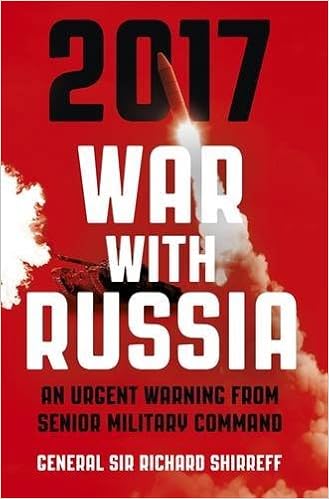
2017 War With Russia: An urgent warning from senior military command

Amazon link

Like David Cameron, I was once in my school's Combined Cadet Force. I have read books on military affairs and profess an interest. I wonder how General Sir Richard Shirreff would rate my abilities to come up with an effective British Army battle plan from my armchair?

I guess the literary world had a similar expectation as regards the bluff man-of-action's first novel. And they have not been disappointed: our troops are battle-hardened, hawk-faced, athletic-looking types who get up at 4 am to run ten miles before hitting their offices; the Russian President is pale with bloodless face, oval eyes cold and menacing, and with a voice 'slightly high-pitched and nasal'.

The American President, one year from time of writing, is a curious Clinton-Trump hybrid, the female CEO. Here is how one of the minor characters, aide Bear sees her:
"Standing up with all the others as she entered, Bear felt an almost physical sense of the power she gave off. The graver this crisis became, the more assured became her leadership.

"I know how lonely command in war can be, he thought. But, dammit, she’s just thriving on it. What was the saying? Cometh the hour, cometh the man? This time it was firmly cometh the woman ... and what a woman.

"With the President seated, MacWhite, the tall, lean former Special Forces general, who looked as if he’d be more at home riding the range somewhere out West than inside the Washington beltway, led the President through the agenda."
Enough: put aside the hyper-stereotyped characters, the pedestrian plotting and the over-acronymed prose. We are not reading the new Tom Clancy; we want to know what's wrong with our defence posture.

In this novelised scenario, the Russians, suffering from empire-withdrawal-syndrome and a realisation that their new borders have left large populations of co-ethnics in the Ukraine, the Baltic States and East Poland, decide to restore their kinfolk to the embrace of Mother Russia.

An invasion of East Ukraine delivers a land-route to the Crimea, followed by an assault on NATO member-states Estonia, Latvia and Lithuania. NATO is paralysed by the inability of its 28 members to agree on anything, the bureaucratic pacifism of the Germans and the openly pro-Russian sympathies of Hungary and Greece. In any event, it has no real military capacity anyway - years of underfunding and neglect have totally hollowed it out.

It's almost game-over, but the Russians make mistakes. They destroy British and German ships anchored in a Latvian port and kill forward-based American soldiers in the battle.

The rest of the story recounts events as America mans up ('that new president'), the Europeans find a new unity and the NATO military come up with a cunning plan. And thankfully, the romantic storyline is kept to a minimum and there is no sex.

Does the plot work as presented? Not a chance: unacceptable risks of nuclear armageddon, way too much reliance on cyber-stuff (which would almost certainly go wrong) while the Russians are portrayed as far too unimaginative.

I suspect that General Shirreff doesn't care much about this criticism either. He really isn't here to write a crafted thriller. His true point is that Europe has essentially blundered into disarmed pacifism and this has to be fixed - so what of that argument?

I don't doubt for a second the detailed picture he paints of European political-elite pacifism, Russia-accommodationism and generalised Euro-incompetence. His picture of the Russian leadership looked a bit too paranoid, emotional and cold-war-ish .. but a little reading around the subject seemed to support his view of the dangerous instability of President Putin's worldview and style of leadership. His view of Russian war aims - not to 'take Europe' but to expand Russia to its 'natural frontiers' - seemed highly plausible too.

Should we risk the nuclear destruction of Western Europe and perhaps American cities to stop this? The novel says 'yes' but in real life the political class would say no. And unless we believe that the current borders in Europe are inviolable until the heat-death of the universe, then it's unlikely that we'll risk armaggeddon for adjustments which, in the end, many will think not without some natural foundation. If the Russians play their cards right.

The critical learning experience is on page 285. Kydd, the new Chief of Defence Staff, is briefing the post-Cameron Prime Minister, Oliver Little, on the relationship between strong conventional forces and the strategic nuclear deterrent:
"But surely, even if we're outmatched conventionally, we've still got Trident?"

"OK, Prime Minister,' sighed Kydd, let me take you through this from first principles. You ask what the Russians will do and I'll repeat. They'll do what they've done at the end of every snap exercise they've called recently. Launch an Iskander tactical nuke as what they call a de-escalatory measure to stop us dead in our tracks and stop us counter-attacking?"

"Hardly sounds to me like de-escalation. Surely them firing a nuke will lead to all-out nuclear war?" asked Little.

"That's precisely the point, Prime Minister. It's counter-intuitive . . . the President knows that there's no way you are going to risk the destruction of human life in the UK by launching a Trident at Russia in response to his tactical nuke when, by so doing, you can almost guarantee a retaliatory strike from an intercontinental ballistic missile in return."

"So, how should we respond? We just have to take it on the chin?"

"Sadly, with the state of our Armed Forces as they are today .. Yes. That would be my advice. Plenty of people told the last government that to be effective, deterrence needs to be matched at every level, conventional and nuclear. As I've just explained, you can't weaken conventional forces and expect Trident alone to protect you. Conversely, if we did have strong conventional forces, but no Trident, they could easily defeat us by threatening to nuke us and we would have no way of deterring them."
This argument is exactly right, but contra the book, NATO is not going into a hot war with Russia over the latter's border accommodations. The trouble is, in the present state of disarray, NATO couldn't get into a hot war with any prepared state over anything; not a good place to be when negotiating with potential adversaries such as Russia and China.

Absent a clear and present danger, none of these Cassandra-like warnings are going to make the slightest difference. So expect more dangerous brinkmanship in the years to come.

--

The Iskander ballistic missile can carry a nuclear warhead up to 50 kilotons. Warheads with one third of that yield were dropped on two Japanese cities in 1945.

Wednesday, May 04, 2016

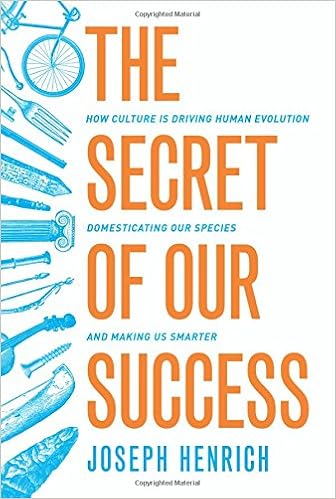
"The Secret of our Success" - Joseph Henrich

Luke tells us that "there is rejoicing in the presence of the angels of God over one repentant sinner."

There is similar rejoicing in heaven over anthropologists who embrace gene-culture coevolution. The late Henry Harpending was the paradigmatic example while Joseph Henrich, by contrast, has only made it part of the way.


That being said, the stellar reviews of "The Secret of our Success" correctly identify the good parts of Henrich's new book. We are cultural beings to the core and without the wisdom of our societies our big brains and high IQs are as nothing. Henrich's paradigmatic example is well described in this review from Joe Brewer:
"HMS Erebus and HMS Terror .. left port in June 1845 from the British Isles under the command of Sir John Franklin in search of a Northwest Passage that could energize trade by connecting western Europe to East Asia. They were outfitted with two field tested ice-breaker vessels equipped with state-of-the-art steam engines, retractable screw propellers, and detachable rudders. They also had five years of provisions and were prepared to deal with the harsh winter in the Arctic Ocean. And yet, even with all of these things going for them, the crew was forced to abandon ship in their second year and move onto King Williams Island—where they became fragmented into small groups and forced to the point of cannibalism before all dying eventually.

"The crew was in an area where Inuits had lived for thousands of years, some of whom came into contact with the shipwrecked crew during the time they were stranded there. It was a harsh environment where the locals had amassed a repertoire of knowledge about how to build kayaks and igloos, hunt sea animals for food, and scavenge for plants during the brief warm spells of summer. Unfortunately for the British explorers, this body of cultural knowledge was not available to them and they suffered the consequences."
Henrich has many similar anecdotes about the adaptations which enabled humans - uniquely amongst primates - to develop, share and propagate a collective culture, something we understand in business when we say that 'good processes get excellent performance from average people'.

Still, there are things not to like. The book is too long: after a promising start it becomes a long-winded sprawl, obscuring the big picture.

Henrich has not internalised modern thinking in genetics, particularly population genetics; his underlying mental framework is still at heart blank-slatism. He doesn't understand the genetics of racial differentiation (cf Greg Cochran's post "Such a thing"); he thinks humankind is still evolving into more effective cultural animals (where's the evidence for selection for that?); and many of his assertions - the reasons for the menopause, for example - are far less settled than he suggests.

The book, despite its flaws, is well worth reading as an antidote to Dawkins-style evolutionary individualism. Ironically it's by far the best account of what a theory of memes would actually look like. But its approach to genetics makes one wince.

Monday, April 11, 2016

"The Seven Pillars of Statistical Wisdom" by Stephen M. Stigler

A review of: "The Seven Pillars of Statistical Wisdom" by Stephen M. Stigler.


Every student of an abstract subject like maths, physics or even philosophy is familiar with this: you are introduced to a foundational concept yet it seems pretty counterintuitive, and you can think of a number of reasons why the said concept ought to be considered problematic. Yet somehow, the textbooks are less than sympathetic.

My advice is to check the history of the under-motivated concept. The original formulations were often so much more compelling, especially when you realise precisely what problem their authors were trying to solve. Your own misgivings may well be represented in critiques by the innovator’s contemporaries.

It was the very success of later generations which led to the wholesale reconceptualisation of their subject’s foundations.

And so it is with statistics, a subject where deep ideas are often obscured by a focus on technique, and where it sometimes seems that little distinguishes a correct line of argument from an equally plausible, but fallacious, alternative.

Professor Stephen Stigler, in this determinedly historical book, starts with a concept as apparently trivial as the mean, or average, of a sequence of observations. Even this is counterintuitive as it requires discarding information, the individuality of the observations. By what right are ‘bad’ measurements to be treated in the same way as ones we think, or know, to be of higher quality? It took quite a few years for the idea to catch on.

Stigler’s second pillar, information measurement, looks at the processing of large data sets. Opinion polls have made us somewhat aware that the accuracy of the proposed mean is proportional to the square root of the number of observations, not the absolute number.

Sampling was applied to the Royal Mint in Isaac Newton’s time, to ensure that the coins they produced used the right amount of gold. In the absence of a correct theory of standard deviation, the tolerance boundaries were set way too wide. Stigler dryly notes that Newton was warden, then master of the Royal Mint from 1696 to 1727 and that on his death in that year left a sizeable fortune. “But evidently his wealth can be attributed to investments, and there is no reason to cast suspicion that he had seen the flaw in the Mint’s procedures and exploited it for personal gain.”

Later chapters deal with hypothesis testing (pillar 3); statistical processing within the dataset itself, without reference to population norms – as in Student’s t-test (pillar 4); regression to the mean - a concept which proved very hard to pin down (pillar 5); experimental design, particularly when varying multiple qualities at the same time (pillar 6); and finally pillar 7, the notion that a complicated phenomenon may be simplified by subtracting the effect of known causes, leaving a residual phenomenon to which attention may now be focused.

If you are both interested and well-versed in statistics, you will find this book illuminating and witty. The converse also applies.

Thursday, March 03, 2016

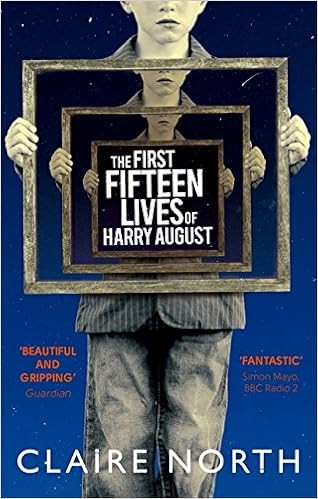
"The First Fifteen Lives of Harry August" - Claire North

I'm currently reading "The First Fifteen Lives of Harry August" by Claire North to my wife as her after-dinner treat.


[Update (March 15th 2016): after 11 readings I've abandoned this book. The plot is slow and uninvolving; the characters insipid and hard to engage with. At fast reading speed this is tolerable but when reading aloud, it's just too difficult to care.]


Here's what The Guardian had to say about it:
"From first line to beautiful denouement, Claire North's The First Fifteen Lives of Harry August  is a gripping read that is often quietly profound, emotionally affecting and intellectually dizzying.

"Harry August is fated to live his life again and again, a kind of identical reincarnation, born to the same parents, in the same body, but with memories of his previous lives intact. As he lies dying at the end of his 11th life he is visited by a seven-year-old girl with a message from thousands of years in the future that he must deliver to the Cronus Club: "The world is ending."

"The members of the Cronus Club are, like Harry, men and women who live their lives over and over. When, in his next incarnation, Harry duly delivers the message, he is told that there is no hope of effecting change. What follows is Harry's investigations into the eventual apocalypse, and his fateful involvement with his friend Victor, a "fellow traveller" intent on accelerating the world's technological progress for his own ends …

"As might be expected from such a narrative, the novel is an examination of determinism and free will, but also a subtle study of friendship, love and the fluid complexity of existence."
Claire North is the pseudonym of Catherine Webb, a prolific and acclaimed author. The book is well-written though I'd probably give it four stars on Amazon; the text sometimes strays too far into clunky exposition but the characterisation and plot development is not without interest.

This is probably speculative fiction rather than science-fiction: the difference being subtle and maybe even tendentious (literary types don't write SF, even when you think that's exactly what they're doing). Speculative fiction is not written from within a scientific or engineering culture.

I have taken to recording my half-hour readings - yes, I'm compiling a de-facto audiobook, full of clinking coffee cups, unwanted phone interruptions and random audience reaction. The folder is on my Google Drive and can be accessed here .. if you fancy being read to, very badly (format is mp3 and m4a). Eight instalments exist as I write; I'm about 25% through. More to come. (But now stopped - see update above).

Tech note: I found NCH's Switch and WavePad very useful (free download) for audio format conversion and audio-level boosting. Thanks NCH.

---

Google recently released an uploader program to transfer all your hard drive photos onto the Google Photos cloud. Choose the option where this doesn't come off your free allowance. I have something like 15,000 pictures and videos assembled over the decades, and more than 24 hours later, it's still uploading the last 649.

The results are arranged on a timeline, and transform Google Photos into a super photo album on a tablet: I'm really impressed. I hope that Google gets moving on adding image search tools - I'd like to tag a photo for a person or place (or any number of attributes or properties) and then search my whole, way-too-large-to-manage dataset.

The picture below, of the person read to each evening, emerged without AI assistance.


Unusually cheerful for first thing in the morning - a campsite in the Dordogne 2012

Who knows how much gold is buried in my back-catalogue?

Wednesday, February 03, 2016

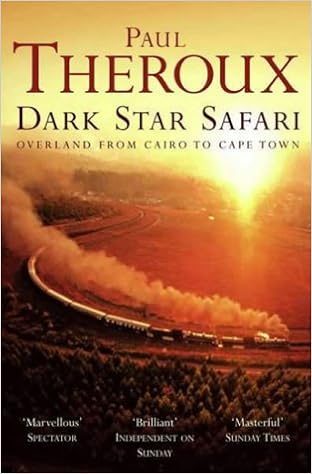
"Dark Star Safari" - Paul Theroux


Somewhere in "Dark Star Safari" Paul Theroux writes "How nice it would be, I thought, if someone reading the narrative of my African trip felt ... it was the next best thing to being there, or even better - because reading about being shot at and poisoned and insulted was in general less upsetting than the real thing" (p. 406).

Here is what the New York Times had to say back in 2003.
''Dark Star Safari,'' his latest travel book, charts the author's arduous journey through Africa, from Cairo to Cape Town, by truck, bus, ferry, train and bush taxi. Theroux sets out ''hoping for the picturesque,'' and at first finds plenty of it. The pyramids of Sudan leave him feeling humbled and uplifted. In the walled city of Harar, a Maltese nun cooks him a gourmet meal and beguiles him with tales of the lover she left for God. An Ethiopian, once a political prisoner, recounts how in his cell he translated ''Gone With the Wind'' on tiny sheets of cigarette-pack foil -- 3,000 in all -- and later published the translation.

Soon, however, the trip becomes a nightmare. Danger dogs Theroux at every turn, from armed Somali highwaymen in Kenya to land mines in Mozambique. Beggars importune, disease and squalor press in. A man with a runny nose sells oranges, ''handing the snot-smeared fruit to customers.'' Appalled by ''the filth, the dirt, the litter,'' beset by ''fungal infections, petty extortion, mocking lepers, dreary bedrooms, bad food, exploding bowels,'' Theroux narrates a Job-like ordeal during which he is ''abused, terrified, stranded, harassed, cheated, bitten, flooded, insulted, exhausted, robbed, lied to, browbeaten, poisoned, stunk up and starved.''
The NYT review goes on to chastise Theroux for egregious rage at the 'agents of virtue' of the aid bureaucracies and a tendency to 'go light' on the 'crimes of western imperialism'. But that's just their standard dogma; Paul Theroux is much more interesting than that.

I was interested in Paul. He sees so much, so very acutely, yet does not draw conclusions. He is a 'how does it feel?' man, not a 'why is it this way?' analyst. No wonder his sons do so well on TV.

What he feels is an affinity with the rural Africa - the order and stability, in a timeless wilderness, of tribal subsistence farming. His fanciful desire is to end his days in that Africa and lose himself in small good works, teaching and writing.

The hurried West, with its shallow diversions and pointless buzz, has imposed itself as an alien force in Africa - aid & trade - creating slum cities and atomising traditional society. The result is disrespect, endless panhandling, crime, disease and violence. Only Africans can help Africa, Paul feels, but notes that every time Africans are left to their own devices - free of their subsidised and corrupt governments - they relapse to the timeless stability of subsistence farming.

Why is this? Paul doesn't know and more importantly, doesn't care.

---

In the end I had Paul Theroux marked down as an INFP. Not very introverted - he is perfectly happy to meet people and chat with strangers (the writer's obligation) - but equally content to blend in, shabby and unobtrusive, mostly the quietist observer. Also the only way to stay safe.

I had already read his follow-up travelogue, The Last Train to Zona Verde and was convinced that if anyone really wanted to understand the likely future of Africa they need not read the fantasies of The Economist or the optimistic deceptions of politicians, it was sufficient just to absorb Paul's immersive prose.

But I was wrong: as the NYT review showed, liberal prejudice can filter just about anything.

Friday, January 15, 2016

“Why String Theory?” by Joseph Conlon (review)

Amazon link: this review is also posted there

The title suggests that Joseph Conlon’s book is a defence of string theory against its detractors; it is so much more than that.

He begins by reviewing the strengths and limitations of the Standard Model. The Standard Model is a somewhat ramshackle construction which, to the surprise of its constructors, has proven extraordinarily successful and resilient over the decades, culminating in the recent discovery of the predicted Higgs boson at the LHC. We know, however, that the Standard Model is wrong because it assumes a fixed spacetime (i.e. no gravity) - it has proved impossible to successfully quantise gravity within the framework of the Standard Model.

Conlon’s approach is historical. The first inklings of string theory came about through attempts to understand the strong nuclear force in the 1970s, where string harmonics emerged mathematically from observed scattering patterns. It later transpired that the ‘strings’ were an epiphenomenon of the correct quantum field theory – quantum chromodynamics – where the force lines did indeed tend to bunch up into strings. The glory years of QFT saw string theory relegated to a backwater.

The end of the seventies saw attempts to quantise gravity under the assumptions of supersymmetry.  It turned out that these ‘supergravity’ theories had severe problems which string theory seemed to solve in a very natural way. Suddenly people began to take notice and the string community rapidly expanded. These were the years of five different string theories, and the realisation that they were all different limits of one underlying theory – M-theory - an insight due to Ed Witten.

The author reviews quantum field theories, string theory and the AdS/CFT correspondence in his characteristically clear way. But after all this work, is there any direct experimental evidence for string theory? Chapter 7 is very short, consisting of this one sentence: ‘There is no direct experimental evidence for string theory.

Having got that out of the way, Conlon now explains how the complex and sophisticated toolkit of string theory has led to insights across physics. He discusses the use of string theory in facilitating calculations in quantum field theories in their strong coupling regime via the AdS/CFT correspondence; the modelling of heavy ion collisions; applications in mathematics (relating to ‘monstrous moonshine’); predictions of dark matter candidates such as axions; predictions of dark radiation resulting from the theory’s extra spatial dimensions; and of course the opportunity to model black hole microstates, entropy and spacetime topology changes in what is presumed to be string theory’s core competence, quantum gravity.

The author now moves on to mini-portraits of the main kinds of scientists he see in the community around him. We hear about the revolutionaries who wish to kick over the applecart (not so easy). We hear about the worker ants whose slogan is ‘Vorsprung durch Technik’ – those researchers who kick the can of science up the road with their calculations so that experimentation can progress - little chance of glory but employment prospects are good. Under ‘Stockholm or Bust’ we meet the model builders, those hoping to call nature right and get to Sweden – and those who game the system. There are the super-theorists, like Witten, members of the ‘Most Sublime Brahminate of Princeton’, and those who appreciate that ‘il faut cultiver notre jardin’ - who look for unfashionable areas which to their eyes show great promise and are able to deliver.

Conlon’s final two chapters address (in a fair and evenhanded manner) the well-known criticisms of string theory and provide rebuttals. He then explains why string theory remains so dominant in the field and hazards some guesses as to its future.

Understanding the state-of-the-art in fundamental physics is of course hard, the subject is inaccessible for most physicists let alone the broader community. Conlon writes (p. 198):
“Undergraduate physics is an unparalleled intellectual experience: it is a smorgasbord of the deepest and most powerful thoughts that have ever been thunk. You learn physics at a rate of a Nobel Prize a week, and the resulting frisson of the mind is at a level that is never experienced again. Four years takes you from Newtonian gravity through the laws of heat and energy, past Maxwell's synthesis of electromagnetism and into the laws of special and general relativity, from the basics of quantum mechanics to the Standard Model and quantum field theory. It is wonderful and magnificent.”
Sadly, beyond these well-explored paths there is the slog of the new, where progress slows to a crawl. In this book Professor Conlon has provided – as he promises in his preface - an astonishingly clear tour of modern physics. It is hard to think of a better, clearer or wittier review, and one which will be particularly useful to science undergraduates curious as to where their field is heading. School students who have done some reading around the subject (e.g. who have read books by Brian Greene) might also find this work of great value. It’s highly recommended.

Wednesday, January 13, 2016

"Acts of the Assassins" by Richard Beard

 Amazon link

So here's an interesting idea. The death of Jesus as a police procedural, updated to a twenty first century Roman Empire. Reviewer Declan Burke writes:
"Gallio is a Speculator – investigator – with the Jerusalem division of the Complex Cases Unit (CCU), an elite department of the Roman military police. The missing body is that of local mystic rabble-rouser Jesus, who was executed by crucifixion only days before. Jesus’ corpse has since gone missing from its tomb, and Gallio – who was charged with overseeing the execution, as a punishment detail for cocking up his investigation into the apparently miraculous resurrection of Lazarus only a few weeks beforehand – can’t afford to allow another stain on his career record.

"A hard-headed veteran, Gallio refuses to believe the rumours being circulated by Jesus’ disciples. “What it can’t possibly be, and what he refuses to contemplate, is died, risen, coming again.” Having witnessed Jesus’ agonies and death on the cross with his own eyes, “Gallio bans all discussion of resurrection as a potential line of enquiry,” and sets out to interrogate the disciples to get at the truth of how they managed to pull off the magnificent trick of stealing Jesus’ body away from a sealed tomb. "
...
" ... the story takes place in a contemporary setting, complete with modern weaponry, travel and attitudes towards terrorism ... a perspective that allows the reader to experience ancient history unfolding in the here-and-now (the origin of the great fire that devastated Rome is referred to as ‘Ground Zero’; Jesus’ Second Coming is taken to mean a spectacular terrorist attack at the heart of the empire).

"It’s a thrilling inventive approach, albeit one leavened by Beard’s slyly absurdist sense of humour. “Whatever the destination is,” Gallio declares as he flies to Antioch from Jerusalem via Amsterdam, “there’s always a change at Schipol.”
Beard is an unusually inventive writer who can disorientate and confuse. The Guardian notes:
"In The Cartoonist, Beard used an artificial, Oulipo-type constraint to illustrate a real-life constraint on the imagination: he wrote an entire novel set in EuroDisney, submitted the text to a libel lawyer, then rewrote the novel from beginning to end, following the lawyer’s instructions to the letter to avoid the risk of defamation. Sometimes, the games that texts are instructed to play are in deadly seriousness."
In this book there are 'continuity errors' which seemed at first to be sub-editing mistakes. The disciples are interrogated by police amidst mausoleums depicting their grisly deaths as ancient history; one surveillance scene shifts inexplicably from the middle of the night to the following evening with no explanation; why would you fly from Antioch to Jerusalem via Schiphol?

I guess if I knew what postmodern was, it wouldn't be, but I do rather draw the line at 'quantum fiction' (Mr Beard, you know who you are).

The Guardian has a good, context-setting review here (the novel appears to have been ignored by the other broadsheets). It's a page-turner, an enhanced experience if you know your New Testament and Acts of the Apostles.

I'm not sure the tricksy stuff entirely does what what I assume the author is trying for - dreamy and disorientating? - but it doesn't derail, just means you have to reflect sometimes rather than just let the narrative sweep you along.

As in many SF stories and thrillers, the narrative tilts just slightly too much to plot vs. characterisation. The main protagonists: Gallia, Valeria, Claudia and Baruch, are real people - I would have liked to have known them a little better.

Saturday, January 02, 2016

'Our Robots, Ourselves' by David Mindell: a review

Link to Amazon page here

David Mindell trained as an electronics engineer, where he worked on deep-water submersibles, and as a social scientist where his ethnomethodological studies have looked in detail at how people construct and rework social relationships to integrate new technologies. If there’s one take-home message here, it’s that people create artefacts – technologies – to solve problems, and that all such tools, even those with substantial AI in the control loop, have to operate successfully embedded within a matrix of human processes.

Mindell’s case studies include underwater crewed and remotely-controlled vehicles; advanced aviation automation and military RPVs; space systems such as Mars rovers and the ISS, and finally innovative proposed systems such as driverless cars. I read one comment on his work which argued that there could be no issue in principle with fully autonomous systems: the fact that existing ‘autonomous’ systems always sit in a loop with human specialists is simply that it hasn’t yet proven cost-effective to automate said specialists. This is to spectacularly miss the point, that all such ‘autonomous’ systems are in fact embedded within human systems; all such artefacts are tasked, their operations monitored and their results delivered into wider human systems and contexts. You can never escape the issue of the human-machine interface.

And this issue has been around for a long time. A generation ago people worried about the inscrutability of expert systems, the bafflement humans felt when a  system veered off into some unexpected course of deduction or action. Was this intended or is it a glitch? In either case, how can we humans continue to engage with the ‘rogue’ system? Mindell has many examples of autonomous subsystems (autopilots and autolanders come to mind) where the automation fails inscrutably, throwing control back to the unprepared user/driver/pilot with consequent disaster. This is the stuff of newspaper headlines.

The automation which seems to work best is augmented reality. Here the automation systems map a high-complexity environment (eg engines and system status, outside terrain) into a visualisation which makes task performance easy (eg keep the craft icon on the guidance icon as you come onto target). Here the human stays in the loop with enhanced powers.

Autonomous systems work where environmental behaviour is largely predictable and there are few (and acceptable) negative consequences to unanticipated failure modes. In military affairs, guided missiles and mines come to mind, although unintended consequences in the latter case have proven controversial. Put a putative autonomous system into an open environment with a great deal of under-constrained human interaction and unpredictable environmental variation (snow, weather, building work, crashes, diversions) and no AI system currently foreseeable can cope. The system requirement would be emulation of the full common-sense and conversational capabilities of a socialised adult human. No, we are nowhere near that point.

These seem to be good reasons to be sceptical about prospects for fully-automated driverless cars, despite their great desirability and corresponding levels of hype.  David Mindell finishes his book with a well-researched assessment of prospects for the Google car and similar automotive innovations. I can summarise by saying, don’t hold your breath.

The author has written an excellent and thought-provoking book, a welcome attempt to see beyond the limitations of a pure systems engineering approach to advanced AI automation: essential reading.

Tuesday, December 08, 2015

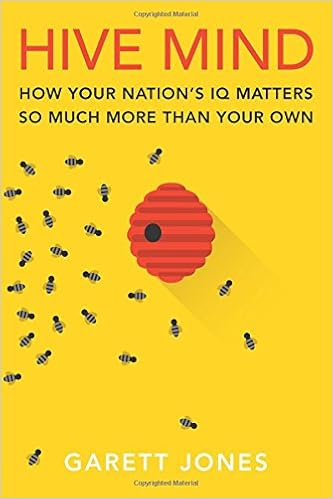
"Hive Mind" by Garett Jones: a review

Amazon link

The long, slow march of Darwinian Evolution applied to the human sciences continues. For more than a decade the work of Richard Lynn and Tatu Vanhanen on ‘IQ and the Wealth of Nations’ was ostracised and ignored; now, in Garett Jones’ new book, it is re-appraised and rehabilitated.

In 2007 James Watson was, well, ‘Watsoned’ for suggesting, "[I am] inherently gloomy about the prospect of Africa [because] all our social policies are based on the fact that their intelligence is the same as ours - whereas all the testing says not really." Since his views are validated in this book, I imagine his re-admission to public life cannot now be long delayed.

What else do we know? From genome studies and CSI police procedurals, we know that humanity exists in genetically-distinguishable ethnic groups, both within ancestral Africa and (via complex historical migrations) in the rest of the world. We know that intelligence as measured by IQ is strongly heritable (0.75). We know that the genetic component of intelligence is polygenic, and that the (thousands of) alleles positively associated with IQ are slowly being identified (the Beijing Genomics Institute is aiming to produce substantive results in the next few years).

And we expect, when we have this sequencing information, that different ethnic groups will exhibit different cognitive genotypes. It will then be clear that to elevate ethnic group (‘country’) intelligence up to (and perhaps beyond) the current East Asian level of IQ 105 is going to require DNA editing – there is a limit to how far good nutrition and iodine supplementation will take you.

Naturally Professor Jones knows all this - as does everyone else who takes the trouble to enquire. Unfortunately in the present state of public discourse, it cannot all be said without the Watsoning process re-engaging.  So in ‘Hive Mind’ Garett Jones had a tough task: to synthesise the current state-of-the-art through the lens of economics while not getting fired. The scientific constraint? Not to say or imply things which are actually untrue or gratuitously mislead in the process.

As many have observed, the book starts well. Rehabilitating the concept and utility of IQ is not new science, it’s a defence and popularisation of what every informed person already knows but of course, it’s necessary and done well. Similarly, the detailed re-examination of national/ethnic phenomenological IQ differences (mostly from Lynn and Vanhanen) is both clear and brave.

IQ is then linked with patience, propensity to collaborate and future-orientation, as Jones reviews research in psychology, political science and game theory. Applied to economics, he describes how, in complex technologies where mistakes can break the whole process (‘O-Ring technology’), there are surprising returns to pervasive intelligence. To put it crudely, high-IQ countries can do leading-edge high-tech, and low-IQ countries can’t (note that this is hardly a surprise when one observes the world).

So far so good, but now the wheels begin to come off a little. As if concerned by the consequences of his argument, Jones feels the need to signal his essential liberalism and humanity. There are long accounts of the Flynn effect to motivate speculation about increasing the IQ of poorer, more corrupt and disorganised nations (really ethnicities). Here he presents intelligence (as measured by IQ) as far more plastic and environmentally-malleable than it actually is.

Finally he plays with some oversimplified economic models to suggest that immigration from low-IQ countries is in the interests of the inhabitants of high-IQ countries (it’s plainly in their own interest - to a point). Naturally he equivocates (consequent damage to existing high-quality institutions). But he seems to ignore both the evidence from history and the increasingly-scary predictions of a hollowing-out of demand for low-and middle-skilled jobs. I’m sure he felt he had to write this but it breaks the rule: do not mislead the reader.

Perhaps in five years or ten years, it will be possible to write a well-balanced public-policy book starting from humanity as it actually is. In such a more enlightened time, a Garett Jones revision of this book would be well-worth reading.

---

Here is the list of national IQs from the book.

Greg Cochran's review - be sure to read the comments.

Slate Star Codex review - be sure to read the comments.

Friday, October 02, 2015

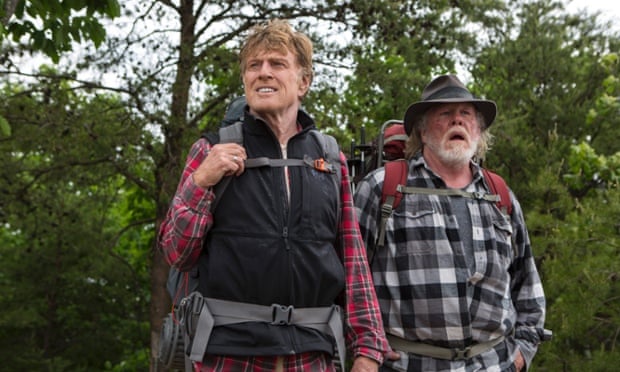
A Walk in the Woods

Robert Redford as Bill Bryson .. plus friend
From The Guardian review:
"In A Walk in the Woods, directed by Ken Kwapis and based on the popular memoir by Bill Bryson, Redford and a pal leap into the uncertainty of old age while hiking the Appalachian Trail.

Redford plays Bryson, who decides well into his career as a travel writer to walk the 1,000 miles from Maine to Georgia – a journey men half his age regularly can’t complete. Fearing for his life, his wife (played by Emma Thompson) forces him take a buddy. The only man he can recruit is a boyhood friend, Katz (Nick Nolte), who he hasn’t spoken to since the pair fell out during a similar trek years back.

Plenty of silly little incidents ensue along the way, with lots of jokes about advancing years. Most of these episodes are far too low-stakes to carry a movie and the bigger picture, about two men past their prime trying to figure out what to do in their dotage, is handled far too simply to have real impact. The result is something that is just fine. It’s pleasant enough to watch, but by no means riveting or revolutionary.

However, the footage of the two of them trudging about is fantastic, all majestic vistas and cute small towns of rural America. For his part, Redford manages to be as charming and winning as he was nearly a half-century back – which goes a long way with such slight stuff. Nolte performs well, but his voice, which sounds like it was taped next to a paper shredder in a tornado, makes for a challenging listen."
The film managed to keep my eyes on the screen and off my watch mostly, but never seemed to deliver beyond bland. I have higher hopes for The Martian which we plan to watch next week; Steve Sailer has a review which damns with faint praise.

Earlier in the day we took a stroll through the nearby Priddy Mineries - what you might call a walk beside the woods - where we topped up on vitamin D on perhaps this last day of summer.

Finally to this evening where we caught up with the Channel 4 series "Hunted": kitsch, but always interesting. With two decades as a telecoms consultant behind me, I'm thinking about the techniques used (or simulated) and wondering what other technologies (drones?) the hunters would use IRL. Clare, as befits her rebel heart, is always on the side of the fugitives ...

Wednesday, June 17, 2015

Humans (TV: Channel 4)

The 'synth' is the pretty one
From The Guardian review:
"Would you? Get one? That’s a discussion that will have been going on in the country’s living rooms during and after the first episode of Humans (Channel 4, Sunday). One meaning your own synthetic, or “synth”: a green-eyed humanoid robot.

On the plus side it will clean and iron and then cook you a nice chicken chasseur for tea, freeing you up for all the good stuff you never find time for. It might even provide some kind of companionship. Plus there are potential upgrades, including adult ones, if you know what I'm saying.

On the downside, there is a danger synths might make you, me, everyone redundant. They are already doing all the jobs people don’t really want to do, not just in the house, but street cleaning, handing out free newspapers, sex work etc (they are basically a bit like immigrants, I’m afraid). But it won’t be long before they’re doing the jobs you might want to do yourself – doctor, lawyer, politician, TV critic, footballer perhaps. The Singularity – when artificial intelligence overtakes human intelligence – isn't far off.

Also, returning to the basic domestic model, it might be a bit creepy having a machine that looks just like a person living in your house. It’s not good for the children either, it’ll mess with their heads. Plus you might be unlucky – like the Hawkins family – and get one, like Anita, that … who can think, and feel. Then things start to get really complicated.

One of the beauties of Humans is that, like Charlie Brooker’s Black Mirror, it really isn't such a big leap, or ask. Only last week there was a story about Ocado creating an army of humanoids with artificial intelligence. The online supermarket robots might not be as pretty as Gemma Chan, who plays Anita (very convincing as a semi-humanoid), but this stuff is happening. Tellingly, Humans is set not some time in the future, but some time around now. It’s sci-fi for the non sci-fi fan, sci-fi that has more than a foot in sci-fact."
Here's the video showing the state-of-the-art in anthropoid robotics, from the DARPA Robotic Challenge last week.


My best guess is that 'synths' as portrayed are 20-30 years away. And then the human race will go extinct.

Wednesday, June 03, 2015

How life got started from nothing at all

Our brains are wired to see life as something special, something fundamentally other than the rocks and stones we see in deserts, on the Moon and on Mars. Yet life is not beyond science, beyond rationality; in essence life is a special kind of chemistry, exploiting the physical properties of membranes, catalysts and energy flows. Yet it's always been hard to see how rocks and oceans on the early Earth could have produced self-replicating biochemical structures with a potential for complexity.


Nick Lane thinks he knows how it happened, written up in his new book "The Vital Question: Why is life the way it is?".

Here is part of The Telegraph's review.
"The Vital Question ... consists of four parts: an exploration of the nature of life and living; a deep dive into life's origin and the emergence of cells; an account of how complex, or eukaryotic, cells arose and why sex and death are inevitable; and a final part that entertains some predictions as to life's future possibilities.

There's a well-known saying in biology: "nothing in life makes sense except in the light of evolution". Lane might amend that to "nothing in life makes sense except in the light of energetics". The discoveries of the structure of DNA, the genetic code and all that follows have been vital in building a better understanding of life and how it changes over time. But no less important, Lane argues, is the discovery - once described as "the most counterintuitive idea in biology since Darwin" - that cross-membrane proton gradients power all living cells. This may sound like a technical detail until one considers the power it unleashes: almost incredibly, it is, per gram, a factor of 10,000 more than the sun. Further, the fact that this mechanism is conserved across all life has vital implications for its origins, constraints and possibilities.

Lane works through these implications. He hypothesises that life originated at alkaline vents at the bottom of the ocean as early as four billion years ago. Lane and his colleagues have previously published on this subject in Nature magazine. Here it is set out with compelling clarity for the general reader.

He then explores the evolution of the eukaryotic cells that form all animals, plants, fungi and algae. "I challenge you to look at one of your cells down a microscope and distinguish it from the cells of a mushroom," writes Lane. "They are practically identical. I don't live much like a mushroom so why are my cells so similar?"

The answer, he argues, has a lot to do with our shared dependence on mitochondria, tiny organelles inside each of our cells that act like batteries, and which are descended from a bacterium that was once swallowed but not consumed by an archaeon. Lane argues that this union and subsequent symbiosis was a freak event. It took place only once, giving rise to virtually every living thing we can see.

Lane concludes that complex life is likely to be rare in the universe — "There is no innate tendency in natural selection to give rise to humans or any other forms of complex life," he writes. "It is far more likely to get stuck at the bacterial level of complexity." He adds that he cannot, however, put a statistical probability on that."
I am in two minds about this book. Lane has a compelling and convincing story to tell, and what could be more important than to see how life could emerge from the inanimate through plausible stages?

But that little biochemical nanomachine called a cell is very complex, much more complex than a car engine. You do have to delve into the details of the piece-parts to engage with this subject. For people without any background in cell biology how easy is that? It's the same problem in all areas of fundamental science: understanding isn't a simple extrapolation of everyone's common sense and experience - you really do have to learn something first and to concentrate.

So I doubt that all the people who generically 'would like to know how it is that life can get started on a planet' will actually engage with and complete this book. But with some degree of persistence (and, to be fair, some background) there is no end to the revelations in Nick Lane's analysis. I was reading along while periodically muttering under my breath things like 'Wow! So that's why we age.'

So recommended for those who really do want to know: you will finish the book and the world will be a different place.

Sunday, November 02, 2014

Snippets

War Dogs by Greg Bear. First of a new trilogy. Tired rip-off of Starship Troopers lacking ideas, authorial engagement and sadly, even much action.

Love Anthony by Lisa Geneva. Her third book (remember Still Alice?). She claims this is her first proper novel. Actually it's a superficial examination of humdrum and conventional setbacks in the lives of two middle-class female literary types. Plus her somewhat clunky, sentimental and rather tedious theory of what it's like to be autistic.

Dominic Cummings' blog. Frankly self-serving account of his time as Michael Gove's spad at the Department of Education. Cummings is somewhat familiar with scientific culture: he knows some stats, a bit of quantum theory, some economics, evolution, genetics and psychometrics. Amongst politicians and civil servants this makes him the one-eyed man blah blah. Sadly, he is of the opinion that this makes people like him better candidates to rule us. Even though he states it himself, he hasn't noticed that successful political leadership is not founded on expertise in formal systems and that the political track record of brilliant academics is abysmal.

Thursday, February 13, 2014

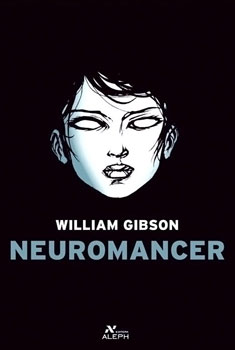
"Neuromancer" by William Gibson (1984)

That famous opening sentence: "The sky above the port was the color of television, tuned to a dead channel."

I first read "Neuromancer" a long, long time ago and remembered nothing of the intricate plot. So now I get to read it again (after a romp through Walter Jon Williams'  "Hardwired") and I guess it's the difference between gold and bronze. Gibson is original, edgy and writes scintillating text; Williams is solid, workmanlike and highly-derivative.

Here's what SF Reviews.net had to say about "Neuromancer" (excerpted) in 2007.
"That its protagonist, Case, is described as a console "cowboy" is no coincidence. Gibson is working within well-worn tropes here. Case is the classic thousand-faced hero, the loner of a million westerns who doesn't come looking for trouble even though trouble has a knack for finding him. His story, in turn, is the Hero's Journey dressed out in techno-chic. Over 20 years later, yes, Neuromancer's capacity to totally blow you away, dude, has dimmed somewhat. It is still an entertaining story to read, and one can see how Gibson's approach certainly had what it took to awaken a fairly stodgy genre from whatever publishing torpor it was in at the time.

...

"Gibson didn't invent a whole lot in Neuromancer, but his masterstroke was in the delivery. Gibson simply turned everything up to "11". The seedy, run-down landscape of the Sprawl has already become the most overused cliché in SF since warp drive. But at the time, thanks to both this book and Blade Runner, it was gloriously new and a welcome riposte to the spotless and squeaky-clean steel and glass futures, inhabited by people who apparently never so much as shed skin cells, presented in media SF like Star Trek. (During our interview, Gibson mentioned going to see Blade Runner while working on Neuromancer's early drafts and coming very close to binning the book as a result, fearing accusations of ripoffery.)

"Gibson also knew that pacing was key. The story has a forward momentum that, at least in the early chapters, allows for no indulgent digressions. Finally, Gibson's language sparkled with moments of sheer visual poetry, adding a texture to the story that made his information-age future all the more real. We'd never really had an SF author talk about "the music of the street" before, or allow us the visualization of the inner workings of a computer matrix as literal landscapes in the way Gibson did. In even the most ruthless techno-future, Gibson found the artistry within the circuitry."
Can't agree with the reviewer that its lustre has dimmed: still blew me away, dude. The visuospatial model  (here called "the Matrix" - yep, somewhat like the film) is not the current metaphor for the Internet .. but as VR improves it could be.

As someone who has dabbled in computer and network security for a living, I kept trying to bridge between malware/security-system interaction today and Gibson's physical-biological vision (ICE and sharks and dark 'n' dangerous blobby clouds and leech-like phages). Yep, it could go that way, you know.

The prequel is the short-story collection "Burning Chrome" and the next volume is "Count Zero" (the trilogy completes with "Mona Lisa Overdrive").


And Molly? I can see why he'd be attracted to her.

Tuesday, January 21, 2014

"The Light of Other Days" - Arthur C. Clarke and Stephen Baxter (2000)

Just finished "The Light of Other Days" by Arthur C. Clarke and Stephen Baxter, first published in April 2000. Here's the review at The SF Site by Steven H. Silver.
"The Light of Other Days" was the title of a classic short story by Bob Shaw, one of the lesser known stars of science fiction. One of science fiction's biggest stars, Arthur C. Clarke, and one of its rising talents, Stephen Baxter, have combined forces to pay tribute to Shaw with their collaborative novel of the same title. One of the features of the Shaw story was the idea of "slow glass," which would transmit light so slowly that it could be used to view the past. The comparative device in the Clarke & Baxter novel is wormhole technology.

"Hiram Patterson, a latter-day Ted Turner/Bill Gates, has found a use for wormholes to broadcast news as it happens from remote locations without the time and expense of transporting a live reporter and camera crew.

"He can create a temporary wormhole, point a camera through it, and capture the images from a home office, no matter where it is located. Patterson's development team, headed by his son, David, continues to push the boundaries of this new technology while Clarke and Baxter begin to examine its social aspects.

"The spread of wormhole technology seems to be based on the internet. Like the internet, it spreads rapidly and reasonably inexpensively. There can be no interaction between the viewer and the subject of their spying. Most importantly, it completely alters the fabric of society and brings the world even closer together.

"The changes to society are continuous, especially since what can be done with wormhole technology and its cost keeps changing. Used to spy on individuals, particularly once the ability to look into the past is discovered, wormhole technology supplants the internet as the primary time-waster.

"People can now not only discover what their neighbours are doing at the moment, they can also see what their neighbours were doing at any time. Privacy has ceased to exist as anyone can spy on anyone else, at any time, without any chance of detection.

"Although there are some noble endeavours, such as the project to completely document the life of the historical Jesus, most people use the technology for more voyeuristic concerns. Given the attitude Clarke exhibited towards organized religion in such recent novels as 3001: The Final Odyssey, the irreverence paid to religion in The Light of Other Days is very understated.

"The Light of Other Days is definitely a novel of ideas. In addition to the primary concept of the wormhole, the story opens with the announcement of the discovery of an enormous asteroid, called the Wormwood, which will impact the earth in 2534, causing the destruction of all life on the planet. The knowledge of the Wormwood inflicts much of humanity with a sense of malaise, adding to the public's need for a diversion like wormhole technology. The authors have also inflicted water shortages on the world which have resulted in several water wars. Many countries have become balkanized and, perhaps the least likely situation, England has become the 52nd state of the US.

"With many interesting ideas, few of which are fully explored, and a dearth of exploration of the characters and their relationships, The Light of Other Days feels more like a work in progress than a finished novel. If the authors wanted to pay homage to Bob Shaw, producing a more complete work may have been the way to do it."
This review is spot on as regards the style of the novel: it reads to me like a very late pulp novel of the nineteen fifties and sixties - the golden age of Heinlein, Asimov and, of course, Clarke. Though by content I suspect Baxter did most of the writing - Clarke's main contribution seems to have been the overarching plot, a reprise of "Childhood's End".

Looking back fourteen years, the novel is remarkably prescient in technological terms. In the novel the dominant global corporation is called OurWorld (a version of Google) with a megalomaniac CEO called Hiram Patterson (father of main characters Bobby Patterson and David Curzon). The characters travel around in automated driverless cars and are surrounded by flying servitor-drones (the novel is set some decades in our present future).

There are some stunning set-pieces, such as where David Curzon programs the "wormcam" to follow his female ancestors back through time (via a 'mitochondrial DNA tracker') - the reader is taken on a dizzying ride across 4.5 billion years.

As with all pulp novels, dazzling sense of awe and wonder has to be set against pedestrian and unconvincing characterisation. One really has to struggle to believe the interpersonal dynamics - particularly the love interest between journalist Kate Manzoni and Bobby Patterson (Hiram Patterson's cloned son and heir apparent).

Quantum wormholes have recently become all the rage too, now linked by some researchers to quantum entanglement in theories of quantum gravity. I was not so impressed with the authors' model of our own physical reality as exhibiting a unique present: a boundary between a frozen block-universe past and a quantum-uncertain and mutable future. We already know that can't be right as our universe does not have a unique observer-independent present . Dr Baxter, of course, knows this consequence of special relativity.

So if you like SF from the golden age you'll enjoy this, but you are likely to share David Curzon's qualms as regards humanity's final fate.

Wikipedia entry for "The Light of Other Days"

Thursday, December 05, 2013

"Singularity Sky" - Charles Stross

Charles Stross is comically left-wing in his private writing (his blog). His novels, however, are imaginative, sophisticated deconstructions of received wisdom on both left and right .. and so to 'Singularity Sky'.

 I had a notion that this was going to be a black hole story - some orbital plot. But that's just my physics prejudice: the singularity here is that of AI and information transcendence - specifically what happens when post-singularity culture meets a rather nasty stalinist police state head-on.

 Leon Trotsky makes a lightly-disguised appearance as the domestic revolutionary leader but the heroes (Martin and Rachel) are Culture-like representatives of future-modernity. As in "Halting State", love soon blooms - I'm beginning to see a pattern here.

Wednesday, December 04, 2013

"Parasite Positive" - Scott Westerfeld

So here's a review of "Parasite Positive" by Scott Westerfeld excerpted from here:
The book follows nineteen year old Cal, as he is on the tail of Sarah, the last of his girlfriends he has infected with the parasite (while not a full blown vampire he is a carrier). Once he has caught her, he can go after his progenitor, Morgan, the girl he lost his virginity to and caught it from.

You see, Cal now works for the Night Watch, and it’s their job to keep New York safe from rabid vampires and stop the spread of the disease.

Only this is much, much bigger that just that; something even worse than an out-break of blood suckers is lurking beneath the New York streets, and secrets centuries old are about to come to the surface, and Cal is going to be right in the middle of it.

I really liked Cal as a character and his developing relationship (and cluelessness) with Lacy a trainee reporter he meets in his search for Morgan, and while this is Cal’s show in regards starring roles, the rest of the supporting cast do an admirable job in keeping the plot moving and dialogue zippy and entertaining

We also get to learn more about parasites than I could ever hope to want to know. Each chapter is intermingled with sections where Cal explains about various parasites, and their particular foibles and reasons for existence. These sections are not just there to make your skin crawl – and they most certainly will do that! – but Cal is using them to illustrate the reasons for the existence of Vampires, and why they are the good guys.

All, in all an excellent read, your skin will crawl and your blood will race, and the next time your cat looks oddly at you, you may just shudder a little!

Scott is a natural SF-thriller writer and this is perfectly pitched for the male adolescent audience (what we call 'young adult'). So having admitted that I enjoyed the book and that the pages turned perfectly adequately, let me make a couple of criticisms.

1. The setting, Manhattan, (and frequently underground Manhattan) is rather claustrophobic - even a writer of Westerfeld's talent struggles to keep yet another case of the hero being chased through dank and dark tunnels fresh and interesting.

2. More importantly, the central premise of the novel is hard to take seriously. Without too many spoilers, we are led to believe that vampirism has something to do with defending humanity against nameless horrors from the deep, barely remembered in ancient legends. The thing is, those evil things just aren't scary enough. Anything a souped-up vampire could do, a tooled up special-forces team could easily surpass. Technology trumps raw evolution.

However, if you can manage to suspend your disbelief, the story is well told and fun.

NB: there is a 'sequel' but reviews suggest that it adds little value.

Tuesday, November 12, 2013

"Gravity" - film and "Quarantine" - Jim Crace

Was there ever a 3D film like it? From Wikipedia:
"Dr. Ryan Stone is a Mission Specialist on her first space shuttle mission aboard the Space Shuttle Explorer. She is accompanied by veteran astronaut Matt Kowalski, who is commanding his final expedition. During a spacewalk to service the Hubble Space Telescope, Mission Control in Houston warns the team about a Russian missile strike on a defunct satellite, which has caused a chain reaction forming a cloud of space debris. Mission control orders that the mission be aborted."
I wonder how this film will play in Moscow?

Russian space-litter hits the ISS

The action story-arc pitches Sandra Bullock's character from one peril into another. The emotional story-line is less stunning: a conventional schmaltzy american tale of a woman who has lost her daughter and can't move on. Somehow, through her experiences on this fated mission, she'll finally come through.

You won't believe a second of it.

The space scenes are a different matter. You will be profoundly convinced that space is irredeemably hostile, and be awestruck by the bravery of astronauts shielded from myriad forms of horrible death by staggering but very frail technologies.
___

"Quarantine" by Jim Crace is a very different experience. Here's an extract from Frank Kermode's review from the NY Times.
 ''Quarantine,'' a novel-fable that offers an imaginative account of Christ's 40-day sojourn in the wilderness. Crace is far from the first to expand the original version. Mark's Gospel dealt with that test -- the watershed of Jesus' career -- in two verses: ''And immediately the Spirit driveth him into the wilderness. And he was there in the wilderness 40 days, tempted of Satan; and was with the wild beasts; and the angels ministered unto him.'' Matthew and Luke elaborated on this account, Matthew in 11 verses and Luke in 13, specifying the Devil's temptations -- to turn stone into bread, to possess glory and power, to cast himself from the pinnacle of the temple. Milton wrote his short epic, ''Paradise Regained,'' as an expansion of those expansions; his Christ is unmoved by all that Satan can throw at Him, the point being that He stands as an exemplary instance of the heroic virtue that just says no.

"Crace's Jesus seems to have no divine origin and no obvious supernatural administrations. An unlearned boy from Galilee, whose too-pious habits are deplored by His parents, He has deserted the paternal carpenter's shop and run away to the Judean wilderness in search of God. He arrives with other quarantiners, each with his or her own purpose: it might be to live 40 days in a cave, with what food and water they bring or can find, to purge guilt or be cured of cancer or barrenness. Jesus chooses the least accessible cave and means to go without food or water for the whole period. In contrast, the merchant Musa, though abandoned by other members of his caravan in what looks like a terminal sickness, lives in a fairly splendid tent with his oppressed and pregnant wife.

"Musa makes a miraculous recovery (ambiguously related to a momentary contact with Jesus). He is a greedy and lecherous crook who cheats the quarantiners, charging them rent for their cave accommodations, spotting and exploiting fake piety; yet he is aware of some special quality, some power of healing, in the Galilean. So, as in the Gospel account, it is the demons who recognize Christ for what He is when others fail to identify him.

"The wilderness setting of this story is rendered in obsessive detail: the geography and geology of the area, its birds and animals, insects and plants, its folk beliefs and superstitions. As often with Crace, there are words one needs to look up in a dictionary, and in fact there are some I can't find in any of mine. It doesn't matter; this, for the moment, is his world or continent, and this is its language. The effect is of an almost hallucinatory concentration.

"This effect is deepened by the reports of dreams and by the shadows cast over the characters and events by the original story from which the new fable derives. When Jesus dies, naked and starved, His body is prepared for burial by busy Miri, the wife of Musa, and her more contemplative friend, Marta; we may remember the sisters Mary and Martha who did the same once for Lazarus. The two women weave a birthmat on Miri's portable loom. It has, perforce, inferior wool and clashing colors, but they save it, a token of the new world of the future.

"Musa, seemingly stranded in the old world, is nevertheless vouchsafed a vague vision of a resurrected Jesus. He even refers to it without distinguishing it from the self-serving lies he tells some people he meets on the road: ''There was a man who had defeated death. . . . 'Be well,' he told me. And I am well.' '' As always with Musa, a faint, visionary knowledge has to live in a context of lies and deceptions. He will ''trade the word'' and ''preach the good news.'' He will make a good thing of it. Incorrigibly corrupt, Musa's is the unregenerate spirit that survives even the most virtuous and spiritual of revolutions, even the touch of the supernatural. Yet this rapist, bully and swindler alone recognizes a healer who will later argue that it is just such people He has come to heal."
Crace's novel is marked by the intense realism of his characters: Musa is sociopathic while the Greek, Shim, is an intellectual whose intellect has no answer to Musa's bullying, visceral intimidation. Shim's attempts to self-justify his many appeasements of Musa ("I never wanted that anyway") are classic.

The tribes of Roman Judea were clans: pastoralists with their well-known 'honour culture' where any insult is met by ferocious clan retaliation. This tends to select for macho males, comfortable with aggression. In such a physical force hierarchy women are often mistreated - I don't believe Crace considered this explicitly but his feel for the culture makes it manifest. Northern European societies which are more atomised (nuclear families, a concept of citizenship) can be more transactional, with less interpersonal aggression and more mutual respect. Nicer to live in for sure.

Tuesday, October 29, 2013

'Ender's Game' - (film)

The film of Orson Scott Card's 1985 novel 'Ender's Game' has been advertised and reviewed as 'Harry Potter meets Star Wars'. As much as the anachronism offends,  the comparison does work up to a point.

Card invested much of himself in his large novel which presents sophisticated battle tactics, subtle human relationships and a dialogue between a 'physical force kill the enemy' view of war and the softer approach of winning your enemy to be your friend. The novel never pretends to have a final right answer.

Doing all of this in 114 minutes was always going to be a stretch. The film feels rushed and doesn't give itself time to explore the emotional dilemmas and personal development core to the story, while the obligate space-battles and planet-demolition seem passe no matter how well rendered.

With too little time the director resorts to tell not show: the result is competent enough but too superficial for the viewer to care about characters or issues. I'd say three stars out of five.

---

Walking back through central Reading with Alex at 11.15 pm is an 'edgy' experience. There are far too many guys with shabby clothes and slurred voices who are way too keen to be your friend ...