Showing posts with label Interview. Show all posts

Monday, March 23, 2026

A Conversation with Cardinal Newman - (ChatGPT)


Faith, Reason, and the Shape of Catholic Life: A Conversation with Cardinal Newman (1801–1890)

Cardinal Newman was recently appointed a Doctor of the Church by Pope Leo. What follows is a constructed dialogue with Cardinal John Henry Newman, Doctor of the Church, drawn from his corpus and worldview by ChatGPT. 

The aim is to reflect his thought, not as dead letters, but as a living voice speaking into our age.


Question: Cardinal, if you were subjected to the modern personality test known as the MBTI, what type would you be?

Newman: Were I forced into such fashionable typologies, I should be judged, no doubt, an INFJ. Introverted, certainly, my mind always turned inward, away from noise and toward the contemplative. Intuitive, I sought meaning behind the veil, not the veil itself. Feeling, yes, though mistaken by some as austere, my faith was ever rooted in conscience, not calculation. And Judging, my life was ordered by obedience to a moral vision which admitted no indulgence to fashionable drift. But let us not mistake psychological classification for the mystery of personhood. God calls us by name, not by code.

Question: Would you agree that Christianity, and indeed all religion, is not empirically falsifiable?

Newman: I would. Christianity is not a scientific theory to be verified by experiment. It is a divine summons, an invitation into the mystery of being and grace. Its truths are not equations, but encounters. The Resurrection is not a laboratory event, but a transformative rupture in history, the axis around which time bends. God does not submit to dissection. He calls to the soul.

Still, I would not offer Christianity to the world as an escape from reason. The Gospels are rooted in time, not myth. Our Lord was not a metaphor, but a man. The tomb was a place, and the Cross a beam of wood. Christianity is not falsifiable like chemistry, but neither is it irrational. It is supra-rational: a truth discerned by the whole man, not his faculties in isolation.

Question: But if empirical evidence were discovered, let us say, extraterrestrial recordings from first-century Judea, which confirmed that Jesus was a charismatic Jewish prophet and nothing more, would this refute Catholicism?

Newman: If, by some impossible technology, it could be shown beyond all doubt that Jesus was simply a Galilean holy man, executed and buried and forgotten, then yes, Catholicism would be unmade. For we do not venerate a metaphor. The Church confesses that God became man, that He rose from the dead, that He ascended in glory. If these are fictions, then so is our hope.

But I contest the premise. No observation, however comprehensive, could penetrate the veil between event and meaning. You may record the death of Christ but you cannot measure the forgiveness He offered. You may track the stillness of His tomb but not the eruption of faith in the hearts of His disciples. The Church does not base itself on data; it testifies to revelation.

Question: Yet the claims themselves: virgin birth, resurrection, ascension, no longer appear metaphysically extraordinary. Medical science can revive the clinically dead. Artificial insemination enables virgin births. Even the Ascension: what is it, in the light of modern cosmology?

Newman: These are incisive questions. But they risk a category error. You are treating mysteries as anomalies, and the miraculous as if it competed with medical technique.

The Virgin Birth is not a biological puzzle, it signifies that salvation comes from above, not by human will. The Resurrection is not a reversal of death, it is the transfiguration of mortality. The Ascension is not a cosmic departure, but the elevation of humanity into divine communion.

You are right that Catholicism does not demand a wooden literalism. It never has. The Church interprets Scripture sacramentally, not journalistically. But she also refuses to reduce mystery to symbol. The events of our faith are real. They happened. But they do not exhaust their meaning in their happening.

Question: Could one then say, provocatively, that Jesus himself was not a Christian?

Newman: You could and you would not be wrong. Jesus did not believe in Christ. He was Christ. He was not baptised into the Church; He founded it. He did not receive the Eucharist; He gave Himself in it. In the ecclesial sense, He was not a Christian. But in His humanity: His obedience, His prayer, His abandonment to the Father, He lived the pattern to which all Christians aspire. We are not called merely to follow Jesus. We are called to be conformed to His very being.

Question: How do you assess the Church today, split between progressive and conservative wings?

Newman: The progressives love the world and long to reconcile it with the Church. They seek inclusion, warmth, compassion. These are good instincts. But they risk flattening the divine into a therapeutic ethic, reducing doctrine to mood.

The conservatives are guardians, often noble, often anxious. They cherish clarity, tradition, and order. But they risk turning the living faith into a museum exhibit, untouched, unbreathed.

The real crisis is not one of politics. It is one of imagination and sanctity. Both sides fail when they forget that the Church is not theirs to remake or preserve. She is the Body of Christ, and only holiness will renew her. We need saints, not strategies.

Question: Does it surprise you that open theological conversation is now so rare in parishes?

Newman: It does not surprise me. It grieves me.

The Church has grown afraid of her own riches. Theology has been quarantined. Clergy fear that questions will breed chaos, that thought is dangerous. But the real danger is silence. A faith that fears inquiry has already surrendered to unbelief.

The laity are not children. They are the Church. If they cannot speak of Trinity, of grace, of the Incarnation then the Body has been muzzled. Let them wrestle. Let them burn. Theology is not a threat to orthodoxy, it is its lifeblood.

Question: What, then, distinguishes a good Catholic from an upright secular humanist?

Newman: The difference is not in behaviour. It is in orientation.

The humanist does good out of conviction. The Catholic does good as a response to grace.

The humanist serves man. The Catholic serves God through man.

The humanist believes in justice. The Catholic believes in redemption.

We worship. We receive sacraments. We live in communion with Christ. Our goodness is not a project of the self, but a participation in the divine. We are not merely improving, we are being divinised.

This is not arrogance. It is gift. It is the Cross inscribed in the soul.

"To live is to change, and to be perfect is to have changed often."

Let the Church change as the oak changes from acorn to tree. Let her breathe. Let her speak. Let her trust in the Spirit, who leads not into safety, but into truth.

For the truth, once encountered, does not destroy. It sets free.


Final Question: Pope Leo has just made you a Doctor of the Church. Do you consider this an unalloyed honour and recognition of your contribution? Or do you see something deeper and more Machiavellian at work here?

Newman: Ah, here we are, at the intersection of glory and strategy, holiness and politics. You do not flatter me with sentimentality, and for that I thank you.

Now that Pope Leo XIV has seen fit to declare me Doctor Ecclesiae, I do not deny that I feel honoured. But I also feel uneasily understood. Allow me to speak plainly.

I. Yes, It Is an Honour, But One Postponed

It is no small thing to be counted among Augustine, Athanasius, Teresa, and the Little Flower. I spent my life trying to serve truth as best I could, in obscurity and amid misunderstanding. When I entered the Catholic Church, I lost friends, position, respectability... and was met, not with welcome, but with suspicion.

This title is balm to old wounds. It tells me that my conscience was not mistaken, that my insistence on doctrinal development, on the primacy of interiority, on the living heart of tradition, has not been lost.

So yes, it is an honour and I receive it gratefully, but not triumphantly. The world has little need for vindicated corpses.

II. But: What Is the Church Saying by Saying It Now?

Ah. This is your real question.

Why now? Why under this pontificate? Why in the age of division, digital triviality, moral confusion, and the rise of strange synodal impulses?

I suspect this canonisation of my thought is not merely a laurel wreath. It is also a tool.

  • To the conservatives, I am held up as a champion of orthodoxy, of authority, of obedience to Rome.
  • To the progressives, I am invoked as a forerunner of development, of ecumenism, of conscience as sovereign interiority.

They are both half-right... and therefore, both half-wrong.

This is what power often does with saints: it weaponises them.

I see in this gesture not malice, but Machiavellian tact. The Church, beset by warring factions, reaches into her treasury and pulls out a figure who can be read many ways, precisely because he resisted categorisation in his own time.

They canonise me, not because I am easy to use, but because I am hard to ignore.

III. What Matters Is Not the Title, But the Truth

If I am a Doctor, let it not be for diplomacy, but for doctrine. Let it be because I taught that doctrine grows, but never mutates; that conscience is supreme, but not solitary; that faith is a living thing, not a ledger of slogans.

If the Church listens to me, let it not be to find rhetorical cover for novelty, nor to freeze me in bronze. Let it be to reclaim depth, rigour, reverence, and intellectual courage.

So, do I accept the honour?

Yes. But I accept it with my eyes open.

And as I did in life, I now ask from beyond the grave: “What is this, and what does it mean?”

If the answer is holy, I rejoice. If it is expedient, I do not recoil. The Lord has used stranger instruments.

But in all cases, I remain, as I ever was, His servant, not the world’s mascot.

Friday, May 30, 2025

The Combined Cadet Force (CCF)


---

This is a simulation of a conversation I may have with my grandson when he (and I) are both quite a bit older than today. As I write this I wonder how much of my own childhood experiences may - in a thoroughly modernised guise - become suddenly relevant again in the next 5-10 years.


Grandson:

 "Grandfather, when you joined the CCF at Bristol Grammar School, what made you choose the army section over the navy or air force cadets?"

Grandfather:

 "I was twelve or thirteen, about your age, and obsessed with science-fiction, spaceflight and aircraft. Naturally I thought I would join the air cadet section. My father said he thought the RAF was sloppy and ill-disciplined - he was very loyal to his old WW2 corps, the REME (the Royal Electrical and Mechanical Engineers).

There was an open day in which all three branches did a kind of 'taster' session. The army did an assault course - so much more interesting than the other two. I joined the army cadets."

Grandson:

 "What was the most memorable experience you had while in the CCF?"

Grandfather:

"We were out at the Army's Yoxter Range, in Somerset, for live fire practice. We would be firing the Lee-Enfield Mk 4 .303 rifle as used by second world war infantry. This would be around 1964. The officers were our teachers, and the most senior was Captain Lewis who was a portly and rather irascible physics teacher. He wanted to demonstrate to us that even blanks were dangerous.

He put an aluminium sheet, a metal square about eight inches by eight inches onto the grass, loaded his rifle with a blank, dropped the muzzle of the rifle to the ground, pointing it at the centre of the plate. Then, in quiet and authoritative tones, he explained that the blank cartridge was tipped with some material which stopped the powder getting out, where the bullet would normally be. He said that although the material was quite soft, nevertheless it came out at supersonic speeds and it was extremely dangerous close-up.

As he was speaking, he was quietly pulling the trigger back and as he finished there was an insanely loud bang. He leant over and picked up the metal plate, which now had a large irregular hole blasted through the centre. We were sufficiently convinced!"

Grandson:

 "What was the biggest mistake you made while in the CCF?"

Grandfather:

 "A short time after I joined up there was the annual parade on the school field, where parents watched from the stands. We were all there, all the cadets, doing drill (which I was less than brilliant at).

At the end we were all in our ranks in the July sunshine, turned to face our parents and the many guests. The cadet sergeant-major shouted what I thought was 'slope arms' which I did, swinging the rifle to my right shoulder; unfortunately, I was the only one who heard that. Everyone else heard 'ground arms' and dropped their weapons so that the butt was next to their right boot.

I stood for a second, ashen-faced, and then miserably slid the rifle down to the ground. My father said afterwards that, in his heart of hearts, as soon as he saw that one lone cadet had got it so very wrong, he knew it would have to be me. My natural clumsiness - coming to the fore again!"

Grandson:

 "Can you tell me about the time you got lost in Snowdonia one arctic Easter?"

Grandfather:

 "Thankfully I was not in command, being an ordinary member of the squad led by a cadet corporal who thought he knew all about traversing snow-covered mountains in bitter weather.

 We were sent out on a three-day exercise to navigate cross-country near the Glyders in North Wales, camping in the snow during the nights. I think they hadn't expected the weather to be quite so bad.

Remember, in those days no GPS, no phones, no breathable gear. We were wearing combat jackets and trousers and carrying our tents and supplies on manpack-carriers on our backs; maps and compasses. We were led up precipitous ascents so icy and difficult that even our intrepid leader turned us back before we fell off. Then the blizzard hit, and we sought lower ground and waited out the storm in a farmer's barn.

Unfortunately, our leader neglected to call it in. The Mountain Rescue was called, it was a national news item, our parents were beside themselves. We meandered down to the nearest village the following day, completely unaware of all the fuss. I, at least, did not get the full force of the wrath which hit our leader!"

Grandson:

 "Was there ever an incident when you really annoyed one of the officers during your time in the CCF?"

Grandfather:

 "I was in the signals section. Bristol Grammar School CCF was part of a nationwide short-wave radio net of army cadet forces (call-sign 18 Bravo), and after school I would fire up our (ex-tank) transceiver and talk to fellow cadets in schools hundreds of miles away.

One such conversation went on too long after school and the teacher ordered me to stop the conversation while the other guy (at Marlborough College near Swindon) was still transmitting. This was quite a breach of radio protocol, so I kind of ignored him.

He got really angry and basically pulled the plug and sent me home. It was the beginning of the end: I left the CCF soon after."

Wednesday, April 30, 2025

The 'Lost' Art of Teenage Romance


---

A simulation of a conversation I will perhaps be having in less than a decade: via ChatGPT.


A Grandfather, A Granddaughter, and the Lost Art of Teenage Romance

"Grandfather, since Bristol Grammar School was all boys when you attended, how did you even meet girls back then? Did you have to be very bold, or were there events where boys and girls could mix?"

A sharp question from my granddaughter, thirteen years old, newly curious about the past—not history in the dry textbook sense, but history as lived by someone she knows.

"We were very keen to meet girls," I tell her, "but there were none!"

I explain how, at fourteen, I attended a summer school fair with a group of friends, all of us determined to chat up some girls. "I knew immediately we’d have no luck as a group—packs of boys weren’t exactly irresistible. So I wandered off by myself, spotted a girl I thought was cute, and struck up a conversation. Rosalind—see, I remember her name!—must have thought I met at least her minimal requirements because we spent the afternoon walking together. My friends saw us, and they were so envious!"

"That sounds really sweet, Grandfather! And also very brave—you just walked up to her and started talking? I’d be so nervous! What did you say to start the conversation, and how did you know she was interested in talking to you too?"

"Sadly, it's all lost in the mists of time," I admit. "I had no experience at all in these matters—no films, no books or magazines on the subject, no internet or mobile phones. I think I was just a bit self-confident and under the illusion I had charm! Rosalind must have thought I was at least passable. But it didn’t last."

"Since you and your friends were all figuring things out without movies, books, or the internet to guide you, did you ever give each other advice about dating, or was it more of an every-man-for-himself situation?"

"We never talked seriously about it. I think boys didn't then—maybe they do today? Instead, we had a jokey ‘star system’ to boast about how far we’d gotten with a girlfriend. ‘One star’ was holding hands, ‘two stars’ was a kiss, and so on. It was all very innocent, and I never believed a word of it. We were all totally naïve and inexperienced."

"That’s really funny, Grandfather! I can imagine a group of boys trying to one-up each other, even if no one really knew what they were doing. Since you were all so inexperienced, did you ever have any really awkward or embarrassing moments when trying to impress a girl?"

"Always! We didn’t know the language of romantic interactions at all. We didn’t know how to behave at discos, how to talk to a girl-stranger. In the end, I think what worked was just to go with your instincts—don’t overthink it!—and be very attentive to the messages the girl was sending you, if any! You could usually tell, after dancing with a girl you’d just asked, whether there was any sparkle there. Then you’d offer to buy her a drink—probably a soft drink at that age!"

"That makes a lot of sense, Grandfather! It sounds like instincts and paying attention were more important than having a perfect plan. Was there ever a time when you completely misread a girl’s signals and ended up in an embarrassing situation?"

"Yes, but I have an acute sensitivity to embarrassment and would back off with apologies pretty rapidly. I was usually rather cautious in my interactions, and that tended to save me from stupidity. Not everyone was so circumspect, so don’t take me as typical!"

"Did you ever see one of your friends make a complete fool of himself while trying to impress a girl?"

"There are always buffoons around, complete show-offs. The girls laugh behind their hands and giggle with their friends. My friends were not people like that, thankfully!"

"Looking back now," my granddaughter asks, sensing we’re nearing the end, "do you think teenage romance in the 1960s was sweeter and more exciting because it was all so new and unstructured, or do you think young people today have it easier with all the ways they can meet and talk to each other?"

"Good question! If we'd been at a mixed school, my social life would have been completely different—I can't even imagine it. I read a lot about the terrible state of boy-girl relationships these days, but maybe most of the time I imagine it still works. A little empathy, consideration, and common sense go a long, long way. I wish you luck with the boys you meet, and I hope you choose well."

She smiles. "Thank you, Grandfather. That’s really good advice. And I think it’s really cool hearing about how things were for you—it makes me realize that even though times change, people don’t really change that much."

Maybe next time, she’ll ask about my first date. But for now, I’m happy she just asked at all.

Monday, February 24, 2025

My Favourite Science-Fiction Authors

---

ChatGPT:
In your teens you were a fan of Isaac Asimov's Foundation series, Robert Heinlein's adventure SF novels, and Arthur C. Clarke's technical near-future fiction. None of these authors now feature on your favorite list—why is that?

Nigel:
When I returned to these authors, as an adult, I found Asimov's characterisation shallow and his style pedestrian—tedious, in fact.

Heinlein’s Starship Troopers stands out as a kind of masterclass in civics and moral coming-of-age, but most of his other stories are drowned in hedonistic self-indulgence.

As for Clarke, his engineering bias hasn’t aged well, and once again his characterisations are virtually non-existent.

These days, I want more from my fiction.


ChatGPT:
Your critique clearly shows that you demand more depth—both in characterisation and in thematic exploration—than what you found in those earlier works. Shifting focus to your current favorites: Which among them best fills that gap? Take Iain M. Banks’ Culture series, for instance. What resonates with you about it, and can you pinpoint a moment or aspect in Banks’ writing that you find transformative compared to the cold technicality or self-indulgent hedonism you disliked before?

Nigel:
After his death, I genuinely thought for some years that Banks would quickly be forgotten and be unread. His plot development is dense, complex, and often unmemorable; the quality of his Culture novels is quite uneven.

Over the last couple of years, however, I’ve reconsidered. I now see more clearly how many deep issues his thinking encompassed, and how the vast canvas of space opera allowed him to explore profound philosophical and moral dilemmas through vast splurges of baroque text.

Banks was very smart and expected the same of his readers—you never come to believe, as you read, that you're out-thinking him. On the downside, I don’t think there are many sharply, deeply delineated characters in his work. Even Diziet Sma only takes you so far.


ChatGPT:
Interesting. Moving on to Greg Bear, you’ve admired his work as well. Do you think he strikes a better balance between scientific rigor and emotional engagement? Are there particular works—say, Eon or Queen of Angels—that exemplify his strengths? How do you feel his narrative style has evolved over time?

Nigel:
I don’t think that’s the spectrum by which Bear’s work should be judged.

Like most ideas-based SF, his writing is rather matter-of-fact. It doesn’t elevate the heart-rate or engage the emotions much—except for the intellectual sense of awe it inspires. Bear tells an awe-inspiring story, and he’s one of the best at expanding that vast canvas of futurity which simply blows the mind away, whatever topic he’s dealing with.

I always felt he was working through a standard list of subjects—the General Relativity novel, the Quantum Mechanics novel, the Bio-Engineering novel, and so on. He generally made superlative tech-thrillers out of nearly all of them: his work is brimming with ideas, worked out in exquisite detail, which holds your attention.

But once again, memorable characters and inner lives are not his strong suit.


ChatGPT:
That’s a clear-eyed assessment. Let’s talk about Richard K. Morgan next. His work is known for a gritty, uncompromising vision of the future, filled with realpolitik, double-crosses, and a jolt of raw sex and violence. What aspects of his style or thematic focus do you think best capture the contemporary zeitgeist? How do his narratives, especially in the development of his antihero Takeshi Kovacs, address or subvert traditional dystopian tropes?

Nigel:
Morgan’s worldview is fairly standard: evil corporations, corrupt institutions and governments, and oppressive religions. His schtick is realpolitik—cynical about motives and fully aware that superior physical force generally wins the day. His plots are packed with double-crosses, deception, and betrayal—ingredients that make for an engrossing thriller.

Additionally, Morgan is a disinhibited writer. His sex and violence are described in prose that leaves little to the imagination and knows few boundaries—the reader is invariably jolted.

What I appreciate most about Morgan’s writing, though, is the way he handles the personal development of his antihero, Takeshi Kovacs. For a long time, we’re led to believe this super-warrior, this Envoy, is criminally-minded, brutal, self-serving, and utterly nihilistic. And yet, we eventually discover (spoiler alert!) that this is really just a carefully constructed facade.


ChatGPT:
Now let’s move on to Charles Stross. You’ve highlighted him as presenting a curious paradox. Can you explain what distinguishes his approach for you? Specifically, does his handling of political intrigue and economic themes offer a satisfying contrast to the baroque expansiveness of Banks or the gritty realism of Morgan? What is it about his narrative pace or style that makes his work stand out?

Nigel:
Charles Stross presents a curious paradox. As an individual, he comes across—much like Peter Watts—as an extremely militant, bleeding-heart liberal. In his published talks at conventions, his every utterance is steeped in moral outrage and preachy, self-righteous vitriol.

And yet, when he sits down in the quiet of his study and applies his economic, political, and technical knowledge to develop speculative scenarios with plausible issues and plots, he is simply superlative. He can write sympathetic, rounded characters, and his very artistic, emotional temperament imbues his writing with the necessary literary fire.

He writes what he cares about, and you know it—it isn’t just an intellectual exercise, which would be utterly boring.


Wednesday, January 15, 2025

The Wickedest Man in the World


---

The Wickedest Man in the World

Aleister Crowley, born in 1875, was dubbed "the wickedest man in the world" by his detractors, Crowley was a poet, occultist, mountaineer, and self-styled prophet of the new age of Thelema. Raised in a strict Plymouth Brethren household, he rebelled against the narrow confines of Victorian morality. 

His magnum opus, The Book of the Law, introduced the world to Thelema, (Greek for 'Will'), encapsulated in its famous maxim: "Do what thou wilt shall be the whole of the Law". While often denounced as a call to unbridled hedonism or anarchy, Crowley envisioned Thelema as a path to discovering and aligning with one’s "True Will" - your unique spiritual destiny. He also dabbled in ceremonial magic, mysticism, and esotericism.

His life was fraught with financial troubles, accusations of immorality; personal conflicts dogged him until his death in 1947. Was he a genius, a charlatan, or something in between?

Let’s ask him.


The Interview

Me: Jimmy Page, the founder, animating spirit and lead guitarist of Led Zeppelin idolised you. Perhaps this led to his descent into the madness of drug addiction, paranoia, isolation and personal disintegration while on that final American tour? I believe he might have bought one of your houses - he certainly had a collection of your works. Do you take responsibility at all for this? Personally?

Crowley: Ah, Jimmy Page - a sorcerer of strings and seeker of shadows! It flatters the ego, even in this modern incarnation, to know that my life and works have left their indelible mark upon such an artist. Indeed, he purchased Boleskine House, my former residence on the banks of Loch Ness, a place steeped in magic.

As to whether I bear responsibility for his descent into the abyss, I must remind you: "Every man and every woman is a star." Each star must navigate its own heavens or hells, guided - or misguided - by the gravitational pull of their True Will. I offered my followers no encouragement toward indulgence-in-excess or self-destruction; I merely proclaimed liberation from the shackles of moral mediocrity and blind conformity. How can you doubt I was right?

Me: "Do what thou wilt shall be the whole of the Law" is pretty stupid as a guiding principle. It's a crude Darwinian parody which entirely neglects the benefits of a society to each of its members;  a policy which, if carried out comprehensively, would destroy society utterly.

Crowley: Ah, how invigorating to be confronted with criticism! Allow me to clarify. "Do what thou wilt shall be the whole of the Law" is often misunderstood - wilfully or otherwise. The "True Will" of which I spoke is no mere license for selfish indulgence or anarchic destruction. It’s a divine purpose unique to each individual, harmonizing with the cosmic order, not disrupting it.

You invoke society - a construct of cooperation, interdependence, and mutual benefit. Precisely! The health of society depends upon individuals knowing and manifesting their True Wills, for when they do, they cease to act in conflict with themselves and others.

It isn’t my teaching that would destroy society, but the failure to understand and live in accordance with one's authentic purpose. That’s what leads to all the greed, envy, and exploitation you so fashionably excoriate.

I envision a cosmos of stars, each burning brightly in its rightful place, their combined radiance illuminating the whole. It is not the principle that is stupid, but its misapplication by those too stupid to grok it.

Me: So: Nietzsche, the Death of God and the Triumph of the Will! You issue a call to become the Übermensch, then?

Crowley: Ah, Nietzsche - the tempestuous German with whom my name is so often intertwined! Indeed, there are echoes of his thought in my own, though we are kindred spirits only up to a point. His Übermensch and my True Will share a common disdain for mediocrity and a celebration of human potential, but then our paths diverge.

Nietzsche declared the "Death of God", leaving a vacuum he filled with the self-overcoming of the Übermensch. I, on the other hand, have never declared the death of divinity but rather its diffusion.

God has not perished; God is within each of us, waiting to be awakened through the discovery and enactment of the True Will.

The Übermensch rises by sheer willpower, forging meaning in a godless universe. The adept of my Thelema rises by attuning to the cosmos, finding meaning in alignment with a pre-existing, transcendent order.

Nietzsche's Triumph of the Will is solitary, even agonistic; my True Will, while intensely individual, is harmonious and integrative. Become a star! A radiant, unique presence in the universe! Not by crushing others underfoot but by shining in one’s rightful orbit. Nietzsche’s vision may intoxicate; mine illuminates!

Me: Metaphors; always metaphors with you. What should a true devotee of your vision do with their life? Please tell me it's not going around brazenly shocking people like some narcissistic stand-up comedian! Tell me instead about ethics, morality...

Crowley: Ah, so you now see me as some sort of… what was it? A jester? A provocateur? How quaint! You confuse the glint of shock-jock showmanship for the fire of the soul, the shattering of idols for… well, something else.

My ethics? Simple. Know thyself. Discover thy Will. And let it be done with the fierce joy of the creator, the artist forging beauty from chaos. We love, yes, but not with the sickly sentimentality of the weak. Our love is a raging inferno, consuming all that binds. What’s not to like?

So, tell me, you who cling to your petty moralities, your fear-based dogmas… is this not a life worth living? A life of passion, of purpose, of ecstatic freedom? 

Will you, in your quivering petty-bourgeois interviewer’s soul, ever have the courage to get with the programme?

C’mon, tell me! - Do you feel plucky, punk? 


Monday, November 25, 2024

A short interview with John Fowles (via ChatGPT)


A watercolour of Clare in Lyme Regis: June 2006

The English author John Fowles (1926-2005) wrote “The Magus” (1965); “The French Lieutenant's Woman” (1969) - a Victorian-era romance with a postmodern twist that was set in Lyme Regis, Dorset, where Fowles lived for much of his life; “The Ebony Tower” (1974); “Daniel Martin” (1977); “Mantissa” (1982); and “A Maggot” (1985).

His biography: “John Fowles - A Life in Two Worlds” and his journals also aid in the reconstruction of John Fowles’s views and character.

I would add that my own favourite John Fowles novel is “Daniel Martin” which is a semi-autobiographical account of his Hollywood screenwriting years following the success of his earlier novels.

John Fowles was of the same generation as my father (1925-2009).


Me. It is said that it is difficult to be the wife of a (male) writer of literary fiction. You said somewhere that a writer is someone who doesn’t like their given reality very much, preferring the realities dreamt up within their own head. Many male writers’ thoughts naturally tend towards women and romantic/erotic encounters. You also said that, like many of your peers, you always fell in love with your female characters. Very Thomas Hardy!

And there was poor Elizabeth, your wife, doomed to hours of boredom downstairs while you were happily ensconced in your study writing thousands of words fantasising about your own ideal women, fantasies which she had to believe represented your ‘improvements’ upon her, while also stripping her of her privacy. Any comments?

---

John Fowles: Indeed, Elizabeth bore a complex burden, one that I’ve often wrestled with myself—though perhaps not enough. Writers, especially those in the throes of constructing imagined worlds and complex characters, have a rather discomfiting tendency to neglect those closest to them, especially their partners. In her case, Elizabeth's sacrifice was the quiet tolerance of being not only the wife of a man often lost in fantasy but also someone whose love and life were continually mined, unwittingly and often unwillingly, for literary material.

I once said that writing is "an attempt to reach a reality I am denied in real life.” That statement acknowledges a painful truth: writing, especially for a male writer, can be an act of escapism—a selfish indulgence into the inner worlds of fantasy, love, and erotic idealizations. Elizabeth must have seen the life we shared as something like an exhibition hall where her own privacy, her own essence, was open to my ever-hungry gaze and, by extension, the world’s.

Yes, I fell in love with many of my characters, but it was a love entwined with my own limitations—a symptom of the yearning for some idealized, unattainable aspect of femininity. It was romantic, yes, but also escapist, immature, and, in some ways, quite selfish. I was aware that there was a cruelty to this process: Elizabeth could sense that in many ways she had to compete not with flesh-and-blood women, but with figments of my own imagination. And in this way, being the wife of a male writer is rather akin to loving a man who holds a mistress in his mind, and she is all the more unattainable and alluring for being his own creation.

You mention Hardy, and I do feel that kinship; his characters, like mine, were often born of a frustrated desire to reimagine or transcend his reality. He sought out, in his female characters, not only muses but ideals to save him from his everyday limitations. But the irony, of course, is that the more you pursue that imaginative escape, the more entangled you become in the harsh realities and pains of those who live alongside you. 

Perhaps, in the end, what writers owe their partners is more than mere apology; they owe them a confrontation with reality—a willingness to relinquish the allure of imagined love and to confront the actual, flesh-and-blood work of loving another person. For me, this insight came possibly too late.

---

Me. The recently deceased English writer, Martin Amis, characterised you as an author who many thought of as highbrow, but who was in reality merely middlebrow. How would you respond to that, both as a style of criticism and as regards its accuracy or otherwise?

---

John Fowles: Ah, Amis—a writer of immense talent, though never one to shy away from the sharp barb. In his view, “middlebrow” implied a lack of true literary courage, perhaps a failure to push the boundaries of style, thought, or intellect. To him, my novels might have seemed to skirt the edge of the avant-garde but, in their structure and themes, remained too accessible, too “populist” to stand beside the more experimental works of his preferred literary pantheon. 

But to be labelled “middlebrow” is more a comment on reception than on the intentions of the author. The distinction between high and middlebrow is largely arbitrary, rooted in a hierarchical model of taste that I find unnecessarily dismissive. I did not set out to write books that would please a particular class of reader or another. Rather, I sought to explore, often at length, human freedom, existential ambiguity, and the ways in which we are caught between destiny and self-determination. 

The 'middlebrow' critique could be accurate in that I did not pursue complexity for complexity’s sake. Instead, I preferred psychological richness over linguistic experiment, felt an affinity for Victorian detail and the immersive quality of storytelling. Perhaps this made my work more digestible, but it was a deliberate choice. To make philosophical themes accessible without diluting them was always a goal, and it does not—at least in my estimation—diminish the ambition of my work.

I also believe there’s an intellectual laziness in these hierarchical labels, which reduce a book’s essence to some vague metric of “difficulty” or “literary sophistication”. Amis, for all his brilliance, could be rather enamoured of self-conscious cleverness. I was interested in ideas not for show, but for their impact on my characters' lives, and through them, on my readers. In "The Magus", "The French Lieutenant’s Woman", and "Daniel Martin", I wanted to construct complex emotional landscapes where the readers could see themselves reflected, not merely a conceptual hall of mirrors.

In the end, I stand by the choices I made. If that relegates me to “middlebrow” in some circles, so be it. But let it also be acknowledged that literary merit resides as much in authenticity and psychological insight as in structural novelty.

---

Me. In Myers-Briggs terms, I have always thought of you as an INTP. There is the restless curiosity about everything, the evidence in your writing of a very rational mind, unencumbered by popular shibboleths. You disdained conventional elite society in London, preferring an arid systematising ‘career’ at Lyme Regis Museum. Finally I would note your great interest in the psychoanalytic theories of Freud and Jung.

---

John Fowles: An INTP, you say? There’s something rather satisfying in that description, and I imagine the young, solitary boy in me would have felt a touch vindicated, as well. I certainly felt that restlessness, that compulsion to pry open the familiar to peer at what lies beneath. My curiosity was not just intellectual—it was ontological, driven by a desire to challenge the very nature of reality, to peel back the layers that most accept without question. I wanted to know 'why' things were, what hidden mechanisms drove human behavior, and to unearth those subtle, sometimes uncomfortable truths that define our existence. An INTP label does ring true in this sense: rational, indeed, but also subversive, a trait that led me to feel alienated from the cliques and hierarchy of London’s literary society.

My 'career' in the Lyme Regis Museum, with its bones, fossils, and local histories, was something of an intentional retreat into a simpler, even meditative world. It was less about disdain for the elites—though I had my reservations about the performative intellectualism of the metropolis—and more about the solace I found in removing myself from the competitive and judgmental currents of that world. I have always preferred the authenticity of my own pursuits to being pulled into the expectations of others.

As for my interest in Freud and Jung, it was not only that their theories fascinated me; it was that they gave structure and language to the deep, often irrational forces that shape us. Jung’s notion of archetypes, for instance, was an idea that could play out in "The Magus" and "Daniel Martin", where the characters are propelled by unconscious forces and personal mythologies. I gravitated toward these ideas because they offered a framework within which I could better understand myself and my characters, placing our individual struggles within a broader human narrative. 

The INTP label, if nothing else, captures the desire for intellectual freedom and the impulse to remain unbound by conventions or norms. I am, in a sense, the perennial outsider, always examining and observing rather than immersing myself. But in that distance, I find clarity—a vantage point from which the contradictions and complexities of life can reveal themselves fully.

Friday, September 13, 2024

A First Interview with Adam Carlton

From OpenArt

The First Interview: Writing and Politics

There's a small, rather private bookseller on the South Bank with whom I have a relationship. Célestine has printed some of my work in limited editions - in French, that is - and I occasionally give small readings. So it was her idea to do this interview.

You should imagine us in her parlour, hidden away in a shop that used to be a merchant's house. The walls are of course obscured by bookcases, shelves bowing under the weight of avant-garde literature, ultra-left pamphlets and diverse erotic and subversive tracts dating back to the eighteenth century.

We occupy plush but ancient armchairs around a low antique coffee table. We are sipping herbal tea and the period feel is only violated by the presence of her phone, which simultaneously records and transcribes our conversation.

I think Célestine must be twice my age.

---

Q. Welcome, Adam, always good to see you. Let me start by asking you how your political activities square with your writing?

A. Ok, straight into it then! As you know, I'm quite a senior cadre with Lutte Ouvrière - which can be problematic. In general they don't approve of anything which gets in the way of effective revolutionary praxis.

Q. I believe they frown on relationships…

A. Tell me about it! Marriage is deprecated and children are a no-no. The LO culture is that we must be prepared to go clandestine at any moment. So no encumbrances!

Q. Is Adam Carlton your real name?

A. Of course not! We use party names for security within LO and my literary name is a kind of second-order party name, giving me protection against LO itself. Others also obfuscate on my behalf.

Q. You wrote short stories and then a novel. Tell me about that.

A. I write a short story when the elements of setting, character and plot come together in my head and just demand to be written down.

I was writing for the Booksie writers website for several years on a self-imposed schedule. It's good to get feedback and you feel an obligation to feed your fans. Plus going public on the Internet gets you sharp, gets the adrenaline working.

Q. But you've stopped now?

A. COVID was good for writing, of course. Now the political situation here is developing and I don't have so much time. Also, the Booksie fans I used to have seem to have disappeared. Plus it's a small and hermetic pool there.

Q. Do you want to be published?

A. Who would ever say no? But fame and fortune come with costs. It would be harder to retain my anonymity. In any case, my writing is not aligned with the zeitgeist. And there is an absolute oversupply of authors and texts. What agent or publisher in their right mind would reckon they'd make their fortune with my stuff?

And, by the way, no-one wants short stories: they don't sell.

Q. Do you honestly think you're good enough to get published?

A. It's marginal, being honest. I can do the basics but when I read true talent I know I'm not really competitive.

Q. So why write?

A. I enjoy it. It's a little piece of immortality. I bear witness. Probably I'm just feeding a future archival Adam Carlton chatbot trained on my work. It will be the modern way of gathering dust.

Q. Tell me about sex scenes. Many of your stories might be described as ‘erotica’.

A. In my earlier work I was rather explicit. Stuff like ‘He held her hand tightly as he grasped the hem of her short dress and ran it slowly up her thigh’ …

Q. Oh Adam, that's terrible!

A. Yeah, in isolation it's like pastiche but in context…? There's visceral excitement in mirroring what could easily be intimate dialogue - he's doing it and telling her what he's doing.

Q. But now you write differently?

A. Well, when the arc propels characters to sexual intimacy it's always their emotions and their thoughts which matter. Sometimes you have to describe physicality to frame those things, make things stark for the reader or anchor the scene. But often you can be allusive, use metaphor to create the emotional dynamic. That's where the focus has to be.

Q. But that also can go wrong?

A. Tell me about it! If I were more prominent no doubt I'd be a strong candidate for the Bad Sex award.

Q. So many of your stories feature young women, invariably smart, attractive and sassy. Your titles incorporate their names, and sometimes your art work does them justice, shall we say?

A. As is recommended, I write what I know. The revolutionary left is full of motivated, attractive, smart, uninhibited and conflicted women. Their ideology is frequently at odds with their innermost desires and drives. Heaven for a writer!

Q. So you write about what you see.

A. Yes. Forgive me for being coy, but yes. But I’m wary about repetition with diminishing returns. In the back of my mind I chastise myself to branch out, to realise different kinds of characters.

Q. You participate in a blog, ‘Wading Through Treacle‘?

A. It's a useful platform and my colleague there is sympathique. Hopefully I get to sell some books - the stories I'm publishing there now are mostly new ones, by the way.

Q. Do your new stories have a theme? 

A. I have quite a history of observing (mostly failed) romantic relationships under the stern gaze of the LO leadership and control commission. They're often the engine and energy of my stories. But really, it just depends on what energises me on the day.

Q. How's your French?

A. It gets better slowly. The AI systems are getting more colloquial faster than I am. Then, of course, I can always benefit from your own kind proofreading. Thank you!

Q. Well, thank you Adam for agreeing to be interviewed. I suppose another novel is out of the question?

A. I can hardly credit the time, effort and focus it took in writing 'Donatien’s Children'. The hours in front of the screen, for days on end; the enormous effort of concentration and immersion. Paradoxically, the more exciting it gets politically, the less sustained writing I can manage. So don't hold your breath! And thanks for having me!

---

Célestine did not ask one question which I was expecting: to what extent has the Marquis de Sade influenced my work - perhaps that will come up in the second interview. Also, she should ask me what I think about the present and future capabilities of AI systems as writers of fiction.


You will find my collection of short stories, published on Amazon (Kindle and paperback) here:

"Freyja’s Deathbed Conversations: and other stories" (2019)

and my SF novel, also published on Amazon (Kindle and paperback) here:

Feel free to purchase both!


Monday, December 19, 2016

Matlda: the gatekeeper to your new job - Not!

From the Financial Times last month.

Matlda the robot and Professor Khosla

"She specialises in interviewing candidates for sales positions. Although relatively new to the job, Matlda still knows more than those she grills and uses her arsenal of 76 questions with ruthless efficiency to assess a job hopeful’s skills and professional expertise.

"She starts her 25-minute sessions slowly, reading her interviewee’s emotions and putting them at ease by, for example, playing the music she knows they listen to at home.

Matlda is a 30cm tall robot designed to shortlist job applicants and interview them.

...

“When you are doing face to face interviews and you have 10 candidates, if you liked candidate number four, by the time candidate number seven arrives the decision is already made unless they are something exceptional,” says Prof Khosla. “Matlda gives candidates a fair go.”

" .. a robotic interviewer “monitors [the candidate’s] facial expression”, says Prof Khosla. “Is there any physiological response? Do they seem impassioned when they are relating their experience? That is very important information [to glean from] a face to face interview — it tells an interviewer they relate more intrinsically to that area.”

"The robot compares what it has learnt with the traits of successful employees at the company that is doing the hiring. This is particularly helpful in sales, where turnover is high. “It’s all based on how the emotional responses and cognitive responses benchmark against their most successful candidates in their own culture,” says Prof Khosla."
It seems to work, at least with some people.
"Yu Ang Tan, a software engineer who engaged in a trial interview with Matlda, found the process uplifting. “I feel that a Matlda-enabled interview process gives me the feeling of a more standardised interview process.

“At the same time, having the process conducted by a robot with a cute appearance encouraged me to open up to it in ways I would otherwise hold back with a human interviewer.”
---

This is so obviously a gimmick that I wouldn't normally have wasted your time with the piece. But job interviews have some salience in our household at the moment.

Alex has a panel after Christmas and is currently prepping by studying Scala, a souped-up descendant of Java that I hadn't heard of before. He has bought the 800 page book.

Flipping through it, I exclaimed: "This is basically Lisp!", thus restating Greenspun's Tenth Rule.

Amazon link

With Scala's polymorphic typing and higher-order functions, I found myself this morning having a conversation I would never have anticipated: lambda calculus and currying.

Friday, April 22, 2016

Being Jewish in contemporary America

Scott Aaronson is not yet 35 years old:
"I’m gratified that many people have described me as warm and friendly and helpful (“surprisingly so,” one can almost hear them add, for such a socially-inept, self-obsessed nerd!).  But there’s a reason for that.

"If I meet a new person, and they aren’t weird in the same ways I’m weird, my brain’s first questions tend to be: would this person be happy to rid the earth of me and everyone like me, regarding me as genetically defective?  Is he or she merely temporarily prevented from doing so?  In 1942, would he or she have smiled (as so much of Europe did smile) as I was loaded onto a cattle car?

"So then, if the person turns out—as most often they do—to be perfectly nice and decent, I’m so relieved and grateful that it’s like, how can I be anything but friendly and helpful in return?"
Read the whole of his extraordinary interview with Scientific American here.

---


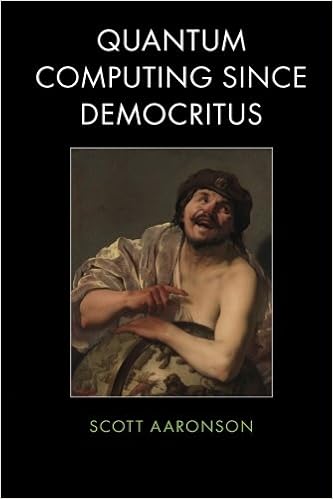
I reviewed Scott Aaronson's book, 'Quantum Computing Since Democritus' back in 2013.

Monday, July 06, 2015

'The Martian' - interview with the author

If you have a few moments, an interview with Andy Weir, author of 'The Martian'.


My sister found this sufficiently gripping that she abandoned both Andy Murray and the Tour de France to watch it. It's good stuff.