Showing posts with label asabiyyah. Show all posts

Tuesday, November 28, 2017

Selling capitalism to the feudal nobility

Steve Hsu is pessimistic about the terminal age of decadence in which we live:
"The empires Glubb studied had a lifespan of about ten human generations, or two hundred and fifty years, despite changing factors such as technology. Glubb describes a pattern of growth and decline, with six stages: the Ages of Pioneers, Conquest, Commerce, Affluence, Intellect and Decadence. He pointedly avoided writing about India or China, focusing rather on middle and western Eurasia, stating that his knowledge was inadequate to the task.

Note that six stages in 10 generations means that significant change can occur over one or two generations -- a nation can pass from one age to the next, as I believe we have in America during my lifetime.
... There does not appear to be any doubt that money is the agent which causes the decline of this strong, brave and self-confident people. The decline in courage, enterprise and a sense of duty is, however, gradual. The first direction in which wealth injures the nation is a moral one. Money replaces honour and adventure as the objective of the best young men. Moreover, men do not normally seek to make money for their country or their community, but for themselves.

Gradually, and almost imperceptibly, the Age of Affluence silences the voice of duty. The object of the young and the ambitious is no longer fame, honour or service, but cash. Education undergoes the same gradual transformation. No longer do schools aim at producing brave patriots ready to serve their country. [ Or to discover great things for all mankind! ] Parents and students alike seek the educational qualifications which will command the highest salaries. ...
Duty, Honor, Country:

The unbelievers will say they are but words, but a slogan, but a flamboyant phrase. Every pedant, every demagogue, every cynic, every hypocrite, every troublemaker, and I am sorry to say, some others of an entirely different character, will try to downgrade them even to the extent of mockery and ridicule.

The 21st century American reality (the Age of Decadence):

"Yeah, I calculated the NPV, and, you know, it's just not worth it for me. I really believe in your project, though. And, I share your passion. Good luck."
The description is of the decline of asabiyyah, as complacency and selfish individualism possess the elites. Yet there is still something superficial about this account.

---

It seems plausible that Duty, Honor, Country are the paramount virtues of a vigorous and rising polity. They are communitarian traits as in Jonathan Haidt's MFT, almost the opposite of the value set of liberalism. Undoubtedly they base themselves on evolutionarily-ancient components of the human psyche, selected for group cohesion.

Pre-capitalist formations, such as the empires of antiquity and those of feudalism, codified and celebrated duty, honour and country/empire. The elites knew they had to hang together or they'd hang separately, given their explicit social position as oppressors. When social solidarity failed, rebellions soon followed. Peter Turchin has written books about this.

In capitalism it's somewhat different. Economic exploitation is hidden behind the veil of equal formal rights for all. Most people sign up to the elite idea that capitalism is not a class society. The elites do not generally rely upon the threat of explicit oppression, but on the atomisation of labour, free to flow where fluid capital requires it (in terms of geography, roles and skills).*

Liberal individualism is the soul of modern capitalism but it doesn't really stir the heart .. and it doesn't glue society together.

---

I'm reading Charles Stross's The Bloodline Feud: The Family Trade and The Hidden Family (Merchant Princes Omnibus Book 1) where the heroine (a feisty tech journalist who is also feudal royalty) attempts to kickstart capitalism in a parallel feudal world. Stross is the pre-eminent writer of economics science-fiction and his book has received plaudits from leading economists such as Paul Krugman.

Amazon link


From a feudal point of view, capitalism as an overarching system looks incredibly weird. The world is run by merchants, who have no interests apart from enlarging their capital again and again?

'What then is life for?' they would ask**.

---

* This is at the root of the 'somewheres' vs. 'anywheres' distinction we saw with Brexit. The Remainers cannot conceive how anyone could be opposed to their vision of a uniform transnational community of right-thinkers embracing an enlightened globalised capitalism; Leavers conversely can't understand why our hard-built and largely pleasant British island community should be subordinated to more powerful European nation-states with their own somewhat inimical interests.


** A quote I once heard: "No-one ever gave their life for IBM."

Friday, November 10, 2017

Into the gun shop

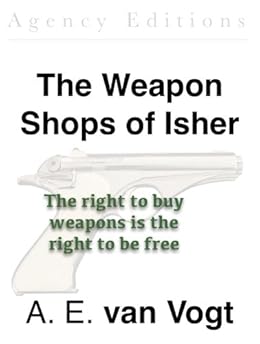
Where does this quote come from?
"The right to buy weapons is the right to be free"
The author at Tincknell Country Store this morning

---

This is one of my favourite A. E. van Vogt books - classic pulp SF:

Amazon link

---

Pretty much any week there will be angst about the prevalence of gun-atrocities in America. If you google "Game theory gun control" the results don't fail to be atavistic and tribal .. yet there is something useful game theory can tell us via the obvious payoff matrix.

Basically if a population is not armed at all (the European dove-dove situation) the result is optimal - but unstable.

If everyone who wants to be is armed (the American hawk-hawk situation), that's stable but very sub-optimal.

The mixed-situation (hawk-dove) is non-equilibrium, spiralling to (hawk-hawk); the doves always lose against hawks.

What keeps the European (dove-dove) situation in place is draconian enforcement against personal gun-possession by the state. But as commentator Tom Foale observes,
"The UK and Australia have banned all but a few guns and have draconian gun ownership requirements. The limited availability of guns and ammo means that criminals wanting a gun are often limited to modified starter pistols and making their own ammo - they are more likely to blow their own hands off. Being caught with one illegally means a long prison sentence. Enforcement keeps the overall equilibrium stable, although there are still a few shootings.

"The problem for the USA is that to shift from its current equilibrium (everyone can own a gun and very high homicide rates) to the better equilibrium (strict controls and low homicide rates) means making individuals feel less safe for quite a while, while the guns are removed. Unilateral disarmament is not a game-winning strategy for either a country or an individual if the risks (or the perceived risks) are high, so individuals will be reluctant to give up their guns. ...

"So I'm afraid that game theory says that the US is stuck with its current mess, unless something changes the game being played. That could be the establishment of large new 'gun-free' enclaves, where all guns (including law enforcement) are left at the entrances. This would require fences and border guards to enforce the rules, just like a small country. However, being as safe as the UK or Australia would make these enclaves very attractive, so I would expect more of these to be established over time.

"The cost of border security, distributed across all of the enclave's citizens, would drop as the enclave got bigger (by the ratio of the area enclosed, which grows in proportion to radius squared, to the circumference which grows in proportion to the radius), so it pays the citizens to encourage growth by inviting in the right sort of people. This might just lead to a scenario where general disarmament is possible."
Lurking behind these general remarks are specific American conditions. In many of the vast rural areas, law enforcement is thin on the ground and reaction times much delayed. Homeowners under threat are reliant on their own means of defence .. and are very reluctant to be disarmed.

In addition, American society is notably low on Asabiyyah - which raises the potential threat level - as compared to more homogeneous societies such as Canada, the Scandinavian countries and Switzerland, all of which have high levels of gun ownership but low homicide levels.

So there are some good reasons why the hawk-hawk equilibrium can't easily be unwound in the States.

Monday, July 25, 2016

The EU: when Asabiyyah goes wrong

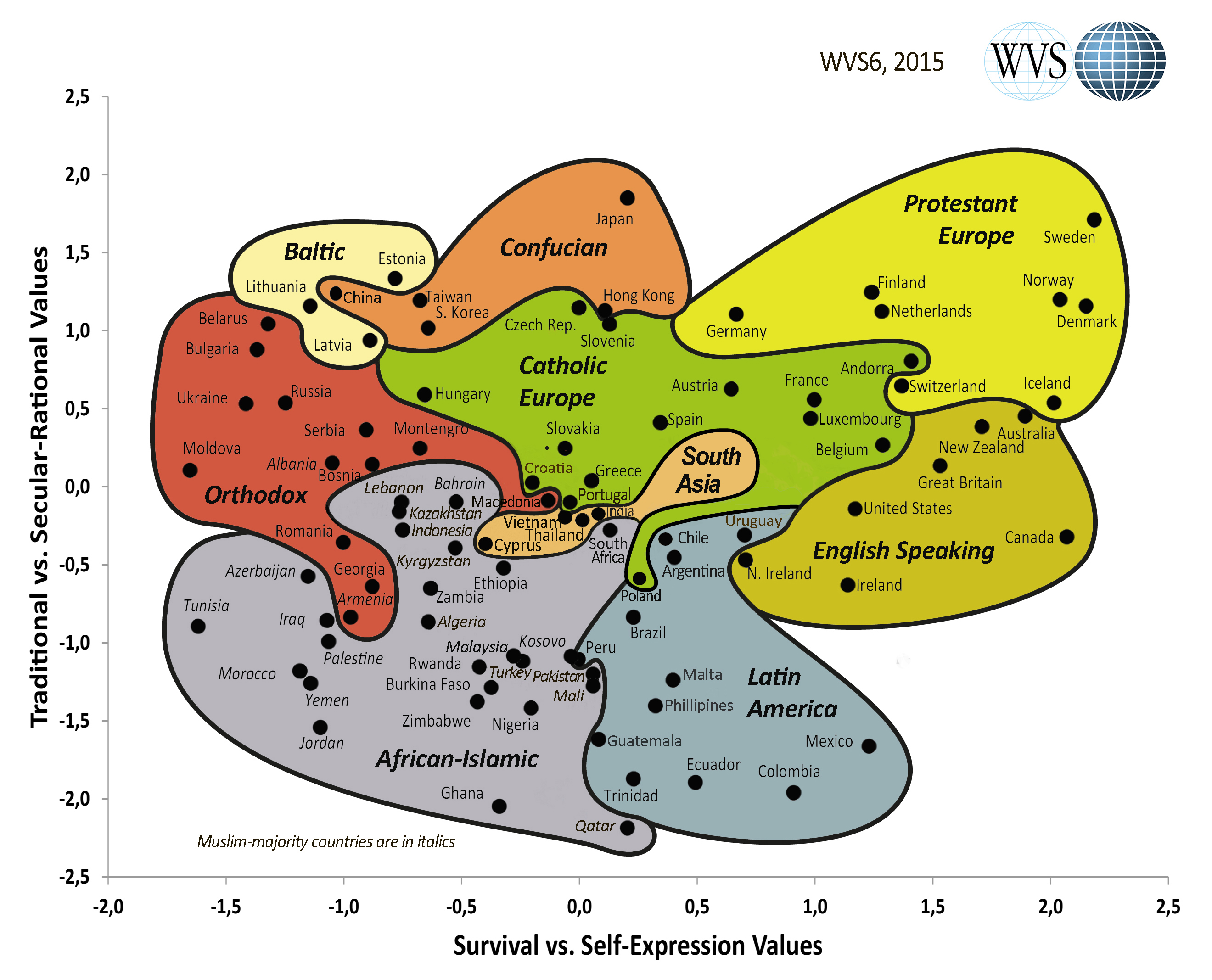
"The World Values Survey (WVS) is a global research project that explores people’s values and beliefs, how they change over time and what social and political impact they have. It is carried out by a worldwide network of social scientists who, since 1981, have conducted representative national surveys in almost 100 countries."


According to the Wikipedia article, the survey is carried out through questionnaires, and the results can be usefully compressed to the two-dimensional representation shown above, which repays some study (click on the image to make it larger).

The labelling of the two axes is less than clear: I suspect that:
  • the horizontal axis measures clan/group conformity - individualism
  • the vertical axis is capturing religiosity - secularism.

Decide for yourself: here is what the article says:
"Traditional values emphasize the importance of religion, parent-child ties, deference to authority and traditional family values. People who embrace these values also reject divorce, abortion, euthanasia and suicide. These societies have high levels of national pride and a nationalistic outlook.

"Secular-rational values have the opposite preferences to the traditional values. These societies place less emphasis on religion, traditional family values and authority. Divorce, abortion, euthanasia and suicide are seen as relatively acceptable.

"Survival values place emphasis on economic and physical security. It is linked with a relatively ethnocentric outlook and low levels of trust and tolerance.

"Self-expression values give high priority to environmental protection, growing tolerance of foreigners, gays and lesbians and gender equality, and rising demands for participation in decision-making in economic and political life."
This would be quite interesting in itself, but Peter Turchin's recent post applies it to the evolution of the European Union. First he notes:
"As I have said on numerous occasions (in this blog and in my other writings), it is hard to get people to cooperate, especially in large social groups. Successful cooperation requires that people share values and institutions. Values tell us why we want to cooperate: what is the public good that we collectively want to produce? Norms and institutions tell us how we are going to organize cooperation. Mismatched values and institutions may doom a cooperative effort even before it has a chance to get going.

"In my opinion, the expansion from the original six nations (Benelux, France, Germany, and Italy – I will refer to them as the “core” EU nations) to the current 28 was a big, big mistake. We can use the data collected by the World Values Survey (WVS) to visualize just how bad this mistake was."
Here is his key insight:
" I am interested to look at this mapping from a different point of view. Accordingly, I color-coded all countries into the following categories:

  • Core (red): the original 6 countries of the EEC

  • EU (brown): the other 22 members of the European Union

  • Europe (green): two Western European countries that are not in the EU

  • Candidate (yellow): current candidates for the EU

  • World (grey): rest of the world (country names omitted for clutter).

"Note: the reason Italy* has an asterix is because, for some reason, it was not included in the sixth wave, so I used its values from the fifth wave data."
Dr Turchin continues,
"The pattern is so striking it almost doesn’t require commentary, but let’s spell it out anyway. The original six (“Core Europe”) group together very closely. There are only two other countries that are part of the same cluster, Austria and Switzerland.

"Remarkably, the modern territories of both of these countries were encompassed by the boundaries of the Carolingian empire (see Is this the Beginning of the End for the European Union?). It looks like the “ghost” of Charlemagne’s empire has more influence on today’s cultural values than such later distinctions as Catholicism versus Protestantism.

"The current 28 members of the European Union, on the other hand, don’t cluster at all. On the contrary, they span three-quarters of world variation in values. Only African-Islamic countries and central America end up outside the ellipse that encompasses all 28 EU members."
You can see where Turkey is. And as for the absence of 'African-Islamic countries', the EU is doing its best to resolve that particular anomaly even as we speak.

If only they had understood Asabiyyah as well as the British Foreign Office, back in the days when it could still do realpolitik.

Saturday, May 07, 2016

War and Peace and War in Europe

People say that the European Union has prevented war in Europe for seventy years; in fact, the truth is precisely the opposite - it is the absence of the conditions for war which have enabled the EU to stagger along all these years.

There are two conditions for war (armed conflict between states):
- two or more states experience differences which cannot be resolved peacefully;

- each state must be militarily capable with a belief in the possibility of winning.*
In the United States, a well-honed system of federal conflict resolution + economic unification tends to dampen inter-state conflicts of interest. If that were ever to break down, the US (federal) military would demolish any individual state's armed forces. They did it before.

In Europe, not so much.

Don't underestimate the sheer war-exhaustion and folk-memories of the Second World War in Europe's economically-strongest states as an engine of peace-so-far.

As Peter Turchin observed in "War and Peace and War" there is a generational cycle here:
'...the father’s generation fights bitterly, their sons seek to avoid the mistakes that led to violence, but the underlying pressures still exist, so their grandsons repeat the pattern as memories of the causes and consequence of civil strife fade.'
If the interests of states within the current EU were to diverge sufficiently, then war is perfectly possible - the legally-enshrined authority of the central institutions of the EU would be brushed aside as effortlessly as during the continuing refugee/immigration crisis and the events in Greece.

KALs' cartoon from The Economist this week

Inter-state war in Europe is neither an imminent prospect nor on the horizon, but a generation of young people has grown up who are not that scared of the idea (having not directly experienced the effects on their societies) and might even welcome the excitement, bonding and opportunities for glory. You may be able to think of examples even as we speak, in the middle-east.

In the absence of an EU army and a demilitarisation of its constituent members a la America, a sufficiently deep clash of interests could certainly lead to armed conflict. (The people pushing for an EU army understand this, I think, but that particular boat is never going to sail).

It's not like the 1990s Balkans conflicts (Yugoslavia was once 'for ever') and the recent Ukrainian events don't show viable scenarios.

---

* If two states have irreconcilable differences but one cannot stand up militarily against the other, we have a technical name for what then happens to it: it's defeated.