Showing posts with label robot. Show all posts

Saturday, October 04, 2025

The 'Brain' of a Care-Robot? - ChatGPT

Which Brain Modules Should a Domestic Robot Have?

Suppose you were designing a humanoid robot—not a glittering sci-fi fantasy, but something far more grounded: a competent domestic assistant. A machine to help with housework, care for an elderly parent, perhaps entertain a grandchild, or notice when something has gone wrong. What parts of the human brain should such a robot simulate? And which parts can be safely left out?

This isn’t a philosophical question. It’s engineering. What neuroanatomical functions are strictly necessary for practical competence in real-world environments, and which are surplus to requirements, baroque artefacts of our evolutionary kludge?

Let’s start with what our robot does need—functional modules inspired by human neuroanatomy that will earn their place in the machine.

1. Sensorimotor Integration

The robot must move around the home, manipulate objects, and interact with humans—all in a three-dimensional, unpredictable world. It needs something akin to the human posterior parietal cortex to integrate visual and proprioceptive cues, a cerebellum-like system for precise, predictive motor control, and a basal ganglia analogue for learning motor routines. Call it the sense-act loop: without it, the robot is a clumsy liability.

2. Object and Scene Recognition

The robot must recognise a wide variety of domestic objects in varied lighting and contexts. This calls for an analogue of the human inferotemporal cortex and visual hierarchy—systems for parsing the identities and affordances of objects. Is this a wine glass or a lightbulb? A towel or a child’s jumper? If it can’t tell, it’s not safe in your house.

3. Memory: Episodic and Semantic

Humans use the hippocampus and temporal cortex to store and retrieve episodic and semantic knowledge. Your robot should too. It needs to remember routines, recognise people, recall preferences, and adapt over time. A robot that forgets how you like your tea every morning will wear out its welcome faster than a cat that soils your slippers.

4. Social Cognition and Affect Simulation

Domestic robots will work in emotionally charged environments—helping the infirm, engaging with children, responding to distress. They must simulate emotional intelligence. Not feel it, of course (that would be indulgent as well as technically difficult), but convincingly mimic the outputs.

The robot needs a lightweight theory of mind: something inspired by the medial prefrontal cortex and temporoparietal junction to interpret gaze, posture, tone, and likely mood. A dash of insula-inspired affect modelling will help it avoid faux pas like offering jokes at funerals or silence during crises.

5. Goal Management and Task Switching

Domestic life is interrupt-driven. The robot needs something akin to the dorsolateral prefrontal cortex and anterior cingulate cortex to manage goals, reprioritise tasks, and handle interruptions. “Put the kettle on—but answer the door first—and don’t forget the toddler is playing with the dog.” If it can’t handle that sort of multi-threaded chaos, it’s just another appliance cluttering the kitchen.


Now, what can be safely ignored?

1. Language Production via Broca’s Area

We don’t need human-style language synthesis. Today’s robots can use pre-trained language models to handle polite conversation and task explanations. No need to simulate Broca’s tangled grammar tree—just bolt on an LLM and move on.

2. Emotional Experience via the Limbic System

Let’s be clear: we don’t want robots with feelings. No amygdala. No nucleus accumbens. They must simulate emotions, not suffer them. Care, yes—sentimentality, no. Empathy as interface, not inner life.

3. Inner Monologue and Default Mode

The human brain spends a lot of time wandering, ruminating, constructing narratives. This is the default mode network, and it's lovely for poets but unnecessary for vacuuming. Your robot doesn’t need to meditate on its day. It just needs to remember where it left the duster.

4. Detailed Phonological Comprehension via Wernicke’s Area

Modern automatic speech recognition bypasses the phonological gymnastics of Wernicke’s area. Feed the audio into a trained model and jump straight to semantic intent. No need to rebuild the human linguistic hierarchy from scratch.

5. Aesthetic and Abstract Modules

No need for music appreciation, mathematical beauty, or religious awe. The robot is not applying for a PhD. It’s cleaning your toilet and reminding you to take your pills. Leave out the philosophical ballast.


So there you have it: a humanoid robot designed not to think like a human, but to perform with enough poise and grace to make itself useful—and perhaps even companionable. We replicate those parts of the brain that support task-competent embodiment, not those responsible for dreams, desires, or despair. A robot housekeeper needs sensorimotor precision, situational awareness, a serviceable memory, and simulated social grace. It does not need Shakespeare, Sartre, or the fear of death.

In short, a polite, emotionally-fluent zombie with an excellent grasp of cutlery placement. What more could you ask for?

Wednesday, October 25, 2017

"They dismiss the last workers from their fully automated factories"


A post at Marginal Revolution from 2010: "What is the biggest flaw in the labor theory of value?".

MR is an Internet temple to neoliberalism so a dismissive, patrician putdown of the Labour Theory of Value (LTV) was never in doubt.

In a comment, Chris Hallquist writes (March 30, 2010 at 12:34 pm):
"My favorite comment on the LTV comes from Peter Singer, of all people, in his largely sympathetic book on Marx. I don’t have the exact quote, but it was something like “The capitalists of the future will not see their profits dry up as they dismiss the last workers from their fully automated factories.”
I'm a capitalist. Suppose I have a Magic Box* which, say, costs £100 a day to run and which produces goods on demand to a value of £x. I have in mind something like a science-fictional 'next-generation 3D printer', which could make a case of baked-beans tins or the engine of a car depending on your menu selection and your whim.

Question: what can I charge for the goods produced? What is £x here?

So initially it's just me with the Magic Box -  I can charge what the market will bear. But soon all my competitors will have one too. The last workers are dismissed from their fully automated factories.

But due to competition, eventually I can charge no more than £100 for whatever I produce in a day. If I try to charge more, someone will undercut me and steal my customers. I make no profit.

Plainly before I get to this point I'm going to stop bothering with this investment in Magic Boxes - what's in it for me?

---

What stops this argument applying to capitalism today?

The primitive state of productivity and the consequent scope for further innovation.

As there is no Magic Box today, as a capitalist I have to use workers and machines to produce commodities for sale. Over a cycle of production the workers are paid for their labour-power at the cost of their own social-reproduction (v) and the machines (and raw materials) are paid for at their cost of operation and depreciation (c).  Given both factors (at a cost of c + v), the workforce then produces goods of value (c + v + s) which, by assumption sell at the direct price (Anwar Shaikh). My profit is then s.

Note that (c + v + s) is the actual (LTV) value which, in this model, equals the direct price of the product. There is no cheating here, no selling things above their actual value.

In the simplest historical models, the first capitalists competed with small-scale artisans engaged in simple commodity production - who make no profit as such on their work. But the capitalists innovate, add machines, significantly lower the cost of production per commodity but sell at (or slightly below) prevailing market prices. They increase their own market share and revenues, and thereby accumulate.

Incidentally they also wreck the economy of the simple commodity producers, forcing them out of business and into the ranks of labourers, who produce nothing but their own ability to work (labour-power) for a capitalist. The advent of capitalism was .. messy.

An 'arms race' then develops in which the contribution of more productive machinery increases and labour is shed. A capitalist could in principle always undercut the competition by lowering s, reducing price towards the cost of production and thereby removing profits, but why is that a good use of investment capital? Far better to use the money to invest in some other business which is still making adequate returns. And if there are no such, then we have a crisis, or stagnation.

[A truly perfect competition would drive s to zero and is impossible under capitalism.]

The limit of this process is the Magic Box where the capitalist needs no workers at all. But, as noted above, once everyone has one the price I can charge is forced down to the cost of production - there are no more profits to be had.

And if the Magic Box takes over the whole economy ("They dismiss the last workers from their fully automated factories") there are no other investment opportunities. It is the stagnation from hell; with nowhere to put your money, capitalism simply can't function.

So the story is this: as total automation comes closer, competition forces prices closer to the costs of production as there are declining opportunities to out-innovate competitors. When the last worker leaves, the capitalist simply stands back to observe the robot factories churning out goods which cannot be sold at a profit. He wonders why he bothered to invest (actually he didn't).

But it's worse even than that.

Meanwhile, the displaced workers have no income so they're kind of mad .. and the capitalists, with their profits vanishing, have nothing to skim for their own personal needs (no doubt their hoards will keep them going for a while). Eventually the automated factories all stop working due to no effective demand. The economy finally collapses and everybody starves.

In the real world, the model doesn't get pushed that far.

---

If some people (or a bunch of AIs) take over the reins of managing these automated factories, and if humans, displaced from production, are given money-tokens to purchase commodities, then we've re-invented simple commodity production - as practiced in antiquity using slaves.

Or perhaps people are also given (or purchase or take!) ownership of the Magic Boxes themselves. People use their machines to produce goods for personal consumption and also to trade unwanted goods with other people for commodities they do want (assuming some diversification due to variations in Magic Box design, capabilities or access to raw materials).

It's not capitalism, it's simple commodity production. And what about the centrally-planned economy, the classic model of post-capitalist socialism?

Another day.

---

This is a note: I'm still reading around these issues and revisions are almost certain. For a more detailed, quantitative and 'orthodox' treatment, leveraging the work of Michael Roberts and Peter Cooper, see "Total Automation under Capitalism?". And here is some background reading.

---


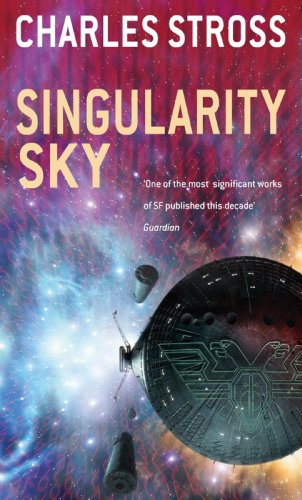
* The economic effects of a 'Magic Box' (a cornucopia machine) were humorously imagined by Charles Stross in his SF novel, 'Singularity Sky' (2008).

Sunday, October 15, 2017

Readings relating to total automation under capitalism

From the film, "Elysium"

Introduction

Suppose progress in AI and robotics manages to eliminate all human jobs: no more human workers. Would capitalism collapse or just sail serenely on, making the elite ever richer while the masses of the dispossessed watch in apathetic horror from outside the gated communities (Elysium)?

The usual Marxist account is that total automation is incompatible with capitalism, yet the standard response is curiously unconvincing. Marxists say that all automation systems are constant capital, and constant capital eponymously can't create new value. Only variable capital, living human labour, can do that. And it's from variable capital that surplus value - profits - are derived.

No workers, no profits.

This argument uses the abstract model of capitalist production developed in Volume 1 of Capital. But it leaves many things obscure.
  • What is the special status of human labour, was Marx a vitalist?
  • As automation increased, what actually would we see in the economy?
  • If total automation brings about some other mode of production, how did we  switch?
Let's see if we can clarify any of this.

---

1. Why can't robots produce surplus value?

The question was asked particularly clearly in this Reddit post.
"I've often read that Marx firmly asserted that a machine cannot create surplus value. However, since technological capabilities have changed quite a bit since Marx's day, today I decided to do some research into modern interpretations of this theory.

"I couldn't find a good answer as to why a robot can't produce surplus value (sure, it's constant capital, but that doesn't really explain it), but I did find mention that neither slaves or animals (which are both living) can produce surplus value, which indicates that there is something very particular about the type of work done by machines, not the inanimate-ness of the machines themselves, that prohibits them from creating surplus value.

"This leads to a few questions:
  • Why can't robots, slaves, and animals produce surplus value?
  • Does the possibility of robots manufacturing other robots affect this?
  • What about human-like robots created in the future?
"How can a society be both slave-based and capitalist (like the old American South)?

"Thanks!"
And here is the favoured answer - somewhat accurate but ultimately confused and unconvincing.
"Slaves are like tools since they are owned. If they exist alongside capitalism, they, like all other tools, pass their value on to the commodity but do not create new value. This does not mean that slaves are not exploited and don't produce a surplus for their masters. They do, but this surplus does not take the form of surplus value. In this case all the master's profit is surplus value transferred from free laborers. ...

"Surplus-value production requires a certain social organization. The question then is: What social organization differentiates the slave from the wage-laborer such that one doesn't produce surplus value but the other does?

"The answer is a social organization of generalized commodity production requiring an extensive division of labor. This social organization requires what Marx calls the laborer's "freedom in the double sense":
as a free man he can dispose of his labour-power as his own commodity, and that on the other hand he has no other commodity for sale, is short of everything necessary for the realisation of his labour-power.
"So, the slave/animal/robot must be given bourgeois rights; it must no longer be possible to buy and sell them, they must be considered equal as commodity owners and sellers. The slave/animal/robot must also be driven off the land and deprived of any means of production. This forces them to sell their labor-power to survive.

"If the animal/robot had the mental and physical capacity to function this way under these conditions, they would be surplus value producers."
Marx was not a vitalist, the term 'living labour' is an economic category (a producer of new value, an entity which brings labour-power to market as a commodity), not a term of biology.

---

2. Forms of Production

The first step to understanding why the Marxist account is, nevertheless, correct is to carefully distinguish different ways stuff can get produced in a complex economy with a division of labour, requiring trading and exchange. It will become clear that the two critical ideas are the distinction between use-value and exchange-value, and the subtleties of the labour theory of value.

We start by describing three forms of economic organisation: pre-capitalist, capitalist and post-capitalist. Only the second creates surplus value, value appropriated by an economic actor other than the producer.

2a. Simple Commodity Production

Wikipedia has a good account of this pervasive economic mode:
"Simple commodity production (also known as "petty commodity production"; the German original phrase is einfache Warenproduktion) is a term coined by Frederick Engels to describe productive activities under the conditions of what Marx had called the "simple exchange" of commodities, where independent producers trade their own products. The use of the word "simple" does not refer to the nature of the producers or of their production, but to the relatively simple and straightforward exchange processes involved. ...

"Simple exchange of commodities is as old as the history of trade, insofar as it has progressed beyond barter, and occurred for thousands of years before most production became organised in the capitalist way. It begins when producers in a simple division of labour (e.g. farmers and artisans) trade surpluses to their own requirements, with the aim of obtaining other products with an equal value, for their own use. Through the experience of trade, regular exchange values become established for products, which reflect an economy of labour-time. ...

"Simple commodity production is compatible with many different relations of production, ranging from self-employment where the producer owns his means of production, and family labour, to forms of slavery, peonage, indentured labour, and serfdom. The simple commodity producer could aim just to trade his products for others with an equivalent value, or he could aim to realise a profit.

"That is to say, simple commodity production is not specific to any particular mode of production, and might be found in many different modes of production, with various degrees of sophistication. It does not necessarily imply that all inputs or outputs of productive activity are commodities traded in markets. Thus, for example, simple commodity producers could produce some products for their own use on their own land, while trading another part of their products. They might buy or trade some tools and equipment, but also make some themselves. ...

"In Marxian political economy, simple commodity production also refers to a hypothetical economy used to interpret some of Karl Marx's insights about the economic laws governing the development of commodity trade: it refers to a market economy in which all producers own the resources (including the ability to work) that they use in production. No-one is a proletarian, selling his or her labor power to another. Instead, each is self-employed.

"In this imaginary model, there is a direct correspondence between prices and the values of commodities. The model is imaginary, because no such society has ever existed in history; simple commodity production has always combined with some other modes of production, and as soon as a market economy reaches any size, it begins to utilise wage labor in production, and falls under the sway of the laws of capital accumulation."
The take-home point is that in simple commodity production the proprietor is neither a wage labourer nor a capitalist.

Amazon link

In general proprietors trade commodities at their value and do not produce surplus value, as Duncan Foley explains (Understanding Capital, p. 31):
"Consider a system of commodity production in which independent producers buy inputs to production, add their own labor to commodities, and sell the commodities for prices that in the aggregate reflect the labor time expended in the value added to the commodities. We could represent the movement of money and commodities in such a system by the diagram:
C-M-C'
where the producer starts with the commodities he has produced (C) and sells them for money (M) as a way of buying another bundle of commodities (C') that better suit his needs. The commodities purchased (C') have the same value as the commodities sold (C). The motive behind this transformation is not any change in the value owned by the producer but the qualitative change in the use-values he consumes.

When we think of the commodity circulation in this way, we realize that the process comes to an end after one round of exchange. Once the producer has exchanged the commodities he initially owns for the bundle he chooses, there is no reason for any further exchange to take place. If the economic process is to continue, the reason for its continuation must be sought outside the process itself, for example, in the external assumption that the next day the producer will once again find himself with commodities C that are not the ones he wants to consume and will be forced to exchange again.

Furthermore, there could be no social surplus value in this system. An individual trader might cleverly manage to buy some commodities below their real values and sell them at or above their real values and in this way appropriate a surplus value through unequal exchange. But whatever these agents gain in surplus value, some other agents must lose, because of the conservation of value in exchange.

Producers add value to commodities by expending labor on them, but in general they receive in exchange no more than the equivalent of this labor time. Thus there appears to be no way to explain the pervasive appropriation of surplus value as the basis of economic life within this conception.

Notice also that the only conception of accumulation of value in such a system is for an agent to realize more value by selling commodities than he spends in buying them over a period. The difference must take the form of an accumulation of money by the agent. But this accumulated value is simply withdrawn from commodity circulation through the agent's abstinence from consumption.

When the agent finally spends the hoard he has accumulated, he simply returns the money value to circulation and withdraws commodities from circulation of the same value (assuming that the value of money has not changed in the  meantime). There is in this conception no systematic process of accumulation."
2b. Capitalism

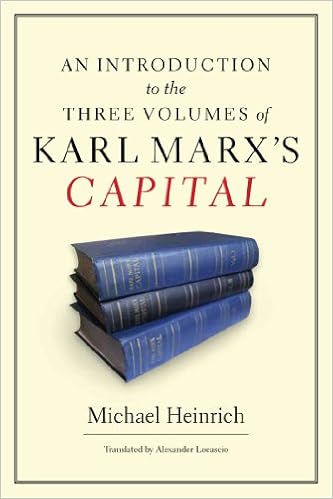
Capitalism is a weird mode of production, its strangeness hidden by its historical and geographical ubiquity, as Michael Heinrich explains in his “An Introduction to the Three Volumes of Karl Marx’s Capital” (p. 17):

Amazon link

"In precapitalist societies, the exploitation of the dominated class served primarily the consumption of the ruling class: its members led a luxurious life, used appropriated wealth for their own edification or for that of the public (theater performances in ancient Greece, games in ancient Rome) or to wage war.

Production directly served the fulfillment of wants: the fulfillment of the (forcibly) restricted needs of the dominated class and the extensive luxury and war needs of the ruling class. Only in exceptional cases was the wealth expropriated by the ruling class used to enlarge the basis of exploitation, such as when consumption was set aside to purchase more slaves, to produce a greater amount of wealth.

But under capitalist relations, production for the sake of increasing the capacity to produce is typically the case. The gains of a capitalist enterprise do not serve in the first instance to make a comfortable life for the capitalist possible, but are rather invested anew, in order to generate more gains in the future. Not the satisfaction of wants, but the valorization of capital is the immediate goal of production; the fulfillment of wants and therefore a comfortable life for the capitalist is merely a by product of this process, but not its goal. If the gains are large enough, then a small portion is sufficient to finance the luxurious existence of the capitalist, and the greater portion can be used for the accumulation (enlargement) of capital.

The fact that earnings do not primarily serve the consumption of the capitalist, but rather the continuous valorization of capital, that is, the restless movement of more-and-more accumulation, might sound absurd.

But the issue at hand is not an individual act of insanity. Individual capitalists are forced into this movement of restless profiteering (constant accumulation, expansion of production, the introduction of new technology, etc.) by competition with other capitalists: if accumulation is not carried on, if the apparatus of production is not constantly modernized, then one’s own enterprise is faced with the threat of being steamrolled by competitors who produce more cheaply or who manufacture better products.

A capitalist who attempts to withdraw from this process of constant accumulation and innovation is threatened with bankruptcy. He is therefore forced to participate, whether or not he wants to."

2c. Bureaucratic Socialism

Sam Williams describes the following scenario:
"A single corporation emerges that controls all of production. Let’s call our imaginary corporation the Universal Company Inc.  Its stock is traded on Wall Street and other global stock exchanges. Indeed, it is the only stock traded on the world’s stock exchanges, because it is the only corporation. It is the only business in the world.

Every factory, mill, mine, farm is controlled by Universal’s board of directors. Managers and technical personnel hired by its board of directors determine exactly what kind of goods are produced and the proportions in which each type of good is produced. Under the rule of Universal Company Inc., all workers are employees of the company since there are simply no other corporations to work for. Under the rule of Universal, what is the highest authority that the individual workers face? Why it’s the board of directors of Universal, which is elected by the stockholders of Universal on the principle of one share one vote.

But do the products of the labor of the workers of Universal take the form of commodities? The answer is no. Why not? Remember, Marx defined commodity production as a situation where the producers work for their own private accounts. Producers of commodities exchange the products of their labor and face no higher authority than the mutual pressure they exert on one another. Or what comes to exactly the same thing, the highest authority the producers face is competition among themselves. But this is not the case with the workers of Universal.

Instead of being indirectly social, the labor of the workers of Universal is directly social, as would also be the case under the rule of the associated producers. The board of directors and its subordinate employees such as managers, computer experts, foremen and so on see to it that the workers produce the right products in the right proportions. Since there is no commodity production, there is also no money, since money is simply a form of the commodity. And for the same reason, there is no capital, since capital consists of commodities and money. Where there is no commodities and money, there is no capital. And where there is no capital, there is no accumulation of capital.

The board of directors of the Universal Company Inc. might choose to continue expanded reproduction, but if it does, it will be accumulating use values not capital.

Since I am assuming a class of stockholders, the workers of Universal are indeed exploited. They are forced—just like is the case at the present day—to work some of the time for the boss—the stockholders of Universal—and some of the time for themselves. This allows the stockholders of Universal to live without working.

But the surplus product produced by the surplus, or unpaid, labor of the workers cannot take the form of surplus value, because there is no commodity production and labor does not take the form of value. And where there is no value, there can be no surplus value. And where there is no surplus value, there is no commodity production and no money. The surplus labor of the workers cannot take the form of profit—surplus value realized in the form of money. And where there is no surplus value and no capital, there is no capitalist mode of production.

While some might want to call our imaginary system of exploitation run by the Universal Company “state capitalism” in order to underline its exploitative nature as opposed to the system of cooperative production carried out by the associated producers, they would be forgetting that there have been other systems of exploitation in the history of human production over the last ten thousand years besides capitalism. But our imaginary system would not be a form of capitalism whatever else it might be, because it would lack the essential characteristics that separate capitalist production from other forms of exploitation.

For example, there would be no crises of the general overproduction of commodities, if only because there is no commodity production. In principle, our imaginary system might experience a generalized overproduction of use values, but that is something very different than the crises we experience under capitalism, which combine a generalized overproduction of commodities with a generalized underproduction of use values."
What Sam Williams describes here is an economic description of the "Communist States" emerging from the Russian Revolution and its WW2 aftermath. If you replace bureaucratic domination by workers control, you have a Trotskyist model for the aftermath of a socialist revolution: democratic socialism as the precursor (as the productive forces are developed) of communism. I have critiqued that model elsewhere.

---

3. Discussion

To read further on why total automation is incompatible with capitalism, please continue to:

"They dismiss the last workers from their fully automated factories".

Friday, May 19, 2017

Care Home automation

We remain transfixed by the low-level of Care Home productivity.


If Care Homes were as productive as car plants, they could lower costs to the point where every old person could expect an affordable and superior level of intimate care until death.

Whereas at the moment ...

It is tempting to think that we're currently stuck - waiting for Google to invent that fusion of AI and robotics which would automate the Care Home worker at significantly lower marginal cost.

If that's so, we may be waiting a while yet.

But perhaps that's the wrong way to think about it ... ?

We talked about it on the way back from Waitrose.
"One of those trick questions they give beginning students of Automation AI: 'How would you design an AI system to paint a car on the production line?'"

Snorts. "Just dip it," she said.

"Yep, absolutely on the right track. The students start talking about cameras, computer vision to steer the paint nozzles. Trying to reproduce a human on the job.

"At this point the lecturer takes pity and explains that the car is simply pinioned to a defined position by side-pommels while the robot paint-sprayer follows a blind, predetermined trajectory. It's considerably easier and cheaper."

"I had that idea already, about a kind of tipper-chair which could give an old person a bath," she said.

"We could think of a Care Home as a car assembly-line for people. But here's another idea. The state-of-the-art chicken abattoir is entirely mechanised. Each chicken is stunned, hung upside-down, has its throat cut, bleeds out, is defeathered, eviscerated and steam-cleaned. Finally it's packed ready to be sent off to Waitrose."

(Pause).

Clare: "Brilliant idea. I can see how that might work as an inspiration for Care Homes. Could be a bit of a PR problem ...
         "But don't let me put you off a bit of lateral thinking."

Thursday, March 02, 2017

Urban warfare just became easier - thanks to Google

From the estimable Boston Dynamics via foreXiv.

You need to watch this video all the way through .. and be very afraid.


"Handle is a research robot that stands 6.5 ft tall, travels at 9 mph and jumps 4​ ​feet vertically. ​It uses electric power to operate both electric and hydraulic actuators, with a range of about 15 miles on one battery charge.

Handle uses many of the same dynamics, balance and mobile manipulation principles​ found in the quadruped and biped robots we build, but with only about 10 actuated joints, it is significantly less complex. Wheels are efficient on flat surfaces while legs can go almost anywhere: by combining wheels and legs Handle can have the best of both worlds."
I have a vision of a swarm of those things clearing ISIS territory, toting AKs or M16s.

---

Incidentally, Google owns Boston Dynamics. This from The Guardian:
"Google’s parent company Alphabet is reportedly looking to offload Boston Dynamics, following tensions within the company about its subsidiary’s fit within the wider corporate culture.

"After a previous robotics video was posted to YouTube, Google communications staff sought to distance the company from the hardware, according to emails leaked to Bloomberg News, citing the feeling that such technology could be “terrifying”.
Please don't let me be the first to ask 'Handle' very politely, "Don't be evil"!

Monday, December 19, 2016

Matlda: the gatekeeper to your new job - Not!

From the Financial Times last month.

Matlda the robot and Professor Khosla

"She specialises in interviewing candidates for sales positions. Although relatively new to the job, Matlda still knows more than those she grills and uses her arsenal of 76 questions with ruthless efficiency to assess a job hopeful’s skills and professional expertise.

"She starts her 25-minute sessions slowly, reading her interviewee’s emotions and putting them at ease by, for example, playing the music she knows they listen to at home.

Matlda is a 30cm tall robot designed to shortlist job applicants and interview them.

...

“When you are doing face to face interviews and you have 10 candidates, if you liked candidate number four, by the time candidate number seven arrives the decision is already made unless they are something exceptional,” says Prof Khosla. “Matlda gives candidates a fair go.”

" .. a robotic interviewer “monitors [the candidate’s] facial expression”, says Prof Khosla. “Is there any physiological response? Do they seem impassioned when they are relating their experience? That is very important information [to glean from] a face to face interview — it tells an interviewer they relate more intrinsically to that area.”

"The robot compares what it has learnt with the traits of successful employees at the company that is doing the hiring. This is particularly helpful in sales, where turnover is high. “It’s all based on how the emotional responses and cognitive responses benchmark against their most successful candidates in their own culture,” says Prof Khosla."
It seems to work, at least with some people.
"Yu Ang Tan, a software engineer who engaged in a trial interview with Matlda, found the process uplifting. “I feel that a Matlda-enabled interview process gives me the feeling of a more standardised interview process.

“At the same time, having the process conducted by a robot with a cute appearance encouraged me to open up to it in ways I would otherwise hold back with a human interviewer.”
---

This is so obviously a gimmick that I wouldn't normally have wasted your time with the piece. But job interviews have some salience in our household at the moment.

Alex has a panel after Christmas and is currently prepping by studying Scala, a souped-up descendant of Java that I hadn't heard of before. He has bought the 800 page book.

Flipping through it, I exclaimed: "This is basically Lisp!", thus restating Greenspun's Tenth Rule.

Amazon link

With Scala's polymorphic typing and higher-order functions, I found myself this morning having a conversation I would never have anticipated: lambda calculus and currying.