In Part 1 we reviewed the recent introduction (in Dortmund, Barcelona, Paris, Gateshead, with planned expansion into London & New York) of 'brothels' populated by sex dolls. The shortcomings of a dumb, passive and inert RealDoll (wikipedia) are fairly well-known. It turns out to be very difficult to add limb mobility, subtly-choreographed movements and intimate vocal interactivity (a la chatbot) to the basic product - although of course people are working on it.
There is a halfway house.
---
Klara used to work the sex lines. She'd lounge in her recliner in her shellsuit in her living room, headset on, daytime TV on mute. Her callers would describe their fantasies, ask intimate questions, pay premium rates. She would string them along, imagination no longer needed, brain in neutral, hackneyed words spilling out.
But now .. her employer had brought her a new business venture. She faced a computer screen, her hand around a joystick. Only the headset was familiar. On screen the life-sized doll lounged provocatively on a king size bed. There were several cameras high on the walls - she could view and zoom from any angle.
The doll was certainly inert although its silicone body, she had been told, would be warm to the touch. More relevantly, the doll had inconspicuous microphones in its ears and a small speaker hidden behind its nose. These were connected to Klara's headset.
Klara would never see the patron's face - some clever AI fuzzed it out - but she could see his body, the patterns of movement, hear what he said. Some of the punters had a fantasy in mind: all Klara had to do was play along, provide audible accompaniment. She was used to to that. In other cases the punters were naive and confused, or positively wanted suggestions. Here Klara was in charge and she enjoyed playing the dominatrix.
And then there were the cases where the customer wanted to play a little rough. Klara wasn't keen on those but she did have a panic button. The sound of the guard's voice interrupting over the internal speakers was a joy. Possibly followed by the guard himself. Other girls were not so queasy; there was some preselection, Klara knew.
Klara was quite aware that the dolls would get better. In future years she could imagine herself as the remote human driver of a self-driving car, there to handle what the onboard systems couldn't yet do. But redundancy wouldn't be an issue for a long time yet.
---
One day, Klara was well into her shift when a new punter entered the room. She couldn't see his face of course but that body, those lithe movements .. were all too familiar.
He had said he would be away at a conference, but there, right in front of her eyes, ... !
---
More: [Endgadget article (NSFW)]: RealDoll's first sex robot took me to the uncanny valley.
Showing posts with label Automation. Show all posts
Friday, March 23, 2018
Wednesday, March 21, 2018
Disruptive automation in the sex trade: part 1
This was all over the tabloids in January, when the establishment opened in Paris, but it only came to my attention this morning when the broadsheets carried the story (about attempts to close it down).
From the BBC:
---
It's normal to see business productivity enhanced by increased automation. Admittedly the dolls seem to be far inferior in competence to human operatives but - as with all disruptive innovations - that will surely improve. Assuming no legal obstacles this would seem to be a growth industry, driving innovation by increasing effective demand.
I see the industry developing in two directions.*
At the bottom of the market the trend will be to maximise automation. You book on an app, your credit card gets you entry into a cubicle, you use the doll, you leave. An AI-camera checks to make sure you didn't break anything (they have your credit card details). A human cleaner** to prepare the next session - robots aren't yet good at dexterity.
---
At the top of the market - for the middle-class consumer who needs euphemisms - I see a therapy centre. You make an appointment, you're greeted by a pleasant (human) receptionist-hostess and shown to an interview room where you engage with a smooth chatbot to determine your psychosexual profile.
You are then directed into a well-appointed room where you engage with the doll for your treatment. Afterwards you do a little post-encounter therapy back with the chatbot, perhaps over a drink, and you're done .. until the next session. Two employees on site: hostess and security guard/cleaner.**
The barriers to entry seem low and the business doesn't look a lot different to any other naturalistic, holistic, psychotherapeutic, new-age consultancy - from the outside. And it should only be a few years until the currently passive doll is upgraded into a fully-automated mobile and talkative sex therapist for an even better experience.
Next: Disruptive automation in the sex trade: part 2.
---
* My examples are rather introverted. The collective sports/sales/stag/military markets could be served in conjunction with hotels, restaurants, pubs .. and the MoD.
** The guard/cleaner has a covert sideline in DNA samples for the police .. and journalists.
![]() |
| She seems rather .. quiet .. |
From the BBC:
"Paris councillors are due to decide on the future of a business where clients are charged €89 ($109; £78) to spend an hour with a silicone sex doll, local media report. Communist councillors and feminist groups have been calling for the closure of Xdolls. Currently, Xdolls is registered as a games centre, but opponents argue it is effectively a brothel. Owning or operating a brothel is illegal in France.Update: 23rd March. The enterprise has been approved by the Council of Paris.
Xdolls is located in an anonymous-looking flat in the French capital and opened last month. Clients are mainly men, though some couples also visit, owner Joachim Lousquy, who formerly managed e-cigarette shops, told Le Parisien newspaper. Xdolls has three rooms, each containing a silicone sex doll measuring about 1m45 (4ft 7in) and worth several thousand euros. Customers make their booking and payment online, and the exact address is kept secret. Not even the neighbours are aware of the nature of the business, Mr Lousquy says. ..
Lorraine Questiaux, lawyer and spokesperson for a Paris feminist association, says "that in France, every year, there are 86,000 women raped". "Xdolls is not a sex shop. It's a place that generates money and where you rape a woman," Ms Questiaux, who also wants the centre closed, adds."
---
It's normal to see business productivity enhanced by increased automation. Admittedly the dolls seem to be far inferior in competence to human operatives but - as with all disruptive innovations - that will surely improve. Assuming no legal obstacles this would seem to be a growth industry, driving innovation by increasing effective demand.
I see the industry developing in two directions.*
At the bottom of the market the trend will be to maximise automation. You book on an app, your credit card gets you entry into a cubicle, you use the doll, you leave. An AI-camera checks to make sure you didn't break anything (they have your credit card details). A human cleaner** to prepare the next session - robots aren't yet good at dexterity.
---
At the top of the market - for the middle-class consumer who needs euphemisms - I see a therapy centre. You make an appointment, you're greeted by a pleasant (human) receptionist-hostess and shown to an interview room where you engage with a smooth chatbot to determine your psychosexual profile.
You are then directed into a well-appointed room where you engage with the doll for your treatment. Afterwards you do a little post-encounter therapy back with the chatbot, perhaps over a drink, and you're done .. until the next session. Two employees on site: hostess and security guard/cleaner.**
The barriers to entry seem low and the business doesn't look a lot different to any other naturalistic, holistic, psychotherapeutic, new-age consultancy - from the outside. And it should only be a few years until the currently passive doll is upgraded into a fully-automated mobile and talkative sex therapist for an even better experience.
Next: Disruptive automation in the sex trade: part 2.
---
* My examples are rather introverted. The collective sports/sales/stag/military markets could be served in conjunction with hotels, restaurants, pubs .. and the MoD.
** The guard/cleaner has a covert sideline in DNA samples for the police .. and journalists.
Sunday, October 15, 2017
Readings relating to total automation under capitalism
![]() |
| From the film, "Elysium" |
Introduction
Suppose progress in AI and robotics manages to eliminate all human jobs: no more human workers. Would capitalism collapse or just sail serenely on, making the elite ever richer while the masses of the dispossessed watch in apathetic horror from outside the gated communities (Elysium)?
The usual Marxist account is that total automation is incompatible with capitalism, yet the standard response is curiously unconvincing. Marxists say that all automation systems are constant capital, and constant capital eponymously can't create new value. Only variable capital, living human labour, can do that. And it's from variable capital that surplus value - profits - are derived.
No workers, no profits.
This argument uses the abstract model of capitalist production developed in Volume 1 of Capital. But it leaves many things obscure.
- What is the special status of human labour, was Marx a vitalist?
- As automation increased, what actually would we see in the economy?
- If total automation brings about some other mode of production, how did we switch?
---
1. Why can't robots produce surplus value?
The question was asked particularly clearly in this Reddit post.
"I've often read that Marx firmly asserted that a machine cannot create surplus value. However, since technological capabilities have changed quite a bit since Marx's day, today I decided to do some research into modern interpretations of this theory.And here is the favoured answer - somewhat accurate but ultimately confused and unconvincing.
"I couldn't find a good answer as to why a robot can't produce surplus value (sure, it's constant capital, but that doesn't really explain it), but I did find mention that neither slaves or animals (which are both living) can produce surplus value, which indicates that there is something very particular about the type of work done by machines, not the inanimate-ness of the machines themselves, that prohibits them from creating surplus value.
"This leads to a few questions:
"How can a society be both slave-based and capitalist (like the old American South)?
- Why can't robots, slaves, and animals produce surplus value?
- Does the possibility of robots manufacturing other robots affect this?
- What about human-like robots created in the future?
"Thanks!"
"Slaves are like tools since they are owned. If they exist alongside capitalism, they, like all other tools, pass their value on to the commodity but do not create new value. This does not mean that slaves are not exploited and don't produce a surplus for their masters. They do, but this surplus does not take the form of surplus value. In this case all the master's profit is surplus value transferred from free laborers. ...Marx was not a vitalist, the term 'living labour' is an economic category (a producer of new value, an entity which brings labour-power to market as a commodity), not a term of biology.
"Surplus-value production requires a certain social organization. The question then is: What social organization differentiates the slave from the wage-laborer such that one doesn't produce surplus value but the other does?
"The answer is a social organization of generalized commodity production requiring an extensive division of labor. This social organization requires what Marx calls the laborer's "freedom in the double sense":
as a free man he can dispose of his labour-power as his own commodity, and that on the other hand he has no other commodity for sale, is short of everything necessary for the realisation of his labour-power."So, the slave/animal/robot must be given bourgeois rights; it must no longer be possible to buy and sell them, they must be considered equal as commodity owners and sellers. The slave/animal/robot must also be driven off the land and deprived of any means of production. This forces them to sell their labor-power to survive.
"If the animal/robot had the mental and physical capacity to function this way under these conditions, they would be surplus value producers."
---
2. Forms of Production
The first step to understanding why the Marxist account is, nevertheless, correct is to carefully distinguish different ways stuff can get produced in a complex economy with a division of labour, requiring trading and exchange. It will become clear that the two critical ideas are the distinction between use-value and exchange-value, and the subtleties of the labour theory of value.
We start by describing three forms of economic organisation: pre-capitalist, capitalist and post-capitalist. Only the second creates surplus value, value appropriated by an economic actor other than the producer.
2a. Simple Commodity Production
Wikipedia has a good account of this pervasive economic mode:
"Simple commodity production (also known as "petty commodity production"; the German original phrase is einfache Warenproduktion) is a term coined by Frederick Engels to describe productive activities under the conditions of what Marx had called the "simple exchange" of commodities, where independent producers trade their own products. The use of the word "simple" does not refer to the nature of the producers or of their production, but to the relatively simple and straightforward exchange processes involved. ...The take-home point is that in simple commodity production the proprietor is neither a wage labourer nor a capitalist.
"Simple exchange of commodities is as old as the history of trade, insofar as it has progressed beyond barter, and occurred for thousands of years before most production became organised in the capitalist way. It begins when producers in a simple division of labour (e.g. farmers and artisans) trade surpluses to their own requirements, with the aim of obtaining other products with an equal value, for their own use. Through the experience of trade, regular exchange values become established for products, which reflect an economy of labour-time. ...
"Simple commodity production is compatible with many different relations of production, ranging from self-employment where the producer owns his means of production, and family labour, to forms of slavery, peonage, indentured labour, and serfdom. The simple commodity producer could aim just to trade his products for others with an equivalent value, or he could aim to realise a profit.
"That is to say, simple commodity production is not specific to any particular mode of production, and might be found in many different modes of production, with various degrees of sophistication. It does not necessarily imply that all inputs or outputs of productive activity are commodities traded in markets. Thus, for example, simple commodity producers could produce some products for their own use on their own land, while trading another part of their products. They might buy or trade some tools and equipment, but also make some themselves. ...
"In Marxian political economy, simple commodity production also refers to a hypothetical economy used to interpret some of Karl Marx's insights about the economic laws governing the development of commodity trade: it refers to a market economy in which all producers own the resources (including the ability to work) that they use in production. No-one is a proletarian, selling his or her labor power to another. Instead, each is self-employed.
"In this imaginary model, there is a direct correspondence between prices and the values of commodities. The model is imaginary, because no such society has ever existed in history; simple commodity production has always combined with some other modes of production, and as soon as a market economy reaches any size, it begins to utilise wage labor in production, and falls under the sway of the laws of capital accumulation."
![]() |
| Amazon link |
In general proprietors trade commodities at their value and do not produce surplus value, as Duncan Foley explains (Understanding Capital, p. 31):
"Consider a system of commodity production in which independent producers buy inputs to production, add their own labor to commodities, and sell the commodities for prices that in the aggregate reflect the labor time expended in the value added to the commodities. We could represent the movement of money and commodities in such a system by the diagram:2b. Capitalism
C-M-C'where the producer starts with the commodities he has produced (C) and sells them for money (M) as a way of buying another bundle of commodities (C') that better suit his needs. The commodities purchased (C') have the same value as the commodities sold (C). The motive behind this transformation is not any change in the value owned by the producer but the qualitative change in the use-values he consumes.
When we think of the commodity circulation in this way, we realize that the process comes to an end after one round of exchange. Once the producer has exchanged the commodities he initially owns for the bundle he chooses, there is no reason for any further exchange to take place. If the economic process is to continue, the reason for its continuation must be sought outside the process itself, for example, in the external assumption that the next day the producer will once again find himself with commodities C that are not the ones he wants to consume and will be forced to exchange again.
Furthermore, there could be no social surplus value in this system. An individual trader might cleverly manage to buy some commodities below their real values and sell them at or above their real values and in this way appropriate a surplus value through unequal exchange. But whatever these agents gain in surplus value, some other agents must lose, because of the conservation of value in exchange.
Producers add value to commodities by expending labor on them, but in general they receive in exchange no more than the equivalent of this labor time. Thus there appears to be no way to explain the pervasive appropriation of surplus value as the basis of economic life within this conception.
Notice also that the only conception of accumulation of value in such a system is for an agent to realize more value by selling commodities than he spends in buying them over a period. The difference must take the form of an accumulation of money by the agent. But this accumulated value is simply withdrawn from commodity circulation through the agent's abstinence from consumption.
When the agent finally spends the hoard he has accumulated, he simply returns the money value to circulation and withdraws commodities from circulation of the same value (assuming that the value of money has not changed in the meantime). There is in this conception no systematic process of accumulation."
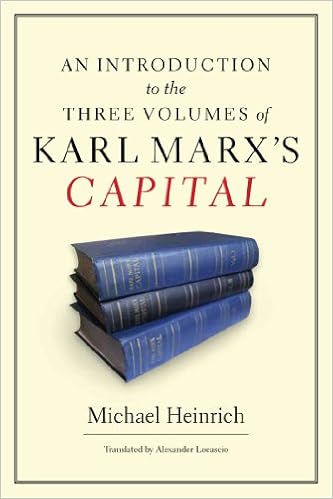
Capitalism is a weird mode of production, its strangeness hidden by its historical and geographical ubiquity, as Michael Heinrich explains in his “An Introduction to the Three Volumes of Karl Marx’s Capital” (p. 17):
![]() |
| Amazon link |
"In precapitalist societies, the exploitation of the dominated class served primarily the consumption of the ruling class: its members led a luxurious life, used appropriated wealth for their own edification or for that of the public (theater performances in ancient Greece, games in ancient Rome) or to wage war.
Production directly served the fulfillment of wants: the fulfillment of the (forcibly) restricted needs of the dominated class and the extensive luxury and war needs of the ruling class. Only in exceptional cases was the wealth expropriated by the ruling class used to enlarge the basis of exploitation, such as when consumption was set aside to purchase more slaves, to produce a greater amount of wealth.
But under capitalist relations, production for the sake of increasing the capacity to produce is typically the case. The gains of a capitalist enterprise do not serve in the first instance to make a comfortable life for the capitalist possible, but are rather invested anew, in order to generate more gains in the future. Not the satisfaction of wants, but the valorization of capital is the immediate goal of production; the fulfillment of wants and therefore a comfortable life for the capitalist is merely a by product of this process, but not its goal. If the gains are large enough, then a small portion is sufficient to finance the luxurious existence of the capitalist, and the greater portion can be used for the accumulation (enlargement) of capital.
The fact that earnings do not primarily serve the consumption of the capitalist, but rather the continuous valorization of capital, that is, the restless movement of more-and-more accumulation, might sound absurd.
But the issue at hand is not an individual act of insanity. Individual capitalists are forced into this movement of restless profiteering (constant accumulation, expansion of production, the introduction of new technology, etc.) by competition with other capitalists: if accumulation is not carried on, if the apparatus of production is not constantly modernized, then one’s own enterprise is faced with the threat of being steamrolled by competitors who produce more cheaply or who manufacture better products.
A capitalist who attempts to withdraw from this process of constant accumulation and innovation is threatened with bankruptcy. He is therefore forced to participate, whether or not he wants to."
2c. Bureaucratic Socialism
Sam Williams describes the following scenario:
"A single corporation emerges that controls all of production. Let’s call our imaginary corporation the Universal Company Inc. Its stock is traded on Wall Street and other global stock exchanges. Indeed, it is the only stock traded on the world’s stock exchanges, because it is the only corporation. It is the only business in the world.What Sam Williams describes here is an economic description of the "Communist States" emerging from the Russian Revolution and its WW2 aftermath. If you replace bureaucratic domination by workers control, you have a Trotskyist model for the aftermath of a socialist revolution: democratic socialism as the precursor (as the productive forces are developed) of communism. I have critiqued that model elsewhere.
Every factory, mill, mine, farm is controlled by Universal’s board of directors. Managers and technical personnel hired by its board of directors determine exactly what kind of goods are produced and the proportions in which each type of good is produced. Under the rule of Universal Company Inc., all workers are employees of the company since there are simply no other corporations to work for. Under the rule of Universal, what is the highest authority that the individual workers face? Why it’s the board of directors of Universal, which is elected by the stockholders of Universal on the principle of one share one vote.But do the products of the labor of the workers of Universal take the form of commodities? The answer is no. Why not? Remember, Marx defined commodity production as a situation where the producers work for their own private accounts. Producers of commodities exchange the products of their labor and face no higher authority than the mutual pressure they exert on one another. Or what comes to exactly the same thing, the highest authority the producers face is competition among themselves. But this is not the case with the workers of Universal.Instead of being indirectly social, the labor of the workers of Universal is directly social, as would also be the case under the rule of the associated producers. The board of directors and its subordinate employees such as managers, computer experts, foremen and so on see to it that the workers produce the right products in the right proportions. Since there is no commodity production, there is also no money, since money is simply a form of the commodity. And for the same reason, there is no capital, since capital consists of commodities and money. Where there is no commodities and money, there is no capital. And where there is no capital, there is no accumulation of capital.The board of directors of the Universal Company Inc. might choose to continue expanded reproduction, but if it does, it will be accumulating use values not capital.Since I am assuming a class of stockholders, the workers of Universal are indeed exploited. They are forced—just like is the case at the present day—to work some of the time for the boss—the stockholders of Universal—and some of the time for themselves. This allows the stockholders of Universal to live without working.But the surplus product produced by the surplus, or unpaid, labor of the workers cannot take the form of surplus value, because there is no commodity production and labor does not take the form of value. And where there is no value, there can be no surplus value. And where there is no surplus value, there is no commodity production and no money. The surplus labor of the workers cannot take the form of profit—surplus value realized in the form of money. And where there is no surplus value and no capital, there is no capitalist mode of production.While some might want to call our imaginary system of exploitation run by the Universal Company “state capitalism” in order to underline its exploitative nature as opposed to the system of cooperative production carried out by the associated producers, they would be forgetting that there have been other systems of exploitation in the history of human production over the last ten thousand years besides capitalism. But our imaginary system would not be a form of capitalism whatever else it might be, because it would lack the essential characteristics that separate capitalist production from other forms of exploitation.For example, there would be no crises of the general overproduction of commodities, if only because there is no commodity production. In principle, our imaginary system might experience a generalized overproduction of use values, but that is something very different than the crises we experience under capitalism, which combine a generalized overproduction of commodities with a generalized underproduction of use values."
---
3. Discussion
To read further on why total automation is incompatible with capitalism, please continue to:
"They dismiss the last workers from their fully automated factories".
Labels:
AI,
android,
Automation,
Capitalism,
Duncan Foley,
Elysium,
Michael Heinrich,
Reddit,
robot,
Sam Williams
Friday, September 15, 2017
The gag is on
Walking down to Waitrose this morning - and dragging the new sholley, my weight-training-induced sore forearms still haven't gone away and it's 'no more Mr Heavy-Shopping-Bags' - I ventured this thought to Clare.
"Shall I tell you the new thing I've learned today?"
Grudging acquiescence.
"You know I'm continually fascinated by the way AI and robotics are going to transform capitalism, and how exactly that transformation's going to work ..."
---
The new thing was from Part 2 of Michael Roberts' insightful series, 'Robots and AI: utopia or dystopia?' ..
The issue is, who gets to be the recipient of such wonders of production, the owners of the robots .. or everyone? It seems contentious.
---
Where to start? The only place was the labour theory of value.
In truth, I don't think the objection can be addressed in ordinary conversation, the sources of demand being manyfold: in addition to the needs of proletarians you will find capitalists' spending on themselves, the market for reproduction and expansion of the means of production .. .
No less a luminary than Rosa Luxemburg got it wrong.
In fact I explained quite clearly both simple reproduction and expanded reproduction within capitalism on this blog, but if you review the two posts you will see the analysis is not wholly trivial.
This afternoon I considered going through the spreadsheets with her - and decided against having my arm bitten off.
---
You may have heard over the last couple of days: Mathematicians Measure Infinities and Find They’re Equal.
It relates to whether there are cardinal numbers between the infinity representing the size of the natural numbers and the larger infinity capturing the size of the real numbers. The continuum hypothesis says no, but that can't be proven using the normal axioms of set theory.
The work of Malliaris and Shelah has some bearing on the matter although not all is completely clear (is the cardinality of p = t the same as the continuum?).
I said to Clare, "Did you know there are different sizes of infinity?"
She snorted, "That kind of nonsense is just what gives mathematics a bad name."
I advanced on her with paper and pen; she sat back on the couch, closed her eyes, put her hands over her ears and started to hum.
"Shall I tell you the new thing I've learned today?"
Grudging acquiescence.
"You know I'm continually fascinated by the way AI and robotics are going to transform capitalism, and how exactly that transformation's going to work ..."
---
The new thing was from Part 2 of Michael Roberts' insightful series, 'Robots and AI: utopia or dystopia?' ..
"The question often posed at this point is: who are the owners of the robots and their products and services going to sell to make a profit? If workers are not working and receiving no income, then surely there is massive overproduction and underconsumption? So, in the last analysis, it is the underconsumption of the masses that brings capitalism down?Roberts here puts his finger on the key mode of production change required by total automation: production of exchange-values collapses and all production is of use-values, just like in slave-owning antiquity.
"Again, I think this is a misunderstanding. Such a robot economy is not capitalist any more; it is more like a slave economy. The owners of the means of production (robots) now have a super-abundant economy of things and services at zero cost (robots making robots making robots). The owners can just consume. They don’t need to make ‘a profit’, just as the aristocrat slave owners in Rome just consumed and did not run businesses to make a profit.
"This does not deliver an overproduction crisis in the capitalist sense (relative to profit) nor ‘underconsumption’ (lack of purchasing power or effective demand for goods on a market), except in the physical sense of poverty. ..."
The issue is, who gets to be the recipient of such wonders of production, the owners of the robots .. or everyone? It seems contentious.
---
Where to start? The only place was the labour theory of value.
"So Marx said that the capitalist pays the worker the value of his labour-power - what it costs to maintain the worker as an effective employee - and sets him to work. But the value the worker actually creates in his day's labour is more than this, and that value belongs to the capitalist, creating his profit once realised in the exchange process.But Clare was having none of this.
"But if the worker is replaced by a robot ..."
"That can't be right. If the worker is paid less than what he produces, then the employer won't be able to sell all his products. No, Marx was quite wrong."I hesitatingly began to talk about Marx's simple and expanded reproduction equations, Departments I and II .. but the audience had switched off.
In truth, I don't think the objection can be addressed in ordinary conversation, the sources of demand being manyfold: in addition to the needs of proletarians you will find capitalists' spending on themselves, the market for reproduction and expansion of the means of production .. .
No less a luminary than Rosa Luxemburg got it wrong.
In fact I explained quite clearly both simple reproduction and expanded reproduction within capitalism on this blog, but if you review the two posts you will see the analysis is not wholly trivial.
This afternoon I considered going through the spreadsheets with her - and decided against having my arm bitten off.
---
You may have heard over the last couple of days: Mathematicians Measure Infinities and Find They’re Equal.
It relates to whether there are cardinal numbers between the infinity representing the size of the natural numbers and the larger infinity capturing the size of the real numbers. The continuum hypothesis says no, but that can't be proven using the normal axioms of set theory.
The work of Malliaris and Shelah has some bearing on the matter although not all is completely clear (is the cardinality of p = t the same as the continuum?).
I said to Clare, "Did you know there are different sizes of infinity?"
She snorted, "That kind of nonsense is just what gives mathematics a bad name."
I advanced on her with paper and pen; she sat back on the couch, closed her eyes, put her hands over her ears and started to hum.
Labels:
AI,
Automation,
Capitalism,
Continuum Hypothesis,
elbow,
forearm,
Malliaris,
Michael Roberts,
Robots,
Shelah,
Sholley,
tendonitis
Wednesday, August 30, 2017
Marx on Slavery
Expecting a vitriolic rant on the absolute evils of slavery in the antebellum American South? There are plenty of those, but here Marx is more interesting, more analytic:
"This is one of the circumstances that makes production by slave labour such a costly process. The labourer here is, to use a striking expression of the ancients, distinguishable only as instrumentum vocale, from an animal as instrumentum semi-vocale, and from an implement as instrumentum mutum.From Note 17 of "Chapter 7: The Labour-Process and the Process of Producing Surplus-Value", Capital Volume 1.
"But he himself [the slave] takes care to let both beast and implement feel that he is none of them, but is a man. He convinces himself with immense satisfaction, that he is a different being, by treating the one unmercifully and damaging the other con amore.
"Hence the principle, universally applied in this method of production, only to employ the rudest and heaviest implements and such as are difficult to damage owing to their sheer clumsiness. In the slave-states bordering on the Gulf of Mexico, down to the date of the civil war, ploughs constructed on old Chinese models, which turned up the soil like a hog or a mole, instead of making furrows, were alone to be found. Conf. J. E. Cairnes. “The Slave Power,” London, 1862, p. 46 sqq.
"In his “Sea Board Slave States,” Olmsted tells us: “I am here shown tools that no man in his senses, with us, would allow a labourer, for whom he was paying wages, to be encumbered with; and the excessive weight and clumsiness of which, I would judge, would make work at least ten per cent greater than with those ordinarily used with us.
"And I am assured that, in the careless and clumsy way they must be used by the slaves, anything lighter or less rude could not be furnished them with good economy, and that such tools as we constantly give our labourers and find our profit in giving them, would not last out a day in a Virginia cornfield – much lighter and more free from stones though it be than ours.
"So, too, when I ask why mules are so universally substituted for horses on the farm, the first reason given, and confessedly the most conclusive one, is that horses cannot bear the treatment that they always must get from negroes; horses are always soon foundered or crippled by them, while mules will bear cudgelling, or lose a meal or two now and then, and not be materially injured, and they do not take cold or get sick, if neglected or overworked.
"But I do not need to go further than to the window of the room in which I am writing, to see at almost any time, treatment of cattle that would ensure the immediate discharge of the driver by almost any farmer owning them in the North.”
In this chapter Marx notes the extreme inefficiency of slavery as compared with the capitalist purchase of labour-power rather than the person of the labourer themselves:
"Then again, the labour-power itself must be of average efficacy. In the trade in which it is being employed, it must possess the average skill, handiness and quickness prevalent in that trade, and our capitalist took good care to buy labour-power of such normal goodness.Generalised slavery is incompatible with the capitalist mode of production as the use of slaves does not create surplus value - the basis of profits. Classical antiquity was not capitalist.
"This power must be applied with the average amount of exertion and with the usual degree of intensity; and the capitalist is as careful to see that this is done, as that his workmen are not idle for a single moment. He has bought the use of the labour-power for a definite period, and he insists upon his rights. He has no intention of being robbed.
"Lastly, and for this purpose our friend has a penal code of his own, all wasteful consumption of raw material or instruments of labour is strictly forbidden, because what is so wasted, represents labour superfluously expended, labour that does not count in the product or enter into its value. [note 17]."
Putting aside moral issues, slaves replacing workers is a form of total automation. But unlike designed systems, human beings are understandably unenthused by a lifetime role as servitor.
Labels:
antebellum,
Automation,
Capital,
Marx,
Slavery,
Volume 1
Friday, May 19, 2017
Care Home automation
We remain transfixed by the low-level of Care Home productivity.
If Care Homes were as productive as car plants, they could lower costs to the point where every old person could expect an affordable and superior level of intimate care until death.
Whereas at the moment ...
It is tempting to think that we're currently stuck - waiting for Google to invent that fusion of AI and robotics which would automate the Care Home worker at significantly lower marginal cost.
If that's so, we may be waiting a while yet.
But perhaps that's the wrong way to think about it ... ?
We talked about it on the way back from Waitrose.
If Care Homes were as productive as car plants, they could lower costs to the point where every old person could expect an affordable and superior level of intimate care until death.
Whereas at the moment ...
It is tempting to think that we're currently stuck - waiting for Google to invent that fusion of AI and robotics which would automate the Care Home worker at significantly lower marginal cost.
If that's so, we may be waiting a while yet.
But perhaps that's the wrong way to think about it ... ?
We talked about it on the way back from Waitrose.
"One of those trick questions they give beginning students of Automation AI: 'How would you design an AI system to paint a car on the production line?'""But don't let me put you off a bit of lateral thinking."
Snorts. "Just dip it," she said.
"Yep, absolutely on the right track. The students start talking about cameras, computer vision to steer the paint nozzles. Trying to reproduce a human on the job.
"At this point the lecturer takes pity and explains that the car is simply pinioned to a defined position by side-pommels while the robot paint-sprayer follows a blind, predetermined trajectory. It's considerably easier and cheaper."
"I had that idea already, about a kind of tipper-chair which could give an old person a bath," she said.
"We could think of a Care Home as a car assembly-line for people. But here's another idea. The state-of-the-art chicken abattoir is entirely mechanised. Each chicken is stunned, hung upside-down, has its throat cut, bleeds out, is defeathered, eviscerated and steam-cleaned. Finally it's packed ready to be sent off to Waitrose."
(Pause).
Clare: "Brilliant idea. I can see how that might work as an inspiration for Care Homes. Could be a bit of a PR problem ...
Labels:
AI,
Automation,
car,
Care Home,
Chicken,
Healthcare,
humour,
robot
Monday, September 12, 2016
Workers, slaves, androids - and agency
Einstein produced well-validated scientific theories combined with speculations which seem out of synch with current quantum orthodoxies, while politically he seemed to be socialist-pacifist.
Marx produced rigorous theories of class societies focusing on the capitalist mode of production (Capital etc), speculated about the future of capitalism (inaccurately), and politically seemed to be, well, a communist.
It pays to stay focused on the theories.
So ignore the politicking and moralising and focus on Marxism as a theoretical system; how exactly do workers as living, breathing persons figure in Marxist economic theory?
---
In the beginning was the 'primitive communism' of egalitarian hunter-gathers. Following the neolithic revolutions - agriculture and pastoralism - we entered the age of class societies. All class societies are unequal. At the bottom there are one or more classes which are the primary producers of the necessities of life.
Through the increased productivity of agriculture and pastoralism, the lower classes produced more than they needed to survive. The excess, the social surplus product, was appropriated by the rulers, also serving to fund the elements of the state - administration, warriors and of course, tax collectors.
There was always an accompanying ideology to explain why this little ditty:
was inapplicable, and in fact downright subversive.
Archaic empires had their God-Kings while Axial age empires harnessed more abstract Gods to the maintenance of social order.
In feudal times, there was "a set of reciprocal legal and military obligations revolving around the three key concepts of lords, vassals and fiefs. A lord was in broad terms a noble who held land, a vassal was a person who was granted possession of the land by the lord, and the land was known as a fief. In exchange for the use of the fief and the protection of the lord, the vassal would provide some sort of service to the lord."
As I mentioned already, for Marx the specific essence of capitalism was generalised commodity production and exchange.
The value at which a commodity is exchanged is captured by the formula c + v + s, where c is the value of machinery and raw materials, v the value of the worker's wage and s the additional value created by the activity of the worker in producing the final commodity.
The class nature of capitalism is exhibited in that the worker produces more value (v + s) than he or she receives in payment (v). It doesn't seem that way, as wages are superficially presented as payment for labour (ie the product of labour) rather than labour-power (the capacity to work - placed at the disposal of the capitalist).
Still, in formal terms the worker and the capitalist meet as equals in the market place; the worker sells his/her labour-power and receives a fair price for it. The workers don't have to sell their labour-power and the capitalist doesn't have to employ them. Proletarians have agency (although the concept is not theorised).
We have to add a few things to get closer to quotidien reality: asymmetries of power between workers and bosses; supply/demand & differing profitabilities creating price-variations around value, and so on. But the principle is as stated.
---
People sometimes talk about wage-slavery, working for the Man. Slavery exists under capitalism (the antebellum American South and Nazi Germany being high-profile examples) but in Marxist economics a slave isn't a proletarian; a slave is not a party to a market-transaction for labour-power: a slave is owned.
In this sense, a slave is in the same category as any other piece of equipment, classified as constant capital (c) in the equation. The slave is not paid wages but is merely provided with the same maintenance and raw materials (specifically shelter, food) as any other piece of smart automation. In particular, a slave does not produce surplus value (just surplus product). An economy comprised wholly of slaves, with no wage-labourers, is exactly equivalent to a totally-automated economy - it cannot operate as a capitalist economy as no surplus value is produced.
It's in this sense that slave economies such as the Roman Empire prefigure speculative-future total-automation economies. The Romans had a class of incredibly advanced, intelligent instrumenta vocalia ('talking tools') embedded within a general technological environment of staggering backwardness and low productivity.
The instrumentum vocale philosophy might be adopted for future AI systems, such as the androids featured in the recent TV programme 'Humans', but we run straight into the problem of agency.
The moment we start treating advanced automation systems as persons, we cannot embed them into the economy as 'talking tools'. Considering them as free agents, we may feel obligated to offer them rights, including labour rights in waged employment. They then enter our existing capitalist society as 'new proletarians' .. and 'new capitalists'.
No doubt that will turn out well.
---
Let's be clear. There is nothing in Marx or reality which prevents a 'robot capitalism'. As long as worker-robots are paid wages which they use to buy their means of self-reproduction in the marketplace, and as long as robot-capitalists can use their robotic work force's labour-power to make profits, capitalist relations of production remain in place.
Protoplasm is not a requirement.
Whether these industrious, capable androids will feel comfortable being taxed to support the remaining, wholly parasitic, humans is an issue I leave to your imagination.
---
In the previous post on this topic, "Total automation under capitalism?", I considered communism brought about by non-sentient automation, giving as an example the 3D printer/fabricator.
In the scenario above, abundance is delivered through automation systems with agency: sentient AI systems - androids or robots - which most people would classify as persons.
It mirrors the distinction in AI research between systems which augment people (like Google today, satnavs or exoskeletons) and those which emulate/replace people, which cut people out of the loop. There are few examples of the latter at the moment - autonomous piloted vehicles perhaps being the most salient.
If we are to avoid the much-hyped technological singularity where in the worst case humans are rendered extinct by our creations, we should perhaps make sure that our automated infrastructure is of the non-sentient type while AI-based agents become our colleagues, companions and friends.
On a bad day, I wonder if this distinction can really hold, given the likely extreme complexity of a communist economy.
Marx produced rigorous theories of class societies focusing on the capitalist mode of production (Capital etc), speculated about the future of capitalism (inaccurately), and politically seemed to be, well, a communist.
It pays to stay focused on the theories.
So ignore the politicking and moralising and focus on Marxism as a theoretical system; how exactly do workers as living, breathing persons figure in Marxist economic theory?
---
In the beginning was the 'primitive communism' of egalitarian hunter-gathers. Following the neolithic revolutions - agriculture and pastoralism - we entered the age of class societies. All class societies are unequal. At the bottom there are one or more classes which are the primary producers of the necessities of life.
Through the increased productivity of agriculture and pastoralism, the lower classes produced more than they needed to survive. The excess, the social surplus product, was appropriated by the rulers, also serving to fund the elements of the state - administration, warriors and of course, tax collectors.
There was always an accompanying ideology to explain why this little ditty:
was inapplicable, and in fact downright subversive.
Archaic empires had their God-Kings while Axial age empires harnessed more abstract Gods to the maintenance of social order.
In feudal times, there was "a set of reciprocal legal and military obligations revolving around the three key concepts of lords, vassals and fiefs. A lord was in broad terms a noble who held land, a vassal was a person who was granted possession of the land by the lord, and the land was known as a fief. In exchange for the use of the fief and the protection of the lord, the vassal would provide some sort of service to the lord."
As I mentioned already, for Marx the specific essence of capitalism was generalised commodity production and exchange.
The value at which a commodity is exchanged is captured by the formula c + v + s, where c is the value of machinery and raw materials, v the value of the worker's wage and s the additional value created by the activity of the worker in producing the final commodity.
The class nature of capitalism is exhibited in that the worker produces more value (v + s) than he or she receives in payment (v). It doesn't seem that way, as wages are superficially presented as payment for labour (ie the product of labour) rather than labour-power (the capacity to work - placed at the disposal of the capitalist).
Still, in formal terms the worker and the capitalist meet as equals in the market place; the worker sells his/her labour-power and receives a fair price for it. The workers don't have to sell their labour-power and the capitalist doesn't have to employ them. Proletarians have agency (although the concept is not theorised).
We have to add a few things to get closer to quotidien reality: asymmetries of power between workers and bosses; supply/demand & differing profitabilities creating price-variations around value, and so on. But the principle is as stated.
---
People sometimes talk about wage-slavery, working for the Man. Slavery exists under capitalism (the antebellum American South and Nazi Germany being high-profile examples) but in Marxist economics a slave isn't a proletarian; a slave is not a party to a market-transaction for labour-power: a slave is owned.
In this sense, a slave is in the same category as any other piece of equipment, classified as constant capital (c) in the equation. The slave is not paid wages but is merely provided with the same maintenance and raw materials (specifically shelter, food) as any other piece of smart automation. In particular, a slave does not produce surplus value (just surplus product). An economy comprised wholly of slaves, with no wage-labourers, is exactly equivalent to a totally-automated economy - it cannot operate as a capitalist economy as no surplus value is produced.
It's in this sense that slave economies such as the Roman Empire prefigure speculative-future total-automation economies. The Romans had a class of incredibly advanced, intelligent instrumenta vocalia ('talking tools') embedded within a general technological environment of staggering backwardness and low productivity.
The instrumentum vocale philosophy might be adopted for future AI systems, such as the androids featured in the recent TV programme 'Humans', but we run straight into the problem of agency.
![]() |
| "Humans" on Channel 4, showing the 'Synth' Anita |
The moment we start treating advanced automation systems as persons, we cannot embed them into the economy as 'talking tools'. Considering them as free agents, we may feel obligated to offer them rights, including labour rights in waged employment. They then enter our existing capitalist society as 'new proletarians' .. and 'new capitalists'.
No doubt that will turn out well.
---
Let's be clear. There is nothing in Marx or reality which prevents a 'robot capitalism'. As long as worker-robots are paid wages which they use to buy their means of self-reproduction in the marketplace, and as long as robot-capitalists can use their robotic work force's labour-power to make profits, capitalist relations of production remain in place.
Protoplasm is not a requirement.
Whether these industrious, capable androids will feel comfortable being taxed to support the remaining, wholly parasitic, humans is an issue I leave to your imagination.
---
In the previous post on this topic, "Total automation under capitalism?", I considered communism brought about by non-sentient automation, giving as an example the 3D printer/fabricator.
In the scenario above, abundance is delivered through automation systems with agency: sentient AI systems - androids or robots - which most people would classify as persons.
It mirrors the distinction in AI research between systems which augment people (like Google today, satnavs or exoskeletons) and those which emulate/replace people, which cut people out of the loop. There are few examples of the latter at the moment - autonomous piloted vehicles perhaps being the most salient.
If we are to avoid the much-hyped technological singularity where in the worst case humans are rendered extinct by our creations, we should perhaps make sure that our automated infrastructure is of the non-sentient type while AI-based agents become our colleagues, companions and friends.
On a bad day, I wonder if this distinction can really hold, given the likely extreme complexity of a communist economy.
Labels:
android,
Artificial Intelligence,
Automation,
Axial age,
Feudalism,
Marx,
Marxism,
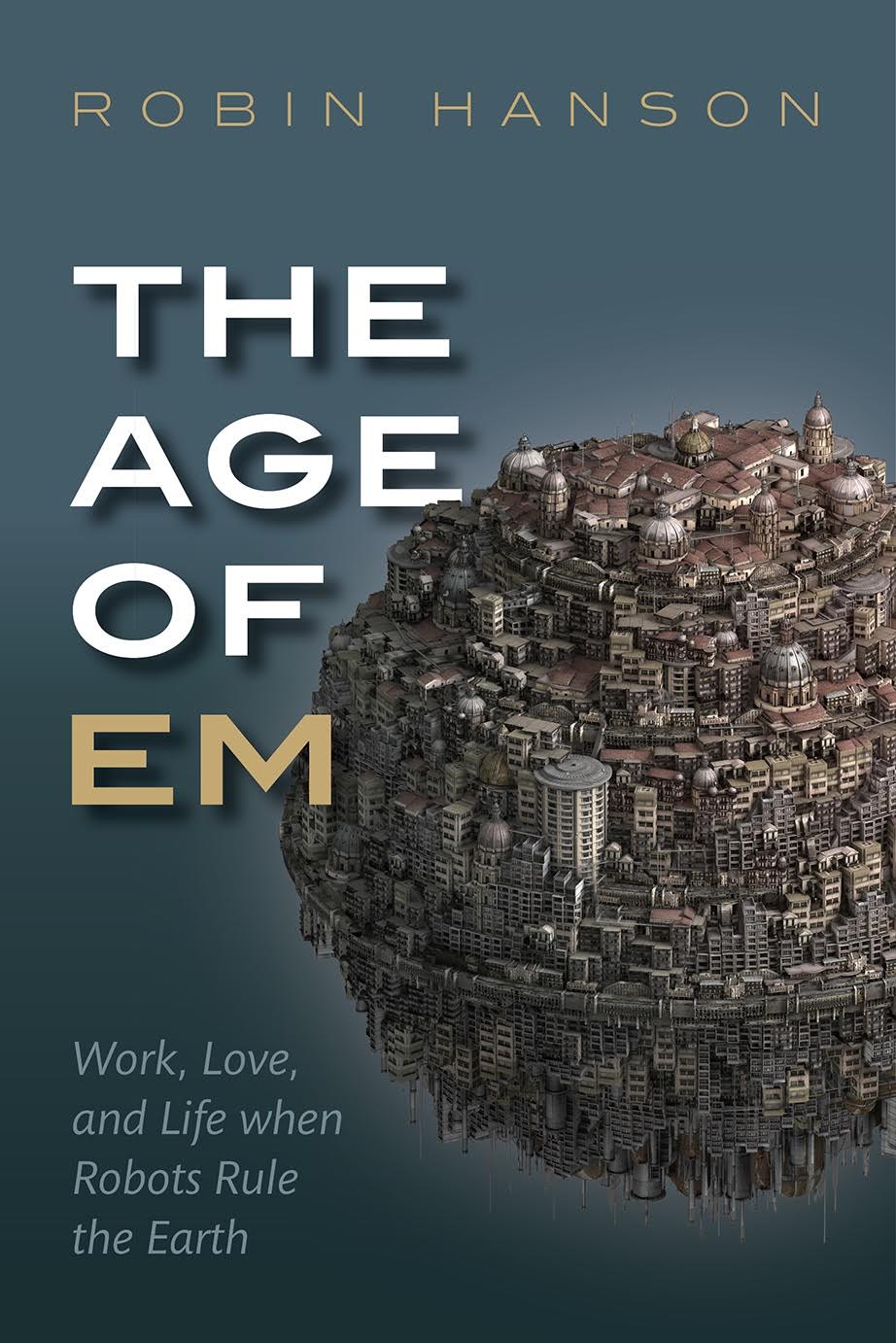
Robin Hanson,
Slave,
Slavery,
Synth,
The Age of Em
Thursday, September 08, 2016
Total automation under capitalism?
1. Introduction
But hunter-gatherers looked down upon early farmer societies, seeing gross inequalities, intense, lengthy and servile labour and an absence of freedom for the majority.
They were right.
The dream of human utopia, the vision which drives social change, is that of an enlightened return to that dawn-era of human equality. A best-case bountiful environment back then of plants, fruit and plentiful game is to be replaced by a sophisticated automation-economy which provides for every need: food, shelter, transport, communications, entertainment and so on.
So productive is this imagined future robotic economy that products are produced at need and no money is involved. Hunter-gatherers did not have to 'pay' to pluck fruit from a wild bush or to hunt animals.
Our future machines are self-producing and self-maintaining. They can be freely used by interested groups to build stadiums, new kinds of computers, rocket ships or to embark upon great projects such as colonising Mars.
Speculative as this sounds, it's not beyond extrapolation from our current technological base; a century might do it. In the jargon, it's called 'development of the productive forces' towards abundance.
But what happens as we move inexorably towards total automation under capitalism?
2. Michael Roberts's three-part series
Noted Marxist economist Michael Roberts has an excellent analysis, starting here.
3. Peter Cooper's Model
Peter Cooper (heteconomist) had an extremely useful post about this back in 2011 entitled "Implications of a Purely Mechanized Economy" which I'm going to discuss in detail.
Peter starts like this:
What has not been created is the kind of value which mediates and regulates commodity exchange via the market, called exchange-value. There is no market!
Exchange-value is a social construct, it is constructed through the human activity of equitably implementing the market exchange of commodities, the normal mode of distribution of goods and services in a capitalist society.
4. The model as automation becomes dominant
Peter Cooper's model has additional mileage. What happens to capitalist production as the mixed sector declines and the total-automation sector continues to grow?
Let's start by halving all the numbers so that the total value of the two commodities produced in this model economy is exactly 100. Rates of surplus-value and profit remain the same.
Now dramatically reduce the constant and variable capital assigned to the Mixed sector. That is, put most of the capital invested in machinery and raw materials into the robotic sector, and employ very few people. In numbers, we have 90% of the produced value invested in robots, 2% invested as constant capital in the Mixed sector, 4% invested as wages and the capitalists appropriate 4% as surplus value.
Here's the spreadsheet.
As you can see, due to the enormous organic composition of capital (c/v = 92/4 = 23) and in the absence of any increase in the rate of surplus value (s/v = 100%), the rate of profit has crashed to 4%. The Mixed sector commodity price at 6.25 is only slightly above the cost of 6.
Doing the maths shows that as the mixed contribution (ie the amount of employed labour) tends to zero, surplus value also tends to zero and price tends to cost leading to zero profits. At this point, capitalism simply can't work.
5. The experience of total automation for the mass of non-capitalists
What would that be like for the great mass of people who are not owners of the vast amounts of capital sloshing precariously around here?
In the comments on his post, Peter Cooper observed:
6. The transition to post-capitalism
We have some prior experience with abundant goods produced at zero marginal cost. Remember the saga of MP3 music files?
There was originally a small cottage industry (around Napster) of people downloading digitised music for free. After a while, pretty much everyone was sharing music files with their friends and families. And so the (secondary) production and distribution of music was taken out of capitalist relations of production: communism in music had arrived.
The first recourse of the capitalist providers of commoditised music was to resort to the power of the state. People were prosecuted, as was Napster. But the masses were too many, the activity too widely-practised and the threats ultimately unenforceable.
In the next iteration, legal and cheapish channels of digitised, downloadable music were provided. Many people were persuaded on moral grounds to use these. After all, communism in the means of general consumption hadn't arrived; musicians had to eat!
Some musicians rebased their revenue streams around live performances or hold-in-the-hand artwork. Streaming developed, which was more easily monetisable. And in the background, people continued to rip/download and share music tracks for free with impunity.
7. The wonderful 3D printer/fabricator
I think this is an interesting template for a possible future.
Suppose a philanthropic billionaire develops the ultimate 3D printer/fabricator. Using sunlight, water, air + scrap materials, it can synthesise food, drinks, shelter, transportation and most other basic and quite sophisticated needs. The machines can also self-reproduce if so instructed.
Think of it as a super-fast-growing tree-analogue - indeed, it might be the result of genetic technology.
The billionaire donates this machine to the world for free. What happens next?
Like the MP3 scenario, I imagine that an idealistic network of early adopters would take up this machine and remove themselves entirely from the capitalist economy. Thus sustained and as in Paul Mason's vision of the future, they would no doubt work on endless open-source improvements.
The capitalists see a sharp decline in the wage-labour force. If you don't want to work, perhaps you don't have to. (There are some issues in this scenario to do with land rights - all land is owned by someone and no-one's making much more of it - but let me skirt over these.)
No doubt some capitalists will make use of these wonderful machines to create a totally-automated robotic sector of the capitalist economy, as Paul Cooper discussed above, but it's in competition with the non-capitalist economy which produces only use values.
Notice in this scenario, which is very bottom-up, the automated printer/fabricators are so competent that coordination issues usually addressed by the capitalist market and which have proved so troublesome for Marxists ('central planning') are largely non-existent.
Insofar as there are big projects which require coordination, these could be done by voluntary associations of those interested.
Tempting as it is to say that the capitalist state would attempt to outlaw these machines and 'restore order', I think that in most cases the balance of forces would be against them. Potential abundance is just too compelling and in this scenario, too easy to accomplish.
Other scenarios are alluded to by Cooper above, including a basic income while the capitalist economy is still completing its work of increasing the productive forces.
8. Conclusions
The left finds itself in a century-old dilemma. The reformist left wants to manage capitalism by using control of the capitalist state to tilt the scales a little more towards the interests of the masses; the revolutionary left wants to abolish the capitalist state and the dominance of capitalist relations of production and exchange, and institute central planning based on workers councils instead, as Lenin and Trotsky envisaged.
The former promises at best limited, quantitative gains while the latter looks completely implausible.
Capitalism is the best social system ever devised for increasing standards of living, productivity and the forces of production. The problem is that its motivation and driving force is capital expansion, not human welfare.
That works for quite a lot of the people whose labour power is required to do that mission, but ignores many more who are economically superfluous. It's usually not malicious - it's just that they don't have a specific capability to be useful right now, or the purchasing power to get noticed.
I suspect Marx was right when he suggested that capitalism could only be surpassed when it was obvious to the mass of people that it was no longer the best way to develop the productive forces in the interests of everyone, and where a superior alternative was also obvious.
This suggests that it's been no accident that capitalism continues to reign supreme, even giving a new lease of life to countries such as Russia and China. The conditions just aren't here yet.
But as long as capitalism continues to drive technological progress, brighter prospects will emerge ahead.
---
Related posts
---
"Primitive communism is a concept originating from Karl Marx and Friedrich Engels who argued that hunter-gatherer societies were traditionally based on egalitarian social relations and common ownership." (Wikipedia).We know more today about the cultural and material poverty of hunter-gatherer societies and the frequently brutal xenophobic warfare between tribes driven by Malthusian pressures.
But hunter-gatherers looked down upon early farmer societies, seeing gross inequalities, intense, lengthy and servile labour and an absence of freedom for the majority.
They were right.
The dream of human utopia, the vision which drives social change, is that of an enlightened return to that dawn-era of human equality. A best-case bountiful environment back then of plants, fruit and plentiful game is to be replaced by a sophisticated automation-economy which provides for every need: food, shelter, transport, communications, entertainment and so on.
So productive is this imagined future robotic economy that products are produced at need and no money is involved. Hunter-gatherers did not have to 'pay' to pluck fruit from a wild bush or to hunt animals.
Our future machines are self-producing and self-maintaining. They can be freely used by interested groups to build stadiums, new kinds of computers, rocket ships or to embark upon great projects such as colonising Mars.
Speculative as this sounds, it's not beyond extrapolation from our current technological base; a century might do it. In the jargon, it's called 'development of the productive forces' towards abundance.
But what happens as we move inexorably towards total automation under capitalism?
2. Michael Roberts's three-part series
Noted Marxist economist Michael Roberts has an excellent analysis, starting here.
3. Peter Cooper's Model
Peter Cooper (heteconomist) had an extremely useful post about this back in 2011 entitled "Implications of a Purely Mechanized Economy" which I'm going to discuss in detail.
Peter starts like this:
“It is well known that in Marx’s theory of commodity production, labor is the source of all new value. The means of production merely pass on their already existing value to new commodities. [...]This is a really important point, at the heart of Marx's theory. When a wild tree produces grapes (from thin air) which you eat, value has been created for sure. A use-value.
“It is critical to recognize that Marx’s argument applies to value, not physical output or wealth. He is not suggesting that labor is the only source of physical output or wealth. Nature, other animals and machines all clearly create new physical output and wealth, as does labor. The argument, rather, is that only labor translates into new value. The plant, machinery and raw materials used up in the production period only pass on their preexisting value (actually, their prices).
"Nature, in contrast, does not transfer any value to output. Instead, private property rights give owners of natural resources a legal entitlement to a payment of rent, which comes out of the surplus value created in the production period."
What has not been created is the kind of value which mediates and regulates commodity exchange via the market, called exchange-value. There is no market!
Exchange-value is a social construct, it is constructed through the human activity of equitably implementing the market exchange of commodities, the normal mode of distribution of goods and services in a capitalist society.
“Of the new value that is created in the production period, some goes to workers as wages and some goes to capitalists and other social groups as surplus value. Specifically, surplus labor – the labor carried out in excess of what is required to produce the equivalent of the value paid to workers in wages and salaries – is the basis of surplus value in Marx’s theory. In aggregate, surplus value equals profit, prior to its distribution among various recipients. Some of it will go to rentiers as rent or creditors as interest income.I going to replace Cooper's symbols with their spelled-out meanings to make reading a little easier.
“Considering that surplus labor is the sole origin of surplus value in Marx’s theory, it is interesting to reflect on an extreme scenario in which the entire production of the economy becomes purely mechanized. Marx’s theory suggests that, in this scenario, capitalism must have ceased to exist! The reason is that there would be no production of surplus value (profit) in such a system, making it unviable for capitalists.
“But what does it mean to say that a purely mechanized economy could not be a capitalist economy? After all, even in such a society, surely we humans would still be doing some things that were not mechanized. So what would be going on?
“It would simply mean that this human activity (labor) was no longer being treated as value production and that our human capacity to work or create (labor power) was no longer being treated as a commodity.
“In such a system, there might still be a requirement to work in order to gain access to material needs, and there might still be authoritarian measures used to direct production. However, it would not be capitalism. The surplus would not take the form of value, but simply its physical form – the material output produced in excess of the needs of social reproduction.
“Equally possible is that we might choose to organize our activities in such a way that income was no longer tied to work. Material needs could be met through the free distribution of the output of mechanized production processes. Required resources and facilities for human endeavors could be made freely available. Human activity could then be genuinely free and associations between individuals voluntary.
“Highly Mechanized Production Under Capitalism
“For capitalism to remain despite a high degree of mechanization, it would instead be necessary that at least some human activity continued to be value production. That would require that some human endeavors were only enabled within the context of value production, just as is the case in our present society.
“In the absence of a basic income guarantee, there would be an onus on the government to ensure demand remained sufficient to sustain high levels of employment. Otherwise, in the midst of such plenty, periodic episodes of mass unemployment, especially if continuing for sustained periods, would likely result in extreme social conflict.
“If human activity remained commodified – i.e. capitalist social relations remained in place – capitalists would retain significant ownership and control of the means of production, including the purely robotized or mechanized production processes. Surplus value would continue to be created out of the employment of labor under capitalist conditions. Just as now, all capitalists would compete for a share out of aggregate profit, irrespective of how much surplus value was created in their own sectors.
“The reason for this, in Marx’s theory, is that competition tends to equalize the rate of profit realized by different sectors, even though it is the least capital-intensive sectors (least efficient sectors) that produce the most surplus value (because proportionately they outlay more on the employment of workers than means of production).
“Briefly, for Marx, the [exchange] value of a commodity equals c + v + s. Here: c is ‘constant capital’, the value (or dollar amount) outlaid for the means of production used up in producing the commodity; v is ‘variable capital’, the sum of value outlaid for the employment of labor; and s is ‘surplus value’, the amount of value produced by workers in excess of the amount (v) outlaid on their employment.Here I'm replacing Cooper's spreadsheet with my own copy: same numbers, easier to read labels. Note that in his simple model, there are just two commodities produced in the time period of production - one by the Robot sector (completely automated) and one by the Mixed sector (with some human input).
“Marx argued that in exchange there would be a tendency for commodities to sell at their ‘prices of production’, 'price', rather than their values. These are the prices that would ensure all sectors received the same rate of profit. They are equal to c + v + profit, [ie cost + profit].
"Prices of production differ from values whenever surplus-value s differs from profit. In sectors with an above average ‘organic composition of capital’ (c/v), profit > surplus-value and price > value.
"The reverse is true of sectors with an organic composition of capital below the average. In this way, competition causes surplus value to be transferred from sectors with below average compositions of capital to those with above average compositions.
“In aggregate, however, Marx maintained that total value equals total price (the sum of all values equals the sum of all prices), surplus-value equals profit, and the value rate of profit equals the rate of profit.
"In effect, the creation of aggregate surplus value in production determines the amount of aggregate profit that can be realized in exchange, with competition between capitalists merely causing a transfer of surplus value between sectors according to their compositions of capital.
“For example, if the economy were divided into two sectors, one completely mechanized and the other employing a combination of labor and means of production, the situation might look something like this (for simplicity, I have assumed all means of production are used up each period so that there is no fixed capital):
![]() |
| Robot and Mixed Capitalist economy producing two commodities, each of value 100 |
“In this example, production in the robot sector occurs entirely without labor. Over the period, $100 worth of robots and other means of production, including raw materials, is used up, passing on $100 to the final value. No new value is produced in this sector, and therefore no surplus value. It is simply the already existing value of the means of production that is passed on to the final value.
"The robots, if able to learn, could be getting smarter and smarter throughout the period, thereby enabling larger and larger material output. But in value terms, there is no new value produced, because the amount paid by capitalists for the means of production will reflect costs of production and the rate of profit, not the material output produced by the means of production.
“In the mixed sector, $20 of value is passed on to the final commodity through the using up of means of production and $80 of new value is created through the employment of labor. Capitalists appropriate $40 as surplus value.
“As already noted, competition between the sectors and between capitalists tends to equalize the profit rate in each sector (in the example, it is 25% in each sector and in the economy as a whole). This is argued to occur as a result of capitalists seeking out the highest return for their investment. If one sector offered a higher rate of profit than the other, investment dollars would flow into the more lucrative sector until no further advantage could be obtained, assuming competitive conditions, which, for Marx, following classical political economy, entails free mobility of money capital.
“The example illustrates that capitalists in the mixed sector do not get to keep the entire surplus value, even though that is the sector in which the surplus value is actually produced. Instead, total price in the robot sector rises above total value produced in that sector ($125 > $100) and total price in the mixed sector falls below total value produced ($75 < $100).
"In Marx's theory, this tendential equalization of profit rates ensures that technical innovation and mechanization are not discouraged by operation of the 'law of value' (value based on labor time). It means that innovators are not penalized in terms of profit for minimizing their use of labor (minimizing their amount of new value production). It provides a competitive impetus to economize on the use of society's labor time.
“The Social Possibilities are Open
“Since it is technically possible for capitalism to continue even in a highly mechanized economy provided human activity remains commodified, the social ramifications of increasing mechanization are an open question. Increasing mechanization makes it possible at some point to sever the connection between work and income entirely. That would seem to offer the greatest potential for human freedom and creativity.
“Yet, there is no inevitability that this option will be taken unless general populations actively press for this social progression. Those with the greatest stake in the existing system may persist in their efforts largely to confine employment opportunities (and access to infrastructure and productive facilities) to the sphere of capitalist social relations. General populations might be persuaded to go along with this state of affairs provided there was sufficient class compromise to ensure that real wages and general living standards rose more or less in line with productivity improvements.
“Nevertheless, with material needs so easily met, the absurdity of such a social relation, in which much of human potentiality can only be expressed on terms acceptable to the capitalist class, may well become increasingly apparent over time. For this reason, there are probably grounds for optimism that, ultimately, some kind of basic income scheme or non-monetary type of guaranteed access to material needs and facilities will emerge provided we put our collective foot down and demand it. If there had been the political will, it probably could already have happened.”
4. The model as automation becomes dominant
Peter Cooper's model has additional mileage. What happens to capitalist production as the mixed sector declines and the total-automation sector continues to grow?
Let's start by halving all the numbers so that the total value of the two commodities produced in this model economy is exactly 100. Rates of surplus-value and profit remain the same.
![]() |
| Value parameters halved so that total economy (2 commodities) is of size 100 |
Now dramatically reduce the constant and variable capital assigned to the Mixed sector. That is, put most of the capital invested in machinery and raw materials into the robotic sector, and employ very few people. In numbers, we have 90% of the produced value invested in robots, 2% invested as constant capital in the Mixed sector, 4% invested as wages and the capitalists appropriate 4% as surplus value.
Here's the spreadsheet.
![]() |
| Wages are now only 4% of the economy |
As you can see, due to the enormous organic composition of capital (c/v = 92/4 = 23) and in the absence of any increase in the rate of surplus value (s/v = 100%), the rate of profit has crashed to 4%. The Mixed sector commodity price at 6.25 is only slightly above the cost of 6.
Doing the maths shows that as the mixed contribution (ie the amount of employed labour) tends to zero, surplus value also tends to zero and price tends to cost leading to zero profits. At this point, capitalism simply can't work.
5. The experience of total automation for the mass of non-capitalists
What would that be like for the great mass of people who are not owners of the vast amounts of capital sloshing precariously around here?
In the comments on his post, Peter Cooper observed:
“In narrow material terms, a purely mechanized economy could generate considerable growth in material output over time. Machines might be creating more and better machines that create more and better machines, etc. No new ‘value’ (appropriated labor) would be created, but material output would be increasing.
“The living of our lives in the broadest sense – our thinking, learning, communicating, interacting, creating, working, playing, etc. – could be developing in a very dynamic fashion with the aid of technology. The potential, in this sense, seems unlimited. As one example, interactive virtual reality technology provides access to a wide range of experiences, albeit vicarious, that would not otherwise be accessible. As an aid to imagination or to physical, emotional and intellectual development, the possibilities seem endless.“I think the real question is whether human activity – life in the broadest sense – has been freed completely from the production of value. Even once we have been freed, we will still be living and experiencing life, including pursuing vocations we find interesting. It’s just that our activities won’t be dictated by value relations.“Regarding the risk of human redundancy, I am not familiar with the theoretical limits to artificial intelligence – for example, whether some kind of robot consciousness is possible and, if so, in what sense – but even if robots were able to reach a point where they could live life better than us, this would not remove our own desire to live life. I don’t think our own experiences would become redundant just because robots might be capable of greater experiences.“Technology often seems ominous under capitalism because it is a threat to our employment prospects as wage labor or undermines the profitability of past investments that relied on older technologies. But that is a defect of capitalism, not of technology. Technology provides the potential for better lives for humans and other species. It is an open question whether we will be able to organize ourselves socially in a way that enables us really to benefit from these opportunities.“I would also question the notion of redundancy in a post-capitalist society. From the perspective of capitalist value production, a worker’s existence is only justified to the extent it enables the production of new value, either immediately through the expenditure of living labor or potentially as a member of the reserve army of labor. But the day we end value production will hopefully also be the day we reject this justification for a person’s life. Hopefully it will be the day we recognize that life needs no justification.
“I have always liked the saying, “we work to live, not live to work”. Unfortunately, it is not really true for many people under capitalism. However, post capitalism, I hope we can do better, and say, “we live for its own sake, and work if we want”.
“It is not that I am necessarily optimistic about the future. I am just suggesting that the social possibilities are open.”
6. The transition to post-capitalism
We have some prior experience with abundant goods produced at zero marginal cost. Remember the saga of MP3 music files?
There was originally a small cottage industry (around Napster) of people downloading digitised music for free. After a while, pretty much everyone was sharing music files with their friends and families. And so the (secondary) production and distribution of music was taken out of capitalist relations of production: communism in music had arrived.
The first recourse of the capitalist providers of commoditised music was to resort to the power of the state. People were prosecuted, as was Napster. But the masses were too many, the activity too widely-practised and the threats ultimately unenforceable.
In the next iteration, legal and cheapish channels of digitised, downloadable music were provided. Many people were persuaded on moral grounds to use these. After all, communism in the means of general consumption hadn't arrived; musicians had to eat!
Some musicians rebased their revenue streams around live performances or hold-in-the-hand artwork. Streaming developed, which was more easily monetisable. And in the background, people continued to rip/download and share music tracks for free with impunity.
7. The wonderful 3D printer/fabricator
I think this is an interesting template for a possible future.
Suppose a philanthropic billionaire develops the ultimate 3D printer/fabricator. Using sunlight, water, air + scrap materials, it can synthesise food, drinks, shelter, transportation and most other basic and quite sophisticated needs. The machines can also self-reproduce if so instructed.
Think of it as a super-fast-growing tree-analogue - indeed, it might be the result of genetic technology.
The billionaire donates this machine to the world for free. What happens next?
Like the MP3 scenario, I imagine that an idealistic network of early adopters would take up this machine and remove themselves entirely from the capitalist economy. Thus sustained and as in Paul Mason's vision of the future, they would no doubt work on endless open-source improvements.
The capitalists see a sharp decline in the wage-labour force. If you don't want to work, perhaps you don't have to. (There are some issues in this scenario to do with land rights - all land is owned by someone and no-one's making much more of it - but let me skirt over these.)
No doubt some capitalists will make use of these wonderful machines to create a totally-automated robotic sector of the capitalist economy, as Paul Cooper discussed above, but it's in competition with the non-capitalist economy which produces only use values.
Notice in this scenario, which is very bottom-up, the automated printer/fabricators are so competent that coordination issues usually addressed by the capitalist market and which have proved so troublesome for Marxists ('central planning') are largely non-existent.
Insofar as there are big projects which require coordination, these could be done by voluntary associations of those interested.
Tempting as it is to say that the capitalist state would attempt to outlaw these machines and 'restore order', I think that in most cases the balance of forces would be against them. Potential abundance is just too compelling and in this scenario, too easy to accomplish.
Other scenarios are alluded to by Cooper above, including a basic income while the capitalist economy is still completing its work of increasing the productive forces.
8. Conclusions
The left finds itself in a century-old dilemma. The reformist left wants to manage capitalism by using control of the capitalist state to tilt the scales a little more towards the interests of the masses; the revolutionary left wants to abolish the capitalist state and the dominance of capitalist relations of production and exchange, and institute central planning based on workers councils instead, as Lenin and Trotsky envisaged.
The former promises at best limited, quantitative gains while the latter looks completely implausible.
Capitalism is the best social system ever devised for increasing standards of living, productivity and the forces of production. The problem is that its motivation and driving force is capital expansion, not human welfare.
That works for quite a lot of the people whose labour power is required to do that mission, but ignores many more who are economically superfluous. It's usually not malicious - it's just that they don't have a specific capability to be useful right now, or the purchasing power to get noticed.
I suspect Marx was right when he suggested that capitalism could only be surpassed when it was obvious to the mass of people that it was no longer the best way to develop the productive forces in the interests of everyone, and where a superior alternative was also obvious.
This suggests that it's been no accident that capitalism continues to reign supreme, even giving a new lease of life to countries such as Russia and China. The conditions just aren't here yet.
But as long as capitalism continues to drive technological progress, brighter prospects will emerge ahead.
---
Related posts
---
Labels:
Automation,
Communism,
heteconomist,
Marx,
Paul Cooper,
Paul Mason,
Postcapitalism,
Robots,
Utopia
Wednesday, November 12, 2014
The Cybercity concept
Def. Cybercity (n). A town or city with high levels of automation and artificial intelligence designed to run and maintain itself autonomously for the benefit of its inhabitants.
History
The concept of the self-maintaining city was extensively developed in twentieth century science-fiction [refs]. A typical plot-line features an automated city deserted for thousands or millions of years, which springs back into activity when the protagonists rediscover it.
In the early twenty first century the concept was elaborated into a detailed vision of a cheap 'machine system' which could 'terraform' an extended area of wilderness into a fully-formed and functional city. Visionaries imagined automated-machines digging sewage and communications tunnels, laying down foundations, erecting high-tech solar-powered houses and setting up communications networks, self-driving transport systems and shops without staff. Some thinkers imagined the main application of the cybercity concept to be that of colonizing Mars.
Realism soon set in, however. It became understood that a town or city is a number of different 'machines for living' and that each subsystem had to be treated separately. Indeed, a major issue was systems integration. It was further understood that the act of initial creation, 'breaking the ground', was fundamentally distinct from the demands of ongoing management and maintenance. And even here, full automation was not required.
Contemporary Developments
The modern theory of cybercities envisages an initial act of city-creation, relying on heavy equipment, usually remote-operated, and prefabricated structures. Once the elements of the city are in place and system-integrated, inhabitants can be allocated to their dwellings and can begin their new cybercity life.
The cybercity's management is remotely-operated. Surveillance systems are ubiquitous and a number of drone-like 'effector' systems perform tasks such as repair, transport, personal and medical care, and security. Some of these are fully-automated and operated by on-board AI systems, others are remotely operated from the cybercity control centre (which can be on a different continent), and some are hybrid.
Cybercity Economics
Cybercities deploy some of the most advanced automation and telecommunications systems currently available, and were initially deployed in first-world settings where they had a competitive advantage. The three main drivers were military bases in dangerous theatres, overspill towns in poor or run-down areas and refugee camps. As costs came down, it became possible to deploy cybercities for the first time in countries such as India, Latin America and Africa where they have had a huge impact, particularly in poor rural areas and urban slum-sprawls.
Although costs are born by that fraction of the world population which is both highly-educated and highly-paid, it is generally felt that the tax-burden is manageable, and that all alternatives are worse.
Security Issues
Where most of the inhabitants of a cybercity are relatively uneducated with poor job prospects, there are inevitably issues with gangs, criminality and violence. The cybercity approach to this problem features both carrot and stick. The stick is comprised of ubiquitous surveillance and pro-active security drones capable of apprehending an offender; the carrot features numerous diversions including VR and simulations, sports and leisure centres as well as facilities for clubs and competitions.
Prospects for the Cybercity
As automation continues to increase in capability and decrease in price, it is expected that the remaining human involvement in both building and operating cybercities will continue to decline. At first sight this would appear to create an ever-growing problem of un- and under-employment. However, with a concomitant rise in the sophistication of diversions which are inherently more interesting than work, this problem is generally felt to be manageable.
History
The concept of the self-maintaining city was extensively developed in twentieth century science-fiction [refs]. A typical plot-line features an automated city deserted for thousands or millions of years, which springs back into activity when the protagonists rediscover it.
In the early twenty first century the concept was elaborated into a detailed vision of a cheap 'machine system' which could 'terraform' an extended area of wilderness into a fully-formed and functional city. Visionaries imagined automated-machines digging sewage and communications tunnels, laying down foundations, erecting high-tech solar-powered houses and setting up communications networks, self-driving transport systems and shops without staff. Some thinkers imagined the main application of the cybercity concept to be that of colonizing Mars.
Realism soon set in, however. It became understood that a town or city is a number of different 'machines for living' and that each subsystem had to be treated separately. Indeed, a major issue was systems integration. It was further understood that the act of initial creation, 'breaking the ground', was fundamentally distinct from the demands of ongoing management and maintenance. And even here, full automation was not required.
Contemporary Developments
The modern theory of cybercities envisages an initial act of city-creation, relying on heavy equipment, usually remote-operated, and prefabricated structures. Once the elements of the city are in place and system-integrated, inhabitants can be allocated to their dwellings and can begin their new cybercity life.
The cybercity's management is remotely-operated. Surveillance systems are ubiquitous and a number of drone-like 'effector' systems perform tasks such as repair, transport, personal and medical care, and security. Some of these are fully-automated and operated by on-board AI systems, others are remotely operated from the cybercity control centre (which can be on a different continent), and some are hybrid.
Cybercity Economics
Cybercities deploy some of the most advanced automation and telecommunications systems currently available, and were initially deployed in first-world settings where they had a competitive advantage. The three main drivers were military bases in dangerous theatres, overspill towns in poor or run-down areas and refugee camps. As costs came down, it became possible to deploy cybercities for the first time in countries such as India, Latin America and Africa where they have had a huge impact, particularly in poor rural areas and urban slum-sprawls.
Although costs are born by that fraction of the world population which is both highly-educated and highly-paid, it is generally felt that the tax-burden is manageable, and that all alternatives are worse.
Security Issues
Where most of the inhabitants of a cybercity are relatively uneducated with poor job prospects, there are inevitably issues with gangs, criminality and violence. The cybercity approach to this problem features both carrot and stick. The stick is comprised of ubiquitous surveillance and pro-active security drones capable of apprehending an offender; the carrot features numerous diversions including VR and simulations, sports and leisure centres as well as facilities for clubs and competitions.
Prospects for the Cybercity
As automation continues to increase in capability and decrease in price, it is expected that the remaining human involvement in both building and operating cybercities will continue to decline. At first sight this would appear to create an ever-growing problem of un- and under-employment. However, with a concomitant rise in the sophistication of diversions which are inherently more interesting than work, this problem is generally felt to be manageable.
Labels:
AI,
Automation,
Cybercity,
Idiocracy
Subscribe to:
Posts (Atom)