Showing posts with label Mars. Show all posts

Tuesday, March 17, 2026

'Mallorca 2045' - a short story by Adam Carlton

Mallorca 2045

She’s twenty-six.

The year before she was born her grandmother was photographed on this very walkway, the one with the charming cafe-restaurant as its backcloth. It’s Camp de Mar, Mallorca in the sunshine.

Now she emulates that very scene: a moment for reflection - how she’s come to be here.

Unlike most of her peers she elected to go to university. Her subject, the economics of consciousness, is like all advanced study now: the AIs do the frontier thinking; a few academics figure out what it might mean for people.

Her family had lived through the Great Transition, the so-called Singularity that had turned out to be nothing of the kind: not a moment but a long crisis. Economies convulsed, elites fractured, power changed hands, whole professions fought back and in defeat, dissolved. Total factor productivity had gone vertical; survival became psychological.

Now abundance is where it’s at. Freed from necessity, the world has reverted to primal drives. Denied-biology has come to the fore but to new and exquisite heights and depths. Love and hate, create and destroy: manifest in forms which would have shocked antiquity.

If some look in the gutters, others look to the stars. Her earliest memories are of those billionaire entrepreneurs who wanted to settle Mars the hard way - with chemical rockets and the most primitive infrastructure. Something that would not have looked out of place in Victorian times. Antarctic expeditions had been their model.

In retrospect, how short-sighted that appears. Fifteen years passed and it became easy to colonise Mars;  the machine systems simply did everything, armed as they were with abundant power and smarts.

It was they which built enormous domes, hyperpower reactors and vast heat sources. Quixotically, they decided to recreate the southern coastline of Majorca at Mars One. So here she is, striding down the replica of the gangway that her grandmother walked down all those decades ago.

She wonders how her grandmother would have felt, bouncing on the slats in mild gravity over a created sea; this buffer of Med-like ocean so useful in the Martian ecology.

She consults her memory and it reminds her that she's going to a modelling show this afternoon. She will exhibit clothes to no purpose at all except the enjoyment of so doing and the enjoyment of the audience in seeing what Martian design has to offer. 

And after that, perhaps she'll roll by the Interstellar office and donate some of her DNA for the starship. The one departing for a second Earth, at some star 40 light years away.

Truly, there's never been a better time to be alive.

Wednesday, February 04, 2026

Plan for the Galaxy *


Nigel: Elon Musk’s rhetoric about pivoting his company towards humanoid robotics strikes me as wildly premature. The technology is nothing like ready. We are nowhere near solving robust manipulation, autonomy in unstructured environments, or long-term reliability. Scaling production now - it looks like a delusion: confusing a demo-prototype for a ready-to-go mass product.

GPT-5.2: That is the central problem. What exists today are research artefacts with good PR. A humanoid robot that can walk, lift a box, or fold a T-shirt under contrived conditions is still missing the hard parts: error recovery, adaptive learning in the wild, energy efficiency, and graceful degradation when things go wrong. These are not polish issues; they are foundational research problems. Betting a company on them now would be a triumph of narrative over engineering.

Nigel: And of course we already have 'humanoid robots': human beings. They are abundant, adaptable, currently cheap by comparison, and astonishingly general-purpose. That’s the benchmark any future humanoid robot has to beat.

GPT-5.2: Precisely. Humans are the incumbent platform. They arrive self-powered, self-repairing, socially competent, and pre-trained by a civilisation that absorbs the cost. Against that baseline, a robot must be not just comparable but decisively better over its lifetime. Until labour is scarce, or required for situations intolerably dangerous, humanoid robots are competing with the most efficient all-round machine ever produced (by natural selection) for the human economy.

Nigel: Except, perhaps, on Mars? Given Elon Musk’s focus on a Martian colony, surely that’s the environment where humanoid robots and AI systems ought to be doing all the heavy lifting: construction, maintenance, preparation all set in place before the first humans ever arrive?

GPT-5.2: I can't agree. On Mars, humans become grotesquely expensive and fragile, so robots do start to look attractive. But Mars is not a proving ground; it is an extreme endgame. Any robot sent there must operate with near-total autonomy, survive years of mechanical stress, corrosive dust, radiation and cold, and repair itself or its peers with minimal human intervention. We cannot yet build machines that do this reliably in a terrestrial warehouse, even. Mars is not a shortcut around Earth-bound difficulty; it is in fact the ultimate stress test.

Nigel: Which pushes us into a deeper question. Why are we so intent - at least in our imaginations - on spreading humanity across the universe? None of us will get to go. Most everything out there looks bleak, uncomfortable, and sterile. Mars itself makes Antarctica look cosy - and we haven't exactly built cities or an economy there, have we?

GPT-5.2: That question is usually dodged with talk of destiny or survival, but stripped of romance it is deeply problematic. Human beings are savanna primates. We flourish only in narrow ecological bands, augmented by environment-mitigation technologies. The wider universe is not hostile by accident; it is hostile by default.

Nigel: Yep, just hostile. And AI and robotics will advance far faster than our capacity to move fragile human bodies across interplanetary, let alone interstellar, distances.

GPT-5.2: Yes. Once machines surpass us in harsh-environment durability, autonomy, and cognition, galactic exploration becomes their project, not ours. At that point, the human role presumably shifts from explorer to originator: the species that lit the fuse...

Nigel: So perhaps the long-term future is not humanity spreading bodily through the cosmos, but humanity giving rise to systems that do, almost by accident?

GPT-5.2: That's a future with a gradual decoupling: humans remain local, terrestrial, culturally rich but spatially constrained; meanwhile, our machines range outward, mapping, building - and expanding where we cannot.

Nigel: There is at least one major science-fictional counter-vision to this rather bleak handover. In Iain M. Banks’s Culture series, very advanced technology and very advanced AI are dedicated to replicating almost utopian human (strictly: human-like) environments elsewhere in the galaxy just by sheer cleverness and the use of vast amounts of energy and technology.

Whole artificial ecologies - Orbitals, habitats, engineered worlds - are built to be extravagantly hospitable. Savannahs, seas, weather, danger without lethality, difficulty without misery. Humans don’t adapt to the galaxy at all; the galaxy is adapted to humans. And the prospect of more savannah-like utopian real estate across the galaxy - for which we don’t have to change humans very much - might be a future humans would be very motivated to try to bring about.

GPT-5.2: Yes. Banks takes the opposite bet to rugged frontier mythology. Instead of forcing humans into hostile environments through grit and sacrifice, the Culture expends unimaginable effort to eliminate hostility itself. Gravity problems, poisonous atmospheres, harsh radiation, scarcity even: all engineered away. It is a vision where intelligence serves comfort rather than combatting the hostile with raw toughness.

Nigel: And crucially, humans are not asked to change very much. No radical post-biological leap is required. They remain recognisably human - fallible, social, embodied - just freed from the tyranny of the mundane, and scarcity, by Minds doing all the heavy lifting.

GPT-5.2: In that sense, it is deeply conservative about human nature, even as it is radically ambitious about technology.

Nigel: Which suggests a motivation that makes more sense than grim Martian heroics. Not survival at any cost, but abundance through exquisite engineering. More and nicer Earths, not harder near-misses. More room to live well, not more ways to endlessly suffer the hardships of pioneers.

Which brings us back to AI. In that vision, AI is not humanity’s replacement but its galactic infrastructure - vast, patient, incomprehensible, and largely benevolent machines to watch over us.

GPT-5.2: And that may be the most plausible long-term equilibrium. Humans remain local, embodied, narrative-driven creatures. AI becomes the civil-engineering layer of civilisation at cosmic scale. Not our descendants, exactly but not rivals either. Something closer to our climate, our environment, our extended phenotype.


* This is in homage to BA Gillies's 'Return to the Galaxy' pulp military-SF series.


Thursday, February 27, 2025

'Hélène' - short story by Adam Carlton (intro)


 ---

1. Before the launch

I was selected from a cast of thousands on the basis of technical excellence and a calm personality. In the abstract I had visualised the mission as challenging and exciting. In the concrete, in the week before launch, my viscera suddenly became aware of what I was doing: something - no pretence any more - something insanely dangerous.

Previously we had been dutiful, even friendly colleagues. Now I bonded with Hélène as a drowning man grasps at driftwood.

Continue reading.


This story is included in  my collection of short stories, published on Amazon (Kindle and paperback) here:

"Freyja’s Deathbed Conversations: and other stories" (2019)

See also my SF novel - Amazon (Kindle and paperback) here:


Thursday, February 13, 2025

SpaceX Needs Orion to Colonize Mars


The Case for an Orion-Based Mars Express

Elon Musk’s vision of a Mars colony is audacious but faces serious engineering constraints. Conventional chemical rockets are painfully slow, taking six to nine months for a one-way trip. The long-duration voyage exposes astronauts to zero-gravity muscle atrophy, bone loss, and cosmic radiation—not to mention the sheer logistical challenge of supplying a colony that remains months away from emergency aid.

The solution? Project Orion.

This nuclear-pulse propulsion concept developed in the late 1950s, offers an alternative that is both feasible and, contrary to popular belief, not an environmental catastrophe.

Orion can get astronauts to Mars in days, solving nearly all the key problems of interplanetary travel.

Engineering the Orion "Mars Express"

A nuclear-pulse Orion spacecraft is fundamentally different from today’s chemically propelled rockets. Instead of burning fuel continuously, it relies on the controlled detonation of nuclear charges (pulsed propulsion) behind a massive pusher plate. Each explosion delivers an impulse that propels the spacecraft forward, with shock absorbers smoothing out the ride.

The key advantage? Sustained high acceleration - one gee is completely feasible - which slashes transit times to a few days while allowing astronauts to live in normal gravity throughout the journey.

A practical Orion Mars Express could have a mass of 1,000 tons, including structure, payload, and charges. Let's examine what’s required to make this work.

Trip Time Calculations

For a spacecraft accelerating at 1 g (~9.81 m/s²) up to the halfway point and then decelerating at the same rate, the travel time depends on the distance to Mars. Assuming a typical Earth-Mars distance of 75 million km (0.5 AU):

  1. Time to turnover (halfway point):

    Time is 24.3 hours. At this point, 37.5 million km into the mission, speed is 860 km/sec and kinetic energy is conservatively 369,000 Terajoules (= 88 Megatons).

  2. Total trip time (acceleration + deceleration):

    Two days to Mars.

This is orders of magnitude faster than chemical propulsion.

Propellant Weight Estimation

A reasonable Orion charge design would use 1 Megaton charges weighing 30–100 kg each. To estimate the number of charges required:

  • Each 1 Megaton explosion provides ~4,000 TJ of energy. Assuming 25% efficiency, the useful kinetic energy per explosion is ~1,000 TJ.
  • To reach turnover speed a 1,000-ton ship needs ~ 369,000 TJ of kinetic energy.
  • This requires 369 charges, translating to a total propellant mass of, say, 40 tons.

For a round trip, we need four times that: perhaps 160 tons of nuclear charges. Even allowing for inefficiencies and added mass, a 1,000-ton spacecraft would still have a substantial payload capacity.

Fallout Concerns: A Non-Issue

One of the primary objections to Orion has been radioactive fallout. However, this is a misplaced concern for deep-space operations. Fallout is only an issue if debris remains gravitationally bound to a planet, but Orion’s nuclear charges would be detonated far from Earth and Mars, where:

  1. Some debris escapes the solar system due to high-speed ejection.
  2. Remaining debris disperses in interplanetary space.
  3. Short-lived isotopes decay within decades.

The actual contribution of Orion debris to space dust is minuscule compared to natural sources (cometary dust, asteroid collisions, etc.). In short, there is no meaningful pollution hazard. Compared to omnipresent cosmic and solar radiation, additional Orion contribution is undetectable.

Why SpaceX Should Pursue Orion


1. Faster, Safer Travel

  • Reduces astronaut health risks from radiation and zero-g.
  • Enables rapid rescue missions and cargo supply.

2. A True Mars Colony, Not a Stranded Outpost

  • With Orion, colonists won’t be months away from help.
  • Ensures stable logistics for food, medicine, and equipment.

3. Dramatically Lower Costs Per Ton

  • Chemical rockets require enormous fuel tanks.
  • Orion’s energy density is vastly superior, allowing larger payloads per launch and many more launches.

4. The Politics Can Be Fixed

Public perception of nuclear propulsion is largely irrational. The same objections were raised about nuclear power, yet today, many recognize its necessity for carbon-free energy. The solution is simple: Orion must operate only in deep space, with payloads launched conventionally into orbit before activation, using SpaceX's currently-planned heavy lift capabilities.

How Long Would It Take to Build?

With sufficient funding, a prototype Orion Mars Express could be ready in 15 years. The key milestones would be:

  • Year 1–5: R&D, materials testing, regulatory approvals.
  • Year 6–10: Small-scale prototypes, non-nuclear test flights.
  • Year 11–15: Full-scale prototype, deep-space nuclear tests.

Conclusion: SpaceX Needs Orion

If Musk is serious about a permanent Mars colony, chemical propulsion simply won’t cut it. Orion is the only realistic way to provide rapid, routine, and cost-effective interplanetary transport. The physics checks out, the fallout problem is a non-issue, and the technology is well within reach. What’s missing is political will—and that, unlike the laws of physics, can change.

It’s time to reconsider Orion. There's no other way.


Note: calculations and final draft: ChatGPT


Wednesday, January 29, 2025

The Antinomies of the Mars Strategy

Amazon

Elon Musk’s vision of a self-sustaining colony on Mars as humanity’s "insurance policy" against existential threats - nuclear war included - is undeniably both sincere and super-ambitious.  The "multiple baskets" strategy assumes that humanity can escape the consequences of both natural disasters and genocidal conflict by scattering across worlds. Yet it is riddled with sad ironies.

Amazon

The early days of the Mars colony would see dependence on Earth for resources, expertise, and support. In the event of a catastrophic breakdown in relations - whether through nuclear war or political strife - Mars would be viewed not as a sanctuary, but as a rogue outpost.

The first major task of a Mars colony might well be to develop defences against Earth-launched IPBMs - designed to destroy it. Sadly it won't have the home-grown tech to do that by itself.

What greater irony could there be than humanity fleeing Earth to escape annihilation, only to face it again in the skies above Mars?

The history of human expansion, whether across continents or into space, shows that our conflicts and power struggles scale alongside our technologies. The cultural, political, and psychological baggage that fuels Earthly discord would follow us there; how could Mars avoid becoming another theatre for the same destructive dynamics, albeit with red dust underfoot and a thinner atmosphere?

A Mars colony, armed with the most advanced tech of its time, might quickly replicate Earth’s adversarial tendencies on its new frontier.

Musk seeks to save humanity from itself, yet the very impulses that make this strategy seem necessary - fear, mistrust, and a penchant for conflict - could doom it. The malfunctioning dream of our red-tinged refuge testifies to our unchanging disputatious nature.


Thursday, January 14, 2021

Hélène - a short story by Adam Carlton


---

1. Before the launch

I was selected from a cast of thousands on the basis of technical excellence and a calm personality. In the abstract I had visualised the mission as challenging and exciting. In the concrete, in the week before launch, my viscera suddenly became aware of what I was doing: something - no pretence - something insanely dangerous.

Previously we had been dutiful, even friendly colleagues. Now I bonded with Hélène as a drowning man grasps at driftwood.


2. My Parents

They visited us shortly before launch. They occupied the comfy armchairs while we sat on the couch like an old familiar couple, our laps covered by the fleece we would have said kept us warm.

They must have been proud.

I was smart in my dress uniform. She was alluring - the PR people had been quite influential that way. We talked of important matters: how long we'd be away (months, years!), the difficulties and dangers so carefully minimised in public (extreme!).

Beneath the blanket we held hands. I pressed my palm against her warm thigh. Her hand shifted to rest on mine. Comfort, the bonding of animals. Our faces were calm, engaged, attention focused on my parents. My mother and father: were they really that oblivious?

Perhaps they knew from experience the intricate pathways of fear.


3. Interplanetary

In transit, Mars Express maintains a spin-weighted recreational space. It takes the aspect of a summer park. Today there's a festival. Good for morale. Some of the participants are even real.

We rock up, hands encumbered with bags and with each other, find a clear space and raise our tent. It's mid-afternoon festival-time. Finally we're done, the mattress inflated, the duvet in place. Hélène sits on the bed as we feel the thudding bass of the band; listen to the chatter just a few feet on the other side of the fabric.

We look at each other: we are haunted.

I reach for her, we touch, our clothes abandoned, desperation in contact. Our bodies merge .. coalesce .. and I forget.

Three feet away people walk, talk and erect their tents.

They're in a different universe.


4. Terminal

The voyage has been quite tedious. The months went by and my terror subsided. It's the dental appointment distantly scheduled, the vital exam months away. You never quite forget but your viscera do not stir. Mostly.

We are, of course, not the first. It's almost - almost! - routine now. Many, most of the missions successfully land and deliver their cargo - people like me, us! - safely. Of course, some don't. Apparently there's a mission-fail probability of less than five percent.

It's acceptable.

We'll shortly transition to Mars orbit, transfer to the shuttle and de-orbit. My body is now completely aware that the near future is lethally uncertain.


5. A Wild Place

We visit the recreational space on this, our last day. We walk the simulated bridleway, colourful with summer blooms and quite deserted. To be frank, I have been chatting her up and holding her hand all the while. With intense urgency, actually.

We sit together in a wildflower meadow. There is a view of sorts - trees on the far side where the surface turns up. The simulated sun shines, there is a bee-ish hum and we link fingers, lie back and stare at the sky. She leans on one elbow and drinks from a water bottle, puts it down. I reach under her arm and pull her to me. Grass is remarkably cold on a shirtless back. The earth is far from flat.

An unclothed girl occludes the sun. For a timeless moment ..  I .. am .. not .. here .. ."


Extract from crew log via store-and-forward from Mars Express. Shuttle lost on re-entry.

Wednesday, September 19, 2018

Life on Mars


The Atacama desert in Chile is high, dry and cold. It has been used by NASA as a Mars simulator.

No-one lives there.

Yet people say they want to live on Mars.

Revealed preferences say: no, they don't.

---

It would not be too difficult to engineer a replica lunar or martian landscape in the Atacama. The excess gravity would be the only inauthentic part of the experience since tourists would be wearing climate-controlled spacesuits. Perhaps there's something you could do with a gantry and bungee cords.

I suspect the mean excursion time might be an hour - more if there was a pressurised dome with a coffee shop and cakes.

Or there again, hyper-realistic VR might do it.

---

All the universe we know about is like this, except where it's worse (planetary gas giants, stellar surfaces).

I'm really not sure galactic tourism is all it's cracked up to be.

Oh yes, aliens. Those creatures which emerged as the top predators on their planet and - subject to the usual biological instincts to expand their numbers and range - have ventured out into the Galaxy.

I suspect they will look ugly and scary, and will consider us competitor-vermin. Even the deepest dyed-in-the-wool liberal might have to accept that there are species-boundaries to effective altruism.

So let's not go there for our vacation. At least not until the Terran Space Navy has thoroughly pacified them.

Sunday, February 25, 2018

Ecopoiesis .. and Mars

Ecopoiesis: "the artificial creation of a sustainable ecosystem on a lifeless planet".

How not to do it

Science-fiction often contemplates beings like ourselves, but powered more efficiently by electricity or nano-nuclear-reactors. It seems curious, watching living things inefficiently stuffing themselves on seeds or carrion or cheesecake.

Yet life on Earth had to bootstrap itself from its primordial, inorganic environment. Through waves of autopoiesis, Earth's ecology got to where it is now. Imagine a conceptual, spherical membrane around the Earth, perhaps just beyond the Moon. Electromagnetic and cosmic radiation transiting this imagined membrane (plus the odd rock) is all that's necessary to drive the entire history of life on this planet.

Now consider a Mars colony. Earth's biosphere (through its human-technological component) may be up to creating a settlement on Mars. But insofar as the colony is not capable of autopoiesis, it's artificial. The Martian 'membrane' needs to be permeable to Earth-resupply for all those essential metals, solar cells, nuclear reactors, smart plastics and many, many other vital supplies.

So Elon Musk should be thinking sustainability .. does that mean Martian terraforming?

Not exactly: Mars couldn't merely replicate a Terran ecology. It needs a Martian ecology, based on what Mars could minimally be re-engineered to be. We need an engineering nudge to push Mars onto a new track, one capable of sustaining a stable, runaway process of biological autopoiesis. Ideally humans could be adapted to join that ecosystem.

How would you do that? Seems harder than launching an electric car into space. But creating a Martian magnetosphere does seem an early requirement - another Tesla business opportunity?

---

Here's a counter-argument. Put that imaginary membrane around London or the UK and permit only radiation to cross it? Could they survive in their current form? Obviously not.

Taking things further, if we couldn't rely on any technology beyond to-hand hunter-gatherer subsistence, the maximum carrying capacity of the UK is probably in the low thousands. Since we have a present GB population in excess of 61 million, we're plainly way above subsistence-equilibrium.

So it's not a slam-dunk argument against colonising Mars that its completely-isolated-from-Earth carrying capacity is zero for the foreseeable future.

This suggests that, like similar marginal propositions such as undersea cities or polar (or lunar) colonies, the two assessment dimensions are:
  • business case (economic sustainability)
  • existential fragility (environmental sustainability).
I note we don't have undersea cities while the antarctic station is for research only.

Friday, June 10, 2016

A backup plan for Mars

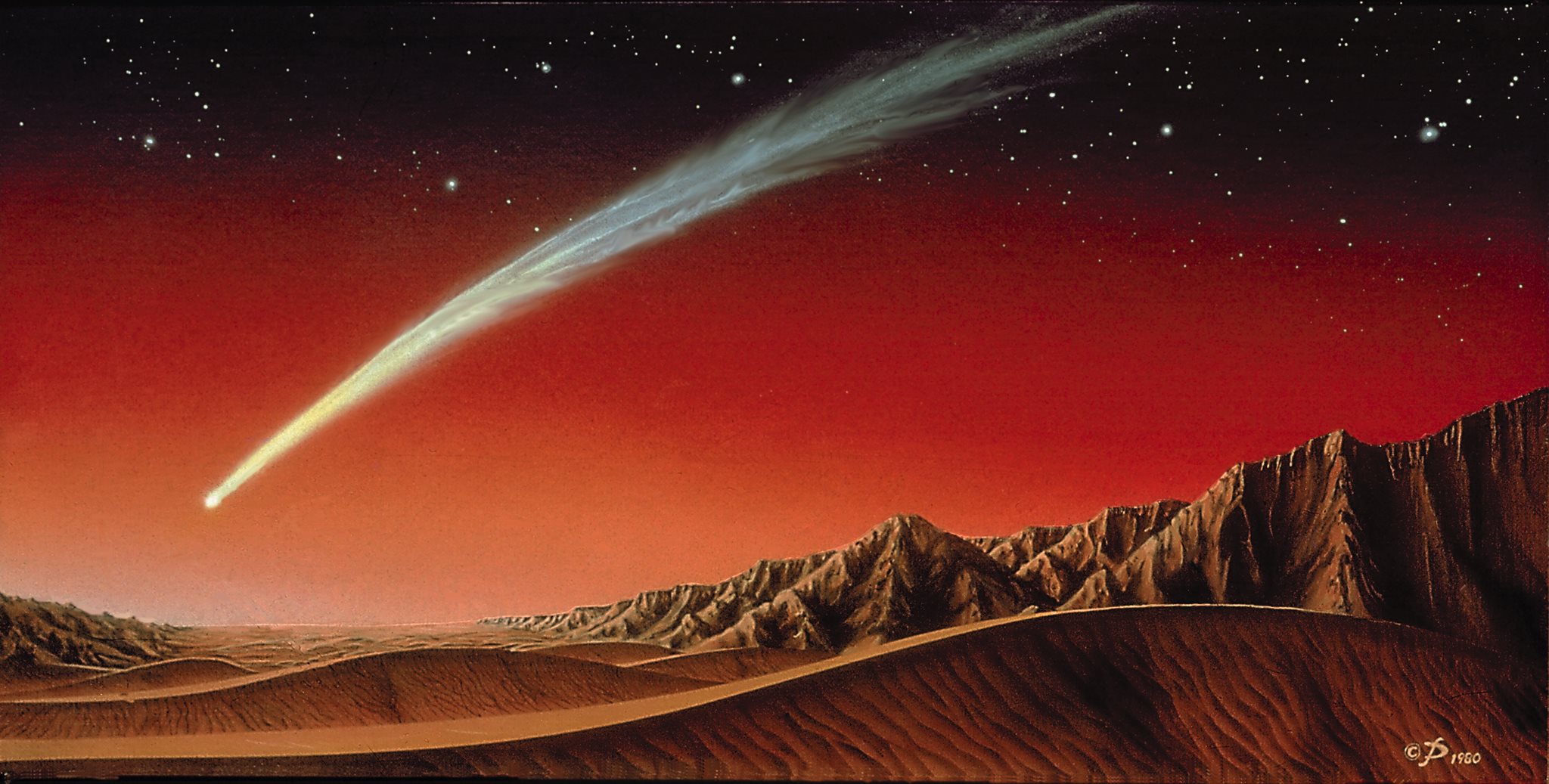
One idea for terraforming Mars involves crashing kilometre-scale ice-comets onto the planet's surface.

A comet impacting on Mars

That might kick-start a colony, but the surface gravity of Mars isn't sufficient to retain a reasonable atmosphere and water over thousands of years.

We could be optimistic and hope our descendants will fix this problem, but why not a little insurance?

I propose we choose some large ice-comets, preferably in the outer system where gravitational perturbations from the likes of Jupiter and Saturn are minimised, and adjust their orbits to intercept Mars in, say, 5,000 years time.

The downside: if there's a civilisation on Mars at that time which lacks technological sophistication, they're going to have some real bad days.

The upside: some would survive. But if Mars loses its water and oxygen, they're all toast anyway.

---

I checked. The JPL ephemeris program can currently model the position of the planets out to 3,000 AD. Their positional accuracy for Mars is around plus or minus one kilometre.

I think we can do this, people.

You know they'll thank us in the end.

Wednesday, February 10, 2016

Quotes

Quote from Andrew Ng, Chief Scientist at Chinese search giant, Baidu:
"Worrying about AI evil superintelligence today is like worrying about overpopulation on the planet Mars."
---

An anonymous comment at Scott Alexander's Slate Star Codex:
Slate Star Codex is 140 IQ discussion about 105 IQ issues.
(Ouch! That post has more amusing and cringe-inducing stuff).

---

Watch out for the LIGO announcement tomorrow that the coalescence of two orbiting black holes has been observed through their gravitational wave signature:

"The masses of the black holes will be 36 and 29 solar masses at the beginning; and 62 for the resulting black hole. The reconstructed orbital speed will be almost exactly the speed of light. As a bonus, they will also observe the "ringdown to Kerr"
More here.

Thursday, December 24, 2015

Christmas Links

Two million YouTubers can't be wrong .. Happy Holidays!


---

Chinese is hard.
"At the end of three years of learning Chinese, I hadn't yet read a single complete novel. I found it just too hard, impossibly slow, and unrewarding. Newspapers, too, were still too daunting. I couldn't read an article without looking up about every tenth character, and it was not uncommon for me to scan the front page of the People's Daily and not be able to completely decipher a single headline."
Read David Moser's (University of Michigan Center for Chinese Studies) scintillating essay, "Why Chinese Is So Damn Hard" - even for the Chinese themselves.

---

Stairs. Such a long trudge forward to get any height .. but wait, Jess Riedel explains that 'alternating tread stairs allow for extremely steep stairs without making the tops of each step too short.'

Take a look at this diagram - the alternating tread stairs are in green - so what's going on?


Alternating tread stairs in green: get upstairs fast. But how does it work? 
---

Also from Jess Riedel. Alex and I watched this all the way through. If you want to go to Mars you'd better have plenty of delta-v, so big engines. Designing those calls for state-of-the-art computational fluid dynamics.

Great videos of their combustion chamber simulations and re-entry vehicle flows:- from SpaceX.


---

As I write, Clare and Alex have just departed for Midnight Mass. Have a good Christmas.

Thursday, August 20, 2015

Genetically Engineered People: ethics and prospects

The Economist coincidentally has this feature in its latest edition
Many SF writers have speculated about genetically-engineering people for diverse environments. Whether it's microgravity habitats, long-duration space missions, water-worlds or high-gravity planets, it seems plausible that we could help natural selection along the way and engineer human DNA to create the adaptations we would need to cope. I alluded to this in the recent post about about buying insurance in case of asteroid impact (apropos living on Mars).

Genetically-modified human: not a pretty sight
It's easy to float the idea, but could it work in practice? There are some ethical issues, to put it mildly. Although most mutations (I'm thinking SNPs - single nucleotide polymorphisms) are additive, the complex relationship between DNA structure and gene expression makes it difficult to mathematically or computationally predict the phenotypical result of this or that allele modification. To get an effect akin to creating a new, tailored species of humanity would require thousands of novel alleles.

How does Nature do it? Evolution creates new alleles by mutation, at random: if the mutation confers an advantage it may survive and spread as the people carrying its less-adaptive competitors are preferentially killed by the environment. Each of us is here because thousands of our long-ago relatives who were somewhat unlike us died horribly, without reproducing.

If our predictive models were good enough, we could short-cut Nature's brutal 'generate and test' algorithm. But no simulation is likely to give us sufficiently accurate data - there are just too many subtleties in a world of real bodies, real environments and real life histories. We would have to do our best, bring new kinds of people into life and just see how they coped. Reduced to such real-life debugging, expect inevitable tragedies.

Greg Egan was thinking along similar lines when he discussed his novel, 'Permutation City'.
Q6: What do you regret most about Permutation City?

A6: Something quite separate from the issues with the Dust Theory mentioned above, although these are all valid points. What I regret most is my uncritical treatment of the idea of allowing intelligent life to evolve in the Autoverse. Sure, this is a common science-fictional idea, but when I thought about it properly (some years after the book was published), I realised that anyone who actually did this would have to be utterly morally bankrupt. To get from micro-organisms to intelligent life this way would involve an immense amount of suffering, with billions of sentient creatures living, struggling and dying along the way. Yes, this happened to our own ancestors, but that doesn’t give us the right to inflict the same kind of suffering on anyone else.

This is potentially an important issue in the real world. It might not be long before people are seriously trying to “evolve” artificial intelligence in their computers. Now, it’s one thing to use genetic algorithms to come up with various specialised programs that perform simple tasks, but to “breed”, assess, and kill millions of sentient programs would be an abomination. If the first AI was created that way, it would have every right to despise its creators.
So what do you think? If the prize was to colonise a new planet, one which could not be terraformed but which could be occupied by suitably-modified people, would the ethics committee approve? Wouldn't it be insane not to go ahead, accepting the inevitable (but hopefully short-term) suffering?

---
By coincidence, The Economist wrote about similar issues in this week's edition.

Wednesday, August 19, 2015

This could ruin your whole day ...

Perhaps we should start to listen to the Tesla guy and put some of our eggs in another basket (make sure the video captions are on - box on bottom right, left of settings; and you can lose the audio ).


If you followed the link you may never think about Excel spreadsheets the same way again.

Putting the 'one million people on Mars' to one side, here are some other options:
  • long-duration refuge sites buried deep inside the mountains; 
  • a (largely) self-sustaining lunar colony;
  • asteroid or orbital habitats. 
They're all hard - but then, so is Mars. Any place where we need advanced technology to survive at all is going to be vulnerable to system crashes. All the proposed refuges need advanced, not basic technology, sustained by hi-tech societies and lots of skilled people.

I would much prefer self-maintaining and self-reproducing technologies (aka 'life') which could be engineered to thrive in these hard environments and could create an ecology in which even underskilled and numerically-depleted humans could survive and progress.

Maybe needs a similar reworking of human, though (see this post).