Showing posts with label Permutation City. Show all posts

Tuesday, July 03, 2018

"Angelmaker": free will and quantum indeterminacy


Amazon link

In “Angelmaker’, Nick Harkaway’s Apprehension Engine MacGuffin threatens to bring complete truth to the human race, in the process necessarily eliminating quantum uncertainty. According to the government agency tasked with suppressing this dastardly plot, this would end reality as we know it. People would be reduced to Laplacian clockwork automata; Free Will would vanish.

The agency is most likely wrong about that, and I'm still too early in the novel to determine whether the author shares that belief (which incidentally didn't seem all that upsetting to Laplace).

---

AI researchers tend to take it as axiomatic that human consciousness (including the illusory sense of free will) may be implemented on a classical computer - no explicit quantum phenomena there.

But are they right?

Neurons are chemistry and chemistry is an effective theory largely decoupled from its quantum foundations. Indeed it's news when a non-classical mechanism is discovered within the chemistry of the cell, such as electron tunneling transport in ATP synthesis.

But nothing in biology depends upon 'the collapse of the wave function’.

In my QM course (SM358) we discussed atomic and molecular structure in terms of orbitals - solutions of the time-independent Schrödinger equation. There were no quantum fluctuations (except for the miniscule Lamb shift), and nowhere for free will to be smuggled in.

Amazon link

I'm reminded of Greg Egan's (classical simulation) Autoverse in his novel Permutation City. If our universe could be re-engineered to work in a Laplacian fashion (and maybe it does) I don't think in a state of nature we'd really notice. Historically, people didn't, you know.

---

I wrote this today while Clare was swimming. Strangely, Google didn't autocomplete this one.

---

Backreaction has a post on this very subject just out. Take a look.

Monday, June 06, 2016

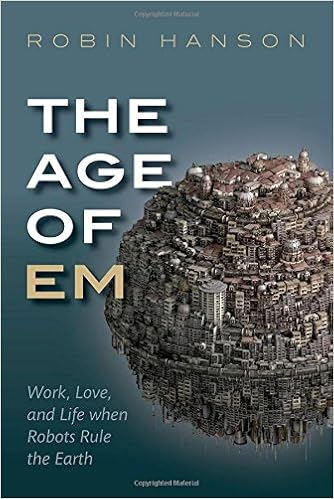
A book abandoned

Cool cover art.

 Amazon link

I read Scott Alexander's extensive review and tried to cancel but too late: the very next day the Amazon parcel arrived. Alexander's review is an easier read than the book itself, which is written in a 'flat' academic style akin to a succession of Wikipedia mini-articles.

I wouldn't have minded if the content had been as described in the back cover quotes ('mind-blowing', 'fascinating', 'stimulating') .. but the ideas are relatively pedestrian, what you would expect if you thought about it a bit; many of Hanson's assertions are plausible without being that compelling.

So after a while of mentally chewing on cardboard, I abandoned.

If a society of brains-emulated-in-hardware-and-software is truly your thing, then it's a lot more fun reading Greg Egan's sublime Permutation City.


---

Back yesterday from a couple of days camping on the heights above Minehead where we also took in the Civil War reenactment at Dunster Castle.

Clare fronting the view of Minehead from the campsite

Dunster Castle: the women spin and cook behind the cannon

The pikemen and musketeers assemble

I'd anticipated a mass mêlée, a pitched battle of The Sealed Knot - but what you see in the pictures was what we got.

The fighting persons in close-up

I especially liked Ginger Baker (above) who gave us a one-person marching drum solo after the obligatory team musket discharges and pike-drill.

Thursday, August 20, 2015

Genetically Engineered People: ethics and prospects

The Economist coincidentally has this feature in its latest edition
Many SF writers have speculated about genetically-engineering people for diverse environments. Whether it's microgravity habitats, long-duration space missions, water-worlds or high-gravity planets, it seems plausible that we could help natural selection along the way and engineer human DNA to create the adaptations we would need to cope. I alluded to this in the recent post about about buying insurance in case of asteroid impact (apropos living on Mars).

Genetically-modified human: not a pretty sight
It's easy to float the idea, but could it work in practice? There are some ethical issues, to put it mildly. Although most mutations (I'm thinking SNPs - single nucleotide polymorphisms) are additive, the complex relationship between DNA structure and gene expression makes it difficult to mathematically or computationally predict the phenotypical result of this or that allele modification. To get an effect akin to creating a new, tailored species of humanity would require thousands of novel alleles.

How does Nature do it? Evolution creates new alleles by mutation, at random: if the mutation confers an advantage it may survive and spread as the people carrying its less-adaptive competitors are preferentially killed by the environment. Each of us is here because thousands of our long-ago relatives who were somewhat unlike us died horribly, without reproducing.

If our predictive models were good enough, we could short-cut Nature's brutal 'generate and test' algorithm. But no simulation is likely to give us sufficiently accurate data - there are just too many subtleties in a world of real bodies, real environments and real life histories. We would have to do our best, bring new kinds of people into life and just see how they coped. Reduced to such real-life debugging, expect inevitable tragedies.

Greg Egan was thinking along similar lines when he discussed his novel, 'Permutation City'.
Q6: What do you regret most about Permutation City?

A6: Something quite separate from the issues with the Dust Theory mentioned above, although these are all valid points. What I regret most is my uncritical treatment of the idea of allowing intelligent life to evolve in the Autoverse. Sure, this is a common science-fictional idea, but when I thought about it properly (some years after the book was published), I realised that anyone who actually did this would have to be utterly morally bankrupt. To get from micro-organisms to intelligent life this way would involve an immense amount of suffering, with billions of sentient creatures living, struggling and dying along the way. Yes, this happened to our own ancestors, but that doesn’t give us the right to inflict the same kind of suffering on anyone else.

This is potentially an important issue in the real world. It might not be long before people are seriously trying to “evolve” artificial intelligence in their computers. Now, it’s one thing to use genetic algorithms to come up with various specialised programs that perform simple tasks, but to “breed”, assess, and kill millions of sentient programs would be an abomination. If the first AI was created that way, it would have every right to despise its creators.
So what do you think? If the prize was to colonise a new planet, one which could not be terraformed but which could be occupied by suitably-modified people, would the ethics committee approve? Wouldn't it be insane not to go ahead, accepting the inevitable (but hopefully short-term) suffering?

---
By coincidence, The Economist wrote about similar issues in this week's edition.