Showing posts with label Science-Fiction. Show all posts

Sunday, January 03, 2021

“Julia et le Voile de la Réalité” by Adam Carlton

From OpenArt

I move towards her table in the cafe of La Réserve, where she sits quite alone with her espresso. I know a lot about her already: her name is Julia, she is twenty five, the pampered only-child of rich Parisian parents. She has recently completed a doctorate in mathematics at the Sorbonne. She has a reputation for being both snobbish and rude.

We were interested.

I sit at her table, muttering in her general direction “You don’t mind?” and then ignore her. A waiter glides up and I order, mirroring her choice of drink. I lean back in the wicker seat and return attention to her.

“I believe you're Julia,” I say, “I’ve heard about you and I wanted to have a word. You OK with that?”

For the first time she looks directly at me. She sees a young man about her own age, rather typical of the arty types who hang around the fifth arrondissement on the Left Bank. Hair a little too long, clothes smart casual, I must come across as the bohemian intellectual, very much part of her own milieu. She says nothing, however, just settles back and waits.

“I work in R&D, a research institute south of here. We’re currently recruiting and someone mentioned you were currently contemplating your options?”

“Your work,” she says, seemingly indifferent, “what exactly do you do?”

I play faux-humble: “Actually, I’m the CTO. But tell me about your own work, which I’m told is impressive.”

I generally adopt the consultant’s methodology in situations like this, honest flattery. It tends to work best when the subject is humourless, which I sensed might apply here.

“I studied computational differential geometry,” she says, looking at her fingernails, “I use numerical analysis to approximate and solve problems in differential geometry. By discretizing high-dimensional continuous geometric manifolds into a lattice of simpler elements I model geometric structures on a computer.”

So that was the game: throw a grenade into the conversation and see what happens. She could have just asked me for my credentials.

“There’s been a lot of work on lattice QCD and also in GR in recent years,” I reply, “and the results have been good, once convergence issues were addressed. But I gather your work was something different?”

So now lofty condescension is replaced by the sharp gaze of suspicion. I'm surprised by the sudden change in her voice. It's like hearing a streetwise chick speak, une meuf qui parle wesh.

“Are you an expert in this field?” she says aggressively.

“I’m afraid not, I’m just an ordinary graduate in technical stuff. Not even from an elite school like yours.” And then in a lower voice, as if I didn’t care whether she heard me or not, “They hired me mostly for my other skills.”

Superiority established, she relaxes and runs her fingers languidly through her long dark hair.

“So what do you do?” she asks.

---

Julia’s interview was at the Institute’s research centre, the Château de la Bourdaisière situated between Tours and Amboise. A former hotel, its peacefulness and secluded location made it ideal. Our idea of an interview was a walk in the grounds on what was a beautiful sunny afternoon. A walk in the park.

“OK Julia,” I said, as we weaved between trees in the smoothly manicured grounds, “there’s always been a tradition in physics of extra dimensions, right?”

Julia was wearing a short black dress, orange and black, all whorls and knots; it seemed warm for this weather.

She affected boredom. Such a stupid question. After all, everyone already knew the answer.

“Kaluza-Klein theory made electromagnetism as geometric as gravity,” she said. “Einstein was impressed, but it wasn’t quantised so everyone else - not so much. Then the String Theory people came along and the extra dimensions proliferated. But there’s never been any physical evidence. That’s why I prefer to stick with maths.”

“OK,” I said, being careful now, “At the Institute we do actually have some evidence of extra dimensions - but not in the sense you mentioned.”

At this she slowed to a stop and turned to face me, hands on hips, an irritated expression on her face.

“Really? I think I might have heard about that!”

“Well, it’s indirect of course, but the extra structure we’re seeing, it isn’t another continuum like those compactified spaces you mentioned. It’s a discrete network. You know, nodes and links? Nodes which can do computation and links which are weights. And it’s a structure which seems to change as we observe it.”

“That sounds more like an artificial neural network to me, you must have made an error.”

“We don’t think so, Julia. Now I accept that ANNs are not your speciality but we think that your computational expertise might add value in researching the interface between this presumed ANN dimension and ordinary reality.”

She prepared to speak, no doubt to dissent, but I cut her off.

“It’s causal,” I said, “In both directions.”

---

We showed Julia the evidence, which was technical, highly indirect but persuasive. The ANN was vast - on the scale of our own universe - but from its ‘elsewhere’ it touched our reality everywhere.

“And you really think it's real?” she said. “Do you think that Einstein thought of geodesics in curved space-time every time he dropped his keys? Do you think Schrödinger saw nothing but collapsing orbitals when he looked across the dew-strewn meadows at the rosy fingers of dawn? Because I can tell you they didn't. It's an intellectual game we play, moving symbols around. Don't tell me it's real.”

“It’s just science,” I said to Julia, “We found real evidence; we don’t understand it; we’re going to figure it out.”

And so she was in.

---

We attended Mass at the Eglise Saint Symphorien de Larçay, about a ten minute drive from the Château. Catholicism had been dying in France for decades, yet Julia’s parents were from that old, conservative, aristocratic stock who had ensured their daughter had received a good religious upbringing; she still attended church regularly. 

Me, I was lapsed.

The reading was Matthew 4:5-7, “Then the devil took him to the holy city and had him stand on the highest point of the temple.  “If you are the Son of God,” he said, “throw yourself down. For it is written: “‘He will command his angels concerning you, and they will lift you up in their hands,so that you will not strike your foot against a stone.’ Jesus answered him, “It is also written: ‘Do not put the Lord your God to the test.’

At this point the priest, a battered, elderly man with a shock of white hair, turned a hard glance into the congregation, fixing his angry eyes upon me. To my left (we stood shoulder to shoulder) I felt Julia stiffen.

The homily was indeed on the theme of hubris, and the sin of placing rationality before faith.

---

I was in Julia’s apartment. Because of the Château’s rural remoteness and its legacy as an ex-hotel, the Institute offered staff rooms set aside as bedsits. Both Julia and I had elected to make use of this arrangement.

I sat in one of the chairs next to a small table - she had made us coffee - while she sat on the bed. She looked guilty.

“What was that about?” I asked.

“Père Emmanuel knows something about what we’re doing here,” she said in a low voice.

I considered this. We had absolutely no outreach programme with the outside world. Then a thought occurred: “This was through the Confessional, wasn’t it?”

She nodded, and proceeded to elaborate - or to confess.

“I worry about what we do here. We operate as though we’re dealing with a perfectly natural phenomenon, a structure present throughout space and time which ‘knows’ what’s happening  and ‘alters’ outcomes. If that’s not God, what is?”

I was genuinely shocked: that was not our reading of the situation at all. 

“Julia, you’ve gone well beyond the evidence. Look, minimally we have evidence of a structure orthogonal to our experienced reality, which perhaps looks a lot like a neural net. Maximally we have some evidence that consciousness inheres in a fundamental, albeit almost inaccessible and invisible constituent of reality. That idea, though unorthodox, has a name you know: panpsychism. More than a few reputable scientists have bought into it.”

She looked stricken. On a sudden impulse, I got up from my chair and sat down beside her, pulling her close for reassurance. A worried Julia snuggled into my shoulder, unconvinced.

---

Outside our little haven, things were getting worse. We were making progress in our work, trying - as Père Emmanuel might say - to know and understand the Mind of God. We wanted to read the structure, to disentangle and unpack cause and effect. Perhaps even play at being our own little gods, altering the network according to our own desires. In all this, funds were never an issue. Our backers, rich private individuals and national security interests, were visibly excited and energised by our findings.

The crisis came to a head two weeks later. Staff from the Institute had been reporting hostile glances and unfriendly jostling when they mingled in the local community, shopping or visiting clubs and bars. Somehow we were becoming notorious despite our best efforts.

Julia and I had become closer. She had not lost her effortless superiority, her sense that she was slumming with an ill-credentialled, uncultured arriviste such as myself. Yet as we walked in the parkland, sometimes our hands would - deniably - brush against each other, or I would help her down some steep gully in a small copse. Julia seemed to need emotional comfort, some non-threatening support.

The old hotel lounge was deserted, one late afternoon when we chanced to meet up. I wanted to know how her work was coming on; but really I wanted to assess her state of mind, her emotional stability. Over coffee we talked.

“I don't know what you thought but I'm not here for theory work, you know,” she explained slowly, “You've got some really good people here, to my surprise.”

Typical Julia, I thought, that old arrogance, you really haven't changed.

But she had, a bit.

“They produce theories and I'm the phenomenologist, I translate their schemas into computer models and run the simulations. Then it's over to the experimenters.”

“I knew you'd add value,” I said, “And I had few preconceptions as to how. But let me ask you something else, let me use one of my ‘other skills’. You're not super-active on the social scene here, not that there is much of one. Does that worry you?”

I was expecting any of: an angry rebuttal, a sarcastic put-down, a slap-down for lèse majesté. To date, Julia had been hermetic in her invincible superiority. Yet, as I observed her closely, I could see signs of a change behind that fixed expression, some softening of her mood.

“I've had a difficult upbringing,” she said, “I was not encouraged to be open with people - ‘We have standards,’ I was always told. I don't find it easy to socialise, it's hard for me to make people out, it's easier just to ignore them.”

I nodded sympathetically, aware of how fragile this moment was. “Let's be friends,” I said simply, aware how weak this offer was, yet also how nothing more would carry conviction.

I stood up, smiled and left without waiting for a reply.

Later that week we were in her room, laughing and joking about something. I playfully pushed her onto the bed and as she lay flopped on her back she said to me amid peals of laughter, “I’m not going to sleep with you, you know!”

I sprawled over her then, our faces centimetres apart. She put her arms hesitantly around my shoulders, her legs seeming of their own accord to accommodate me, the fabric of her jeans rustling against my chinos.

“Of course you won’t,” I said.

---

The riot started on Sunday an hour after Mass. Père Emmanuel had brought some dozens of his flock - beefy farmer types armed with the tools of their trade - to protest outside our well-guarded front gates. A tractor dumped bales of straw ready to be set afire. Burn the heretics. The priest stood on the trailer and began to rant and rave against this lair of the devil. It was call-and-response, hammers and pitchforks raised in unison, the old communist symbols repurposed.

Quite a few of the resident staff were there to watch along with Julia and myself. Our small group clumped on our side of the perimeter, positioned where we could see most of the action. Our security staff and the local police were inconspicuously observing the unfolding situation, waiting impassively. 

Père Emmanuel was getting more excited, doing God’s work with indomitable confidence. It was at the peak of his exertions when there was a loud percussion and the priest dropped as if felled, toppling off his perch and onto the gravel track.

For a moment, nothing… and then all hell broke loose.

Along with the rest of the staff we were hustled away from the stones and the sudden molotov cocktails arching across the boundary hedge. I myself was struck a glancing blow by a sharp wedge of flint, doing my duty, shielding Julia.

Then the forces of law and order went in hard, as is the French tradition. We could hear the screams from back at the house.

---

Local news reports gave credence to satanic rites, black magic and the intervention of the evil one.

Official reports suggested the accidental operation of a stun grenade and a stress-induced heart attack. We didn't even bother publicising the facts of the matter. Instead we simply waited the media out, knowing that within a couple of weeks attention would simply shift to the next salacious novelty. And we redoubled our security.

Julia, however, was psychologically devastated. There was nothing I, or any other member of the Institute could do.

---

Within a week a new priest arrived at the parish. 

Père Valmont, SJ could not have been more different from his predecessor. No doubt someone had had a word with the Archbishop in Tours. He was young, energetic, technocratic - and anxious to have a conversation with Julia.

As was she with him.

After her meeting with the new priest she asked to talk with me in the old library. Surrounded by ancient volumes in their multistoried cabinets, we sat and appraised each other. Finally I asked what the new priest had said. It had evidently had an impact since Julia's spirits seemed to have completely recovered. In fact she was a different woman now: eyes sparkling, her entire being re-energised.

She settled back, her eyes losing focus, and began outlining what the priest had told her.

“He said the answer to all my questions is something called ‘Molinism’,” she began,  “It’s named after the 16th-century Jesuit theologian Luis de Molina. In fact Père Valmont was keen to emphasise the role of the Society of Jesus in these matters!”

She smiled at this, as if acknowledging her new priest's human pride in his order. 

“Molina was deeply concerned with the apparent tension between God's foreknowledge and human freedom. If God knows everything in advance, how can we truly be free in our choices? And if He is omnipotent, why does He allow evil to exist in a world He created?”

I nodded. I rarely thought about theological matters but this had always seemed a bit of a show-stopper.

“The priest said that Molina came up with the concept of "middle knowledge" - scientia media. He argued that God knows not only what will happen, but also what would happen in any possible circumstance, given the free choices of individuals. You are free to make your choices, but God, through His middle knowledge, knows precisely what those choices will be without coercing or determining them.

“God doesn’t override your ability to choose; rather, He allows you to act freely, while at the same time ensuring that His ultimate purposes are fulfilled. Evil, though tragic, is permitted because it is part of a broader tapestry that, through God’s wisdom, will ultimately bring about greater good, even if we don’t fully understand how.”

“That sounds pretty hand-wavy,” I said.

She ignored that, knowing she was about to enlighten me.

“Then he said that he had been told I was a mathematician, and would therefore have no problem with the idea of God minimising the path integral of Evil minus Good over possible universes (think of a path here as the entire history of a variant universe, he said). God’s Lagrangian, he called it; he said that Richard Feynman would have understood.”

“I had no idea the Jesuits trained their people in advanced mathematical physics.”

“I think he might have been ‘specially chosen',” she replied, with unexpected irony.

“So how does this resolve your damning ethical and theological problems with our work here?”

I was nervous about broaching this question. I did not want to bring the whole house of cards tumbling down by stupidly highlighting any weak points in her new-found certainty. 

But I need not have feared: her familiar look of patronising superiority returned.

“I reviewed my models,” she said, “in my head, on the way back. We already looked at what properties in the world the network structure was optimising as it processed its inputs. That was the motivation for some of the experiments we did, ethically dubious as I now see them to be. I’ll go check some more, but I’m sure I must have already known subconsciously what was really going on. Wow, this is so big, you know!”

And with that she stood up in haste and returned to her office, her mind already far elsewhere.

---

Roll the calendar forwards. Julia and I are walking in the grounds as we so often do now. It is a balmy late-summer evening, still warm with the light pleasantly fading around us. We are walking hand in hand. This new Julia is more self-assured, less conflicted. It’s as if she has let something go and found that her demons did not erupt, did not take over, did not even exist: phantasms that have finally departed.

We stop at a tree by the lake and she leans against a sturdy tree as we embrace. This is the stuff of teenage fumbling: items of her clothing tumble to the grass; our moves become more intense, more intimate. She flushes, her small sighs say she is done. I lead her by the hand and motion her down to the shaded grass. At first gently, then with furious energy I make love to her. All my pent-up tangled feelings, the tensions of our last weeks, now released in this moment of catharsis.

And afterwards she stands up, pulls down her dress, picks up her belongings from the grass and looks at me cooly.

“I told you I would never sleep with you,” she said.

I look at her, gripped by confusion. I’m unprepared for sudden rationality.

“And so, this,” she says, and walks away, leaving me standing there, uncomprehending and aghast.

The next morning she leaves the Institute for ever, checking out in the grey predawn, a taxi to the station, no forwarding address.

I am not worried for her, I know she has her network. It’s elsewhere that I look, floundering in my grief and disbelief.

What was the optimisation there? I silently pray, What greater good did that entail?

No matter how our research may fare in the future, I know that that is something I will never understand.


You will find my collection of short stories, published on Amazon (Kindle and paperback) here:

"Freyja’s Deathbed Conversations: and other stories" (2019)

and my SF novel, also published on Amazon (Kindle and paperback) here:

Feel free to purchase both!


Friday, April 24, 2020

"Super-Fab" by Adam Carlton

1: Charity

     They first arrived in charity shops, no-one knew from where. In appearance they were like microwave ovens: cubical things, cavities whose front door came with a screen rather than a metallised window. Soon, however, their true function became apparent: they fabricated things.
     Mrs Chigwell from Bournemouth Children’s Aid took delivery of the parcel. The charity shop was on the high street, one of a cluster. She had been manning the counter for half an hour but business was light. Squally rain outside had deterred passing trade, though as she surveyed the racks of old books and dingy clothes she could see one or two regulars hunkered down at the back, waiting out the heavy morning hours of a long, tedious day.
     The doorbell rang and a young delivery man walked in, staggering under the weight of his package. Mrs Chigwell gave him a tentative smile and beckoned him to place it on the table they used to sort through donations. It seemed quite heavy and cumbersome and at first she thought it might have been a mis-delivery from Amazon. They surely weren’t expecting anything, or at least she hadn’t been told. But Amazon didn’t make those kinds of mistakes, did it?
     Mrs Chigwell beckoned her daughter across to help. She was so proud of Julia. Doctor Julia she reminded herself, with that advanced degree from Imperial College up in London. Julia was down for the holidays, helping her out in the shop. She'd know what to do.
     Julia and her mother carried the box into the kitchen at the back of the store and got it unpacked. The instructions were written in a curious variant of English but were not hard to understand. The first thing to do was to plug the machine into a wall socket.
     Mrs Chigwell smiled. Her passing thought was that they were on the receiving end of a practical joke. It was very elaborate, she thought, could this be something dreamt up by Mr Harris who managed the shop? It was getting near Christmas and at a stretch she could imagine it was the kind of thing he might do, something to lighten the spirits. Could it be fairy-lights?
     Julia read from the instruction flowchart. She mused for a while, trying to make a decision. Finally she said, “I’d like a nice cup of hot chocolate.” Mrs Chigwell openly laughed: her daughter was such a tease. The machine promptly replied--Mrs Chigwell gave a small start of alarm--asking her to open the door and place inside various pieces of food rubbish. It listed the kinds of things it wanted.
     The deplorable state of the kitchen (no-one had cleared up recently) sufficed to provide several slices of stale bread, a plastic bowl of cold, discarded chips and a cup full of water. Mrs Chigwell was again reminded of a microwave as the box hummed, giving out a slight smell of ozone. Five minutes later there was a soft chime and the screen flashed a ready message. Inside Julia found the garbage had been transformed into exactly what she had asked for. She cautiously sampled the piping-hot drink--it turned out to be delicious.
     Children’s Aid in Bournemouth was just one of thousands of outlets which received a ‘Super-Fab’ as they became known. The Internet buckled as people experimented, tested and speculated as to how they worked, racing to confirm that they were indeed trustworthy. A consensus grew that they were the very latest in 3D printers. There were no obvious limits as to what they could produce, provided they got the right raw materials and the result would fit in the box. And they really worked, did just what they advertised.
     So that was the very earliest understanding of the devices. That, and the fact that no-one seemed to know where they had come from.
     Mrs Chigwell set the machine up in a corner of the shop and advertised free food and drinks to the passing homeless people of Bournemouth. The cost to her was volunteer time, power from the mains and leftover rubbish and water which the machine consumed as raw materials. She was not the only one, and in this small way the sum of human happiness increased a trifle in Britain’s run-down towns.

2: Replication

     The machines had an unexpected party piece: they could produce themselves. This was discovered by way of a joke request from Perry Zhang, a student at Manchester University on the second day after the machines surfaced.
     Perry made his humorous suggestion and, to his surprise, was asked to fetch various raw materials. He shoved in some old mobile phones, some plastic water bottles (full) and a few other household items until the machine professed itself happy. After less than ninety minutes the door opened and Perry was able to pull out a number of small rectangular units. After another feed and a further hour, more units became available and thereafter it was a simple matter for Perry to stack these into a cubical shape the same size as the Super-Fab--it turned out there was only one way to do it.
     A faint smell of burning emerged from the assembly as temporary partitions dissolved and internal connections welded tight, and then it became apparent that a second, identical unit calmly squatted in front of Perry. A copy had indeed been fabricated.
     The cost: Perry’s unskilled labour, some surplus electronic devices and other junk and three hours of electricity at the level of a one-bar fire. Perry tested the newly-spawned device until he was sure that it worked correctly, then he gave it to his girlfriend.  He wrote up his experience on his social media page, mentioning that the device had told him it could produce a new Super-Fab of any size at all. Useful, it suggested, for making bigger things.

3: Production

     Bill Jones ran a small factory in Birmingham making clocks. He bought in parts from many suppliers and employed skilled workers and advanced machine tools to create his high-quality products. Since you could buy timing devices from many sources at rock-bottom prices, the clock-making business was precarious. Bill’s enterprise survived in an artisan niche, making quirky, individualistic devices for discerning bohemians and specialist customers.
     Bill was imaginative and a go-getter. He bought a Super-Fab from one of the middlemen-sellers who were rapidly springing up and tested it in a spare workshop next to his office. The machine asked for a sample of the clock Bill intended to duplicate. Bill settled on one of his more intricate and expensive ones, a specialist device the Navy used on submarines. The machine also requested the ’blueprints’ in standard CNC G-Code format.
     After some minutes of analysis, the machine requested a list of low-value raw materials--plastics and metals. Bill was easily able to procure these from the factory stockroom. Soon, after the usual humming and ozone, a duplicate clock emerged. Bill thought that it looked identical to those his factory regularly produced at some considerable expense. He sent it for testing; it passed with flying colours, well within all the tolerances.
     Bill thought long and hard.
     First off, I could get this machine to duplicate itself, he thought. Run a few cycles of that and I’d have a rack of them at next to no cost. Then I could let my highly-trained but expensive production workforce go, just keeping a couple of conscientious but unskilled guys to run the Super-Fabs. My existing machine tools could be recycled as raw materials. Then I could churn out clocks across my product range on demand.
     What would it cost? He thought about it: electricity, waste materials and a few ancillary helpers. His costs would plummet; he would make a fortune. But then he thought some more. His competitors were not stupid; they would surely do the same. The price of commodifying clocks would plunge to their basic cost of manufacture.
     And then he had a further thought: why will my customers need me? They could do this for themselves if they’ve got one of these machines. All they need is a blueprint, a specification and they can get that on the Internet just like I do. So in fact I don’t have a business any more. He immediately called his lawyers and arranged a crash meeting to liquidate his company. Would anyone be mug enough to buy it off him?

4: Macroeconomics I

     The effects of the explosion of Super-Fab numbers on the economy were not long coming. The machines could replace much conventional manufacturing which displaced workers from the labour market in droves. Consequently social-security and unemployment-pay demands had never been greater, yet as tax revenues fell the benefit system couldn’t keep up. In many cases benefits were time-limited--but future job prospects for workers in manufacturing had never been bleaker.
     This could have been catastrophic--except that there were now plenty of charities which would provide any worker or family who needed it with a free Super-Fab. Once they had the machine, plus scraps and an electricity supply, then they could make practically anything they needed. So the lack of wages wasn’t an immediate, life-challenging problem.
     Dependence on electric power was, however, an issue; the national grid itself became brittle. Some workers failed to turn up for work since they didn’t really need a full wage. But others, those expelled from the labour force, were finding it difficult to pay for power and other necessities such as rent.
     People discovered, however, that the machines could produce both solar panels and a highly-efficient battery. A new kind of battery pack (a radioisotope thermoelectric generator?) had been designed by some smart ‘makers’ as they were being called--leftist engineers in the emerging counter-economy.
     Soon networked Super-Fabs were talking to each other, exchanging raw materials and sub-assemblies. Some people of philanthropic bent with access to land used their spaces for giant versions of the Super-Fabs. These could produce artefacts as large as ships or aircraft--or transporters to take these giga-machines to wherever they were needed.

5: Robot

     Small businesses like Bill Jones’s clock factory were soon out of business. But perhaps that had always been expected with the march of automation. More surprising was the demise of service jobs such as plumbers.
     Catherine May was perhaps the first person to discover the astonishing versatility of her miracle box. As the puddle emerged from behind the washing machine she sobbed in despair. She had never been able to find a reliable plumber and this emergency was not to be born!
     A small sound, like a trap door opening, warned Catherine that something else was happening. Strange, vaguely threatening devices were emerging from a hitherto-unsuspected opening in her Super-Fab. Catherine desperately rushed across to her six-month-old child in its high-chair to protect it.
     Such instinctive caution was unnecessary, however. The miniaturised crawling and flying things approached the mass of pipes behind the leaking machine and began to inspect them. Soon a larger device emerged from the front aperture of the Super-Fab: something which had arms built for engineering, something that looked like a traditional science-fiction robot.
     Twenty minutes of clunking and squeaking, replacing and lubricating followed, completed by a small amount of mopping. The devices returned to the Super-Fab to donate their bodies for re-use; the machine announced that the problem was fixed.
     “How do you know?” asked a quavering Mrs May.
     “Everything a plumber knows, I know,” said the device with not a trace of pride, “I’m on the Internet.”
     And so plumbers, hairdressers and other personal-service companies were rendered obsolete--and consequently bankrupt.

6: Macroeconomics II

     Once they were networked and had access to limitless Internet skills, the Super-Fabs were able to substitute for vast swathes of the existing economy. But what about big engineering? What was the story on dams and motorways? These were exemplars of social artefacts, things which it made no sense for any one user to dream up or install even if their Super-Fab had the theoretical capability.
     In fact the Super-Fabs did have the capacity for heavy engineering. The networked devices were soon discovered to be mining, refining and transporting raw materials extremely cheaply--most of the cost was simply power. They would, however, do none of these things by themselves; someone had to request it. That someone could only be government. Private entrepreneurs had no personal use for such monstrosities since they could no longer figure out any way to make money from them.
     Why was that? Because with costs tending to zero, no private company could avoid being undercut by a competitor who could charge even less for the finished product. There had always been a left-wing criticism that some social needs were under-supplied because no capitalist would invest to provide the necessary product.
     The Super-Fabs, however, could produce human necessities at zero cost. They were like the blackberry bushes which grow in the natural world, offering their bounty to anyone who stretches out a hand, their miracle of sun-powered nanotech provided free of charge. The Super-Fabs would always crowd out a capitalist employer who could not price at cost and stay in business.
     Government was all that was left.
     What about the banks and investment? That too was a short story. The banks were impoverished by the drastic shrinkage of the capitalist sector of the economy, the lack of investment opportunities. But the role of money did not vanish. There was still a need for a means of exchange and a store of value. It was noted that the banks had predated capitalism and would outlast it, at least for a while.
     However necessary it might be though, Government was in crisis. Perhaps this refuted the communist ideal, or perhaps it was what Engels had meant by 'the administration of things rather than people'.

7: Governance

     The Prime Minister has arranged a private briefing at a secluded country house in Norfolk. This would have been in month three or four. The house is a fine example of Palladian architecture set in sculpted grounds. It has been rescued from the National Trust by a government which understands the periodic need for a refuge from everyday events.
     The PM sits alone in a large wood-panelled room, savouring the silence. It’s ten o’clock in the morning and the early spring sun sends shallow rays across the finely-mown lawns towards the lake. Birds take their leisure or skim the surface: ducks, he thinks, or perhaps grey geese. It’s hard to be sure at this distance. He sips his coffee and strives to be at one with the landscape. His momentary peace is spoilt by the muffled sound of the door scuffing open, marking the entrance of his civil service science adviser.
     “Who’s on first?” the PM asks.
     “The engineer.”
     “When do we get on to economic policy?”
     “This afternoon.”
     The first expert is wheeled in, a professor at Imperial College. The science advisor points her towards the lectern and its projection screen. The PM dunks a Brontë biscuit in his mud-coloured milky coffee--a secret vice--and sits back expectantly to listen. The engineer has been told to keep it simple. She explains that the Super-Fabs are part machine but mostly organic. Someone has expanded biology to encompass functions which are presently carried out by engines and electronics.
     “For example, mass-spectrometry and data packet routing are carried out by highly-modified biological organelles.”
     The Prime Minister has no idea what this means, so he does that thing politicians do, he changes the subject.
     “Do we know who did this? I mean, could we do this?” he asks.
     “It’s certainly beyond us,” replies the engineer, “It’s the kind of thing people have speculated about--synthetic biology. Probably designed by advanced AI systems. It’s certainly way beyond anything achievable by human experts.”
     “They tell me these Super-Fabs can now reproduce like amoeba,” says the PM, “So how smart are they? Are they spying on us?”
     The professor shakes her head in irritation.
     “Prime Minister, the really important thing here is the breakthrough to human-level intelligence. The AI systems on board these boxes can accomplish everyday tasks, like plumbing or car repairs or hairdressing, better than any human. They’re networked through the Internet and they learn from each other. They synthesise special robots and drones to do jobs and those robots come with a wider variety of sensors than humans ever had. They are so much more advanced than we ever imagined artificial general intelligence would be, surely the result of bootstrapping.”
     The PM doesn’t get this either but thinks it might be important; he glances at his science advisor.
     “She means a succession of AIs each designing a smarter version of themselves. In a few generations you might get to where the Super-Fabs are now. The problem has always been that very first step, the starting-off point. But it looks like someone finally did it.”
     The professor says sorrowfully, “You ask if they’re spying on us. Why on earth would they even bother?”

8: Abundance

     There is an evening debate at the London School of Economics. It's between two leading economists of differing persuasions. Only one will be invited to brief the PM, so the stakes are high. The chair-person addresses the student audience in the vast darkened auditorium.
     “It’s a great economic paradox we see today. The economy is in free-fall, a major contraction with bankruptcies everywhere. Yet people have never been so well provided for. Tonight we will attempt to find out why.”
     The format is a prompted discussion with the chair. The neoclassical guy, a professor based at LSE, opens by explaining that the Super-Fabs have changed the market-structure to such an extent that competition is killing existing businesses.
     “You may remember,” the professor says, addressing the shrouded mass of students, “how in your microeconomics course you were taught about perfect competition. Companies have to accept the market price on offer and a company’s profit is simply the general rate of interest.”
     The chair seeks controversy to liven things up: “But no company wants to be in that kind of a market, with no surplus funds for R&D, no spare capital for anything risky or speculative, no-one making any real money. It’s marginal whether to invest at all in a sector where perfect competition holds sway, isn’t it?”
     The LSE man smiles agreeably, waving his hand, “The Super-Fabs are dragging every sector of the economy into the very model of perfect competition. It's an excellent outcome. It's well-known this is Pareto-optimal for social welfare.”
     The chair mutters, almost inaudibly, “And yet the economy is close to collapse with an investment strike and no tax revenues.”
     “Not so fast,” interjects the heterodox professor from King’s College, taking on her LSE colleague, “All your talk of normal profits hides the fact that workers in a capitalist economy have to produce more value in the working day than they cost in their wages--that’s where the profits come from. But these machines, these Super-Fabs, aren’t paid wages. Once you have one you can produce goods and services at essentially no cost. The machines are even providing their own power supplies now--and sharing raw materials and components.”
     The chair-person hasn't heard this news.
     “Oh yes,” the King’s College professor confirms, “It seems that they’ve started doing those things. And once they show a new capability it spreads pretty fast.”
     The chair-person defends orthodoxy, “You can’t compete with free,” he objects, “No-one will invest. The economy is going to tank--unless,” and here he stares almost wildly at the assembled students, “unless they make the Super-Fabs illegal!”
     The heterodox economist rolls her eyes, “An employer will only invest if they expect to make money, but these machines are zero-cost slaves: both costs and revenues are tending to zero. That kind of competition is making capitalist production impossible. As my bourgeois friend here,” she points to the chair, “correctly states, you can’t compete with free.”
     The chair looks irritated at this faint praise.
     “However we have been here before,” she continues, “We’re transitioning to an economy the ancient Greeks or Romans would have been very familiar with. With automated slaves seeing to production there will still be plenty of administrative tasks, deciding those things which affect vast numbers of people. Greek and Roman politicians were justly famous. And we will have so much more in the way of resources. The Prime Minister may well be lauded as the Cicero of the new age!”
     There is applause at this, although some in the audience perhaps recall that Mr C. came to a rather sticky end.
     The King’s College economist is finishing up. “The Marxists always believed that capitalism would create the conditions for its own supersession. They thought it would have to be something violent like a Leninist proletarian revolution but that has never seemed remotely likely.”
     At this a small group at the back of the room unfurls a red banner adorned with a hammer and sickle and starts to hiss. But they calm down before they can be ejected; even they are interested in where the speaker is going with this.
     “But even Marx, you know, had some inkling of the truth. In his Fragment on Machines he predicted that capitalism would end up replicating and improving on every human ability, both physical and mental, thereby eliminating the need for human workers entirely. Capitalism is finally being vanquished not by the ascendant proletariat but by that class's very departure from the scene. And so we are where we are.”
     Amidst the applause it was enthusiastically agreed that King’s College would brief the Prime Minister.

9: Utopia

     Not every state in the world settled upon a managed transition like those in the advanced economies of the West. There were autocratic regimes which did indeed try to ban the Super-Fabs, imposing draconian penalties for possession. It was as if they had tried to ban breathing the very air itself, so they could maintain the sale of oxygen bottles.
     And so the world turned itself upside-down, roughly and smoothly, becoming a post-capitalist planet. It seemed there were a lot of things that ordinary, decent folk had always wanted to do. And now they had their chance.

10: Mallorca: some months later

     Julia lies on her beach-recliner next to Timothy's, listening to the quiet hissing of the waves. She is already regretting their impulsive hook up.
     Behind them, gleaming white rental apartments front the shoreline. There are no staff. With the complete hegemony of the Super-Fabs, hotels have finally become Le Corbusier's famed machines for living in. Julia beckons a passing beach-minibar for a refreshing chilled fruit cocktail.
     Timothy is from a well-off family--which had meant something tangible before the transition. He's currently working on his doctoral thesis: The Exogeneity of Moral Values within Marxian Ontology at Columbia University. The Old Philosopher’s work has achieved such a comeback over the last year.
     Julia herself is from the other side of the tracks, a sleepy, down-at-heel seaside town in England called Bournemouth. By grit and native talent she worked her way up to an advanced degree in ecology; her thesis on the dynamics of species in competition with each other.
     “Marx was right,” murmurs Timothy, mentally reviewing part of his own great work, “Once scarcity was abolished people were finally able to live up to their true potential.”
     “Yet the Super-Fabs can make guns, drugs and instruments of torture. They can and they do.”
     It’s a familiar argument: is the glass half-full or half-empty? Timothy isn’t really concentrating--these arguments bore him. He simply rolls out the standard rebuttal.
     “Most crimes disappeared when there was abundance. No need to steal, after all. Pretty much every human want is satisfied by something or other in the Super-Fab’s repertoire, there's no need to grab it by cunning, trickery or force. And the people’s police and justice system are perfectly able to mop up the rest, especially given the high-tech surveillance and enforcement kit the Fabs made for them.”
     Julia has been reading the local news reports. Something strange is stirring in the sun-baked volcanic interior of the island. Something which speaks to her professional training.
     “The global network of Super-Fabs now forms a completely-parallel ecology,” she says, “They're mobile and they reproduce. They were designed to serve us but things could easily go a little haywire. Some replication glitch, some programming error or hack would do it. Their and our basic interests are far from totally aligned. After all, God isn’t making much in the way of new territory, are they?”
      She sips her rapidly-warming drink.
     “The Romans were always most scared of a slave revolt, weren't they? That's why their punishments were so draconian.”
     Timothy doesn’t see how any of this could relate to his thesis. It seems orthogonal to the social relations of post-capitalist society, the economics of the transition to fully-automated luxury communism.
     Just scaremongering and doom-speak.
     Julia is not nearly as much fun as he’d hoped.
     Neither of them notices the black shapes emerging from the waves. Alligator-bodies with spectral eyes and laser-mouths crawling in their dozens out of the surf, here to recycle the garbage and claim their world for ever.

END

© Adam Carlton 2019.

---

This is a somewhat dramatised view of the inner logic of total automation.


You will find my collection of short stories, published on Amazon (Kindle and paperback) here:

"Freyja’s Deathbed Conversations: and other stories" (2019)

and my SF novel, also published on Amazon (Kindle and paperback) here:

Feel free to purchase both!


Wednesday, February 26, 2020

Deistic Ontology

Photo by Robynne Hu on Unsplash

Imagine the headlines:
  • Powerful alien discovered!
  • Alien has superpowers--knows what you’re up to!
  • You are being judged!
Don’t you think every government, military and R&D facility would be on the case, working up threat analyses on this powerful, moralistic entity?

Apparently not. Yet we have to take this Being seriously. Deny its existence and the Great Religions are simply men and women in frocks expressing pointless rituals: an OCD epidemic.

And as for their followers …

---

If God is real, what would our research programme conclude? Omniscient, omnipotent and moralistic: it’s a tough specification, pretty much full-on agency, a fully-realised intentional system.

Agents are conceptualised within AI as four-vectors: [Perceptions, Beliefs, Goals, Actions]. The corresponding agent-algebra tells you that perceptions combine with prior beliefs and goals to generate plans consisting of actions. In the process, beliefs and goals get updated. It’s more complex but this basic model is good enough for Government work.

Where do an agent’s goals come from? Ultimately from homeostasis requirements. The agent is designed to survive (in biology its genes are): as Woody Allen said, “80 percent of life is showing up.

The non-trivial agent confronts a challenging environment which knocks it away from its enduring, homeostatic ambitions--it gets hungry or thirsty; it’s threatened, damaged or needs to find a mate. In its situated context homeostasis determines goals and plans … and demands their execution to restore the agent to its set-point.

---

How do we apply this model to God?

For omniscience and omnipotence, God’s sensor and effector apparatuses must span all of spacetime. God’s beliefs should be accurate--but complete and effective sensory coverage should address that, other (processing) things being equal.

But what are God’s goals?

It seems parochial that a Cosmic God should be motivated by the needs or welfare of the puny beings of Sol Planet Three at Big-Bang + 13.8 billion years. I think we need a more universal homeostasis requirement, something more Spinozan.

God is concerned with preserving the harmony of the universe.

A requirement for homeostasis is only interesting if there is a threat to it. At the level of the universe--harmoniously regulated by the laws of physics--God becomes non-trivial, non-superfluous only if there is a threat to those very laws. Perhaps in the bifurcating projections of the universe's state-vector in Hilbert space--where our universe shimmers in possibilities--there are pathological outcomes which threaten the very fabric, the very integrity of the entire cosmos.

Catalysed false-vacuum decay.

Just as the coldest place in the universe is on planet Earth, perhaps the greatest threat to our universe’s stability is also here?

Imagine God as a deep neural net with inputs and outputs at each point in spacetime: past, present and future. The neural net resides in an orthogonal set of spatial dimensions and has a developmental trajectory in a second time dimension. Its understanding of the present state of all reality is its collection of input-vectors in superposition. Each input-vector corresponds to a possible world weighted by its amplitude.

The feedback loop in second-time is from possible worlds and their amplitudes through the God-net with its evolving weight-matrices through to spacetime actions through to revised amplitudes. The intent is to ensure that possible worlds representing pathological excursions constitute a set of measure zero.

Who or what is giving God grief? People who want supernatural actions--either to help their own cause or to bring fire and brimstone down on their opponents. Praying over the millennia hasn’t had much effect but high-energy physics?

It is possible to frighten God: perhaps in productive ways.

If you knew there was a well-funded, competent adversary-team with access to unimaginably high energy-densities sufficient to trigger a bubble nucleation event, what would you do? If you were a state with an intelligence agency and resources, that is.

Could we go beyond threats against the Deity. Could we converse with it -- is God a second-order intentional system? What should we say? Is God even a conscious entity? Is God classical or a quantum entity, could God be in a superposition of mental states?

So that's the setting (as requested). Now over to Adam to devise the characters, plot and narrative.

Tuesday, September 25, 2018

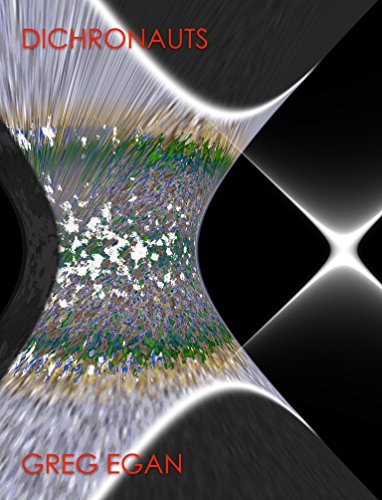
"Dichronauts" - Greg Egan


Amazon link

Grant Hutchison wrote this insightful review on Amazon.
"To some extent this is a companion volume to Egan's Orthogonal trilogy. In those books, he imagined what it would be like to live in a universe in which the time dimension behaved geometrically in exactly the same way as the three spatial dimensions, rather than with the hyperbolic coordinate relationship (described by special relativity) that we see in our own universe.

In this book, Egan describes a universe in which one of the spatial dimensions has time-like properties - introducing the hyperbolic relationships of relativity into everyday spatial coordinates. (The title, Dichronauts, meaning "travellers in two times" is a reference to the fact that his story universe has two time-like dimensions (time and "axial") and two regular spatial dimensions.

So we have a world in which simply trying to rotate an object can change its apparent shape; where it's impossible to rotate a north-facing object to face east, or an east-facing object to face north; where the stable shape for a planet is the hyperboloid depicted on the cover; where light can't travel to the north or south; and where falling over in those directions can have lethal consequences.

As with Orthogonal, Egan's aliens have one utterly alien property (in this case, we have two intelligent species that exist as commensals, one threaded through the skull of the other), but otherwise behave and speak like clever and amiable humans. And that's fine, because Egan's imagined world is strange enough without him expecting us to accommodate to an alien society, too. I'm therefore reminded of Hal Clement at his best, though Egan's characters have more humour.

The story is a quest, in which the reader finds out more about the world along with the story's characters. There are some surprises, and one toe-curling moment I certainly didn't see coming.

I knock off a star only because I think Egan's world may simply be too strange for many readers. In Orthogonal, one could amble along accepting that there was something a little odd about time without fretting about the details. In this story, almost every event is influenced by the strange spatial geometry, and if you don't find the geometry of special relativity engaging, you may be left floundering.

Egan provides some explanatory detail in the Afterword (which could productively be read first, since it contains no significant spoilers), and much more information on his website."
In fact the best advice is to read Egan's website physics primer first.

I read the first volume of the Orthogonal series and could't get into it. I felt that Egan was basically interested only in the setting - the physics - and was merely compelled by the fact that he was writing a novel to parachute some characters and plot in. Alternate spacetime topologies are plainly somewhat interesting, but one feels that 90% of the value is to be found on Egan's website in the relevant physics essays.

So I don't think I'll be reading Dichronauts any time soon. As another reviewer wrote:
"I really wish Grey Egan would stop writing these thought experiment alternate physics books. They're too much like hard work and are, frankly boring. He is a writer of enormous talent and needs in my opinion to concentrate on narrative and character rather than narrow concept world building."
My thoughts exactly.

Thursday, August 23, 2018

"Postmodernism, or, The Cultural Logic of Late Capitalism" - Fredric Jameson

Amazon link

I've just begun reading Fredric Jameson's masterpiece and was struck by this excerpt (page 4):
"As for the postmodern revolt against all that [i.e. modernism], however, it must equally be stressed that its own offensive features from obscurity and sexually explicit material to psychological squalor and overt expressions of social and political defiance, which transcend anything that might have been imagined at the most extreme moments of high modernism—no longer scandalize anyone and are not only received with the greatest complacency but have themselves become institutionalized and are at one with the official or public culture of Western society.

What has happened is that aesthetic production today has become integrated into commodity production generally: the frantic economic urgency of producing fresh waves of ever more novel-seeming goods (from clothing to airplanes), at ever greater rates of turnover, now assigns an increasingly essential structural function and position to aesthetic innovation and experimentation.

Such economic necessities then find recognition in the varied kinds of institutional support available for the newer art, from foundations and grants to museums and other forms of patronage. Of all the arts, architecture is the closest constitutively to the economic, with which, in the form of commissions and land values, it has a virtually unmediated relationship.

It will therefore not be surprising to find the extraordinary flowering of the new postmodern architecture grounded in the patronage of multinational business, whose expansion and development is strictly contemporaneous with it. Later I will suggest that these two new phenomena have an even deeper dialectical interrelationship than the simple one-to-one financing of this or that individual project.

Yet this is the point at which I must remind the reader of the obvious; namely, that this whole global, yet American, postmodern culture is the internal and superstructural expression of a whole new wave of American military and economic domination throughout the world: in this sense, as throughout class history, the underside of culture is blood, torture, death, and terror. "
Postmodernism is surely a liberal project. Jonathan Haidt (Moral Foundations Theory) has highlighted liberal blindness to the moral dimensions of sanctity, respect for due authority and sexual/social propriety. Pussy Riot are rightly postmodernist icons.

Jameson here nails the moral selectiveness of fashionable liberal opinion.

---

Jameson is undeniably brilliant - his work suffused in the culture of Western Marxism and the Frankfurt School. I'm debating whether to get his later (2005) review, "Archaeologies of the Future: The Desire Called Utopia and Other Science Fictions".

Amazon link

"This is a brilliant study of utopia and science fiction, from Thomas More to Philip K. Dick, by the master literary critic. "Archaeologies of the Future", Jameson's most substantial work since "Postmodernism", investigates the development of the Utopian form since Thomas More, and interrogates the functions of Utopian thinking in a post-Communist age.

The relationship between utopia and science fiction is explored through the representations of otherness...alien life and alien worlds...and a study of the works of Philip K. Dick, Ursula LeGuin, William Gibson, Brian Aldiss, Kim Stanley Robinson and more."      [From the Amazon page].

Wednesday, June 27, 2018

Syrinx learns a lesson

Amazon link


From the Night's Dawn Wikipedia entry:
"Syrinx, a young Edenist, is next introduced, leading life from a young age telepathically attached to a bitek starship called Oenone. As she grows she learns more about the world with her sentient starship, becoming best friends (as is the normal bond between bitek starship and captain). ...

Syrinx travels to the world of Atlantis, a world covered by water, inhabited by floating "islands" which themselves are sentient. But she discovers that the possession has also begun there. In the process she is captured and tortured badly, and suffers a psychotic breakdown. ...

Syrinx is psychologically reconstructed with the help of the founder of the Edenist culture."
In the Edenist habitat, Syrinx is placed into a simulation to undergo psychiatric rehabilitation. This includes therapy with Wing-Tsit Chong's stored persona (Chong was the inventor of affinity and founder of Edenism). He speaks thus (Chapter 11):
"At last, we achieve progress. Where is the only place your personal past can take form?"

"In my mind?"

"Good. And what is the purpose of life?"

"To experience."

"This is so, though from a personal view I would add that life should also be a progression towards truth and purity. But then I remain an intransigent old Buddhist at heart, even after so long. This is why I could not refuse the request from your therapists to talk to you. Apparently I am an icon you respect."
At this point, Wing-Tsit Chong embarks upon a discursion into Buddhism, but this is what I wish he had said.
"Every experience you have, Syrinx, the neural network in your brain encodes by rewiring itself. If we could watch your connectome, it would get a little more uniquely tangled than someone who had not shared that experience."

She shakes her head. This is a commonplace observation. She's not getting it.

"So consider this, Syrinx. You seriously think the purpose of life is some local brain rewiring in your own skull?"

"What else could it be?"

"Existence is arguably better than non-existence. You are here, Syrinx, because your parents created you. If they had not done so, you wouldn't be virtually stood before a simulated elder in a wheelchair expounding superficialities about the meaning of life .."

"That is the standard Darwinian argument, sir. That the purpose of all living things is to survive and reproduce. Yet if the results are merely more mobile neural nets, all accumulating experiences - rinse and repeat - how does this get us any further?"

"My child, I could say that's physics for you but I am a Buddhist. Surely we of all people can unask the question, prizing Nothingness over Being as we do."

Tuesday, June 27, 2017

"The Rise and Fall of D.O.D.O."

Another big tome by Neal Stephenson, abetted this time by the writer of historical novels, Nicole Galland. I have not read Ms Galland's work so cannot really speculate whether it's her influence which has lightened up Stephenson's often ponderous prose-style.

In any event, the result is an amusing YA time-travel cum magic tale. It starts slow, introducing characters gradually but sustains interest, gradually approaching genuine excitement. Yes, reader, it's worth the ride.

Amazon link

The main point of view is that of Melisande Stokes, a young Harvard bluestocking linguist. Her drab existence is upended one day when she collides with Tristan Lyons, a handsome young, straight-arrow military type who has just been ejected from the office of her unpleasant boss, Dr Roger Blevins.

Tristan, on what seems almost a whim, decides to recruit Melisande instead. The black-ops military organisation Lyons is heading is called D.O.D.O. A running gag is that the meaning of the acronym is itself classified. But .. it's to do with magic: magic that used to work but has terminally ceased to function since the introduction of photography c. 1851 .. (blah blah collapses wavefunction blah blah).

It turns out that magic can be restored.

Stephenson here throws in a QM-multiverse substrate for magic - which pretty much falls at the first hurdle since it can't explain how witches could effect time-travel, which they can. Anyhow, magic today can only be restored within a 'Schrödinger cat box' which 'suppresses decoherence', The main characters don't seem to understand how that would work, something probably shared with the reader.

But the authors really don't care about that. They are much more interested in the culture clash between the young activists (Melisande, Tristan, the computer geek guy and a few others) and the military bureaucracy brought in to run the show as it becomes more successful. The novel has an unerring feel for management speak (witches are reclassified as MUONs - Multiple-Universe Operations Navigators) and the impact of political correctness, particularly on historical figures brought to the present ('Anachrons'). Much opportunity for knowing humour.

The plot, such as it is, involves attempts to secure rare artefacts from the past to raise money for the cash-strapped D.O.D.O, a strangely well-informed bank which straddles the centuries, and a plot to restore magic by changing the past. Let us just say that the principal-agent problem looms rather large.

The bad guys (senior military and academics) are convincingly-hissable villains and the heroes winsome and decent. There is also a hint of chemistry in the air, dear reader.

Buy it. You won't be disappointed.

---

The Guardian's review.

Friday, May 05, 2017

Diary: flies + schizophrenia + fasting + reading

The fly menace: net curtains on the landing

A screen fronts the pantry

A dry, chilly, easterly wind gusts from the continent, so what do houseflies do? Seek nooks and crannies to avoid being dehydrated and swept away. Hence the plague of buzzing monstrosities in our bedrooms, bathrooms and kitchen.

New net curtains have gone up, the pantry screen was reattached: nothing seems to work. My latest belief is that they are crawling between the floors and emerging from small gaps around the pipework.

---

Perhaps I was over-influenced by the BBC Horizon documentary on Schizophrenia, "Why Did I Go Mad?".  The programme was interesting throughout: strong on phenomenology though weak/misleading on analysis.

The usual BBC inability to accept that genetics can underlie anything of importance.

In fact schizophrenia is 80% heritable, and triggered by a variety of stress factors.

I was most interested in the schizophrenic's objectification of 'sub-personalities': auditory hallucinations (voices) and visual illusions - often eerily-scary monsters. Somehow the brain's attribution of agency is being misapplied to internally-generated subconscious events.

They say psychosis is like being awake, but living in a dream.

---

Jenni Russell had an interesting piece in The Times yesterday, "It’s worth going hungry for a healthier life". She says,
"Fasting’s complex effects are still being explored but one of its most important mechanisms is that it pushes cells into repair mode, through a process called autophagy. After 12 hours or so of no food, a starving cell starts burning up diseased and damaged proteins, tumours and viruses, in a kind of spring-cleaning that only takes place when there are no alternative sources of energy.

"Autophagy has been known about for 50 years but not until recently has its essential function been widely understood. In past centuries, when food was relatively expensive and scarce, autophagy happened naturally in the long gap between supper and waking up. Now that food is so easily available many of us eat continuously, from breakfast until late-night snacks, meaning that autophagy cannot take place. That is disastrous for our physiology.

"Junk and rubbish build up in our cells and cannot be cleaned out. It is as if we are in a car driving continuously with the accelerator pedal down, never pausing to stop at a garage to have the engine parts, brakes, wheels or oil replaced. ...

"One of fasting’s most exciting consequences is its potential to regenerate the immune system. As I have mentioned on these pages before, I came across this particular research three years ago, just after it was published and just as my own treatment for a long-running auto-immune illness was about to be halted by the NHS because of its tremendous expense.

"Valter Longo, a leading anti-ageing specialist at the University of Southern California, had discovered that when mice fasted for three days at a time they generated new stem cells from their bone marrow. This was astounding. It meant that over six months of occasional fasts they replaced damaged immune cells with perfect ones. Potentially, this had huge implications for anyone with an auto-immune disorder and indeed everyone else, since a major cause of ill-health is the deterioration of our immune systems as we age.

"Dr Longo warned readers not to try this themselves but I couldn’t wait. With considerable scepticism — but more despair — I imitated the mice, started fasting on water-only for three days at a time, was cured within weeks and have never relapsed. It has made me a reluctant convert to fasting since a few days without food have proved more effective than 20 years of medical care by devoted doctors and £200,000-worth of drugs."
Assuming you don't find it paywalled, it's worth reading the whole article. In any event, we're into the recommended 36 hour fast even as I write this.

Here's Jenni Russell's previous (and very popular) article on her fasting.

---

After Charlie Fletcher's final Oversight book, "The Remnant", I started reading Greg Bear's "Quantico" to Clare last night. Alas, the qualities which reward silent reading to oneself do not transfer to reading Bear aloud. In recitation, Quantico is leaden, stilted and confusing. So it's abandoned.


Tonight I'll hope for better with Frederik Pohl's classic "Gateway". The link is Readings to Clare.

Thursday, February 23, 2017

Liberals meet the Moties: high-K vs. high-r

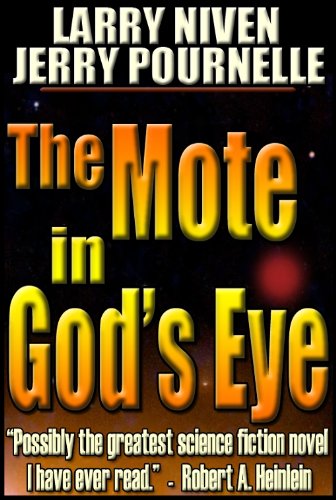
My current after-dinner read to Clare is that wonderful old (1974) classic, "The Mote in God's Eye" by Larry Niven and Jerry Pournelle.

Amazon Link

Here's a brief plot summary (it's surely OK now for spoilers).
"An alien spaceship using a light sail to fly at speeds below the speed of light appears in the human system of New Caledonia. The ship has been traveling for at least 135 years.

The Viceroy ruling the New Caledonia system, the Emperor's appointed representative, determines that a mission of two ships will be sent to the alien system that sent out the pod. Both species are wary, protective, and secretive.

Communication is established; understanding, however, remains more distant. One of the warships is invaded by a lower alien species and must be destroyed. Three Midshipmen end up alone on the planet, uncovering the aliens' desperate secrets of uncontrollable population explosion and giving their lives to protect Empire secrets.

Three aliens are sent to accompany the remaining human ship and crew back to New Caledonia as ambassadors."
The Moties are an example of an r-selected species which, via their technological civilization, solve the high death-rate problem - at least until their numbers hit ultimate carrying capacity.

From Wikipedia:
"As the name implies, r-selected species are those that place an emphasis on a high growth rate, and, typically exploit less-crowded ecological niches, and produce many offspring, each of which has a relatively low probability of surviving to adulthood (i.e., high r, low K).

In unstable or unpredictable environments, r-selection predominates due to the ability to reproduce quickly. There is little advantage in adaptations that permit successful competition with other organisms, because the environment is likely to change again. Among the traits that are thought to characterize r-selection are high fecundity, small body size, early maturity onset, short generation time, and the ability to disperse offspring widely.

By contrast, K-selected species display traits associated with living at densities close to carrying capacity, and typically are strong competitors in such crowded niches, investing more heavily in fewer offspring, each of which has a relatively high probability of surviving to adulthood (i.e., low r, high K). ...

In stable or predictable environments, K-selection predominates as the ability to compete successfully for limited resources is crucial and populations of K-selected organisms typically are very constant in number and close to the maximum that the environment can bear (unlike r-selected populations, where population sizes can change much more rapidly).

Traits that are thought to be characteristic of K-selection include large body size, long life expectancy, and the production of fewer offspring, which often require extensive parental care until they mature. ... Organisms with K-selected traits include large organisms such as elephants, humans and whales, but also smaller, long-lived organisms such as Arctic terns. ...

The r/K dichotomy can be re-expressed as a continuous spectrum using the economic concept of discounted future returns, with r-selection corresponding to large discount rates and K-selection corresponding to small discount rates."

The novel revolves around the debate between liberals and conservatives as to how to deal with the Moties (who pretend to be high-K liberals). It's an eerie book to read, weirdly analogous to contemporary debates in the media. It's been suggested on a regular basis that it would make a stupendous film, but until Hollywood learns to love The Donald, I fear their immune system makes that prospect stillborn.

---

Advanced capitalist countries have been carrying out an interesting experiment with effective birth control over the last fifty years or so. A possible result has been a decline in fertility leading to projected population collapses: Japan is often mentioned as a trend-setter.

Birth control is a central theme in the novel too. The treatment is very game-theoretic: over their history, some Motie continents under strong political leadership did in fact practice population control. They were simply outbred and then conquered by their more numerous competitors.

Tuesday, March 15, 2016

BBC Two and "The City And The City" - China Miéville


Something to look forward to later this year. BBC Two has commissioned "The City And The City" in four hour-long episodes. Inspector Tyador Borlú, of the Extreme Crime Squad, Besźel, will soon be investigating the murder of Mahalia Geary.
"The City & the City takes place in the cities of Besźel and Ul Qoma. The precise location of these cities is not described. However, various references in the book indicate that the cities are perhaps in the coastal Black Sea region of south-central Europe: Besź smugglers traffic in goods from Varna, Bulgaria and Bucharest, Romania; protagonist Tyador Borlú enjoys his coffee in the Turkish style.

"These two cities actually occupy much of the same geographical space, but via the volition of their citizens (and the threat of the secret power known as Breach), they are perceived as two different cities. A denizen of one city must dutifully 'unsee' (that is, consciously erase from their mind or fade into the background) the denizens, buildings, and events taking place in the other city – even if they are an inch away.

"This separation is emphasised by the style of clothing, architecture, gait, and the way denizens of each city generally carry themselves. Residents of the cities are taught from childhood to recognise things belonging to the other city without actually seeing them. Ignoring the separation, even by accident, is called "breaching" – a terrible crime by the citizens of the two cities, even worse than murder."
How will they deal with "unseeing"? Perhaps they'll 'fade out' the other city?

"The City And The City" is my favourite China Miéville novel. It has weaknesses in both plot and characterisation, but I have never seen 'the social construction of reality' better realised.

Update: 7th April 2018. They finally showed it - here's my review.

---

In other news, Arthur C. Clarke's 'Childhood's End' comes as a three-part series to Sky 1 at 9 pm this Thursday (repeated a few hours later, deep in the night, on Sky 2).

Mr Clarke's rather clunky fiction has largely gone out of fashion - who reads it any more? - but 'Childhood's End' is clever, has genuine plot surprises and is filled with a galactic sense of wonder.

I do hope they do it justice.