Showing posts with label Richard Beard. Show all posts

Thursday, January 14, 2016

Heroes for today

Richard Beard - novelist

I have two heroes for you today. My first is Richard Beard, author of "Acts of the Assassins" which I wrote about yesterday. On his blog he has a post which starts like this:
"Aoccdrnig to rscheearch at Cmabrigde Uinervtisy, it deosn’t mttaer in waht oredr the ltteers in a wrod are, the olny iprmoetnt tihng is taht the frist and lsat ltteer be at the rghit pclae. The rset can be a toatl mses and you can sitll raed it wouthit porbelm. Tihs is bcuseae the huamn mnid deos not raed ervey lteter by istlef, but the wrod as a wlohe."
Do you see what he's doing here?
"... the Cmabrigde rscheearch meme demonstrates that in some cases a reader only needs the first and last letter of individual words ..."
The other letters are (somewhat) randomised. Beard sees this as a metaphor for his novel.

---

Intermission

It's gotten cold. Someone should have told this rose which I photographed for Clare in the garden yesterday.

The January Rose in Wells, Somerset - note the buds
---

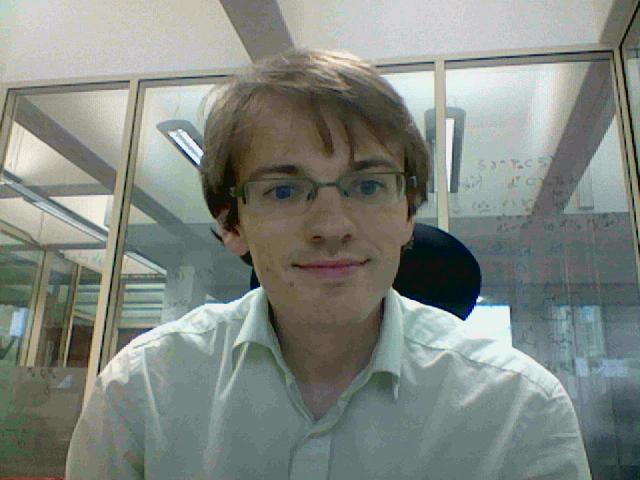
My other hero for today - Professor Joseph Conlon of Oxford University's Physics Department. I'm just completing his excellent book, "Why String Theory", which had me writing the following note-to-self at 1.45 am - in the dark - on a post-it next to my bed.


The answer by the way - it depends.

Prof. Conlon writes well and is ferociously bright (here's his CV).
Professor Joe Conlon

I'm looking forwards to reviewing his excellent book (see my review here) but he is sadly mistaken if he thinks his work will inform after-dinner conversations amongst 'lay-people' up and down the land. He may have just a few equations, and those for presentational purposes, but insofar as his treatise is a model of conceptual clarity and sophistication (which it is), to that extent it is sadly inaccessible to anyone lacking a first degree in a STEM subject.

Yes, really.

Once again the truism applies: 'popular' science books are actually read by other scientists, curious outside their own fields.

Incidentally, if anyone from the BBC is reading this, Joe Conlon looks just the guy to explain the frontiers of science to suitably-prepared grown-ups on BBC4. Give him a screen test ... right now.

Wednesday, January 13, 2016

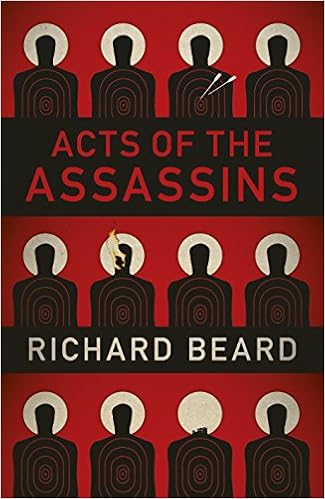
"Acts of the Assassins" by Richard Beard

 Amazon link

So here's an interesting idea. The death of Jesus as a police procedural, updated to a twenty first century Roman Empire. Reviewer Declan Burke writes:
"Gallio is a Speculator – investigator – with the Jerusalem division of the Complex Cases Unit (CCU), an elite department of the Roman military police. The missing body is that of local mystic rabble-rouser Jesus, who was executed by crucifixion only days before. Jesus’ corpse has since gone missing from its tomb, and Gallio – who was charged with overseeing the execution, as a punishment detail for cocking up his investigation into the apparently miraculous resurrection of Lazarus only a few weeks beforehand – can’t afford to allow another stain on his career record.

"A hard-headed veteran, Gallio refuses to believe the rumours being circulated by Jesus’ disciples. “What it can’t possibly be, and what he refuses to contemplate, is died, risen, coming again.” Having witnessed Jesus’ agonies and death on the cross with his own eyes, “Gallio bans all discussion of resurrection as a potential line of enquiry,” and sets out to interrogate the disciples to get at the truth of how they managed to pull off the magnificent trick of stealing Jesus’ body away from a sealed tomb. "
...
" ... the story takes place in a contemporary setting, complete with modern weaponry, travel and attitudes towards terrorism ... a perspective that allows the reader to experience ancient history unfolding in the here-and-now (the origin of the great fire that devastated Rome is referred to as ‘Ground Zero’; Jesus’ Second Coming is taken to mean a spectacular terrorist attack at the heart of the empire).

"It’s a thrilling inventive approach, albeit one leavened by Beard’s slyly absurdist sense of humour. “Whatever the destination is,” Gallio declares as he flies to Antioch from Jerusalem via Amsterdam, “there’s always a change at Schipol.”
Beard is an unusually inventive writer who can disorientate and confuse. The Guardian notes:
"In The Cartoonist, Beard used an artificial, Oulipo-type constraint to illustrate a real-life constraint on the imagination: he wrote an entire novel set in EuroDisney, submitted the text to a libel lawyer, then rewrote the novel from beginning to end, following the lawyer’s instructions to the letter to avoid the risk of defamation. Sometimes, the games that texts are instructed to play are in deadly seriousness."
In this book there are 'continuity errors' which seemed at first to be sub-editing mistakes. The disciples are interrogated by police amidst mausoleums depicting their grisly deaths as ancient history; one surveillance scene shifts inexplicably from the middle of the night to the following evening with no explanation; why would you fly from Antioch to Jerusalem via Schiphol?

I guess if I knew what postmodern was, it wouldn't be, but I do rather draw the line at 'quantum fiction' (Mr Beard, you know who you are).

The Guardian has a good, context-setting review here (the novel appears to have been ignored by the other broadsheets). It's a page-turner, an enhanced experience if you know your New Testament and Acts of the Apostles.

I'm not sure the tricksy stuff entirely does what what I assume the author is trying for - dreamy and disorientating? - but it doesn't derail, just means you have to reflect sometimes rather than just let the narrative sweep you along.

As in many SF stories and thrillers, the narrative tilts just slightly too much to plot vs. characterisation. The main protagonists: Gallia, Valeria, Claudia and Baruch, are real people - I would have liked to have known them a little better.