Showing posts with label Culture. Show all posts

Saturday, January 25, 2025

Communism works given abundance? Or does it?

Amazon

Iain M. Banks with his ‘Culture’ novels has given us by far and away the best imagining of a future communist society, namely: The Culture

Typical is this, from Iain M. Banks' short story "The State of the Art" where the narrator reflects: "Money is a sign of poverty. This is an old Culture saying I remember every now and again..."

The Culture's post-scarcity society has transcended the need for money. From such a vantage point, the presence of money implies that resources are limited and need to be allocated, whereas in the Culture, advanced technology ensures abundance for all. 

Marx, himself, could not have put it better.

But Banks’s Culture had something else present day humanity does not: ubiquitous genomic engineering.


Luxury communism: a world where automation, artificial intelligence, and biotechnology have eradicated scarcity. The conventional (Marxist) vision is one of equality, abundance, and freedom from toil. It seems almost churlish to entertain deep skepticism regarding such a utopia.

The material logic of luxury communism is straightforward. Advances in technology make goods and services cheaper, energy cleaner, and human labour effectively unnecessary. Automation manufactures products with little to no human oversight; AI runs everything; biotech revolutionises agriculture and healthcare. A universal basic income (or free goods and services) ensures that everyone has access to life’s essentials and, soon after that, life’s luxuries.

Freed from the drudgery of work, they say, people could pursue creative, intellectual, or spiritual fulfillment (cf. the projected fantasies of those bourgeois intellectuals: Marx, Engels and Trotsky).

"From each according to his ability, to each according to his needs."

History tells us something else. When material concerns diminish, struggles for symbolic goods - status, power, recognition - intensify. Privileged elites in ancient Rome, medieval Europe and beyond often engaged in bitter rivalries not for survival but for prestige.

These conflicts were no less destructive than battles over land or wealth.

Think of the culture wars we see around us. Their ‘precariat’ foot-soldiers are not starving - although they plainly aspire to those enhanced material privileges to which they feel entitled - but their elite leadership is generally well-provisioned: it’s power, prestige and dominance which motivate them.

The sociologist Thorstein Veblen famously described the "conspicuous consumption" of elites, where the display of excess becomes a competitive weapon. Prestige, by its nature, is a scarce commodity. A luxury communist society, no matter how materially abundant, would still foster competition for symbolic dominance.

The result? Endless power struggles dressed in new clothing.

If only these patterns were merely ‘cultural’. But culture is the expression of biology. Humans evolved in environments where resources were limited, and high-position in dominance-hierarchies ensured survival. Traits like competitiveness, aggression, negotiation skills and status-seeking were selected over millennia. Those hierarchies don't look like going away.

Could we genetically-engineer our way out of this trap? We didn’t evolve for abundance, but given it, perhaps we could engineer the necessary adaptations? The resulting "dove society" might prioritise empathy, cooperation, and collective well-being over hierarchical and competitive drives.

Technically this could, of course, work. Genetic traits influencing aggression, impulsivity, or competitiveness will be understood and may be edited out. Likewise, empathy, patience, and long-term thinking could be genetically enhanced. The result? A society designed for harmony, not strife.

The evolutionary "hawk-dove" model now makes its voice heard. Hawks are aggressive, taking what they want by force; doves are cooperative, caving in to avoid conflict. Generally dove societies are unstable, their members replaced by hawks, although under some boundary conditions a 'mixed strategy' can be stable, though still one in which conflict is necessarily built in (those hawks!).

And perhaps a dove society is just too boring, too stationary and too stagnant. Doomed to extinction through tedium. 

Even Iain Banks preferred to write about Special Circumstances, the least ‘harmonious’ and ‘placid’ wing of the Culture, comprising those individuals ruthless and devious enough to deal with uncouth, vibrant and so very alive ‘barbarians’.

So perhaps the real problem with luxury communism is that it only works in a society of losers.

We’re never going to colonise the Galaxy that way, are we, Mr Elon Musk?


Thursday, January 23, 2025

Is Taylor Swift Kitsch?

Milan Kundera defined it best: kitsch is emotional manipulation masquerading as art; the comforting echo of feelings we already know. In 'The Unbearable Lightness of Being', he dissects its mechanics with precision. 

“Kitsch causes two tears to flow in quick succession,” he writes. The first tear: “How nice to see children running on the grass!” The second tear: “How nice it is to be moved, together with all mankind, by children running on the grass!” 

Kitsch merely indulges our emotions, flatters us into self-congratulatory sentimentality, affirming our collective decency without requiring us to question or confront anything uncomfortable.

Kitsch is the wallpaper of the Overton Window, to thoroughly abuse a metaphor. No wonder governments of all persuasions adore it. Kitsch is their ultimate propaganda weapon, a velvet glove for the iron fist - peddling conventional unity and moral certainties while smothering critical thought under a disapproving, moralising blanket of sugar.


Kitsch is both relational and absolute, in the way that mathematics is both hard and easy. What is kitsch to the worldly adult might be a revelation to a younger person, or one less culturally attuned. Art that merely panders to a sophisticated viewer - repackaging familiar emotions with no hint of challenge - can still serve as a framing portal for someone seeing it with fresh eyes.

A banal love song may bore a seasoned listener, but for a teenager wrestling with their first heartbreak, it might feel like truth spoken from the mountaintop. Kitsch, then, is not the absence of impact - it’s the absence of growth.

Like the dimension which spans from prim to romantic to erotic to pornographic, kitsch inhabits a continuum. Artists differ in their positioning as well as in their attitude to their art. Worst are those jaded, cynical performers who know only too well what they are recycling.

The better an artist is, the more authenticity you may discern: once their act becomes over-familiar they grow dissatisfied and look into their own selves to find something new to say.

They may succeed, and - if so - they may additionally rediscover an audience. Many artists, like David Bowie and Robert Plant, go in and out of fashion: but never (at least in their own eyes) are they in the business of kitsch. They never try to emulate their own Tribute Bands.

But being original is not often the same as being popular.

So where does this leave Taylor Swift and her epic tours? For the discerning adult, they certainly seem kitsch: expertly produced spectacles, their emotional punch choreographed to the millisecond.

Her lyrics play it safe, her melodies stick to the tried and true, and her narratives revolve around themes we’ve all seen before - relationships, self-discovery, and empowerment, endlessly rinsed and repeated. 

There’s no risk here, it appears, no challenge to the audience’s intellectual or emotional horizons. For adults, Swift’s tours can sometimes seem the pop equivalent of fast food: tasty, satisfying - and utterly conventional.

For her primary audience - young, mostly female, and navigating life’s emotional minefields for the first time - these performances are something altogether different. They are maps for uncharted territories, offering structure to feelings too raw to articulate. To a teenage girl experiencing heartbreak or self-doubt, Swift’s songs don’t pander at all; they resonate. Her art provides emotional scaffolding where none previously existed, and that scaffolding matters. It’s not kitsch for them; it’s an initiation.

I am about as far as it is possible to be from familiarity with Taylor Swift’s body of work. Yet it seems to me that underneath the machinelike-juggernaut there is an existential self-doubt, an awareness that what she does is time-limited, not least by her own maturation. If she kept with the teenage angst regardless, then that would indeed be the hallmark of kitsch.

Instead I think she will continue to try new things, taking the very real risks of falling out of fashion. And that is the mark of a performer who eschews kitsch.

Kitsch is art’s terminal state - the point at which creativity ossifies into convention, when the daring and disruptive becomes safe and sentimental. True art, by contrast, jolts and destabilizes. It drags us into the unfamiliar and forces us to confront what we’d rather ignore. But that kind of innovation is rarely appreciated at the time.

True art’s fate is to degenerate into kitsch: in the extreme, kitsch isn’t just the opposite of art; it’s where art goes to die. Its tombstone reads: “Beloved by all, challenging to none.” 


Saturday, April 20, 2024

What I'm Reading


From OpenArt

Absolution Gap” by Alastair Reynolds: This science fiction epic throws us into a future where humanity has colonised countless planets. Reynolds crafts a vast and intricate space opera, delving into themes of technological advancement, engineered religions and an existential fight for survival against the Inhibitors. 

Who Killed Jesus?” by John Dominic Crossan: Shifting gears completely, Crossan's book takes a historical and critical look at the life and death of Jesus of Nazareth. He dissects the various Gospel accounts, contrasting 'prophecy historicised' and 'history remembered' in the context of the political and social climate of first-century Galilee and Judea. This work would certainly be controversial amongst those with traditional religious convictions. In his conclusion, Crossan explains how reason and faith - correctly understood - cannot and should not be taken to contradict each other: historical and sacralised readings (parable expressed as history) each have their own validity.

Fools, Frauds and Firebrands” by Roger Scruton: Renowned philosopher Roger Scruton takes aim at various intellectual movements and ideologues in this collection of essays. Scruton, a champion of conservatism, critiques figures like Jean-Paul Sartre, Michel Foucault and Slavoj Žižek,  arguing against their views on reason, morality, and society. This is a battle which will be fought forever.

The Culture series of Iain M. Banks” by Simone Caroti: This analysis of Iain M. Banks' justly-famous science fiction series delves into the utopian society of "The Culture." Caroti explores the series' themes of post-scarcity economics, artificial intelligence, and how people spend their time within this highly advanced civilization. An interesting point of comparison might be with Reynolds' "Absolution Gap" mentioned above – how do these two fictional universes grapple with similar questions about humanity's future? Caroti's book is not so well-written, but better in content, than Paul Kincaid’s rather moralising take on the same subject (Iain M. Banks: Modern Masters of Science Fiction).

Despite their vast differences in subject matter, all these books grapple with big questions about humanity, society, and our place in the universe. Scruton and Crossan, though likely from somewhat opposing viewpoints, both engage in critical examinations of established (and orthodox) narratives. The science fiction books explore different facets of humanity's potential future, with Reynolds presenting a more dystopian outlook compared to the utopian Culture envisioned by Banks.

Wednesday, May 04, 2016

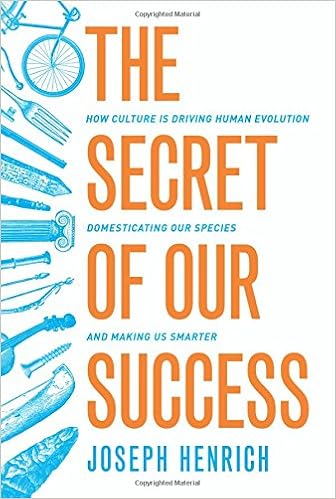
"The Secret of our Success" - Joseph Henrich

Luke tells us that "there is rejoicing in the presence of the angels of God over one repentant sinner."

There is similar rejoicing in heaven over anthropologists who embrace gene-culture coevolution. The late Henry Harpending was the paradigmatic example while Joseph Henrich, by contrast, has only made it part of the way.


That being said, the stellar reviews of "The Secret of our Success" correctly identify the good parts of Henrich's new book. We are cultural beings to the core and without the wisdom of our societies our big brains and high IQs are as nothing. Henrich's paradigmatic example is well described in this review from Joe Brewer:
"HMS Erebus and HMS Terror .. left port in June 1845 from the British Isles under the command of Sir John Franklin in search of a Northwest Passage that could energize trade by connecting western Europe to East Asia. They were outfitted with two field tested ice-breaker vessels equipped with state-of-the-art steam engines, retractable screw propellers, and detachable rudders. They also had five years of provisions and were prepared to deal with the harsh winter in the Arctic Ocean. And yet, even with all of these things going for them, the crew was forced to abandon ship in their second year and move onto King Williams Island—where they became fragmented into small groups and forced to the point of cannibalism before all dying eventually.

"The crew was in an area where Inuits had lived for thousands of years, some of whom came into contact with the shipwrecked crew during the time they were stranded there. It was a harsh environment where the locals had amassed a repertoire of knowledge about how to build kayaks and igloos, hunt sea animals for food, and scavenge for plants during the brief warm spells of summer. Unfortunately for the British explorers, this body of cultural knowledge was not available to them and they suffered the consequences."
Henrich has many similar anecdotes about the adaptations which enabled humans - uniquely amongst primates - to develop, share and propagate a collective culture, something we understand in business when we say that 'good processes get excellent performance from average people'.

Still, there are things not to like. The book is too long: after a promising start it becomes a long-winded sprawl, obscuring the big picture.

Henrich has not internalised modern thinking in genetics, particularly population genetics; his underlying mental framework is still at heart blank-slatism. He doesn't understand the genetics of racial differentiation (cf Greg Cochran's post "Such a thing"); he thinks humankind is still evolving into more effective cultural animals (where's the evidence for selection for that?); and many of his assertions - the reasons for the menopause, for example - are far less settled than he suggests.

The book, despite its flaws, is well worth reading as an antidote to Dawkins-style evolutionary individualism. Ironically it's by far the best account of what a theory of memes would actually look like. But its approach to genetics makes one wince.

Friday, April 15, 2016

"Why do they hate us?"

Consider a tough gang. You, an outsider and by yourself, choose to walk up to the gang leader in front of fellow gang members and indulge yourself in a series of choice insults.

What happens to you?

Most countries have (or had) laws of lèse-majesté, which formalise penalties for disrespect to leaders. You may protest you have a right to free speech, but rights do not grow on trees. They're no more than agreements to permit certain kinds of behaviour, backed up by the powers of a State.

Absent such a State .. there are no rights.

And why would different communities agree on what should be morally permitted?

Whether it's Charlie Hebdo or that German comedian and President Erdogan, Jonathan Haidt's Moral Foundations Theory sheds some light.

Here's TheReformedMind post: "Applying Haidt’s Moral Foundations Theory to responses to “The Innocence of Muslims”:

"At a lawyers conference I attended recently, the conversation turned to “The Innocence of Muslims,” the offensive YouTube video that has sparked riots throughout the Muslim world. “Why do they react this way?” a partner at a major law firm asked, referring to Muslim societies.

"The idea that people would take such offense at an inept video, and blame American society in general rather than the individuals who produced the film, was incomprehensible to this American lawyer: “We would never react that way.” The other lawyers agreed.

This conversation came back to me this week as I read Jonathan Haidt’s very worthwhile new book, The Righteous Mind. Mostly, the book explores the different moral psychologies of American conservatives and liberals.  (Haidt argues that the differences are largely innate — “pre-wired,” he says — thus confirming Iolanthe’s famous observation that “every boy and every gal/ That’s born into the world alive/Is either a little Liberal /Or else a little Conservative!”).

"One chapter, though, compares American moral intuitions with those of other societies. America, Haidt says, has what psychologists call a WEIRD culture — Western, Educated, Industrialized, Rich, and Democratic. WEIRD cultures have a strong “ethic of autonomy”: they hold that “people are, first and foremost, autonomous individuals with wants, needs, and preferences” which, barring direct harm to others, should be fulfilled.

"In such cultures, as Jean Bethke Elshtain remarked at the annual Erasmus Lecture this week, “loyalty” principally means “being true to oneself.” The First Amendment reflects this ethic: it promotes the widest possible range of individual expression and advises offended listeners to avoid harm by turning away.

Largely through American influence, WEIRD values increasingly dominate international human rights discourse. This is ironic, because WEIRD cultures are global outliers — and America is the farthest outlier of all. Most of the world does not see autonomy as the most important value and does not privilege individual expression to the extent we do. Many cultures, Haidt says, have an “ethic of community” that sees people principally as members of collectives — families, tribes, and nations — with strong claims to loyalty. And many cultures have an “ethic of divinity,” which holds that people’s principal duty is to God, not themselves.

“In such societies,” Haidt writes, “the personal liberty of secular Western nations” — including the unrestrained freedom of expression — “looks like libertinism, hedonism, and a celebration of humanity’s baser instincts.”

Haidt’s account explains much of the incomprehension on display at that lawyers conference. To someone in a WEIRD cultural environment — and the educated upper-middle class in America, Haidt claims, is the WEIRDest environment of all — it is very hard to understand how people could feel morally outraged by an inept video that insults divinity. It seems so counter-intuitive.

"The incomprehension works the other way, too. To someone in a non-WEIRD environment, it is very hard to understand how people could feel morally justified defending sacrilegious expression. Haidt’s account suggests that the differences between these cultures are going to be extremely difficult to negotiate. Intuitions are stubborn things."

Moral parochialism is very tempting. Haidt says, "Morality binds and blinds." We're right and the other guys are wrong. He believes modern democratic states are a better solution to organising society than those that preceded them, and that their organising principle of rule-based utilitarianism is for the best ;-).

However, we should do better than blank incomprehension, let alone gratuitous provocation, when we encounter cultures which are not so WEIRD. And if people choose not to, there will be consequences - even if you personally believe on moral grounds that there shouldn't be. *

---

Further reading:

---

* Very relevant to all this is the incomprehension between honour cultures and dignity cultures. The EU is a dignity culture; the Middle-East and Turkey are honour cultures.

Wednesday, September 09, 2015

Culture: Honour vs. Dignity vs. Victimhood


By way of introduction, if you are unfamiliar with the concepts of 'microaggressions' and 'trigger warnings' you should take a look at this first.

OK, to business. Interesting (if somewhat repetitive and breathless) article here, by way of Marginal Revolution.

In the article, Jonathan Haidt writes:
"I just read the most extraordinary paper by two sociologists - Bradley Campbell and Jason Manning - explaining why concerns about microaggressions have erupted on many American college campuses in just the past few years.

In brief: We’re beginning a second transition of moral cultures. The first major transition happened in the 18th and 19th centuries when most Western societies moved away from cultures of honor (where people must earn honor and must therefore avenge insults on their own) to cultures of dignity in which people are assumed to have dignity and don’t need to earn it. They forswear violence, turn to courts or administrative bodies to respond to major transgressions, and for minor transgressions they either ignore them or attempt to resolve them by social means. There’s no more dueling.

Campbell and Manning describe how this culture of dignity is now giving way to a new culture of victimhood in which people are encouraged to respond to even the slightest unintentional offense, as in an honor culture. But they must not obtain redress on their own; they must appeal for help to powerful others or administrative bodies, to whom they must make the case that they have been victimized.

It is the very presence of such administrative bodies, within a culture that is highly egalitarian and diverse (i.e., many college campuses) that gives rise to intense efforts to identify oneself as a fragile and aggrieved victim. This is why we have seen the recent explosion of concerns about microaggressions, combined with demands for trigger warnings and safe spaces, that Greg Lukianoff and I wrote about in The Coddling of the American Mind."
In the cited article, Bradley Campbell and Jason Manning describe the three cultures thus (slightly edited below, mostly to remove citations).
"THE EVOLUTION OF MORAL CULTURE

Social scientists have long recognized a distinction between societies with a “culture of honor” and those with a “culture of dignity”…. The moral evolution of modern Western society can be understood as a transition between these two cultures.

Culture of Honor

Honor is a kind of status attached to physical bravery and the unwillingness to be dominated by anyone. Honor in this sense is a status that depends on the evaluations of others, and members of honor societies are expected to display their bravery by engaging in violent retaliation against those who offend them. Accordingly, those who engage in such violence often say that the opinions of others left them no choice at all … .

In honor cultures, it is one’s reputation that makes one honorable or not, and one must respond aggressively to insults, aggressions, and challenges or lose honor. Not to fight back is itself a kind of moral failing, such that “in honor cultures, people are shunned or criticized not for exacting vengeance but for failing to do so”. Honorable people must guard their reputations, so they are highly sensitive to insult, often responding aggressively to what might seem to outsiders as minor slights.

Cultures of honor tend to arise in places where legal authority is weak or nonexistent and where a reputation for toughness is perhaps the only effective deterrent against predation or attack. Because of their belief in the value of personal bravery and capability, people socialized into a culture of honor will often shun reliance on law or any other authority even when it is available, refusing to lower their standing by depending on another to handle their affairs.

But historically, as state authority has expanded and reliance on the law has increased, honor culture has given way to something else: a culture of dignity.

Culture of Dignity

The prevailing culture in the modern West is one whose moral code is nearly the exact opposite of that of an honor culture. Rather than honor, a status based primarily on public opinion, people are said to have dignity, a kind of inherent worth that cannot be alienated by others.

Dignity exists independently of what others think, so a culture of dignity is one in which public reputation is less important. Insults might provoke offense, but they no longer have the same importance as a way of establishing or destroying a reputation for bravery. It is even commendable to have “thick skin” that allows one to shrug off slights and even serious insults, and in a dignity-based society parents might teach children some version of “sticks and stones may break my bones, but words will never hurt me” – an idea that would be alien in a culture of honor.

People are to avoid insulting others, too, whether intentionally or not, and in general an ethic of self-restraint prevails. When intolerable conflicts do arise, dignity cultures prescribe direct but non-violent actions, such as negotiated compromise geared toward solving the problem. Failing this, or if the offense is sufficiently severe, people are to go to the police or appeal to the courts. Unlike the honorable, the dignified approve of appeals to third parties and condemn those who “take the law into their own hands.”

For offenses like theft, assault, or breach of contract, people in a dignity culture will use law without shame. But in keeping with their ethic of restraint and toleration, it is not necessarily their first resort, and they might condemn many uses of the authorities as frivolous. People might even be expected to tolerate serious but accidental personal injuries … .

The ideal in dignity cultures is thus to use the courts as quickly, quietly, and rarely as possible. The growth of law, order, and commerce in the modern world facilitated the rise of the culture of dignity, which largely supplanted the culture of honor among the middle and upper classes of the West … . But the rise of microaggression complaints suggests a new direction in the evolution of moral culture.

Culture of Victimhood

Microaggression complaints have characteristics that put them at odds with both honor and dignity cultures. Honorable people are sensitive to insult, and so they would understand that microaggressions, even if unintentional, are severe offenses that demand a serious response. But honor cultures value unilateral aggression and disparage appeals for help. Public complaints that advertise or even exaggerate one’s own victimization and need for sympathy would be anathema to a person of honor – tantamount to showing that one had no honor at all.

Members of a dignity culture, on the other hand, would see no shame in appealing to third parties, but they would not approve of such appeals for minor and merely verbal offenses. Instead they would likely counsel either confronting the offender directly to discuss the issue, or better yet, ignoring the remarks altogether.

A culture of victimhood is one characterized by concern with status and sensitivity to slight combined with a heavy reliance on third parties. People are intolerant of insults, even if unintentional, and react by bringing them to the attention of authorities or to the public at large. Domination is the main form of deviance, and victimization a way of attracting sympathy, so rather than emphasize either their strength or inner worth, the aggrieved emphasize their oppression and social marginalization. …

Under such conditions complaint to third parties has supplanted both toleration and negotiation. People increasingly demand help from others, and advertise their oppression as evidence that they deserve respect and assistance. Thus we might call this moral culture a culture of victimhood because the moral status of the victim, at its nadir in honor cultures, has risen to new heights. ...

That victimhood culture is so evident among campus activists might lead the reader to believe this is entirely a phenomenon of the political left, and indeed, the narrative of oppression and victimization is especially congenial to the leftist worldview. But insofar as they share a social environment, the same conditions that lead the aggrieved to use a tactic against their adversaries encourage their adversaries to use that tactic as well. For instance, hate crime hoaxes do not all come from the left."
The problem with cultures of honour is that they don't scale well. Large enterprises, whether of government or industry, require a certain predictability, formality and impersonality of behaviour. Not much works if people keep getting offended all the time and spend their lives fighting or at the very least threatening. But at least the powerful and successful tend to win.

Victimhood is arguably worse: people keep getting offended all the time and then waste everyone's time complaining and seeking sanctions. This levelling down stops almost any behaviour leading to success, which by its nature leads to inegalitarian outcomes of privilege and power. Economists, by the way, have a name for this: it's called rent-seeking behaviour.

If you believe that the future depends upon social and technological progress, then I'm afraid that the dignity culture, with all its faults, is the way to go.

Thursday, October 30, 2014

Three good pieces

1. Best review of Iain M. Banks's Culture sequence


Matt Hilliard, a smart and insightful reviewer at Strange Horizons wrote this piece on his blog: the best assessment of what on earth Banks was trying to do with his Culture novels. His take on Peter Watts' Echopraxia is equally superior.

2. Steve Hsu's popular and accessible article on genetic engineering for super-intelligence

Steve Hsu in action
"Super-Intelligent Humans Are Coming - genetic engineering will one day create the smartest humans who have ever lived".

'Stephen Hsu is Vice-President for Research and Professor of Theoretical Physics at Michigan State University. He is also a scientific advisor to BGI (formerly, Beijing Genomics Institute) and a founder of its Cognitive Genomics Lab.'

His blog is here.

3. What makes the quadcopter design so great for small drones?

Remember all those camera drones with four rotors arranged in a square? Amazon's PR stunt for drone delivery? Why do we still go for helicopters in the large then? Is the future the quadcopter?

Here's why not.

A helicopter drone

Thanks to Jess Riedel's blog for the last two links.
---
Oh, and here's a laugh-out-loud bonus from The War Nerd.

Take me to Istanbul ..