Showing posts with label 2017 War with Russia. Show all posts

Monday, August 22, 2016

Kamm, Corbyn and NATO


There's something about establishment vilification which makes a person reconsider old certainties. In today's Times, Oliver Kamm takes Jeremy Corbyn to task for his 'pacifism' (as usual with JC, nothing is really for sure).

According to Kamm, what did Jeremy say?
"... asked at a leadership hustings how he would respond if a Nato ally was invaded by Russia, Mr Corbyn replied: “I would want to avoid us getting involved militarily by building up the diplomatic relationships and also trying to not isolate any country in Europe . . .” He added: “I don’t wish to go to war. What I want to do is achieve a world where we don’t need to go to war, where there is no need for it.”
We wearily recall Trotsky: "You may not be interested in war, but war is interested in you."

Kamm continues:
"President Putin’s regime has already unilaterally altered the boundaries of Europe by force on preposterous pretexts. Mr Corbyn has in effect announced to this aggressive and expansionist power that if he is in charge there will be no costs and no resistance if Russia adopts the same methods against allies to which we are bound by treaty obligations.

"A few weeks ago, Nato announced plans to increase its strength in Poland and the Baltic states. Under a Corbyn government, those democratic allies won’t be able to rely on us."
One should generally listen to Oliver Kamm's very trenchant, neoliberal/neocon views and then adopt precisely the opposite.

Going to war with a serious opponent (Russia) is an existential business. This is not something any state does lightly. You may recall that America, our supposed great ally, took its time coming to our assistance in both the first and second world wars. Strangely, they took account of their own national interests.

The problem with NATO is that its mutual self-defence treaty locks in a supposed commonality of national interests which cannot in fact exist.

When NATO attacks some ultra-weak foe in a discretionary war, this is obscured - the war effort by some NATO members may be purely notional. This renders moot Oliver Kamm's point:
"Imagine that Mr Corbyn’s wish had been acted on. In 1998, the UN Security Council voted three times to identify the crisis in Kosovo as a threat to international peace and security and demand a response by the government of Slobodan Milosevic in Serbia. Milosevic’s forces intensified their persecution of Kosovan Albanians, driving hundreds of thousands from their homes.

"Belatedly, Nato launched a bombing campaign against Serbia in 1999. It thereby prevented a humanitarian catastrophe in Europe. Nato’s intervention rescued a threatened population and put Kosovo’s fate in the hands of a UN administration."
We say NATO, but in reality this was a coalition of the neocon-willing: no-one in the US or the UK feared retaliation from the Serbs. NATO was a convenient figleaf.

If Russia gets into a border war in Eastern Europe with a NATO member, does anyone really think NATO will automatically go to war on its behalf? General Sir Richard Shirreff pointed out in his recent book, "War with Russia", that for real wars NATO is an archaic, hollowed-out shell - an ineffectual paper tiger.

In truth we go to war when that's the only way to further advance our national interests. Treaties which would attempt to drag us into war against such interests are merely foolish pretences.

Would it really be such a catastrophe to let NATO go? Then we (and the rest of Europe) might get real about what we do, and do not, existentially care about.

Monday, May 23, 2016

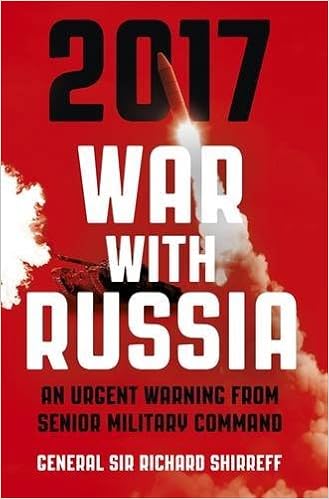
2017 War With Russia: An urgent warning from senior military command

Amazon link

Like David Cameron, I was once in my school's Combined Cadet Force. I have read books on military affairs and profess an interest. I wonder how General Sir Richard Shirreff would rate my abilities to come up with an effective British Army battle plan from my armchair?

I guess the literary world had a similar expectation as regards the bluff man-of-action's first novel. And they have not been disappointed: our troops are battle-hardened, hawk-faced, athletic-looking types who get up at 4 am to run ten miles before hitting their offices; the Russian President is pale with bloodless face, oval eyes cold and menacing, and with a voice 'slightly high-pitched and nasal'.

The American President, one year from time of writing, is a curious Clinton-Trump hybrid, the female CEO. Here is how one of the minor characters, aide Bear sees her:
"Standing up with all the others as she entered, Bear felt an almost physical sense of the power she gave off. The graver this crisis became, the more assured became her leadership.

"I know how lonely command in war can be, he thought. But, dammit, she’s just thriving on it. What was the saying? Cometh the hour, cometh the man? This time it was firmly cometh the woman ... and what a woman.

"With the President seated, MacWhite, the tall, lean former Special Forces general, who looked as if he’d be more at home riding the range somewhere out West than inside the Washington beltway, led the President through the agenda."
Enough: put aside the hyper-stereotyped characters, the pedestrian plotting and the over-acronymed prose. We are not reading the new Tom Clancy; we want to know what's wrong with our defence posture.

In this novelised scenario, the Russians, suffering from empire-withdrawal-syndrome and a realisation that their new borders have left large populations of co-ethnics in the Ukraine, the Baltic States and East Poland, decide to restore their kinfolk to the embrace of Mother Russia.

An invasion of East Ukraine delivers a land-route to the Crimea, followed by an assault on NATO member-states Estonia, Latvia and Lithuania. NATO is paralysed by the inability of its 28 members to agree on anything, the bureaucratic pacifism of the Germans and the openly pro-Russian sympathies of Hungary and Greece. In any event, it has no real military capacity anyway - years of underfunding and neglect have totally hollowed it out.

It's almost game-over, but the Russians make mistakes. They destroy British and German ships anchored in a Latvian port and kill forward-based American soldiers in the battle.

The rest of the story recounts events as America mans up ('that new president'), the Europeans find a new unity and the NATO military come up with a cunning plan. And thankfully, the romantic storyline is kept to a minimum and there is no sex.

Does the plot work as presented? Not a chance: unacceptable risks of nuclear armageddon, way too much reliance on cyber-stuff (which would almost certainly go wrong) while the Russians are portrayed as far too unimaginative.

I suspect that General Shirreff doesn't care much about this criticism either. He really isn't here to write a crafted thriller. His true point is that Europe has essentially blundered into disarmed pacifism and this has to be fixed - so what of that argument?

I don't doubt for a second the detailed picture he paints of European political-elite pacifism, Russia-accommodationism and generalised Euro-incompetence. His picture of the Russian leadership looked a bit too paranoid, emotional and cold-war-ish .. but a little reading around the subject seemed to support his view of the dangerous instability of President Putin's worldview and style of leadership. His view of Russian war aims - not to 'take Europe' but to expand Russia to its 'natural frontiers' - seemed highly plausible too.

Should we risk the nuclear destruction of Western Europe and perhaps American cities to stop this? The novel says 'yes' but in real life the political class would say no. And unless we believe that the current borders in Europe are inviolable until the heat-death of the universe, then it's unlikely that we'll risk armaggeddon for adjustments which, in the end, many will think not without some natural foundation. If the Russians play their cards right.

The critical learning experience is on page 285. Kydd, the new Chief of Defence Staff, is briefing the post-Cameron Prime Minister, Oliver Little, on the relationship between strong conventional forces and the strategic nuclear deterrent:
"But surely, even if we're outmatched conventionally, we've still got Trident?"

"OK, Prime Minister,' sighed Kydd, let me take you through this from first principles. You ask what the Russians will do and I'll repeat. They'll do what they've done at the end of every snap exercise they've called recently. Launch an Iskander tactical nuke as what they call a de-escalatory measure to stop us dead in our tracks and stop us counter-attacking?"

"Hardly sounds to me like de-escalation. Surely them firing a nuke will lead to all-out nuclear war?" asked Little.

"That's precisely the point, Prime Minister. It's counter-intuitive . . . the President knows that there's no way you are going to risk the destruction of human life in the UK by launching a Trident at Russia in response to his tactical nuke when, by so doing, you can almost guarantee a retaliatory strike from an intercontinental ballistic missile in return."

"So, how should we respond? We just have to take it on the chin?"

"Sadly, with the state of our Armed Forces as they are today .. Yes. That would be my advice. Plenty of people told the last government that to be effective, deterrence needs to be matched at every level, conventional and nuclear. As I've just explained, you can't weaken conventional forces and expect Trident alone to protect you. Conversely, if we did have strong conventional forces, but no Trident, they could easily defeat us by threatening to nuke us and we would have no way of deterring them."
This argument is exactly right, but contra the book, NATO is not going into a hot war with Russia over the latter's border accommodations. The trouble is, in the present state of disarray, NATO couldn't get into a hot war with any prepared state over anything; not a good place to be when negotiating with potential adversaries such as Russia and China.

Absent a clear and present danger, none of these Cassandra-like warnings are going to make the slightest difference. So expect more dangerous brinkmanship in the years to come.

--

The Iskander ballistic missile can carry a nuclear warhead up to 50 kilotons. Warheads with one third of that yield were dropped on two Japanese cities in 1945.

Thursday, May 19, 2016

Army ready?

"The famous run is a 2.4km (1.5 mile) track in which you must complete the full distance within the given time. The time you have to complete the run will vary depending on the position within The Army that you have applied for.

"Before starting your timed run, you will warm up as a squad with the other people in the selection process. This consists of a slow jog and walk over a distance of 800 metres.  You will then immediately begin your test.

"The required times for the various regiments within The Army are as follows:

"Parachute Regiment - Run Time 09.40"
OK, so we're not going there.
"Royal Signals, Army Air Corps, Royal Logistic Corps, Royal Electrical & Mechanical Engineers, Adjutant Generals Corps, Army Medical Services, Royal Army Veterinary Corps, Intelligence Corps, and Corps of Army Music – Run Time 14.00"
In my school CCF I was in the Signals, so let's take 14 minutes as my target. If you run a km in five minutes (12 km/hour) you will run 2.4 km in 12 minutes. Way to go.

I don't usually use the treadmill in the gym. Too many historical problems with my knees after years of pavement jogging. But this morning I did five hard minutes on the cross-trainer, then did five minutes at a fast-but-comfortable pace on the treadmill.

Distance run in five minutes? 0.88 km.

Time for 2.4 km at this pace = (2.4/0.88) * 5 = 13 minutes 38 seconds.

I'm army-ready.

---

Is the British Army ready? This morning, Amazon delivered General Sir Richard Shirreff's new book, "2017 War With Russia: An urgent warning from senior military command", ordered on the back of my recent reading of Mark Urban's tale of military unpreparedness, "The Edge".


From the blurb:
"Written by the recently retired Deputy Supreme Allied Commander Europe and endorsed by senior military figures, this book shows how war with Russia could erupt with the bloodiest and most appalling consequences if the necessary steps are not taken urgently.

"President Putin said: 'We have all the reasons to believe that the policy of containment of Russia which was happening in the 18th, 19th and 20th century is still going on...' And 'If you press the spring, it will release at some point. Something you should remember.'

"Like any 'strongman', the Russian president's reputation for strength is everything. Lose momentum, fail to give the people what they want and he fails. The President has already demonstrated that he has no intention of failing. He has already started a lethal dynamic which, unless checked right now, could see him invade the Baltic states.

"Russia's invasion and seizure of Georgia in 2008 was our 'Rhineland moment'. We ignored the warning signs - as we did back in the 1930s - and we made it 'business as usual'.

"Crimea in 2014 was the President's 'Sudetenland moment' and again he got away with it. Since 2014 Russia has invaded Ukraine. The Baltics could be next.

"Our political leaders assume that nuclear deterrence will save us. General Sir Richard Shirreff shows us why this will not wash."
I see the Amazon comments are already being filled up with 'warmonger!' sentiments. And naturally one would like to discount books like this in advance, on grounds of special pleading and bureaucratic rent-seeking.

But the job of the armed forces is to defend the country against credible threats. If a senior guy believes it's incapable of doing that, he has a duty to speak out and give chapter and verse.

So I'm going to read this one carefully.