Showing posts with label big bang. Show all posts

Wednesday, October 22, 2025

Fiat Lux, Ad Curvaturam Infinitam

Fiat Lux, Ad Curvaturam Infinitam

To see what becomes of a confined plasma as its energy density climbs without limit, we go backward in time. The early universe is our model: a cauldron where matter and radiation were a single, incandescent medium, with expansion the only relief valve. Atoms could not exist; there was scarcely a vacuum - just fields and charged particles under pressure so intense that spacetime itself was warped.

Drive a plasma back along that path and it changes quality as temperature rises. At a few billion degrees, photons collide and create electrons and positrons as pair production becomes significant. Additional heating is diverted into mass; the plasma fattens on its own light.

Push harder and structure dissolves. Nucleons themselves - protons and neutrons - unbind into a quark–gluon plasma, a brief recapitulation of the universe’s first microseconds. Beyond that, symmetries once broken are restored; forces we now see as distinct - electroweak, strong - reveal their underlying unity. 

Confinement writes the last act. When energy density drags too much on spacetime geometry, gravity takes command. Curvature deepens until no light can report back. Temperature and density cease to be useful concepts. The system crosses that horizon where thermodynamics collapses to a spacetime singularity.

Thus the plasma limit at ever-increasing energy density is not an explosion but an erasure. From created light to infinite curvature, the arc closes into that final black hole.


In Frederik Pohl’s Heechee Saga—the series beginning with Gateway and centred on the miner-turned-billionaire Robinette Broadhead—the great revelation is that the vanished Heechee have taken refuge inside the event horizons of black holes. These are not the remnants of dead stars but engineered singularities: collapses of pure energy, the theoretical kugelblitzes of relativistic physics.

In reality, the path to such a construct would not be a clean collapse of light into singularity. The converging radiation would first generate an ultrarelativistic pair plasma, as photon–photon interactions spawned electron–positron pairs. Only when that incandescent plasma’s self-gravity overcame its own radiation pressure would it continue inward, closing the horizon and sealing the Heechee’s refuge.


Thursday, July 06, 2017

What would amaze Newton? Not much

"I've seen things you people wouldn't believe: attack ships on fire off the shoulder of Orion. I've watched C-beams glitter in the dark near the Tannhauser Gate. All those... moments... will be lost... in time, like... tears... in rain." (ref).
Did I mention that I am already bored with the future?


As an experiment, I mentally bring Sir Isaac Newton (1642-1727) back to life as a fully-formed adult, and ask what surprises him about three hundred and fifty years of progress. I don't mean surprised in any obvious sense, I mean stuff he'd discover that he genuinely could not have anticipated.

Our present-day culture and technology? I think that was all imaginable in the 17th century. I hesitated a bit at computers - the whole concept of hardware-software seems to depend on a post-Newton paradigm - but then I remembered Leibnitz.

So I think the only things which would truly amaze the brought-forward Newton are:
  1. Relativity
  2. Quantum Theory
  3. The neurobiological basis of mind.
The first two violate his Galilean worldview; the third his strong religious beliefs.

---

Today we know the universe - spatially and temporally - pretty well: from 10-32 seconds at startup out to about 100 billion years ahead.

We also know what the universe is macroscopically made of: galaxies, black holes, stars, planets, space-boulders, dust & gas clouds. The known laws of physics apply to virtually all of the phenomenology of these objects - we can predict with high accuracy what it would be like to visit.

No real surprises there.

---

Life is bounded by physics, chemistry and thermodynamics. We have a reasonable theory of biogenesis ('The Vital Question') and the transition to eukaryotic and multicellular life.

I wouldn't be surprised to find we are the only technological society in this galaxy (evidence) and I think we have a reasonable idea about the kinds of aliens that might exist - once we peel off those rose-coloured spectacles.

If I were to achieve an unwanted immortality, I just don't see where future history could differ much surprise-wise from that space which science-fiction has already massively, redundantly charted.

I would be interested - but I don't see myself massively amazed.

---

Note: there really isn't that much room for reality to out-weird our imagination when a leading paradigm to understand the spacetime in which we live is described thus:
"The zeroth order phenomena [in quantum gravity] is locality itself. This must be the case if, as is sometimes hypothesized, locality is emergent in the classical or continuum limit of a fundamental quantum theory of gravity, whose states are networks living in no space, perhaps spin networks or records of entanglement.

The first order departures from locality are quantum phenomena, especially entanglement. Indeed one version of this proposal is that spatial relations are emergent from entanglement. ... "
From Lee Smolin's paper, "What are we missing in our search for quantum gravity?".

Sunday, September 25, 2016

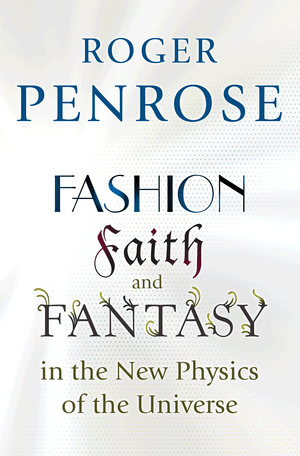
Fashion, Faith and Fantasy: a kind of review

Amazon link

I have just "finished" this book and put my hands up in dismay at the thought of reviewing it.

Roger Penrose is now 85 and this book may be the final presentation of his worldview. Although he talks about the 'layman' as his audience, potential readers should recall "The Road to Reality". In Amazon reviews of that tome, retired maths professors and physics PhDs lined up to recount at which chapter they hit the limits of their knowledge and had to give up.

This volume is not so different.

In a nutshell:

1. Penrose dislikes String Theory because its extra dimensions admit too many functional degrees of freedom (basically the number of possible field configurations).  It is not explained clearly why the super-explosion in the functional freedom space size is problematic, although he does make a related point that he believes that the six 'curled-up' dimensions are actually unstable and should collapse.

Perhaps it's obvious.

2. Quantum Theory is seen as a partial or incomplete theory - in particular, Penrose thinks that its linearity will be violated in an improved theory. He believes that the reason we don't observe 'Schrödinger's cat' spatial superpositions is due to the gravitational effects of superposition (he takes spatial delocalisation to have a real gravitational effect, aligning with his ontological realism for the quantum state). Specifically, the gravitational self-energy due to the superposition generates energy uncertainty, equivalent to time-uncertainty, hence superposed stationary states collapse into a position eigenstate very quickly. As he explains it, the maths behind this is pretty advanced, requiring general relativity.

3. Cosmologically, Penrose is not a fan of inflation, basing his criticisms on the 2nd Law and entropy. His criticisms have force suggesting that inflation retains support faute de mieux.

What does Penrose himself suggest as alternatives? He thinks twistor theory (a framework featuring emergent space-time) continues to have promise, and believes that a particular kind of bouncing, recurrent universe traversing through repeated big-bangs can explain the extraordinarily low entropy 13.8 billion years ago.

I think it's good for physics that he wrote this book, but absent a huge background in general relativity, complex analysis, twistor theory, quantum field theory and tensor analysis it's difficult to assess the merits of his arguments.