Showing posts with label John Wheeler. Show all posts

Friday, December 01, 2017

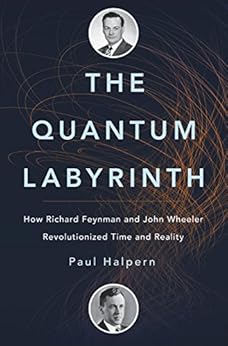
"The Quantum Labyrinth" - Paul Halpern

Amazon link

Paul Halpern, a physicist and historian of science, has written here a combined biography of John Wheeler and Richard Feynman covering the fifty years of their interlinked careers in physics (c. 1940-1990). Feynman started out as a student of Wheeler's, working on the deep problems of Dirac's early formulation of quantum electrodynamics, specifically 'the infinities'. Wheeler and Feynman resurrected the old Newtonian idea of 'action at a distance', combining advanced and retarded solutions of Maxwell's equations to model radiation resistance. This led to Feynman's development of the path integral formalism.

The war diverted both of them to the Manhattan project - Feynman's war in particular has been amply covered in many other books, together with his doomed marriage to Arline.

Post-war we see the full-on assault on QED where Feynman diagrams make their appearance, we accompany Wheeler as he makes General Relativity relevant again, and we encounter topics as diverse as cosmology, the Everett interpretation of quantum mechanics, time travel, nanotechnology and quantum computing.

To read this book is to journey with the protagonists. It's strong on places and times, on personalities and issues and debates. There are no equations or diagrams, although Halpern has a talent for verbal description (he makes a reasonable job of describing delayed-choice experiments, for example).

If you're a physics graduate who has absorbed the abstractions as a logical edifice, you will find this book an ideal complement as you watch the builders debating models and shooting each other down, while racing for priority. They say you should never watch sausages being made, but in physics it adds that vital human dimension of context and motivation.

Wednesday, November 29, 2017

Ed Witten speaks ...

Ed Witten is the foremost theoretical physicist alive today, although his introspective nature does not make great TV: consequently he's largely unknown to the general public.

Ed Witten (from Quanta magazine)

Peter Woit's recent post points towards an interview of Witten by Natalie Wolchover of Quanta magazine. Here is some of what Witten had to say:
"I tend to think that there isn’t a precise quantum description of space-time — except in the types of situations where we know that there is, such as in AdS space. I tend to think, otherwise, things are a little bit murkier than an exact quantum description. But I can’t say anything useful.

The other night I was reading an old essay by the 20th-century Princeton physicist John Wheeler. He was a visionary, certainly. If you take what he says literally, it’s hopelessly vague. And therefore, if I had read this essay when it came out 30 years ago, which I may have done, I would have rejected it as being so vague that you couldn’t work on it, even if he was on the right track."
By synchronicity, I'm currently reading this (which I have also reviewed):

Amazon link

which is a biographical account of the tangled lives of John Wheeler and Richard Feynman. Wheeler was the visionary, the 'big picture' guy, while Feynman was the 'let's get down to the basics and do the calculations' artisan-theorist.

Somehow the whole was greater than the parts: birds and frogs.

Witten continues:
"I tend to assume that space-time and everything in it are in some sense emergent. By the way, you’ll certainly find that that’s what Wheeler expected in his essay. As you’ll read, he thought the continuum was wrong in both physics and math. He did not think one’s microscopic description of space-time should use a continuum of any kind — neither a continuum of space nor a continuum of time, nor even a continuum of real numbers.

On the space and time, I’m sympathetic to that. On the real numbers, I’ve got to plead ignorance or agnosticism."
The whole interview is Witten playing the role of Feynman to the shade of Wheeler.

---

Other posts on emergent spacetime: and here's Wheeler's essay (pdf) which Witten referenced - it is infuriatingly vague, written in Wheeler's characteristic mangled-syntax english.