Showing posts with label Peter Woit. Show all posts

Monday, December 09, 2024

That Roger Penrose biography


Amazon link

I have just read this biography of Roger Penrose ("The Impossible Man" by Patchen Barss) and I am conflicted. The author has spent years researching the book, visiting key locations, interviewing most of the people who were central to Penrose's life and spending a large amount of time befriending Roger Penrose himself. 

There is a great deal of personal detail about the minutiae of Penrose's life and relationships: with parents, siblings, friends and ex-partners.

In the old days this could have been an interesting and insightful picture of an intriguing man and his truly transformational ideas in mathematics and physics. Yet, we no longer live in those days: to get published today one has to adopt a moralising, self-righteous and judgemental tone. 

Victims must be found and Roger Penrose must be found to be at fault.

It's not quite a hit-job, but it's in that paradigm. The author's hard work has given us a voyeuristic picture to be sure but it's not super-surprising: most lives are like that in kind if not degree. 

Such prurience might be forgiven if it led to deeper understanding but it does not. The author seems to think it's Penrose's fault that he turned out - in terms of emotional distance and intense intellectual focus - much like his father, but that doesn't surprise the majority of humanity who have heard the saying that 'the apple does not fall far from the tree'.

Peter Woit has a similar distaste for the patronising tone of this biography and its lack of interest in Penrose's specific accomplishments - although saying that Penrose's manner of relationships was typical of upper-class Englishmen of his generation (born in the 1930s) understates just how specifically detached from intimate emotional competence Roger Penrose actually was and is.

The comments on Woit's blog are interesting too. Someone said that Penrose's naivety led to him being taken advantage of by the author who kind of set him up - and that too sounds plausible.

There is room for a better book which does what Penrose himself failed to do in several of his own publications: explain what is unique and valuable in Roger Penrose's work in terms ordinary mortals can sort of understand.


Trivia note: I spoke once to Professor Penrose on the telephone in the 1980s, when I led a team at the STL research lab in artificial intelligence: we were considering hiring from his post-doc team. Penrose was helpful but reserved, as I recall, as if talking to business people about non-science topics only necessitated the loan of a few neurons for the duration of the call...

Monday, September 10, 2018

The Interpretation of Quantum Theory (again!) - Philip Ball

Amazon link

I'm into extreme diminishing returns on books about the interpretation of quantum theory. And here is another, only worth considering because Peter Woit has bothered reviewing it:
"Philip Ball’s Beyond Weird is the best popular survey I’ve seen of the contemporary state of discussions about the “interpretation” of quantum mechanics. ...

Instead of spending a lot of time in the rut of Bohmian mechanics, Ball dismisses it quickly as:
But it is hard to see where the gain lies… Even Einstein, who was certainly keen to win back objective reality from quantum theory’s apparent denial of it, found Bohm’s idea ‘too cheap.”
Dynamical collapse models like GRW also get short shrift:
It’s a bodge, really: the researchers just figured out what kind of mathematical function was needed to do this job, and grafted it on… What’s more of a problem is that there is absolutely no evidence that such an effect exists.
As for the “Many-Worlds Interpretation”, which in recent years has been promoted in many popular books, Ball devotes a full chapter to it, not because he thinks it solves any problem, but because he thinks it’s a misleading and empty idea:
My own view is that the problems with the MWI are overwhelming – not because they show it must be wrong, but because they render it incoherent. It simply cannot be articulated meaningfully… 

The MWI is an exuberant attempt to rescue the ‘yes/no’, albeit at the cost of admitting both of them at once. This results in an inchoate view of macroscopic reality suggests we really can’t make our macroscopic instincts the arbiter of the situation…

Where Copenhagen seems to keep insisting ‘no,no and no’, the MWI says ‘yes, yes and yes’. And in the end, if you say everything is true, you have said nothing.
There’s a lot of material about serious efforts to go beyond Copenhagen, by understanding the role that decoherence and the environment play in the emergence of classical phenomena out of the underlying quantum world. This discussion includes a good explanation of the work of Zurek and collaborators on this topic, including the concept of “Quantum Darwinism”. ... "
The comments on Woit's post are also interesting.

---

For what it's worth (which is nothing) I suspect that we don't understand what the equations of quantum theory mean because we're still thinking in terms of the primacy of the 4D continuum. Starting from a more foundational space, ('spacetime is emergent'), quantum theory might just seem .. obvious.

Anyway, it's on my Kindle stack to look at later.

---

Update: Here's the review/

Wednesday, January 24, 2018

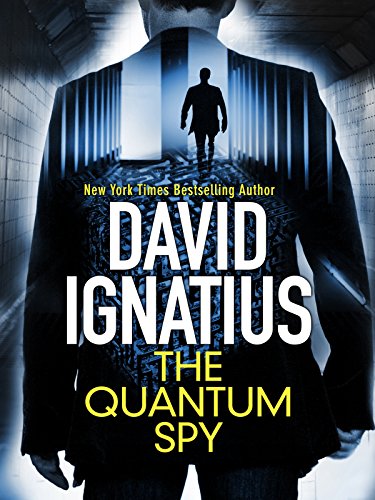
"The Quantum Spy" - David Ignatius

Amazon link

I first heard about this techno-thriller via Peter Woit's website, 'Not Even Wrong'.
"I don’t often read spy thrillers, but just finished one, The Quantum Spy, by David Ignatius. Ignatius is a well-known journalist at the Washington Post, specializing in international affairs and the intelligence community (and known to some as The Mainstream Media’s Chief Apologist for CIA Crimes). While the book is fiction, it’s also clearly closely based on reality. Sometimes writing this sort of “fiction” allows an author to provide their take on aspects of current events that confidentiality prevents them from writing about as “non-fiction”.  ...

The topic of The Quantum Spy is Chinese spying on American research in quantum computing. This is very much in the news these days: after finishing the book I picked up today’s paper to read about the arrest of a Chinese-American ex-CIA agent on charges of being a mole spying for the Chinese (a central theme of the Ignatius novel is the divided loyalties of a Chinese-American CIA agent). ...

Ignatius clearly spent quite a bit of time talking to those very knowledgeable about this. One part of his story is about a company closely based on D-Wave, and he explains that the technology they have is different than the true quantum computer concept that is being pursued by others. Majorana fermions and topologically protected states make an appearance in another part of the story. One character’s reading material to orient himself is Scott Aaronson’s Quantum Computing Since Democritus.

The novel portrays the US and Chinese governments as highly concerned and competitive about quantum computing technology and its security implications. I’d always naively assumed that classified research on quantum computing was carried on just by groups within the NSA or other security agencies, but Ignatius tells a different story. According to him, what happens is that groups performing unclassified government-funded quantum computing research in the open can find themselves forced to “go dark”, with their work going forward classified and no longer publicly accessible. His plot revolves around Chinese efforts to get information about such research. ..."
But is the novel any good? Peter Woit rather piously explains:
"I’m the wrong person to ask, the few spy stories I’ve read have been because of an interest in some non-spy thriller aspect of the story. The spy thriller aspect of this one didn’t seem particularly compelling, but what do I know."
But on Amazon, the title of the thriller is given as: "The Quantum Spy: An unputdownable technothriller that will keep you gripped".

Having devoured this on my Kindle, I can confirm that it's an edge-of-the-seat page-turner.

---

Characters good: check. Plot races along: check. Not too much political correctness: check.

I thought the conflicting loyalties thing of Chinese-Americans was sympathetically done. It's the perennial question.  Substitute 'ethnic kin' for 'friend'.

In the novel, the 'D-wave'-like machine seems to accomplish wonders in facial recognition over a vast CCTV dataset. This seems completely unrealistic: I think with some image-pre-processing (eigenfaces) this task would be fast-enough on conventional computers, and I think it's beyond the state of the art for current quantum computers. But what do I know?

The novel only really disappoints in its saccharine finale: all must have prizes.

Very American.

---

My review of  'Quantum Computing Since Democritus' - Scott Aaronson.

Wednesday, November 29, 2017

Ed Witten speaks ...

Ed Witten is the foremost theoretical physicist alive today, although his introspective nature does not make great TV: consequently he's largely unknown to the general public.

Ed Witten (from Quanta magazine)

Peter Woit's recent post points towards an interview of Witten by Natalie Wolchover of Quanta magazine. Here is some of what Witten had to say:
"I tend to think that there isn’t a precise quantum description of space-time — except in the types of situations where we know that there is, such as in AdS space. I tend to think, otherwise, things are a little bit murkier than an exact quantum description. But I can’t say anything useful.

The other night I was reading an old essay by the 20th-century Princeton physicist John Wheeler. He was a visionary, certainly. If you take what he says literally, it’s hopelessly vague. And therefore, if I had read this essay when it came out 30 years ago, which I may have done, I would have rejected it as being so vague that you couldn’t work on it, even if he was on the right track."
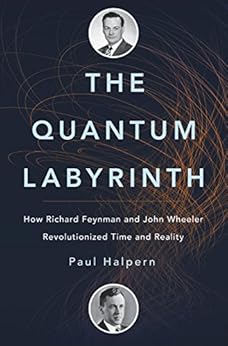
By synchronicity, I'm currently reading this (which I have also reviewed):

Amazon link

which is a biographical account of the tangled lives of John Wheeler and Richard Feynman. Wheeler was the visionary, the 'big picture' guy, while Feynman was the 'let's get down to the basics and do the calculations' artisan-theorist.

Somehow the whole was greater than the parts: birds and frogs.

Witten continues:
"I tend to assume that space-time and everything in it are in some sense emergent. By the way, you’ll certainly find that that’s what Wheeler expected in his essay. As you’ll read, he thought the continuum was wrong in both physics and math. He did not think one’s microscopic description of space-time should use a continuum of any kind — neither a continuum of space nor a continuum of time, nor even a continuum of real numbers.

On the space and time, I’m sympathetic to that. On the real numbers, I’ve got to plead ignorance or agnosticism."
The whole interview is Witten playing the role of Feynman to the shade of Wheeler.

---

Other posts on emergent spacetime: and here's Wheeler's essay (pdf) which Witten referenced - it is infuriatingly vague, written in Wheeler's characteristic mangled-syntax english.

Friday, December 30, 2016

This is what it is like ...

My experience of research was in the 1980s, when I was delving into the mysteries of intelligence, via AI. The process model was this:

  • Take your most acute/insightful intuition
  • Find a simple-enough formal model/example
  • Analyse/program the model
  • Show some surprising/interesting results
  • Write/publish your paper.

AI at the time presented a superfluity of interesting problems - truly it was bliss to be a researcher. Only later did I realise that the most profound questions ('What evolutionary pressures selected for natural, human intelligence?') led into a conceptual swamp, where the right questions could not even be identified, let alone solved.

In physics, subject to centuries of theoretical and mathematical development, the situation facing the new postgraduate researcher is overwhelming and intimidating. As Bob Henderson observes,
"What we’d created is called a “toy model”: an exact solution to an approximate version of an actual problem. This, I learned, is what becomes of a colossal conundrum like quantum gravity after 70-plus years of failed attempts to solve it. All the frontal attacks and obvious ideas have been tried. Every imaginable path has hit a dead end. Therefore researchers retreat, set up camp, and start building tools to help them attempt more indirect routes. Toy models are such tools. Rajeev’s river almost certainly didn’t run to The Grail. The hope was that some side stream of one of its many tributaries (Virasoro, Yamabe …) would.

"Actually that was my hope, not Rajeev’s. Rajeev, I believe, just liked doing the math. The thing was a puzzle he could solve, so he solved it. For him that was enough.

"I, of course, had my sights set on bigger game."
Bob Henderson recounts an insightful, often tragic tale of hope and disillusion. Beautifully written to boot. Give it a try.


Via Peter Woit.

Sunday, October 18, 2015

A proof beyond understanding


From Nature via Peter Woit:
"Sometime on the morning of 30 August 2012, Shinichi Mochizuki quietly posted four papers on his website.

The papers were huge — more than 500 pages in all — packed densely with symbols, and the culmination of more than a decade of solitary work. They also had the potential to be an academic bombshell. In them, Mochizuki claimed to have solved the abc conjecture, a 27-year-old problem in number theory that no other mathematician had even come close to solving. If his proof was correct, it would be one of the most astounding achievements of mathematics this century and would completely revolutionize the study of equations with whole numbers.

Mochizuki, however, did not make a fuss about his proof. The respected mathematician, who works at Kyoto University's Research Institute for Mathematical Sciences (RIMS) in Japan, did not even announce his work to peers around the world. He simply posted the papers, and waited for the world to find out."
So you'd think people would be all over it, right?
"Probably the first person to notice the papers was Akio Tamagawa, a colleague of Mochizuki's at RIMS. He, like other researchers, knew that Mochizuki had been working on the conjecture for years and had been finalizing his work. That same day, Tamagawa e-mailed the news to one of his collaborators, number theorist Ivan Fesenko of the University of Nottingham, UK. Fesenko immediately downloaded the papers and started to read. But he soon became “bewildered”, he says. “It was impossible to understand them.” ...

Everyone — even those whose area of expertise was closest to Mochizuki's — was just as flummoxed by the papers as Fesenko had been. To complete the proof, Mochizuki had invented a new branch of his discipline, one that is astonishingly abstract even by the standards of pure maths. “Looking at it, you feel a bit like you might be reading a paper from the future, or from outer space,” number theorist Jordan Ellenberg, of the University of Wisconsin–Madison, wrote on his blog a few days after the paper appeared.

Three years on, Mochizuki's proof remains in mathematical limbo — neither debunked nor accepted by the wider community. Mochizuki has estimated that it would take a maths graduate student about 10 years to be able to understand his work, and Fesenko believes that it would take even an expert in arithmetic geometry some 500 hours. So far, only four mathematicians say that they have been able to read the entire proof."
And something strange happened to those four ...
"But so far, the few who have understood the work have struggled to explain it to anyone else. “Everybody who I'm aware of who's come close to this stuff is quite reasonable, but afterwards they become incapable of communicating it,” says one mathematician who did not want his name to be mentioned.

The situation, he says, reminds him of the Monty Python skit about a writer who jots down the world's funniest joke. Anyone who reads it dies from laughing and can never relate it to anyone else."
Worth reading the whole thing. Another article, from Quora, here (written by a 15 year old!)

There will be a Clay Mathematics Institute, University of Oxford, Workshop on IUT Theory of Shinichi Mochizuki, Monday December 7 - Friday December 11, 2015.