|
| Franz Kafka statue in Prague |
When Google Lens tells me the picture above is the Statue of Franz Kafka in Prague, glossed by Wikipedia as:
"The Statue of Franz Kafka is an outdoor 2003 sculpture by Jaroslav Róna, installed on Vězeňská street in Prague, Czech Republic. It is based on a scene in Franz Kafka's first novel, Amerika, in which a political candidate is held on the shoulders of a giant man during a campaign rally, and carried through the streets,"Google's app is doing something really complex, leveraging artificial neural nets trained by massive datasets. But it's fundamentally inference:
The world we live in |= the pixel map of the photo and Google Len's summary text.and
the pixel map of the photo |- Google Len's summary text.Satisfiability and entailment.
All AI systems need to map their sensor/effector primary data to internal representations which allow inference (deductive, inductive, abductive etc) - regardless of the engineering mechanisms they adopt. Neural nets training their weights are optimising the probability of valid inferences about the world.
---
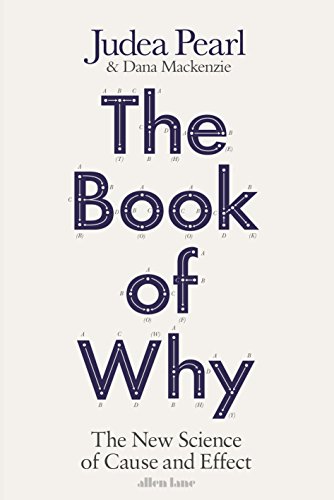
Judea Pearl has a new book out arguing for the introduction of causality into AI systems. In a recent Quanta interview he said:
"All the impressive achievements of deep learning amount to just curve fitting."Here's the book.
 |
| Amazon link |
Causality is one of those constructs like Free Will, Consciousness and the intentional stance which don't exist in the underlying physics (the theories which the universe satisfies as far as we can tell), but which are emergent in a world of self-aware agents.
They usefully describe relationships between belief-and-goal-driven entities; they succinctly encode the effects of the second law of thermodynamics plus boundary conditions. We use these concepts .. and AI will have to if we are ever to create socially-competent artificial agents.
What Pearl is really asking for is an AI which utilises the intentional stance (specifically including reasoning about cause and effect).
---
To find out more about Judea Pearl's work (without buying the book!) view the recommended slides at his website. For a review of Pearl's substantive contribution to causality theory, see here.
My own subjective response? I find his dense notation and cluttered semantics worthy but unexciting.
---
Update: my further impressionistic, superficial and under-researched thoughts.
The difference between a mere association between P and Q (which could be a spurious correlation, or the result of an independent cause of both) and a causation, P causes Q, is captured by the modal operator of necessity []. See here for a detailed discussion.
To check P causes Q we need to check: [](P → Q) and [](¬Q → ¬P).
So we're in possible world semantics and we look to 'neighbouring worlds' to check the truth status of P and Q. But we have the usual problem that such worlds are way too 'big', too full of irrelevancies.
So like Situation Semantics, Pearl takes the engineering approach of restricting his worlds to just those entities and actions which seem relevant to the causality under investigation. These are his causal diagrams which he intends to counterfactually 'mutilate'.
A philosophical strategy similar to the modal analysis of epistemics etc .. and of similar utility.