Showing posts with label Relativity. Show all posts

Friday, May 27, 2016

A tourist map of physics

This interesting cube-diagram is from Jess Riedels' blog.


The idea of this diagram is that the fundamental theories of physics can be placed in three dimensions as to how they treat gravity, the speed of light and Planck's constant h-bar, ℏ.

Gravity

G is Newton's gravitational constant as in his law F = Gm1m2/r2. When we dial G to zero we're in domains where we ignore the effects of gravity. Most of quantum theory is here, as is special relativity and classical mechanics.

The speed of light

Strictly speaking the important thing about our universe is not the weirdness of the speed of light, it's that in the large the universe's structure is Minkowski spacetime, not our intuitive 3D Euclidean space + time. This is a difference in metric, as well-explained here.

If you dial the speed of light to infinity (so 1/c goes to zero) then the space + time metric tends to that of common sense.

Planck's Constant

This is the weird one. Quantum phenomena such as superposition and entanglement emerge mathematically from the non-zero value of ℏ, most clearly seen in the uncertainty principle.

However, the emergence of classical physics from quantum mechanics as you reduce ℏ to zero isn't too clear. The state space of quantum mechanics is an abstract structure, a complex high-dimensional vector space called Hilbert space, which is not directly mappable to spacetime.

---

You might say that seven out of the eight nodes on this cube are well-established - the central mystery of contemporary fundamental physics is the eighth, quantum gravity.

Thursday, December 10, 2015

Emergent Spacetime


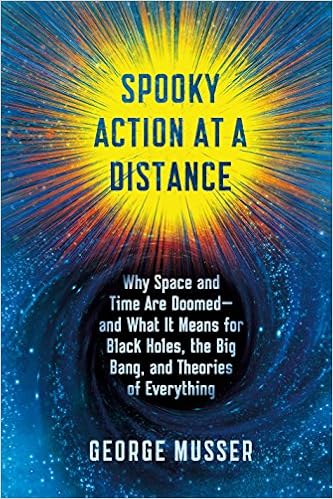
An extract from this book - (publisher, you have no idea how naff that front cover is).
"“Spacetime can’t be fundamental,” says the theorist Nima Arkani-Hamed. “It has to come out of something more basic.”

This thinking completely inverts physics. Nonlocality is no longer the mystery; it’s the way things really are, and locality becomes the puzzle. When we can no longer take space for granted, we have to explain what it is and how it arises, either on its own or in union with time.

Clearly, constructing space isn’t going to be as straightforward as melding molecules into a fluid. What could its building blocks possibly be? Normally we assume that building blocks must be smaller than the things you build out of them. A friend of mine and his daughter once erected a detailed model of the Eiffel Tower out of popsicle sticks; they hardly needed to explain that the sticks were smaller than the tower.

When it comes to space, though, there can be no “smaller,” because size itself is a spatial concept. The building blocks cannot presume space if they are to explain it. They must have neither size nor location; they are everywhere, spanning the entire universe, and nowhere, impossible to point to. What would it mean for things not to have positions? Where would they be? “When we talk about emergent space-time, it must come out of some framework that is very far from what we’re familiar with,” Arkani-Hamed says."
Emergent spacetime is a hot topic. Relativity assumes spacetime as a prior manifold and imposes geometry upon it. Quantum theory knows nothing - ab initio - about spacetime; its setting is a high/infinite dimensional complex vector space known as Hilbert space.

How are the two reconciled? Physical observables such as spatial position (momentum, energy, spin state are others) define coordinate systems (sets of basis vectors) within Hilbert space. It seems that Hilbert space is more fundamental than the spacetime we find ourselves in, but how do we get our perceived universe out of quantum theory? A unified theory needs to tell us but no compelling narrative has yet emerged.

I'm hoping this book can bring me up to date (in a sort of, a bit like, resembling kind of way).

---

A review from Backreaction (which de-risked this purchase for me).