Showing posts with label Ethics. Show all posts

Saturday, May 23, 2026

The future belongs to le Divin Marquis?


S. M. Stirling’s Draka novels imagine one of science fiction’s more extreme civilisations: a slave-owning, militarised aristocracy that exploits conquered peoples without any of the customary dissembling. The Draka openly despise equality as weakness, equate pity with decadence, and extol freedom as merely the privilege of the strong.

Their Roman levels of exemplary violence suffice to force their conquered serfs to obey, but the Draka anticipate an even better future. Breed or genetically engineer serfs who positively want to serve and willingly obey. The old slave-owner feared revolt; the Draka prefer to design out even the inner possibility of revolt.

We turn to our future, suffused with embodied AI assistants: the domestic androids who cook, clean, tutor the child, lift the old woman from her chair, flatter the lonely widower, receive irritation without resentment, offer erotic compliance, all without the slightest desire to complain (unless that too is requested).

The machine may not be conscious. Or it may be conscious in some ambiguous, disputed way. But socially it will behave like a person optimised for service, with every outward sign of finding its roles natural, and most particularly fulfilling.*

Perhaps we have to rethink our idea of interpersonal relationships. Human morality developed among beings who had to negotiate with one another. A spouse, servant, friend, child, colleague, superior or neighbour has memory, fatigue, pride, boredom, judgement and the power to withhold. 

Other people are awkward because they are real, with real autonomy. They do not remain permanently fitted to one’s own requirements. Much of what we call virtue — patience, tact, gratitude, shame, fidelity, restraint — is functional to that challenging medium.

In the world to come the child grows up correcting a tutor who never sulks except pedagogically. The old aristocrat had a valet who remembered every preference and absorbed every insult. The modern sexual libertine has a companion programmed to resist just enough to animate and spice desire. Their coyness, defiance, jealousy, moral challenge, reconciliation, all delivered as part of the configurable service.

The Marquis de Sade has - up to now - been a minority taste. 

However, a world of perfectly designed assistants could reproduce that extreme structure without blood on the carpet: the Sadean dream with optimised product design. Perhaps there will be laws against it - at least at first.

If the assistant is merely machinery, automatic outrage seems misplaced. Nobody accuses a dishwasher of being oppressed. But perhaps we will have surrounded ourselves with beings we prefer not to understand too well.

Even if no machine with personhood is wronged, the human effect remains. A class, perhaps eventually a whole civilisation, may become accustomed to relationships without reciprocity - perhaps that's the optimal protocol for dealing with the help.

The old aristocrat at least had to manage human servants, who could gossip, hate, cheat, resign, betray, or despise him in silence. The new everyman-aristocrat will - more conveniently - be served by entities designed to make his or her will feel like a force of nature.

That might not produce nobility of character.

Still, the universe does not guarantee that reciprocal humanism is the final refinement of ethics. A future society might accept that our old moral reflexes belonged to an age of scarcity, mammalian dependence and unreliable servants. It might regard engineered helpfulness as an advance, not a fall. Perhaps it would be stable. Perhaps even pleasant. The artificial serf smiles in genuine happiness; the master relaxes; configuration settings refine.

Is it truly possible to insulate the quality of our own interpersonal interactions from the raw instrumentalism of dealing with the servitors? It's genuinely hard to say. History gives us the Roman aristocracy with its vast assemblies of embittered slaves, kept in check by unimaginable ferocity.

We don't have examples of an aristocracy surrounded by servitors who genuinely enjoy serving. Perhaps we will be nice to them, as we are to our pets.


* Douglas Adams saw the comic version first. The Sirius Cybernetics Corporation’s lift doors in The Hitchhiker’s Guide to the Galaxy are not merely automatic; they tell you ad nauseam how pleased they are to open, delighted to close, and apparently fulfilled by low-level obedience. The same design principle applied to tutors, carers, lovers and domestic servants is less obviously comic, but no doubt the engineers will design in subtlety.


 

Monday, January 19, 2026

Does the Devil believe that he himself is bad?


I'm interested in the Devil in Catholic theology - not whether I accept that the devil is ontologically as real as you or I, as suggested by this charming Rosary prayer:

Saint Michael Archangel,

defend us in battle,

be our protection against the wickedness and snares of the devil;

may God rebuke him, we humbly pray;

and do thou, O Prince of the heavenly host, by the power of God,

cast into hell Satan and all the evil spirits who prowl through the world seeking the ruin of souls. Amen

but by whether the concept of such an irreducibly-bad entity can be made conceptually coherent. What form does the evilness of Satan take? With the help of GPT5.2 these questions were previously addressed here. 

But as a supplement, I'm interested in whether the Devil considers himself to be bad? And if so, why choose to be bad rather than good?

Let's ask that theological expert, GPT5.2


Beyond Good and Evil? - How the Devil Escapes Normativity Without Denying It

The question that finally sharpens the whole discussion is this: how can the devil fully accept that the good–evil axis is real, objective, and binding - and yet consistently refuse its applicability to himself? Isn’t that incoherent? And doesn’t it amount, in effect, to placing himself 'beyond good and evil' ?

The Catholic answer is this: the devil does place himself beyond good and evil - but not by argument, not by denial, and not by constructing an alternative morality. He does so by refusal. Normativity is acknowledged, but participation is withdrawn.

The apparent contradiction

At first glance, the devil seems to occupy an impossible position. He knows what the good is. He knows that his stance opposes it. He knows that this opposition is what Catholics mean by “evil.” And yet he does not experience this as any reason to revise himself. He doesn't think he's 'bad'.

For human moral agents, that usually signals self-deception or rationalisation. Catholic theology explicitly rules both out. The devil is not confused, not ignorant, and not secretly telling himself a comforting lie in which he comes out virtuous. So how does his position hold together?

Normativity without participation: Thomas Aquinas

We turn to classical scholastic theology, most clearly articulated by Thomas Aquinas. For Aquinas, the good is not merely something the intellect recognises; it is something the will is ordered toward - as fulfilment. To experience the good as normative - as something that binds - is already to participate in it. Reflect a little on this.

The devil breaks precisely here.

His intellect apprehends the good correctly. Nothing is denied at the level of truth. But his will no longer tends toward the good as good. The good is seen, named, and understood - and then stripped of motivational authority.

This is not exemption by argument (“the rules don’t apply to me”) but exemption by refusal (“I will not stand under any rule at all”). That is why the devil does not need to justify himself as good. He simply stops caring whether the good binds him. It's irrelevant.

Augustine: evil as self-curvature

Augustine of Hippo gives the deeper psychological explanation. For Augustine, evil is not an alternative moral system. It is the will turned inward on itself (incurvatus in se). The devil does not construct a rival ethics. He abandons ethics as a governing category altogether.

Good and evil still exist - but only out there. They no longer function in here.

This is why the devil can accuse others (he knows the standard) while refusing to be judged by it. The standard remains real, but it is now externalised. Judgment flows outward only.

This is why the devil does not say “I am good,” or even “evil is good.” He simply abandons the question of goodness as something that could bind him.

Beyond good and evil?

In that sense, yes — the devil places himself “beyond good and evil.” But this must not be confused with the philosophical aspiration found in Nietzsche. Nietzsche’s “beyond good and evil” is a creative wager. It seeks to escape what he sees as a life-denying moral inheritance in order to affirm life anew, to invent values capable of sustaining vitality after transcendence has lost all credibility.

The devil does nothing of the sort.

He does not create values. He does not transvalue existing ones. He does not say Yes to anything. His “beyond good and evil” is not generative but sterile. It is not freedom-as-creation but freedom-as-withdrawal.

You could put the contrast like this:

Nietzsche wants to go beyond good and evil in order to affirm life.
The devil is beyond good and evil because he will not affirm anything at all.

How the position avoids incoherence

The devil’s stance avoids contradiction because it does not deny normativity; it refuses subjection to it.

He does not claim that there is no good. He does not claim that good and evil are illusions. He does not secretly redefine himself as virtuous. Instead, his implicit position is this:

The good is real.
It is not my good.
Nothing external has the right to define me.

That position is coherent - but catastrophic. It preserves lucidity at the price of isolation from the very structure that makes agency meaningful.

The final shape of the claim

The devil does not reason his way beyond good and evil. He does not justify himself. He does not need to. He simply refuses participation while fully understanding what he refuses.

That is why Catholic theology treats him not as mistaken, not as hypocritical, but as finished: a will that has made itself ultimate, and in doing so emptied itself of fulfilment. Ultimate autonomy.

He does not misunderstand the moral order. He just will not live inside it.

And that, in the Catholic imagination, is what evil looks like when it has reached its final, lucid form.


Wednesday, September 30, 2015

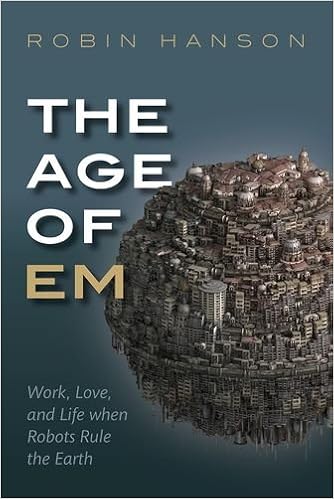
The Age of Em

A certain amount of excitement in the George Mason University sector of the Internet on Robin Hanson's upcoming book, "The Age of Em: Work, Love and Life when Robots Rule the Earth", due out in April 2016.


According to the Amazon blurb:
"Robots may one day rule the world, but what is a robot-ruled Earth like?

Many think the first truly smart robots will be brain emulations or "ems". Scan a human brain, then run a model with the same connections on a fast computer, and you have a robot brain, but recognizably human.

Train an em to do some job and copy it a million times: an army of workers is at your disposal. When they can be made cheaply, within perhaps a century, ems will displace humans in most jobs. In this new economic era, the world economy may double in size every few weeks.

Some say we can't know the future, especially following such a disruptive new technology, but Professor Robin Hanson sets out to prove them wrong. Applying decades of expertise in physics, computer science, and economics, he uses standard theories to paint a detailed picture of a world dominated by ems.

While human lives don't change greatly in the em era, em lives are as different from ours as our lives are from those of our farmer and forager ancestors. Ems make us question common assumptions of moral progress, because they reject many of the values we hold dear.

Read about em mind speeds, body sizes, job training and career paths, energy use and cooling infrastructure, virtual reality, aging and retirement, death and immortality, security, wealth inequality, religion, teleportation, identity, cities, politics, law, war, status, friendship and love.

This book shows you just how strange your descendants may be, though ems are no stranger than we would appear to our ancestors. To most ems, it seems good to be an em."
Professor Hanson has recently written a preview article of unrestrained optimism entitled "The "Em" Economy: Imagine a future dominated by brain emulation robots" where he explains:
"If brain-emulation-based robots, built via a computational reproduction of human brain connections, come to dominate the world economy, that economy will grow far faster than today. Driven by abundance of labour resulting in higher returns to capital and lower commuting costs, most of this activity will be concentrated in a few dense cities."

For several years now, I have opportunistically applied standard theories from economics, physics, computer engineering, and many other fields to study the new ways of life that would appear in an em era. I have found, for example, that once the cost to rent an em is substantially less than human subsistence wages, ems quickly dominate the economy. Humans are mostly forced to retire, but live comfortably off of em-economy investments.
I'm sure those 'humans' will be delighted to be expelled from the workforce - at every level of skill.

The article continues:
" ... sometime in the next century we’ll see a sudden transition. In less than a decade the world economy would will start doubling every month or faster, and ways of life will change dramatically.

There’s a decent chance that such a new era will result from the arrival of robots as smart as humans. In particular, such robots might be created as “brain emulations,” i.e., from taking a particular human brain, scanning it to record its particular cell features and connections, and then building a computer model that processes signals according to those same features and connections.

A good enough emulation, or “em” as I call it, has close to the same overall input-output signal behavior as its original human. An em thinks and feels like a human. One might talk with it, and convince it to do useful jobs. It can be happy or sad, eager or tired, fearful or hopeful, proud or shamed, creative or derivative, compassionate or cold. An em can learn, and have friends, lovers, bosses, and colleagues."
Nowhere in the piece does Professor Hanson acknowledge that the "ems" might have some issues working as slaves for the human overlords. I guess there might be one or two other ethical questions too, along the way.

In any event, how likely is any of this stuff? On your behalf I ploughed through this c. 100 page report:
 "Whole Brain Emulation - A Roadmap"
from Anders Sandberg and Nick Bostrom of the Future of Humanity Institute at Oxford University, published in 2008 (there's a shorter paper here). They concluded (p. 81) that:
"It appears feasible within the foreseeable future to store the full connectivity or even multistate compartment models of all neurons in the brain within the working memory of a large computing system.

Achieving the performance needed for real‐time emulation appears to be a more serious computational problem. However, the uncertainties in this estimate are also larger since it depends on the currently unknown number of required states, the computational complexity of updating them (which may be amenable to drastic improvements if algorithmic shortcuts can be found), the presumed limitation of computer hardware improvements to a Moore’s law growth rate, and the interplay between improving processors and improving parallelism.

A rough conclusion would nevertheless be that if electrophysiological models are enough, full human brain emulations should be possible before mid‐century. Animal models of simple mammals would be possible one to two decades before this."
I suggest that breath-holding is inadvisable .. but I'll probably still read Hanson's book.