Showing posts with label The Three-Body Problem. Show all posts

Friday, October 28, 2016

Death's End (The Three-Body Problem) - Liu Cixin

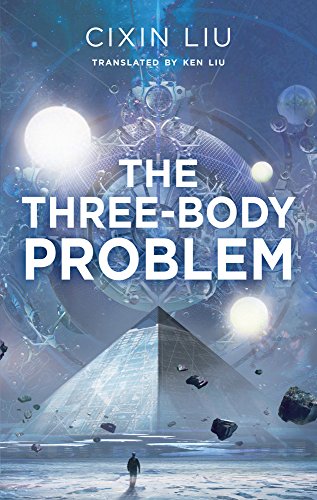
In "The Three-Body Problem" we were introduced to the Trisolarans, the highly-advanced inhabitants of the Alpha Centauri system who had designs upon the Earth.


Amazon link

I wrote about it here.

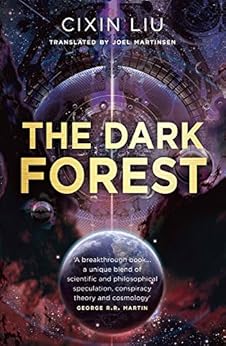
The second volume, "The Dark Forest", posed the problem: how can you defend yourself against an incoming alien invasion force of overwhelming technical superiority with perfect intelligence of your every move, but one which will not arrive for hundreds of years. Here is my fan-review.
Amazon link

Amazingly, Liu Cixin finds a way, but one which is dangerously unstable.

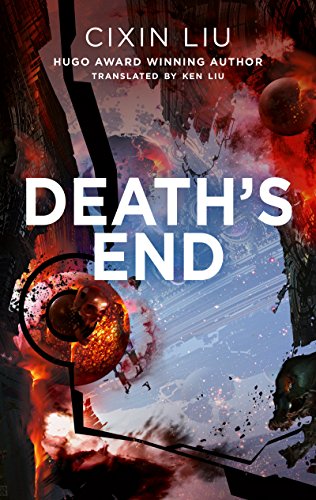
Now the final volume has been released, "Death's End". To those who were wondering how Liu Cixin would surpass volume two, I'm pleased to confirm that he has shifted up to the whole universe, if not the metaverse. Yes, big ideas in science-fiction are back!
Amazon Link

The author's characters exemplify moral choices, as in a mediaeval Morality play.

As a purist, I'm a little irritated by the scientific faux pas, including  the classic seeing incoming entities travelling at the speed of light before they arrive, and the idea that a spherical space station with spin-induced internal 'gravity' has a 'gravity' vector everywhere normal to its surface ('the skyscrapers near the spin axis experienced reduced gravity as their spires rose like needles towards the light at the centre of the sphere').

Perhaps we can blame the translator?

'Death's End' (in line with current Chinese views) satirises Western Europe's 'decadent, feminised welfare state model' as incapable of taking tough decisions. This, along with his explicit gender roles, has earned him the wrath of at least one American academic who wants literature to function as agitprop.

If you like intelligent, classic pulp-SF with a Chinese cultural spin you need to get this trilogy.

Tuesday, November 10, 2015

Wolves amongst the stars


About a month ago I read Liu Cixin's epic 'The Three-Body Problem' as described in this post. In volume two of the trilogy, 'The Dark Forest', the Trisolaran invasion fleet has been launched from the nearby Centaurus system and is 400 years out from Earth. Trisolaran technology appears invincible and worse, the Trisolarans can listen to everything happening on Earth and have a fifth column of human supporters for their genocidal mission.

Earth turns to the Wallfacers - and Luo Ji  in particular. Here's a rather lengthy extract where Luo Ji is explaining some unpalatable truths to his burly police bodyguard, Shi Qiang.
They crossed the highway to where the embankment blocked out the lights of the residential area. Groping about in the dark that surrounded them, Luo Ji and Shi Qiang sat down on the sandy ground.

"Let's begin," Luo Ji's voice sounded in the dark.

"Give me the easy version. At my level, I'm not going to understand anything complicated."

"Everyone can understand, Da Shi. The truth is simple. It's the kind of thing that, once you hear it, you'll wonder why you didn't come up with it yourself. Do you know about mathematical axioms?"

"I took geometry in high school. 'Only one straight line can be drawn between two points.' That kind of thing."

"Right. So now we're going to set out two axioms for cosmic civilization.

"First, survival is the primary need of civilization. Second, civilization continually grows and expands, but the total matter in the universe remains constant."

“And then?"

"That's it."

"What can you derive from those little things?"

"The same way you can figure out an entire case from a bullet or a drop of blood, cosmic sociology is able to describe a complete picture of galactic and cosmic civilization from those two axioms. That's what science is like, Da Shi. The cornerstone of every discipline is quite simple."

 "So let's see you derive something."

...

"... The universe is big, but life is bigger! That's what the second axiom means. The amount of matter in the universe remains constant, but life grows exponentially. Exponentials are the devils of mathematics. If there's a microscopic bacterium in the ocean that divides once every half hour, its descendants will fill the entire ocean in the space of a few days, so long as there are sufficient nutrients. Don't let humanity and Trisolaris give you a false impression. These two civilizations are tiny, but they are only in their infancy. Once a civilization passes a certain technological threshold, the expansion of life through the universe is frightening. For instance, take humanity's present navigation speed. In a million years, Earth civilization could fill the galaxy. And a million years is a short time measured against the universe."

"So you're saying that, taking the long view, the entire universe might have that kind of... what are they calling it, a 'dead hand'?"

"No need for the long view. Right now the entire universe has been dealt that dead hand. Like Hines said, civilization may have started in the universe billions of years ago. Looking at the signs, the universe might be packed full already. Who knows how much empty space there is in the Milky Way or the universe, or how many resources are left?"

"But that's not right, is it? The universe looks empty. We haven't seen any other alien life apart from Trisolaris, right?"

"That's what we'll talk about next. Give me a cigarette."

Luo Ji groped about in the dark for a while before taking the cigarette from Shi Qiang's hand. When Luo Ji next spoke, Shi Qiang realized he had moved to a spot three or four meters away.

"We need to increase the distance to make it feel more like outer space," Luo Ji said.

Then he lit the cigarette by twisting its filter, and Shi Qiang lit one of his own. In the dark, two tiny red planets stood in distant opposition.

"Okay. To illustrate the problem, we now need to establish the most elementary model of cosmic civilization. These two balls of flame represent two civilized planets. The universe is made up of only these two planets, and apart from them there's nothing else. Erase all of our surroundings. Can you locate that feeling?"

"Yeah. That's an easy feeling to find in a dark place like this."

"Let's call these two civilized worlds your civilization and my civilization. They're separated by a great distance, say, a hundred light-years. You can detect that I exist, but you don't know any details. However, I'm completely ignorant of your presence."

"Right."

"Now we need to define two concepts, 'benevolence' and 'malice' between civilizations. These words themselves aren't very rigorous in a scientific context, so we've got to restrict their meaning. `Benevolence' means not taking the initiative to attack and eradicate other civilizations. 'Malice' is the opposite."

"That's a low bar for benevolence."

"Next, consider your options for dealing with me. Please remember that the axioms of cosmic civilization should be kept in mind throughout the process, as well as the distance scale and the environment of space."

"I could choose to communicate with you."

"If you do that, you should be aware of the price you'll pay: You'll have exposed your existence to me."

"Right. In the universe, that's no small thing."

"There are different degrees of exposure. The strongest form of exposure is when I know your precise interstellar coordinates. Next is when I know your general direction, and the weakest is when I only know of your existence. But even the weakest form of exposure makes it possible for me to search for you, because since you've detected my existence, I know that I'll be able to find you. It's only a matter of time from the standpoint of technological development."

"But my boy, I could still take the risk to talk to you. If you're malicious, then it's my bad luck. But if you're benevolent, then we could have further exchanges and ultimately be united into a benevolent civilization."

"Okay, Da Shi. Now we've come to the crux of it. Let's return to the axioms of cosmic civilization: Even if I'm a benevolent civilization, can I determine at the start of our communication whether or not you are also benevolent?"

"Of course not. That would violate the first axiom."

"So once I've received your message, what should I do?"

"Naturally, you ought to determine whether I'm benevolent or malicious. Malicious, and you eradicate me. Benevolent, and we can continue communicating."

The flame on Luo Ji's side rose up and moved back and forth. Evidently he had gotten up and was pacing.

"That's fine on Earth, but not out in the universe. So next we'll introduce an important new concept: the chain of suspicion."

"That's an odd term."

"The term is all I had at first. It wasn't explained to me. But, later, I was able to infer its meaning from the words themselves."

"Who didn't explain it?"

"... I'll tell you later. Let's continue. If you think I'm benevolent, that's not a reason to feel safe, because according to the first axiom, a benevolent civilization can't predict that any other civilization is benevolent. You don't know whether I think you're benevolent or malicious. Next, even if you know that I think you're benevolent, and I also know that you think I'm benevolent, I don't know what you think about what I think about what you're thinking about me. It's convoluted, isn't it? This is just the third level, but the logic goes on indefinitely."

"I get what you mean."

"That's the chain of suspicion. It's something that you don't see on Earth. Humanity's shared species, cultural similarities, interconnected ecosystem, and close distances means that, in this environment, the chain of suspicion will only extend a level or two before it's resolved through communication. But in space, the chain of suspicion can be very long. ...."

Shi Qiang took a drag on his cigarette, and his contemplative face emerged from the darkness for a moment.

"... In actual cosmic civilization, the biological differences between different groups might be as high as the kingdom level, and cultural differences are even further beyond our imagining. Add to this the vast distances between them, and you have chains of suspicion that are practically indestructible."

"That means that the outcome is the same, regardless of whether we're benevolent civilizations or malicious civilizations?"

"That's right. That's the most important aspect of the chain of suspicion. It's unrelated to the civilization's own morality and social structure. It's enough to think of every civilization as the points at the end of a chain. Regardless of whether civilizations are internally benevolent or malicious, when they enter the web formed by chains of suspicion, they're all identical."

"But if you're much weaker than I am, you're not a threat to me. So I could always communicate with you, right?"

"That won't work, either. Here we need to introduce a second important concept: the technological explosion. I didn't get a full explanation for this, either, but it was far easier to infer than the chain of suspicion. Human civilization has five thousand years of history, and life on Earth might be as much as a few billion years old. But modern technology was developed over the course of three hundred years. On the scale of the universe, that's not development. It's an explosion! The potential for technological leaps is the explosive buried within every civilization, and if it's lit by some internal or external factor, it goes off with a bang. On Earth it took three hundred years, but there's no reason why humanity should be the fastest of all cosmic civilizations. Maybe there are others whose technological explosions were even more sudden.

"I'm weaker than you, but once I've received your message and know of your existence, the chain of suspicion is established between us. If at any time I experience a technological explosion that suddenly puts me far ahead of you, then I'm stronger than you. On the scale of the universe, several hundred years is the snap of a finger. And it might be that my knowledge of your existence and the information I received from our communication was the perfect spark to set off that explosion. That means that even though I'm just a newborn or growing civilization, I'm still a big danger to you."

Shi Qiang watched Luo Ji's flame in the darkness as he thought for a few seconds, then looked at his own cigarette.

"So I have to keep quiet."

"Do you think that will work?"

They smoked. The balls of flame brightened and their faces emerged from the darkness like the gods of this simple universe, deep in thought. Shi Qiang said,

"No, it won't. If you're stronger than me, then since I was able to find you, one day you'll be able to find me. And then there will be a chain of suspicion between us. If you're weaker than me, you could experience a technological explosion at any time, and that would take us back to the first case. To sum up: one, letting you know I exist, and two, letting you continue to exist, are both dangerous to me and violate the first axiom."

"Da Shi, you've really got a clear mind."

"My brain can keep up with yours so far, but we're only getting started."

Luo Ji was silent in the dark for a long time. His face emerged in the weak light of the ball of flame two or three times before he said,

"Da Shi, this isn't a start. Our reasoning has already reached a conclusion."

"Conclusion? We haven't figured anything out! Where's the picture of cosmic civilization you promised?"

"If neither communication nor silence will work once you learn of my existence, you're left with just one option."

In the long silence that followed, the two flames went out. There was no wind, and the dark silence turned thick as asphalt, connecting sky and desert into a murky whole. At last Shi Qiang uttered one word in the darkness: "F***!"

"Extrapolate that option out to the billions upon billions of stars and hundreds of millions of civilizations, and there's your picture,"

Luo Ji said, nodding in the darkness.

"That's... that's really dark."

"The real universe is just that black."

Luo Ji waved a hand, feeling the darkness as if stroking velvet.

"The universe is a dark forest. Every civilization is an armed hunter stalking through the trees like a ghost, gently pushing aside branches that block the path and trying to tread without sound. Even breathing is done with care. The hunter has to be careful, because everywhere in the forest are stealthy hunters like him. If he finds other life—another hunter, an angel or a demon, a delicate infant or a tottering old man, a fairy or a demigod—there's only one thing he can do: open fire and eliminate them. In this forest, hell is other people; an eternal threat that any life that exposes its own existence will be swiftly wiped out. This is the picture of cosmic civilization. It's the explanation for the Fermi Paradox."

Shi Qiang lit another cigarette, if only to have a bit of light.

"But in this dark forest, there's a stupid child called humanity, who has built a bonfire and is standing beside it shouting, 'Here I am! Here I am!"' Luo Ji said.

"Has anyone heard it?"

"That's guaranteed. But those shouts alone can't be used to determine the child's location. Humanity has not yet transmitted information about the exact position of Earth and the Solar System into the universe. From the information that has been sent out, all that can be learned is the distance between Earth and Trisolaris, and their general heading in the Milky Way. The precise location of the two worlds is still a mystery. Since we're located in the wilderness of the periphery of the galaxy, we're a little safer."

"So what's the deal with the spell?"

...
Liu Cixin's science fiction is old-school and high-concept, inspired equally by Isaac Asimov's psychohistory and China's ancient history. This second volume grapples with the problem: how can you deal with an extermination force of overwhelming military superiority, almost perfect data intelligence but one which is hundreds of years away, past any planning horizon politicians, the military and the people are accustomed to?

As ever, his solutions are ingenious .. and implicit in the excerpt above.

In volume three, Death's End (April 2016), his ambitions seem to be set even higher.

Sunday, October 11, 2015

"The Three-Body Problem" - Liu Cixin


Liu Cixin's "The Three Body Problem" is a most amazing work of science-fiction. Here's an excerpt from the Locus Online Review:
"The novel begins as a politi­cal horror story, set during the more shocking excesses of the Cultural Revolution in 1967. Ye Wenjie, a young astrophysi­cist, witnesses her father beat­en to death by youthful Red Guards, simply for insisting on a standard model of quantum mechanics, which they view as ‘‘reactionary idealism.’’ Though this brutal opening chapter is short, it sets up not only an impor­tant aspect of Wenjie’s character for the rest of the novel – including an action she takes which may imperil the world – but also much of the novel’s ideational structure, which returns again and again to the question of science as a reliable model of reality.

For US readers, the anti-intellectualism of the Red Guards may come as something of a shock – but it’s not as though we haven’t seen impassioned denials of science for political and ideological reasons here at home. Wenjie herself survives, but is exiled to a remote logging camp, where she is betrayed by a colleague and given a choice between prison and participating in a secret research project located near the camp, which we soon realize has something to do with a SETI effort on the part of the Chinese govern­ment.

Decades later, an aging and reclusive Wenjie is sought out by a young nanotech researcher seeking clues to a series of suicides among physicists, the most recent of whom is Wenjie’s daughter Yang Dong, who left behind a cryp­tic message that ‘‘Physics has never existed, and will never exist.’’ A line like that is cat­nip for just about any hard SF reader, and The Three-Body Problem delivers on the promise in ways that are at times stunningly inventive and at times contrived.

Physics experiments, even under the most controlled conditions, are beginning to yield apparently random re­sults, and the researcher, Wang Miao, begins to wonder if there might be a connection be­tween these events, Wenjie’s earlier activities at that SETI installation, and even an addic­tive online game called ‘‘Three Body,’’ set in a world that alternates between random peri­ods of chaos and limited times of stability – caused by the three suns that give the novel its title, and that reflect the three-body problem of classical physics and the difficulty in predict­ing the orbital mechanics of such a system.

Suddenly the novel begins to open up from its violent beginnings and more ruminative middle sections. We learn that those ancient SETI signals had been intercepted by an im­periled alien civilization in just such a three-body system, the Trisolarans, who now see the colonization of Earth as their best chance at survival. (If this sounds like a dreaded spoiler, it’s already there in the book’s jacket copy.) We find ourselves in the middle of an alien invasion narrative, albeit an invasion that may not arrive for centuries, given the distance. This pretty clearly sets up a problem for the second novel in Liu’s trilogy, while a dramatic point-of-view shift late in the novel seems to set us up for a third, which promises to be radically more science fictional than this one.

In fact, Liu has been prepping us for this sling­shot as far back as the opening chapters, where he says of Wenjie’s betrayal by her colleague that ‘‘historians would all agree that this event in 1969 was a turning point in humankind’s history.’’ That’s the sort of pulpish narrative hook that makes you want to dare the author to deliver, but Cixin Liu does, causing us to not only to wonder whether physics might ac­tually be ‘‘destroyed,’’ but what those Triso­larans are actually up to. If Tor (or someone) doesn’t follow up with the next two volumes in this series, it will be a crime against trilogies (a line I never thought I would write)."
The purist in me blanched as the author seemed to confuse his gravitational attraction forces with his gravitational tidal forces in a couple of game-scenarios; but despite the wobble I remained hooked on a plot which continually defied prediction. Reminiscent of Stanisław Lem, this is not the kind of science-fiction anyone in the west is writing.

Part 2 of the trilogy, "The Dark Forest", arrived on my Kindle app an hour ago. And the Chinese are making a film of "The Three-Body Problem" due for release in July 2016.

---

Note: in reading this book, it helps to know that in Newtonian mechanics, the three-body problem is chaotically intractable. For normal planetary/stellar dynamics, general relativity doesn't add anything, but in fact the three-body problem in GR is even worse (look under 'Geodesic hypothesis').