Showing posts with label EU. Show all posts

Thursday, January 22, 2026

What the Confederacy teaches the EU


What the Confederacy teaches the EU

One reason the South lost the American Civil War, it is said, was 'States' Rights'. The southern states, in their overriding desire for autonomy, could not agree on funding, budgets or military strategy. The parallels with the European Union seem almost too exact.

In fact, the Confederate States of America did not lose the American Civil War because it believed in states’ rights, but because it believed in them too much to fight a modern war effectively. The ideology that justified secession also crippled central authority once war began.

Southern governors routinely resisted Richmond’s attempts to raise troops, impose conscription, requisition supplies, or coordinate railways. Each state wanted victory, but not at the price of yielding control. The result was chronic underfunding, logistical chaos, and strategic incoherence. War is the ultimate collective-action problem. The Confederacy failed it.

Weak central finance is fatal in prolonged conflict. The Confederacy could not tax effectively, could not borrow credibly, and could not impose budgetary discipline across states. Inflation ran wild. Armies starved while states hoarded resources. The North, by contrast, built a centralised fiscal-military state almost in real time.

The EU’s position is not identical, but the structural resemblance is obvious. The EU has fragmented fiscal authority, no unified defence budget of consequence, no centralised military command, and no shared willingness to impose sacrifice. And no unified political-military strategy. In peacetime, this looks like pluralism; in crisis, it looks like paralysis.

Ideology substitutes for capacity until it doesn’t. Southern elites believed moral legitimacy and local autonomy would compensate for industrial inferiority and weak coordination. They assumed that because their cause was “right”, the machinery would somehow follow. It didn’t.

The EU exhibits a softer version of the same error: an implicit belief that norms, procedures, and moral language can substitute for hard power and decision speed. That works only while someone else guarantees the security envelope.

Confederations struggle against centralised adversaries. The Union was not just larger; it was more decisive. It could concentrate force, absorb losses, and pursue long strategies despite political noise. Confederations are bad at that. They argue while the other side acts.

The EU was never designed to fight a war. It is designed to prevent one internally. That design choice carries a price in a world where external coercion has returned.

The Confederacy’s ideology was not merely decentralised; it was internally contradictory. It demanded autonomy for states while requiring unified sacrifice. The free-riding narrative writes itself.

The EU’s ideology is different: it deprecates sovereignty rather than worships it. But the functional outcome in extremis can be similar - reluctance to centralise power even when survival arguments are made.

So the thesis is best stated like this. The problem is not “states’ rights” per se. It is the refusal to subordinate autonomy to survival. That is a lethal trait in wartime systems.

If Europe ever faces a genuine existential crisis - not a managed proxy conflict, not a sanctions regime, but a direct strategic threat - it will discover very quickly whether it is a union or merely a committee. Most likely the EU will do what it usually does: fracture into competing, antagonistic allegiances.

This post follows on from: Preparing for War.

The next post, The failure to create a 'United States of Europe', explores why the EU can't become a unitary state.


Thursday, December 14, 2017

The United Socialist States of Europe


In the mid-1970s when I was trying to escape from teaching, I applied for an executive officer job with the Civil Service. I took the tests and attended an interview where I was asked, "What do you think about Britain being in the Common Market?".

I was conflicted: I was still a revolutionary socialist so I knew the party line was: 'No to the Europe of the capitalists, for a United Socialist States of Europe!'.

On the other hand, I was a disillusioned leftist and inclined to doubt that insurrection was likely to engulf Europe any time soon. In any case, I quite liked the idea of Europe: I'd had some great holidays there.

I responded without conviction that I thought the Common Market was not a good idea for Britain. No doubt that was why I didn't get the job .. (only kidding: there were a thousand reasons for the Civil Service not to employ me).

The left is now all at sea over Europe though; the pristine ideological purity of half a century ago has been shredded.

---

If the UK capitalist class was truly united in wishing to stay in the EU, that inconvenient referendum result would have been subverted or reversed well before now.

It's certainly true that almost all economists believe that being part of the customs union, with a say on policy, offers by far the best prospects for the UK economy. It goes with the flow of globalisation, increased market size, lowered transaction costs and just-in-time logistics.

But the UK bourgeoisie has never been quite so committed to that predominantly political project which the EU truly is. The path to ever greater convergence, towards that famed economic and political integration into a 'superstate', is in practice one of transition to a unified European polity under German dominance.

With its global interests - the tepid afterglow of Empire - the British establishment always wanted the economic benefits without the political subordination. That balancing act has become ever more difficult as Germany has become more assertive and other members states more reliant upon it, more subservient to its power one might say.

So apart from the most devoted servants of international finance capital in the City (the George Osborne wing of the Tory Party; the Blair wing of Labour) there is a kind of strategic paralysis gripping most other sectors of the capitalist class.

So-called soft-Brexit, which is essentially the status quo ante but with even less political influence in Europe (or, even more disengagement, to put the positive spin on it), is thus the favoured option.

Smaller, more national and regional businesses get little of benefit from the EU and lack lobbying power there. These are the stalwarts of the Tory Party in the country and the most enthusiastic Brexiteers.

Meanwhile everyone is now familiar with the plight of the traditional, relatively unskilled working class, marginalised by higher-skilled, younger and more energetic competition from Eastern Europe. As they have been pressed back into the reserve army of labour, their resentment has fuelled a visceral 'leave' sentiment: a problem for Labour and a tantalising opportunity for the Tories.

---

I don't have any views as to what the revolutionary left ought to be campaigning on here. The theory says that you should base your line on objective political analysis, not the vagaries of sentiment of your base-support. Since the EU is just as much a capitalist/globalisation project now as it was 45 years ago, the orthodox Leninist-Trotskyist position must be to oppose it.

But this implies that there's a viable strategy to supersede capitalism (a United Socialist States of Europe!) which can be meaningfully counterposed - and there is not.

The alternate argument, heard from those bright young revisionists in Labour's Momentum, is that socialism has to build on capitalism - it will be even more global and harmonised etc - so we obviously have to back all movement in that direction under capitalism. This reflects the naive idealism of their middle-class professional base which I myself exhibited (and suppressed) in my interview with the Civil Service.*

I'm not here to give advice to British capitalism on their optimal strategy: they don't need much assistance anyway to converge on 'soft-Brexit' as their preferred way forward.

But any institution which lionises George Osborne, Emmanuel Macron and Angela Merkel is going to find me heading rapidly towards the exit.

---

* What's wrong with that argument, I hear you say? Simply this: the purpose of capitalism is always and everywhere the valorisation (the self-expansion) of capital. This single-minded dynamic often cuts across broader human interests and values as you may have noticed.

We don't have to completely roll-over for every project of the haute-bourgeoisie to get the benefits of their development of the productive forces. There's a reason they're called 'the bubble'. With effort they can be constrained and diverted.

Friday, February 17, 2017

Le terrible dilemme de la glorieuse France


Prior to Germany's unification in the mid-nineteenth century, France had regularly been top dog in Europe for a thousand years. From Charlemagne through the Sun King to Bonaparte, the French do not forget.

After the second world war, with Germany both beaten and shamed, the French seized upon the idea of the EEC/EU. They would lead an exhausted continent, and the humiliated Germans would pay.

This vision of the EU as a greater, more glorious France endured for fifty years. It took the post-Cold War reunification of Germany and a new generation of Germans with declining guilt, to parlay Germany's economic power into European political leadership.

Who can forget those pictures of Angela Merkel, striding into power-summits with a diminutive Francois Hollande trotting beside her, as if a handbag dog?

A Germany coming into its own will have its natural satellites: Austria, parts of Eastern Europe. But France? Here is the dilemma. The EU project has become a suffocating straitjacket for France, forcing it into subservience to Germany. German-interest policies inflicted upon the whole EU have created popular discontent within France as elsewhere.

The result has been the collapse of the establishment parties in France, the Socialists and the Republicans, and the emergence of a Tony Blair-lite politician (Emmanuel Macron) along with the nationalist Front National as the main contenders for power.

The French establishment is solidly pro-EU, and as defeatist as the British powers-that-be. Its 'realistic' view is that the economic realities cannot be denied and that the best France can hope for is German satellite status with influence.

Marine Le Pen speaks for a France which, like Brexit UK, decouples from German domination.

It's not clear whether the upcoming Presidential election will coincide with a decisive rupture in the dynamics of French politics, which could hand Le Pen the victory. But the tensions between la glorieuse France and its default deferential future will only grow.

If not this time, then the next.

Tuesday, December 06, 2016

It's lunchtime for Italy ...


From The Spectator blog today:
"Being a politician in Rome these days is a bit like sitting in a nice Trattoria, surrounded by a large group of office colleagues.  You’ve just finished a long lunch but no one wants to ask for the bill because it is obvious from the carnage on the table that its going to be a whopper, and it is equally obvious that no one has any money to pay for it all.

"In such circumstances there is zero upside in being the person who asks for the bill, or tries to get people to empty their pockets.  The only sensible thing to do is to continue to order bottles of limoncello and wait for the German restaurant owner to chuck everyone out.

"Italy is unable to reform.  No one can afford to expend the political capital necessary to take on the many and varied vested interests.  In the old days, the Pope would have called for a jubilee, a once in a generation carnival of debt write-offs. Nowadays, the equivalent might be a currency devaluation.

"The problem is, of course, that right now, the Italians are using someone else’s currency."

Nothing bad will ever happen to Italy ...

Monday, July 25, 2016

The EU: when Asabiyyah goes wrong

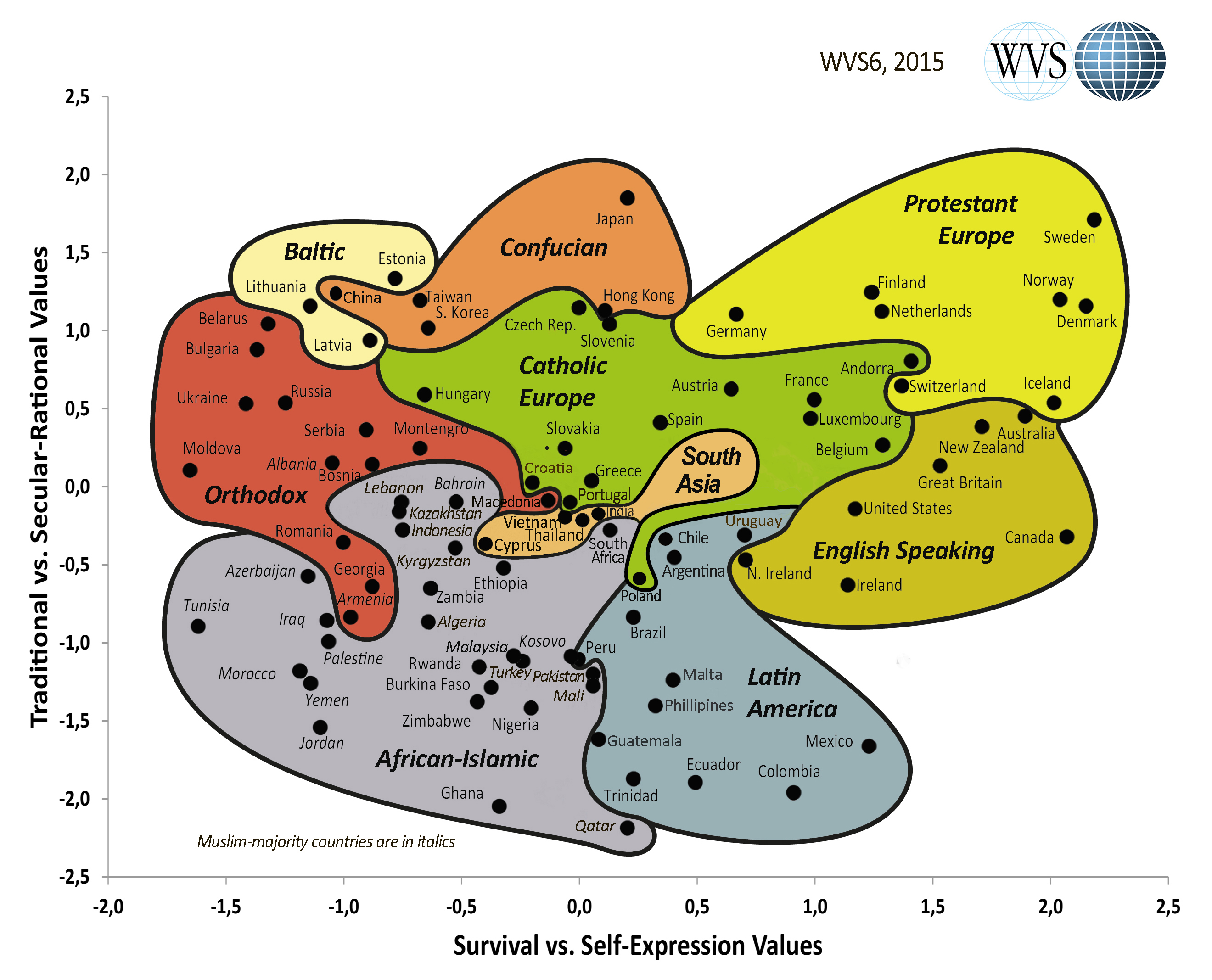
"The World Values Survey (WVS) is a global research project that explores people’s values and beliefs, how they change over time and what social and political impact they have. It is carried out by a worldwide network of social scientists who, since 1981, have conducted representative national surveys in almost 100 countries."


According to the Wikipedia article, the survey is carried out through questionnaires, and the results can be usefully compressed to the two-dimensional representation shown above, which repays some study (click on the image to make it larger).

The labelling of the two axes is less than clear: I suspect that:
  • the horizontal axis measures clan/group conformity - individualism
  • the vertical axis is capturing religiosity - secularism.

Decide for yourself: here is what the article says:
"Traditional values emphasize the importance of religion, parent-child ties, deference to authority and traditional family values. People who embrace these values also reject divorce, abortion, euthanasia and suicide. These societies have high levels of national pride and a nationalistic outlook.

"Secular-rational values have the opposite preferences to the traditional values. These societies place less emphasis on religion, traditional family values and authority. Divorce, abortion, euthanasia and suicide are seen as relatively acceptable.

"Survival values place emphasis on economic and physical security. It is linked with a relatively ethnocentric outlook and low levels of trust and tolerance.

"Self-expression values give high priority to environmental protection, growing tolerance of foreigners, gays and lesbians and gender equality, and rising demands for participation in decision-making in economic and political life."
This would be quite interesting in itself, but Peter Turchin's recent post applies it to the evolution of the European Union. First he notes:
"As I have said on numerous occasions (in this blog and in my other writings), it is hard to get people to cooperate, especially in large social groups. Successful cooperation requires that people share values and institutions. Values tell us why we want to cooperate: what is the public good that we collectively want to produce? Norms and institutions tell us how we are going to organize cooperation. Mismatched values and institutions may doom a cooperative effort even before it has a chance to get going.

"In my opinion, the expansion from the original six nations (Benelux, France, Germany, and Italy – I will refer to them as the “core” EU nations) to the current 28 was a big, big mistake. We can use the data collected by the World Values Survey (WVS) to visualize just how bad this mistake was."
Here is his key insight:
" I am interested to look at this mapping from a different point of view. Accordingly, I color-coded all countries into the following categories:

  • Core (red): the original 6 countries of the EEC

  • EU (brown): the other 22 members of the European Union

  • Europe (green): two Western European countries that are not in the EU

  • Candidate (yellow): current candidates for the EU

  • World (grey): rest of the world (country names omitted for clutter).

"Note: the reason Italy* has an asterix is because, for some reason, it was not included in the sixth wave, so I used its values from the fifth wave data."
Dr Turchin continues,
"The pattern is so striking it almost doesn’t require commentary, but let’s spell it out anyway. The original six (“Core Europe”) group together very closely. There are only two other countries that are part of the same cluster, Austria and Switzerland.

"Remarkably, the modern territories of both of these countries were encompassed by the boundaries of the Carolingian empire (see Is this the Beginning of the End for the European Union?). It looks like the “ghost” of Charlemagne’s empire has more influence on today’s cultural values than such later distinctions as Catholicism versus Protestantism.

"The current 28 members of the European Union, on the other hand, don’t cluster at all. On the contrary, they span three-quarters of world variation in values. Only African-Islamic countries and central America end up outside the ellipse that encompasses all 28 EU members."
You can see where Turkey is. And as for the absence of 'African-Islamic countries', the EU is doing its best to resolve that particular anomaly even as we speak.

If only they had understood Asabiyyah as well as the British Foreign Office, back in the days when it could still do realpolitik.

Wednesday, July 06, 2016

Bubble-think and the ultraleft

Peter Turchin has a phrase, the 'overproduction of elites'.
"Elite overproduction generally leads to more intra-elite competition that gradually undermines the spirit of cooperation, which is followed by ideological polarization and fragmentation of the political class. This happens because the more contenders there are, the more of them end up on the losing side. A large class of disgruntled elite-wannabes, often well-educated and highly capable, has been denied access to elite positions."
He writes:
"The youth cohort in Europe, those in their 20s and 30s, are the highest educated in the history of humanity – and there are not enough jobs that would use their skills. History shows that the overproduction of youth with education credentials is a sure sign of political turbulence to come."
Ed West (The Spectator blog) describes what these elites believe:
"More widely, in political discourse and culture, warm, fluffy notions about human nature are favoured over depressive realism. From a very young age children are read books and shown films that teach the message that we are all basically good and just like us, and then the more intelligent ones are sent off to universities where conservatism has been frozen out."
It is sometimes thought that the chic-radicalism of the bien-pensant is politically represented by the likes of Jeremy Corbyn and the hard left. But this isn't really true: the Marxist left privately characterises bubble-think as petit-bourgeois, a utopian worldview in which everyone is 'nice' and there are no more victims. Petit-bourgeois utopians aren't known for letting the class structure of society trouble their righteous little heads.

Whatever Corbyn may himself believe (who knows?) the hard left supporting him are in no doubt that the way forward is not to manage or prettify capitalism but to destroy it, replacing it with a 'democratic, centrally-planned economy under the control of workers' councils'.

The Marxist position on the EU of the Capitalists is Brexit; the EU is to be replaced by a post-capitalist socialist Europe.

The Bubble  is firmly Remain, as they identify with their pan-European elite tribe (as Ross Douthat observed).

The Marxist left is a highly-ideological minority which for tactical reasons hides its differences with bubble-leftism. This has been the strategy for decades: the expectation is that as the crisis of capitalism develops, the faux-leftists will become amenable to Marxist ideas, swelling the ranks of the Revolutionary Party.

It seemed to work for Lenin, back in 1917.

---

The non-Corbynistas in the PLP, what we used to call 'The Labour Party', are no less bubble-thinkers. The Tristram Hunts and Chuka Umunnas are not unfamiliar with Hampstead and Islington. It's just that they have a sense that managing a capitalist economy does impose some constraints over generalised niceness, equality of outcome and punching-up: decisions necessarily make enemies.

And what about the real proletarians, those millions of workers - mostly outside London - who really are working class and who recognise neither their identity nor their interests in Corbyn politics, or leftist or neo-Blairite bubble-think?

I suggest those Labour policy-makers not in thrall to bubble identity-politics might think a bit about a manifesto for them (here's an idea).

Tuesday, July 05, 2016

The Warrior, the Priest and the King

The roles required for effective governance: the warrior, the priest and the king.

  • The warrior is the enforcer, using charm, gifts and bludgeons to get stuff done
  • The priest is the strategist, directing the plays with divinely-inspired vision
  • The king exemplifies the unity and purpose of the community as a whole.

Many political failures result from getting these roles wrong; either by omitting one or more of them or misallocating power between them. Take Brexit (from an elite point of view):
David Cameron was the King, George Osborne was the Warrior (the Treasury frequently plays the role of enforcer) and people like Gove and Hilton were the Priests. But Osborne also played the strategist while Gove was used merely departmentally and Hilton bailed. The result was a fatal lack of coherent strategy and a sense of visionless coasting on the part of the Cameron administration.
Sometimes the Warrior is in the ascendant. When Margaret Thatcher came to power, the Establishment was beset by enemies: unruly trades unions, a rapacious EU bureaucracy, a stumbling economy. The Warrior demolished her opponents but couldn't progress to the role of King. Her endless search for further enemies brought about her downfall. Her successor, the emollient John Major, was a weak King.

You could tell a similar story about Winston Churchill.

In Myers-Briggs terms:

  • the King is a Guardian, most likely an ESTJ/ESFJ; 
  • the Warrior is often an Artisan ESTP .. or perhaps a righteous Idealist ENFJ; 
  • the priest is typically an intellectual Rational (NT).

The Labour Party

They have a diffident intellectual leader (Corbyn) failing to play the King; they have a far-left intellectual John McDonnell as Shadow Chancellor, failing as an effective Enforcer; and no Priest with a widely-supported political programme. In short: leaderless, ineffectual and all over the place; a party in civil war.

The Tories

Faced with novel challenges post-Brexit, they need powerful people in all three roles. Gove would be a good candidate as the Priest, although his political ineptness would have to be supervised; the Warrior role is up for grabs and not really visible in this leadership election, while Theresa May is a psychological match for the King role.

The question for Theresa May is whether she's up for the mission, or sees herself instead as a trojan horse for the dominant Establishment Remain faction. In the latter case, there will be tears before bedtime.

---

All of the above informs programme management as well. And business: COO, CMO, CEO.

Monday, July 04, 2016

Leave wins 421 seats across the UK, Remain just 229

A lot of chat, including here, about the prospects of weaselling out of the Brexit vote.

The referendum aggregated individual votes across the UK. But what if you group the votes by constituencies and see how each constituency would have voted?

BuzzFeedNews did it here (h/t: Marginal Revolution).
"To see how the country’s referendum vote could affect a general election, we’ve translated the referendum results (which in England, Scotland and Wales were counted by council area, not constituency) into results broken down by parliamentary seats.

"And when you do that, you get a radically different outcome. Instead of a close result, Leave win in a landslide.

"Although the referendum result was close nationally, Remain piled up many of its votes in a relatively small number of constituencies (London and Scotland being prime examples). As a result, the UK’s first-past-the-post electoral system would produce an extremely skewed result.

"In our projection, Leave would win 421 seats across the UK, while Remain would win just 229."


A solid sea of blue = Leave constituencies.

Yellow (Remain) indicates two things: the anti-English nationalist votes in Northern Ireland, Scotland and the northern part of Wales, plus the geography of the Elite Bubble in English/south Wales constituencies.

Most MPs won't be backing the coup, I suggest.

---

Peter Turchin (Cliodynamics) has an interesting piece: "Brexit as Destructive Creation".
"Now, in the aftermath of the referendum, the main question is, what’s next? In the following I propose some answers suggested by the new discipline of Cultural Evolution and my research on historical dynamics (Cliodynamics).

"My proposal is quite radical. Rather than trying to fight the disintegrative trend, we should allow it to run its course, destroying the EU as it is now. But we need a European Union. Thus, what I hope will happen is another integrative project within Europe, one that will learn from the mistakes of the last one.

"In other words, the EU is dead; long live a new and better EU."
Read the whole thing.

Sunday, July 03, 2016

'I'm so glad I'm a Beta'

Many people have said this, but not as well as Ross Douthat in the NYT yesterday.
"Now that populist rebellions are taking Britain out of the European Union and the Republican Party out of contention for the presidency, perhaps we should speak no more of left and right, liberals and conservatives. From now on the great political battles will be fought between nationalists and internationalists, nativists and globalists. From now on the loyalties that matter will be narrowly tribal — Make America Great Again, this blessed plot, this earth, this realm, this England — or multicultural and cosmopolitan.

Well, maybe. But describing the division this way has one great flaw. It gives the elite side of the debate (the side that does most of the describing) too much credit for being truly cosmopolitan.

Genuine cosmopolitanism is a rare thing. It requires comfort with real difference, with forms of life that are truly exotic relative to one’s own. It takes its cue from a Roman playwright’s line that “nothing human is alien to me,” and goes outward ready to be transformed by what it finds.

The people who consider themselves “cosmopolitan” in today’s West, by contrast, are part of a meritocratic order that transforms difference into similarity, by plucking the best and brightest from everywhere and homogenizing them into the peculiar species that we call “global citizens.”

This species is racially diverse (within limits) and eager to assimilate the fun-seeming bits of foreign cultures — food, a touch of exotic spirituality. But no less than Brexit-voting Cornish villagers, our global citizens think and act as members of a tribe.

They have their own distinctive worldview (basically liberal Christianity without Christ), their own common educational experience, their own shared values and assumptions (social psychologists call these WEIRD — for Western, Educated, Industrialized, Rich and Democratic), and of course their own outgroups (evangelicals, Little Englanders) to fear, pity and despise. And like any tribal cohort they seek comfort and familiarity: From London to Paris to New York, each Western “global city” (like each “global university”) is increasingly interchangeable, so that wherever the citizen of the world travels he already feels at home.

Indeed elite tribalism is actively encouraged by the technologies of globalization, the ease of travel and communication. Distance and separation force encounter and immersion, which is why the age of empire made cosmopolitans as well as chauvinists — sometimes out of the same people. (There is more genuine cosmopolitanism in Rudyard Kipling and T. E. Lawrence and Richard Francis Burton than in a hundred Davos sessions.)

It is still possible to disappear into someone else’s culture, to leave the global-citizen bubble behind. But in my experience the people who do are exceptional or eccentric or natural outsiders to begin with — like a young writer I knew who had traveled Africa and Asia more or less on foot for years, not for a book but just because, or the daughter of evangelical missionaries who grew up in South Asia and lived in Washington, D.C., as a way station before moving her own family to the Middle East. They are not the people who ascend to power, who become the insiders against whom populists revolt.

In my own case — to speak as an insider for a moment — my cosmopolitanism probably peaked when I was about 11 years old, when I was simultaneously attending tongues-speaking Pentecostalist worship services, playing Little League in a working-class neighborhood, eating alongside aging hippies in macrobiotic restaurants on weekends, all the while attending a liberal Episcopalian parochial school. (It’s a long story.)

Whereas once I began attending a global university, living in global cities, working and traveling and socializing with my fellow global citizens, my experience of genuine cultural difference became far more superficial.

Not that there’s necessarily anything wrong with this. Human beings seek community, and permanent openness is hard to sustain.

But it’s a problem that our tribe of self-styled cosmopolitans doesn’t see itself clearly as a tribe: because that means our leaders can’t see themselves the way the Brexiteers and Trumpistas and Marine Le Pen voters see them.

They can’t see that what feels diverse on the inside can still seem like an aristocracy to the excluded, who look at cities like London and see, as Peter Mandler wrote for Dissent after the Brexit vote, “a nearly hereditary professional caste of lawyers, journalists, publicists, and intellectuals, an increasingly hereditary caste of politicians, tight coteries of cultural movers-and-shakers richly sponsored by multinational corporations.”

They can’t see that paeans to multicultural openness can sound like self-serving cant coming from open-borders Londoners who love Afghan restaurants but would never live near an immigrant housing project, or American liberals who hail the end of whiteness while doing everything possible to keep their kids out of majority-minority schools.

They can’t see that their vision of history’s arc bending inexorably away from tribe and creed and nation-state looks to outsiders like something familiar from eras past: A powerful caste’s self-serving explanation for why it alone deserves to rule the world."
H/t: Steve Sailer.

--

Here's the full quote (chapter 2).
"At the end of the room a loudspeaker projected from the wall. The Director walked up to it and pressed a switch.

"… all wear green," said a soft but very distinct voice, beginning in the middle of a sentence, "and Delta Children wear khaki. Oh no, I don't want to play with Delta children. And Epsilons are still worse. They're too stupid to be able to read or write. Besides they wear black, which is such a beastly colour. I'm so glad I'm a Beta."

There was a pause; then the voice began again.

"Alpha children wear grey. They work much harder than we do, because they're so frightfully clever. I'm really awfully glad I'm a Beta, because I don't work so hard. And then we are much better than the Gammas and Deltas. Gammas are stupid. They all wear green, and Delta children wear khaki. Oh no, I don't want to play with Delta children. And Epsilons are still worse. They're too stupid to be able …"

The Director pushed back the switch. The voice was silent. Only its thin ghost continued to mutter from beneath the eighty pillows.

"They'll have that repeated forty or fifty times more before they wake; then again on Thursday, and again on Saturday. A hundred and twenty times three times a week for thirty months. After which they go on to a more advanced lesson."

Wednesday, June 29, 2016

Ganging up on the English

The Northern Ireland Protestants tended to vote leave, identifying with the English working class.

The Northern Ireland Catholics tended to vote remain, identifying with their brethren across the border.

The Scots voted remain to arm themselves with countervailing power against the English.

The Welsh showed their shallow sense of national ethnic identity by identifying more with the English working class. I don't know the figures for the more nationalist North Wales.

The illusions of the new European demos so cruelly exposed - it lives only in the elite bubble.

The fault lines in that historical and increasingly wobbly construct, the 'United Kingdom', are equally exposed to view.

Monday, June 27, 2016

My fantasy Labour Party

I'm watching the Labour shadow cabinet implode this morning with emotional detachment. There was a time, in my twenties, when I was tribally Labour; later I confess I voted for Blair. But it's all been downhill since then, Gordon, Ed and Jeremy.

---

My ideal, fantasy Labour Party

1. Puts its hands up for capitalism, predatory and destructive though it is, as no other economic system can take us forwards. My Labour Party supports technological innovation and accepts there can be no equality of outcome in a successful capitalist society.

Yes, we can and should do mitigation.

2. My Labour Party controls immigration on the basis of individual skills, talent and character according to national needs. No uncontrolled admission on the basis of which nation state the enquiring immigrant happens to reside in.

The most salient reason for this is that both our social fabric and the functioning of our institutions are critically dependent on our human capital. We need more people who are smart, skilled, conscientious and prosocial. They're hardly the majority of those wanting in.

3. I'd rather like the Labour Party to exhibit, or at least partially reflect, the value system of its mass base. Hampstead champagne-socialism and Islington bien-pensant liberalism doesn't do it for me.

Don't get me wrong, I wouldn't actively ban readers of The Guardian from joining or leading my Labour Party - I do believe in toleration.

Sunday, June 26, 2016

Weaselling out of Brexit

David Lammy MP has called for Parliament to vote to continue with membership of the EU, pointing out that the Brexit Referendum was advisory and non-binding. "Let this nightmare end!"

Such a vote would be superfluous. The exit process can only begin once Article 50 is invoked by the UK government. The 'Leave' leadership doesn't seem very keen, and apart from Gove, no senior Tory seems to have their heart really and truly set on Brexit.

The vast majority of parliamentarians, along with the bulk of the establishment elite want to stay in the EU. Here is how to weasel out of Thursday's inconvenient result (which was pretty close, right?).

1. Do nothing quickly. Any backsliding right now would have the northern masses on the street. Things would get ugly.

2. Do what Boris suggested a few months back. With article 50 in the back pocket, wring some further concessions out of Germany. Choose the issues which are both achievable and targeted to detach 3-4% of leavers back to remain.

3. Towards the end of the year - no sooner! - announce that the EU has finally seen sense and that there is no need to go through the upheaval of Brexit. After months of scare stories and a few actual horrors, see if you can get away without holding another referendum, just let the whole thing fade away (it was only 'advisory' 😉).

It was all a ghastly glitch, but things are now reassuringly back to normal.

See if I'm wrong.

Saturday, June 25, 2016

Scottish Referendum v.2

Question for SNP supporters. You say you don't want to be a satellite country of the English. And I understand that, the history and everything. But why switch to becoming a satellite of the Germans instead?

We all like the Germans, of course. It was the satellite bit you should be worried about.

My advice: vote for your independence and then keep it. Like a grown-up country. Norway comes to mind. And Switzerland.

So don't apply to join the EU - and you do know they intend to humiliate you, right?

The 4th Reich hits a speed bump

When the historians come to write about Brexit they will observe that it took a human lifetime, 70 years, for Germany to resume its traditional role as dominant country in Europe (after WW2).

Although at first its policies appeared classically liberal - fiscal rectitude, free movement of labour, barely-limited Muslim immigration - they naturally aroused resentment amongst the populations of satellite countries within the EU as Germany tried to impose its will across the union.

"Naturally people feared the consequences of a further evolution of German expression of its national interests.

"It was perhaps inevitable that the UK, the second largest economy in the EU and the most semi-detached, would take the logical step of removing itself from satellite status in 2016.

"The emergence of a medium power on the periphery of Europe not structurally dominated by Germany was of interest to major powers such as the US, Russia and China, whose interests sometimes conflicted with those of the new Holy Roman Empire (this phrase, although deprecated in public, was frequently heard in the euro-corridors of power - whereas 'fourth Reich' was unthinkable).

"The resulting pattern of alliances was fascinating .."

Sadly the text finishes here.

Monday, May 16, 2016

European pacifism won in practice, if not in theory

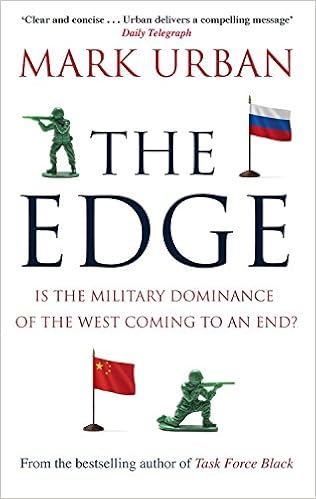
Mark Urban, diplomatic and defence editor on the BBC's Newsnight, wrote "The Edge: Is the Military Dominance of the West Coming to an End?" about six months ago.

Its arguments have been highlighted again by recent Brexit Referendum discussions about the impact of the EU on war between states in Europe.


Here is an excerpt from The Telegraph's review.
"How many American tanks are permanently stationed in Europe? At a time when Vladimir Putin has invaded Ukraine and grabbed 10,000 square miles of his neighbour’s territory, you might be surprised to learn that the answer is none.

"With impeccable timing, the last American main battle tank left Europe shortly before the onset of Ukraine’s crisis in 2014. During the Cold War, the United States Army kept 5,000 tanks in Europe to defend its Nato allies; today, not a single one remains.

"Surely the world’s only superpower could rustle up some heavy armour pretty quickly in the event of an emergency? Don’t be so sure. General Sir Richard Shirreff, formerly Nato’s deputy supreme allied commander, thinks that America would need between six and 12 months to deploy one armoured division in Europe.

"Russia, meanwhile, has no fewer than 2,300 tanks, most of them already positioned in the European theatre.

"In The Edge, Mark Urban sounds the alarm over the scale and pace of the West’s disarmament since the collapse of the Soviet Union. Back in 1979, Urban, now the diplomatic and defence editor of Newsnight, was “for a short heady time” the “commander of one of the British Army’s 900 Chieftain tanks”.

"The era when Britain could field hundreds of the heaviest machines of war now seems impossibly distant. By way of comparison, the Army was down to 36 operational tanks for much of last summer.

"The picture at sea or in the air is little better. Year after year, every country in Nato – including America – has been paying off warships and decommissioning fighter squadrons.

"Even the forces that remain have been hollowed out by a shortage of spare parts and trained personnel. On paper, the Spanish Air Force has 39 Typhoon fighters, but only six are actually ready for combat. Of Germany’s 109 Typhoons, only 42 are in any condition to defend the country’s airspace.

"In clear and concise prose, Urban lays out the way in which an entire continent has chosen the path of wholesale disarmament. It is impossible to read this authoritative book without feeling a deep sense of alarm, indeed of wonder, that our leaders have chosen to take such breathtaking risks.

"The assumption behind the shredding of Nato’s defences is that warfare between European countries is no longer conceivable. In military jargon, “state-on-state” conflict is now irrelevant; the sole purpose of the tattered remnants of our armed forces is to fight “non-state actors” like terrorists and insurgents.

"Russia, however, was never so foolish as to make such an assumption. After the Cold War, the Kremlin was at first compelled to disarm for the simple reason that Russia’s economy had collapsed. For the last decade, however, Russia has been rearming on a huge scale – and its generals take the ruthless business of “state-on-state” conflict very seriously indeed. In Georgia in 2008 and now in Ukraine, those are precisely the kind of wars that Putin has chosen to fight."
Mark Urban paints a disturbing portrait of a "hollowed out" Western military. After the end of the Cold War, investment in classic state-on-state military systems was throttled right back. We have ageing ships and aircraft, and if they were destroyed in combat, the factories which could replace them have long since ceased production.

Urban contains his irritation at his colleagues in the media 'commentariat' - pacifist, consumed by imperialist guilt, united in a belief that interstate conflicts will never again transition to violence, at least as far as EU nations are concerned.

It's not true that pacifism has won a bloodless victory amongst Western elites. Urban observes that there is substantial funding for spooks and drones. And some UK investments, notably the carriers and the aircraft to fly off them, should come good after 2020 (we trust).

Absent an existential threat, the military was always going to fare badly in the tight budget wars after the Cold War. It's still possible to argue that Russia is simply sorting out historic anomalies as to where its borders should lie, and that the level of middle-eastern inspired conflicts outside of the middle-east are far removed from conventional warfare. Urban discusses these points.

Fundamentally, however, Western Europe is prosperous and disarmed. Historically states which have placed themselves in such a posture ended up as easy pickings for anyone with a military who felt sufficiently acquisitive.

It seems hard to believe that such a fundamental truth is now entirely behind us. Or that America will always save us (at potentially huge cost to itself).

---

It might be argued that we would have warning and could re-arm fairly quickly. But our weaponry is getting more and more complex and expensive with ever longer lead times.

It's been a cliche for a long time that an adversary with cheap and cheerful weapons (guns, fighter aircraft, bombers, ships, missiles) which can be produced quickly and in bulk, and who has a readiness to accept losses can beat a much higher-tech opponent who finds it difficult to develop, deploy and maintain its super-advanced systems .. and is loss-averse.

Wednesday, February 24, 2016

Combat the four whites!


The four whites are bread, pasta, potatoes, rice. These high-GL bad boys have been replaced in our diet by mashed beans (looks like mash, tastes quite a bit different), cauliflower rice (looks nothing like rice, tastes nothing like rice) and sweet potato (pretty much like potato - but a deafening chorus assures me it's OK).

 I think my favourite new diet element may be the Sauerkraut.

 ---

Is it ever the same day at every location on Earth?

You need to be thinking about the International Date Line and the Midnight Line, the north-south arc where it's always locally midnight. Interestingly, the former is a coordinate of convention while the latter is coordinate-independent.


Crossing the IDL, you always transition to the day before; crossing the Midnight Line you always transition to the day after. When these two line coincide ... they cancel.

Visualising 3D spatial geometry is difficult, isn't it?

 ---

Oh Lord, Emma Thompson and a chorus of luvvies want us in; George Galloway (Britain's answer to Mussolini) and a bunch of UKIPers want us out. What's a sensible person to do!

When I was young my father was baffled by my strange geekish persona and declared I had 'no common sense'. He sometimes called me 'goon' after a character in his favourite radio programme, 'The Goon Show'.

Neddie Seagoon - 'an affable but gullible idiot'

I have profoundly agreed with his general approach since I discovered that the genius John von Neumann wanted the US to launch a first thermonuclear strike on Russia in the window before the Soviets got the H-bomb.

That's why I'm less than impressed by the intellectual Michael Gove's high-minded and thoroughly rational fretting about 'sovereignty'.

Friday, February 19, 2016

The Boys in the Bubble

Bagehot in "The Economist" today

Bagehot writes:
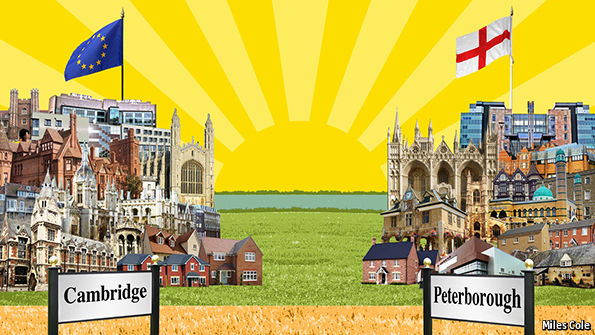
"BEING a Eurosceptic in a university city is a lonely business. In the drizzle outside the Cambridge Union a student in a roll-neck is trying to hand anti-EU leaflets to the cliques hurrying past. Most ignore him. One, having taken a folded piece of card, glances at it and sighs “nah”, shoving it back into the campaigner’s hand.

"Inside, in the neo-Gothic chamber, pro-EU luminaries ply their arguments to cheers. When Richard Tice, an anti-EU campaigner, delivers his speech students bob up and down, machine-gunning him rebarbative questions. Did regulation not exist before Britain joined the union? Why do so many firms support membership? If Britain doesn't control its borders why do foreign students struggle to get visas?

"When Mr Tice quotes “the highly respected economist, Tim Congdon” (a notorious Eurosceptic) the chamber resounds to laughter and sarcastic applause."
Things are different in Peterborough.
"Compare that with Peterborough, a similarly sized city at the other end of Cambridgeshire. At a public debate there locals voted decisively in favour of Brexit. “I asked rhetorically what the audience would put at risk to leave the EU,” recalls Mr Huppert. “They shouted back: ‘Everything’.”
Cambridge and Peterborough are geographically close and in many ways quite similar, so why the different attitudes to the EU?
"Cambridge bears the hallmarks of an economy in which one in two has gone to university, Peterborough is visibly a city of school-leavers.

"When it comes to the EU, this difference is everything. Education levels are “an extremely strong predictor” of an individual’s views on the subject, stresses Robert Ford, an expert on public opinion: the more qualifications someone has, the more pro-European he or she is likely to be.

"According to polls by YouGov, those educated only to 16 oppose EU membership by 57% to 43%, but among graduates it is 38% to 62%. When education is controlled for, other factors affecting an individual’s views on Europe—like income, choice of newspaper and even age—diminish.

What is it about those five years of study between 16 and 21? The answer has two parts. First, the self-interested one. “Having a degree is increasingly a prerequisite of getting on in life,” observes Mr Ford, adding: “Both sides are aware that there is a drawbridge called university and that those who don’t get across it are disadvantaged.”

[...]

"The second, cultural driver mostly concerns immigration. Whereas many in Cambridge see incomers as highly educated Germans and Swedes bringing their expertise to research projects, start-ups and product-development meetings, in Peterborough they are Lithuanian potato-pickers who, if not competing with locals for unskilled work, are at least nipping at their heels."
The Economist has sussed out the underlying trend though:
"University attendance has exploded, which suggests that Britain will become more internationalist and comfortable with EU co-operation. Yet in the meantime it seems the country will be increasingly polarised: liberal, Cambridge-like places on the one side; nationalist, Peterborough-like ones on the other and an ever-shrinking middle ground between the two, as the population bifurcates into those whose skills make them globally competitive and those who must compete with robots and the mass workforces of the emerging economies.

[...]

"Eventually Britain will look more like Cambridge than it does today."
In the year after taking A-level (i.e. at age 18+) 52% of young people were at a higher education institution - with one per cent at Oxbridge and another 8% at other Russell Group universities, according to a Government report.*

So Oxbridge is taking the top 1% of the population age-cohort and inducting them into an international elite bubble. I feel it is unlikely, short of the initiative described in my previous post, that very much more of Britain 'will look more like Cambridge in the future than it does today'.

There are better, more forward-thinking arguments which might speak to Oxbridge undergraduate as to the merits of leaving the present incarnation of the Holy Roman Empire. But that's for another day ... although ironically, The Economist got there before me.
___

Update: (March 18th 2016): see also "Brexit: the issue is Germany".

---

* These figures are interesting. If the 1% admitted to Oxford and Cambridge were selected entirely on merit, the IQ cut-off would be z = 2.33 SD, or 135. If you believe that some get into Oxbridge by not being quite as bright as that, but by having connections, then the merit IQ threshold will be greater than 135.

For the Russell Group  (the top 24 non-Oxbridge including my own alma mater, Warwick), you have to be in the top 9%. This requires z > 1.34, or an IQ of at least 120. In practice, IQ demands are likely to be less for non g-loaded subjects like English and Drama (plus there are those connections again), so this is very much a lower bound for disciplines positively requiring high-IQ (typically STEM subjects and philosophy).

---

We were in the Cribbs Causeway Mall today, pictured below, where I replaced my Primark trousers with softer and more luxurious variants from John Lewis at seven times the price.

The author at Cribbs Causeway Mall

I also popped into my first Apple store. I was expecting style and imagination, but was confronted by six large Formica-like tables upon which were arrayed rows of tethered iPhone 6s and MacBook Air laptops. The whole experience seemed tacky and impoverished; the shop was, however, crowded.

Sunday, November 15, 2015

Two, three, many banlieues *

One of my favourite William Gibson quotes: 'The future is already here — it's just not very evenly distributed.'

And so to the Future of Europe.

In the Sunday Times today, Niall Ferguson writes an opinion piece:
"I am not going to repeat what you have already read or heard. I am not going to say that what happened in Paris on Friday night was unprecedented horror, for it was not. I am not going to say that the world stands with France, for it is a hollow phrase. Nor am I going to applaud François Hollande’s pledge of “pitiless” vengeance, for I do not believe it. I am, instead, going to tell you that this is exactly how civilisations fall.

Here is how Edward Gibbon described the Goths’ sack of Rome in August 410AD: “. . . In the hour of savage licence, when every passion was inflamed, and every restraint was removed . . . a cruel slaughter was made of the Romans; and . . . the streets of the city were filled with dead bodies . . . Whenever the Barbarians were provoked by opposition, they extended the promiscuous massacre to the feeble, the innocent, and the helpless. . .”

Now, does that not describe the scenes we witnessed in Paris on Friday night?"
Ferguson then quotes extensively from Bryan Ward-Perkins' excellent book, 'The Fall of Rome'. (which I recently wrote about here).
"The end of the Roman west, he writes in The Fall of Rome (2005), “witnessed horrors and dislocation of a kind I sincerely hope never to have to live through; and it destroyed a complex civilisation, throwing the inhabitants of the West back to a standard of living typical of prehistoric times”.

In five decades the population of Rome itself fell by three-quarters. Archaeological evidence from the late fifth century — inferior housing, more primitive pottery, fewer coins, smaller cattle — shows that the benign influence of Rome diminished rapidly in the rest of western Europe. “The end of civilisation”, in Ward-Perkins’s phrase, came within a single generation."
Ferguson sees the parallels:
"Uncannily similar processes are destroying the European Union today, though few of us want to recognise them for what they are. Like the Roman Empire in the early fifth century, Europe has allowed its defences to crumble. As its wealth has grown, so its military prowess has shrunk, along with its self-belief. It has grown decadent in its shopping malls and sports stadiums. At the same time it has opened its gates to outsiders who have coveted its wealth without renouncing their ancestral faith.

The distant shock to this weakened edifice has been the Syrian civil war, though it has been a catalyst as much as a direct cause for the great Völkerwanderung of 2015. As before, they have come from all over the imperial periphery — from North Africa, from the Levant, from south Asia — but this time they have come in their millions, not in mere tens of thousands.

To be sure, most have come hoping only for a better life. Things in their own countries have become just good enough economically for them to afford to leave and just bad enough politically for them to risk leaving. But they cannot stream northwards and westwards without some of that political malaise coming with them. As Gibbon saw, convinced monotheists pose a grave threat to a secular empire.

It is doubtless true to say that the overwhelming majority of Muslims in Europe are not violent. But it is also true that the majority hold views not easily reconciled with the principles of our liberal democracies, including our novel notions about sexual equality and tolerance not merely of religious diversity but of nearly all sexual proclivities. And it is thus remarkably easy for a violent minority to acquire their weapons and prepare their assaults on civilisation within these avowedly peace-loving communities."
And his conclusions?
“Romans before the fall”, wrote Ward-Perkins, “were as certain as we are today that their world would continue for ever substantially unchanged. They were wrong. We would be wise not to repeat their complacency.”

Poor, poor Paris. Killed by complacency."
Ward-Perkins observed that the Roman Empire in the West could have collapsed four or five times in the preceding centuries. Simultaneous massed incursions at different edges of the empire would have defeated the Roman legions which were only about ten percent better than tooled-up barbarians (the Romans had better training, discipline and logistics).

The advanced capitalism of Western Europe is not going to be militarily smashed by Islamic fundamentalists. If it were absolutely necessary, if we were to put aside moral scruples and worries about collateral damage, the 'terrorists' could be annihilated any time we chose. But in any foreseeable circumstances, no popular sentiment or credible politician is going to sanction that.

No, we already know what a future Europe with millions of middle-eastern Muslim immigrants looks like. That future is already here, just currently unevenly distributed.

To see it, you only have to look in the banlieue suburbs of Paris and Brussels.

Such a great idea, to replicate those banlieues across Germany and the rest of the EU. **

---

* Younger readers may not recognise the allusion to Ernesto "Che" Guevara's famous 'Create Two, Three, Many Vietnams!' (1966).

** Bonus question. What real-world experiences would it take to alter the open-border, uncontrolled-immigration fantasies of The Economist and economists such as Bryan Caplan? Writers and thinkers who take care never to reside anywhere near the resulting ghettos.

Monday, July 06, 2015

Free-riding in Greece

OK, I admit it, I was wrong. I really thought that the Greeks would vote yes and we could resume the long habit of kicking the can down the road. But here we are instead, in a strange but very familiar place.

The Greek situation is a special case of the welfare dilemma, a form of moral blackmail. What do you do when the feckless shirker refuses to act responsibly and demands you continue supporting him and his family? If you don't, he says, my partner and kids will starve and it will be your fault.

My 'partner', Clare, wondered how ISIS would respond to this dilemma. Briskly, I would have thought.

Anyway, the leaders of the EU now have to decide:
  1. Tough it out and turn off the taps. The Greek economy will implode and those tender of heart (there are many) will blame the rich EU in general and the Germans in particular.

  2. Carry on transferring cash to the corrupt and incompetent Greek state, in which case other 'Club Med' dysfunctional states may well give up on paying their way .. and the Germans get to continue to transfer their gold to feckless others in perpetuity.

  3. Kick the can down the road somehow.
How the EU hopes that the general theorem - if something cannot continue for ever then it will stop - does not apply in this case!

There is another option. One which would naturally happen within the borders of a functional state. The authorities would turf out the incompetents and crooks and put in place an efficient administration to sort things out. But somehow, no-one seems to want the Germans to do that.

We were down at Bristol Harbour this morning, a propos of nothing much. It was too rainy for the mini-cruise we had been contemplating.

The SS Great Britain at Bristol Harbour