Showing posts with label Holy Roman Empire. Show all posts

Saturday, November 24, 2018

UDI from the proto-empire

Brexit: the fundamental issue is the UK vis-à-vis Germany

Brexit is not hard to understand.

1. The Germans are overt players again

Germany is waking from its decades of political hibernation. Its long atonement for the crimes of Nazism. The years in which it hid pursuit of its national interests behind the EU project, passive-aggressively ceding political leadership to France.

The new emerging Germany is finally ready and willing to be the European hegemon. Ask Greece.

2. The French know their place

The French elite, under Macron, has already capitulated, providing ideological cover to the German project with its narrative of transnationalism and 'ever closer union'. It's rather like the UK relationship with the US although the French have more influence over Germany.

La France profonde is increasingly restive.

3. The British: global financial reach + indifferent regional manufacturing

The UK elite, from its vantage point of a global financial nexus, knows it could never dominate Germany in Europe. But neither does it wish to be dominated. Its European strategy has always been transactional and divisive.

4. A political UDI suits both sides in the EU

A rising Germany is happy that the UK, a game-spoiling rival, is withdrawing from the ring. The French likewise.

The more globalised, financialised UK sees a least bad outcome in maintaining optimised economic access to the European market for goods and services. The British (English? .. London?) elite is therefore broadly happy with the May government's Brexit strategy and is content to spend the next plurality of years fine-tuning it.

Despite the aspirations of UK Remainers (fans of the Macron project), there has been no concerted pressure from the major EU powers (Germany, France) for a second referendum. The 'People's Vote’ has been theatre, reflecting a lack of purchase on the core of UK elite opinion.

5. Labour should tactically prop up the May government

If Labour were smart, they would abstain on the early December parliamentary vote on the May proposals.

This would avoid complicity in the risk of an uncontrolled hard Brexit (which would dismay their Momentum base and be strongly opposed by the UK elite) while exposing May's reliance on Labour to get her own policy through.

The three-way civil war inside the Conservative party would intensify and the Tories would look even less a viable government.

6. Plus ça change ... in the short run

As the UK transitions out of the EU in March 2019, all the cans will have been kicked down the road for another few years.

The May government may well stagger on to the next election (due 2022), spinning its administrative wheels with no consensual Tory vision or roadmap whatsoever - and with Labour salivating and preparing for government.

Friday, March 18, 2016

Brexit: the fundamental issue is the UK vis-à-vis Germany

Henry Kissinger once famously observed, “Poor old Germany. Too big for Europe, too small for the world.

The British seem to believe that the EU is perpetually on the brink of collapse due to this or that crisis. In fact the EU subsists in a political 'lowest-energy state' - it continually varies its political geometry to accommodate challenges; it endures, it does not collapse. There is, however, an underlying secular trend towards German dominance.

For well-known historical reasons, Germany has hitherto been reluctant to overtly lead the EU - but things are changing. The EU core zone is evolving into Germany and its satellites, client states if you will. The suggestions of a supersized Holy Roman Empire are not misplaced.

The Holy Roman Empire in the early 16th century

Put to one side the headline issues of euro-idealism, immigration scares, trade-tariff issues, easy currency transactions and free-ish travel arrangements. Political strategy is about interests and power. The strategic issue facing the UK (perhaps I mean England) will be the same in the twenty-first century as it was in the twentieth. What's the best way to deal with Germany?

  1. If the UK stays in the EU, will it end up as a German satellite? 
  2. If it leaves, will it still end up as a German satellite, albeit at arm's length?

It might be argued that other countries were quite prepared to tolerate being 'Germany's running dogs' - in that old, unpleasant communist phrase. Sure, they yap, bicker and whine a bit, but they were keen to join the EU and prepared to embrace the Euro. They knew what they were getting into. Even Greece figured it out in the end.

England, you say, has always made it clear we're not signed up to the EU vision. We don't believe the answer is always 'more Europe'.

From Germany's point of view (and that of its allies) that makes the UK a real pain to deal with. The UK is the Kevin Pietersen of the European Union - a big hitter with no loyalty or esprit-de-corps. There are those in the europroject who would be delighted to see such an awkward member-state just push off.

But in or out, we continue to face the fundamental issues of power relationships and the resolution of conflicts of interest between the UK and a German-led Europe.

My feeling is that there can, in the end, only be one leader of the EU and that's Germany. So the answer to question 1 above is 'yes'.

There are historical precedents for offshore islands maintaining independence from a mainland hegemon (Japan, Taiwan, Singapore) although it's never easy. So my answer to question 2 above is 'not necessarily'.

But don't rush to judgement - perhaps there are worse things in the world than being Germany's competent and loyal senior lieutenant?

---

Marl Mardell at the BBC website has a perceptive piece on this.

Friday, February 19, 2016

The Boys in the Bubble

Bagehot in "The Economist" today

Bagehot writes:
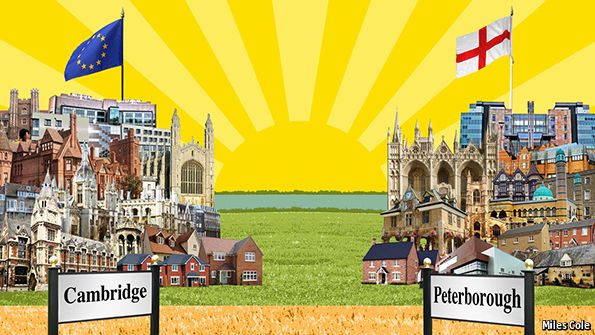
"BEING a Eurosceptic in a university city is a lonely business. In the drizzle outside the Cambridge Union a student in a roll-neck is trying to hand anti-EU leaflets to the cliques hurrying past. Most ignore him. One, having taken a folded piece of card, glances at it and sighs “nah”, shoving it back into the campaigner’s hand.

"Inside, in the neo-Gothic chamber, pro-EU luminaries ply their arguments to cheers. When Richard Tice, an anti-EU campaigner, delivers his speech students bob up and down, machine-gunning him rebarbative questions. Did regulation not exist before Britain joined the union? Why do so many firms support membership? If Britain doesn't control its borders why do foreign students struggle to get visas?

"When Mr Tice quotes “the highly respected economist, Tim Congdon” (a notorious Eurosceptic) the chamber resounds to laughter and sarcastic applause."
Things are different in Peterborough.
"Compare that with Peterborough, a similarly sized city at the other end of Cambridgeshire. At a public debate there locals voted decisively in favour of Brexit. “I asked rhetorically what the audience would put at risk to leave the EU,” recalls Mr Huppert. “They shouted back: ‘Everything’.”
Cambridge and Peterborough are geographically close and in many ways quite similar, so why the different attitudes to the EU?
"Cambridge bears the hallmarks of an economy in which one in two has gone to university, Peterborough is visibly a city of school-leavers.

"When it comes to the EU, this difference is everything. Education levels are “an extremely strong predictor” of an individual’s views on the subject, stresses Robert Ford, an expert on public opinion: the more qualifications someone has, the more pro-European he or she is likely to be.

"According to polls by YouGov, those educated only to 16 oppose EU membership by 57% to 43%, but among graduates it is 38% to 62%. When education is controlled for, other factors affecting an individual’s views on Europe—like income, choice of newspaper and even age—diminish.

What is it about those five years of study between 16 and 21? The answer has two parts. First, the self-interested one. “Having a degree is increasingly a prerequisite of getting on in life,” observes Mr Ford, adding: “Both sides are aware that there is a drawbridge called university and that those who don’t get across it are disadvantaged.”

[...]

"The second, cultural driver mostly concerns immigration. Whereas many in Cambridge see incomers as highly educated Germans and Swedes bringing their expertise to research projects, start-ups and product-development meetings, in Peterborough they are Lithuanian potato-pickers who, if not competing with locals for unskilled work, are at least nipping at their heels."
The Economist has sussed out the underlying trend though:
"University attendance has exploded, which suggests that Britain will become more internationalist and comfortable with EU co-operation. Yet in the meantime it seems the country will be increasingly polarised: liberal, Cambridge-like places on the one side; nationalist, Peterborough-like ones on the other and an ever-shrinking middle ground between the two, as the population bifurcates into those whose skills make them globally competitive and those who must compete with robots and the mass workforces of the emerging economies.

[...]

"Eventually Britain will look more like Cambridge than it does today."
In the year after taking A-level (i.e. at age 18+) 52% of young people were at a higher education institution - with one per cent at Oxbridge and another 8% at other Russell Group universities, according to a Government report.*

So Oxbridge is taking the top 1% of the population age-cohort and inducting them into an international elite bubble. I feel it is unlikely, short of the initiative described in my previous post, that very much more of Britain 'will look more like Cambridge in the future than it does today'.

There are better, more forward-thinking arguments which might speak to Oxbridge undergraduate as to the merits of leaving the present incarnation of the Holy Roman Empire. But that's for another day ... although ironically, The Economist got there before me.
___

Update: (March 18th 2016): see also "Brexit: the issue is Germany".

---

* These figures are interesting. If the 1% admitted to Oxford and Cambridge were selected entirely on merit, the IQ cut-off would be z = 2.33 SD, or 135. If you believe that some get into Oxbridge by not being quite as bright as that, but by having connections, then the merit IQ threshold will be greater than 135.

For the Russell Group  (the top 24 non-Oxbridge including my own alma mater, Warwick), you have to be in the top 9%. This requires z > 1.34, or an IQ of at least 120. In practice, IQ demands are likely to be less for non g-loaded subjects like English and Drama (plus there are those connections again), so this is very much a lower bound for disciplines positively requiring high-IQ (typically STEM subjects and philosophy).

---

We were in the Cribbs Causeway Mall today, pictured below, where I replaced my Primark trousers with softer and more luxurious variants from John Lewis at seven times the price.

The author at Cribbs Causeway Mall

I also popped into my first Apple store. I was expecting style and imagination, but was confronted by six large Formica-like tables upon which were arrayed rows of tethered iPhone 6s and MacBook Air laptops. The whole experience seemed tacky and impoverished; the shop was, however, crowded.