 |
| Amazon link |
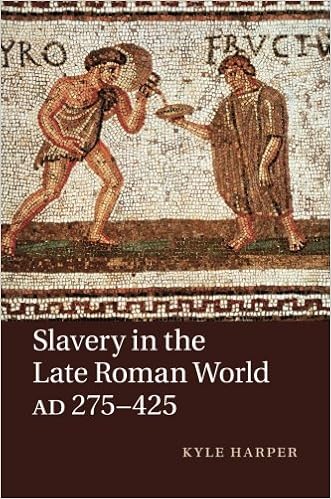
From "Conclusion. After the fall: Roman slavery and the end of antiquity" - (my emphasis).
"The transition from Roman to post-Roman societies in the west was not a shift from one mode of production to another (slave, feudal, or peasant). The transition was from an unusually complex society to much simpler forms of social and economic organization.
The fall of the empire saw a dramatic loss of structural complexity. Roman society, with its exceptional levels of commerce and urbanism, fostered an unusually complex stratification of wealth. Roman society knew a staggering, tripartite hierarchy of wealth; not only were the rich unimaginably rich, but beneath them was a social element — modest by modern standards, exceptional by pre-modern measures — living above subsistence.
In the post-Roman centuries, the decisive middle was gradually lost, and a simpler, binary division of wealth asserted itself. The process of social simplification asserted itself at both the top and bottom of society. Post-Roman aristocracies changed as much as the lower classes.
Wickham has highlighted the structural, economic importance of the change. The Roman aristocracy was unusual in being a civilian aristocracy; the upper tiers of the status hierarchy were based, quite nakedly, on wealth. The Roman elite was an agro-commercial elite. There were changes already in the long fourth century — the rise of an imperial service elite (whose salaries, however, provided them with capital) and, even more fatefully, the rise of an ecclesiastical elite.
After the fall of Rome, it is the civilian, commercial aspect of the aristocracy which suffered most; the military and ecclesiastical castes were pushed to the fore. This is the elite we can follow in the colorful pages of Gregory of Tours' history, with its Roman bishops clinging to a civilized past and its violent Merovingian overlords roaming the landscape.
What we need to imagine, behind the new, vividly drawn social figures, is the different relation between the aristocracy and agricultural production which lies behind the story.
The fate of the lower classes in the post-Roman west is a more difficult problem. We should resist the temptation to compress all laboring dependents into a single undifferentiated mass. The idea of a centuries-long "merger" among the lower classes, leading eventually to serfdom, has occupied a place in the historiography that is neither empirically nor analytically justified." (pp. 500-501).
"... The successor societies of the post-Roman west, from ca. AD 450-650, inherited sizeable slave populations, and the violence of the age continually created new captives, new slaves. But the reduction in the demand for slaves was ultimately the decisive secular trend. The recession of exchange-oriented production [ie of luxury, non-subsistence goods] undermined the demand for higher-risk, controllable forms of estate labor. [ie slaves]
The demise of the towns obliterated the premature middling element of Roman society, along with its slave-owning habits. The status system rooted in Roman civil law lost its moorings but never totally collapsed. Germanic forms of dependence surely had an impact.
Men and women also came to think of their identity in religious and not just civil terms. The slaves in the post-Roman sources — on papal estates, in the will of Remigius, in the letters of Gregory the Great or the histories of Gregory of Tours — are slaves, and it would be unwise to deny this fact.
But slaves and slave-owners were increasingly exceptional, marginal. The archaeological record provides incomparable testimony to the slow recession of commercial exchange and the consequent slacking of elite control over agriculture. Yet, these were truly post-Roman societies in a way that societies of the Carolingian era were not. [Carolingian Empire: 800-888]
This is of primary significance for the history of slavery, and for the history of labor and dependency in general. After a long arc of decline, by the seventh century the basic vocabulary of status was capable of undergoing radical change. This change was possible only because slavery had been in decline now for two centuries." (pp. 502-503).
The key idea here is the economic regression after the collapse of the effective Roman state in the west (described with precision by Kyle Harper in his book, "Climate collapse and pandemics: the fall of Rome").
It was the Roman state which guaranteed the social position of the commercial elites with their enormous effective demand for specialised luxury goods. It was the Roman state which secured trade routes and the inviolability of commercial contracts. And it was the state which stabilised the inherently volatile social formation of institutionalized slavery.
Absent this state all those things declined and then collapsed. The new mode of production which rose from the ashes of the dark ages was based on fundamentally different production relations: the feudal relations of honour and obligation between nominally free individuals.
See also: "Semper timere .." for more about the violence required to reproduce the institution of slavery. When slavery is woven into the the very fabric of elite life (every wealthy household had slaves) it requires a continual pervasive miasma of patronal violence. Slaves not kept in a chronic state of abject fear will shirk, overstep their social bounds, escape or rebel. As property they have little stake in the status quo.
Such systematised, chronic despotism fundamentally conditions laws, culture and the very nature of the slave-state itself. It's difficult to image a feudal society in which slavery was an essential institutionalised layer (although there were plenty of slaves in feudal societies). I suspect that like capitalism, institutional slavery is hard to get started.
