Showing posts with label Military. Show all posts

Monday, June 29, 2026

DARPA's future model of combat computing


DARPA's recent RFI on low-resource computing rethinks computation under battlefield conditions: scarce power, unreliable components, limited communications, cramped physical space and little opportunity for maintenance. Welcome to the burgeoning world of the sensor, drone, robotic scout and autonomous battlefield node.

This resembles the constraints that shape biological evolution. Living systems operate under severe energy budgets. Their components are noisy and failure-prone. They rely on local decision-making, tolerate damage, and continue functioning despite incomplete information; resilience matters more than perfection.

Future military systems will exhibit characteristics familiar in nature: distributed intelligence, local sensing and action, redundancy, graceful degradation and adaptation to specialised roles. An unattended sensor, a reconnaissance drone and a robotic logistics vehicle will look like different species occupying different ecological niches.

Natural selection optimises for survival and reproduction while military systems must remain understandable, controllable and trustworthy to their human operators. But it's going to be an SF jungle out there - it already is.


Wednesday, August 06, 2025

Why the Stalemated Equilibrium in Ukraine?


The Treadmill: Why the Russo-Ukrainian Front Won’t Budge

Every few months there are claims of a transformational breakthrough - Iranian Shaheds, Western ATACMS, Russian Lancet drones, AI-generated target decks, you name it. Yet the 1,200-kilometre front line still remains static. How can all these years of technological innovation produce nothing more decisive than First World-War fixed positions and an equilibrium of murderous attrition?

One answer might be that defence has outrun offence but that isn’t quite true. What’s happening instead is a frenetic evolutionary race in which every advantage is neutralised before it ripens into a war-winning coup. It looks like stalemate; in reality the treadmill is spinning so fast that both armies run flat-out merely to stay in the same place.

1   Total transparency kills surprise

Cheap satellites and quad-copters give both sides a god’s-eye view. Mass any armour and it is spotted, geolocated, and gift-wrapped for artillery within minutes. Breakthrough manoeuvre used to hinge on concealment; but in 2025 the battlefield is one enormous fish-bowl.

2   Cheap lethality makes defence dominant

A £400 FPV drone can slip through a T-72’s engine deck and do the work of a forty-grand anti-tank missile. Add kilometre-deep minefields, Ukraine is now the most heavily mined country in the world, and you have reinvented Ypres, only with thermal cameras on every fencepost.

3   Electronic warfare eats drones until drones adapt back

Russian jammers spoof Ukrainian quad-copters; Ukraine homes HIMARS on the jammer; Russia bolts the jammer onto a light jeep and drives off; Ukraine rewrites the autopilot to target-select or fly home through the resulting GPS blackout. The loop is measured in weeks, not procurement cycles.

4   Force-to-space mismatch

Even after Moscow’s partial mobilisation and Kyiv’s successive drafts, troop density rarely exceeds one battalion per kilometre: too thin to defend everywhere yet too thin to mass a spearhead without being noticed (point 1) and then shredded (point 2).

5   Industrial and political ceilings

Russia cranks out shells but is sanction-starved for optics and chips; Ukraine receives Western kit only as fast as governments vote the money and Rheinmetall spools up new 155 mm lines. Neither side amasses enough precision munitions to sustain a rolling offensive, so they default to artillery grinds punctuated by local jabs.

6   A nuclear shadow boxing ring

The Kremlin mutters about “existential stakes”; Washington and Berlin drip-feed weapons lest they tip Moscow over the edge. Kyiv therefore fights with one diplomatic arm tied, while Moscow dares not mobilise fully for fear of regime instability. Strategic restraint reinforces operational stalemate.

7   The feedback loop outruns doctrine

Successful offence demands a symphony: breaching, de-mining, air support, EW suppression, rapid exploitation. Both armies are improvising the score in real time, but every rehearsal is filmed by hostile drones and countered before the next act. Innovation is permanent; exploitation is elusive.


So yes, defence has the upper hand but not by virtue of a single impregnable technology. It is the collision of cheap sensors, cheap shooters, and instantaneous adaptation that tilts the cost curve. Each offensive toy breeds its counter-toy before any general can write the field manual. Until one side manages to slow that feedback cycle, by blinding the opponent’s recon-strike complex, or by mass-producing autonomous swarms faster than the jammers can mutate, expect the treadmill to keep spinning, grinding steel and lives without ever delivering the clean breakthrough the nineteenth-century textbooks promised.

Wednesday, July 23, 2025

In combat: no atheists in the foxholes?

---

A quiet tent at a forward operating base, late evening. Distant artillery mutters like thunder far off. Nigel, a civilian embedded briefly with a military chaplaincy unit, is seated opposite Father Thomas, a Roman Catholic military chaplain in his late fifties. A metal mug of tea steams gently between them.


Nigel:
You’ve heard the phrase, “There are no atheists in the foxholes”. I’ve always thought it was glib, but recently I’ve been wondering if there’s a deeper, psychological truth buried in it. Not about metaphysics, necessarily, but about fear. Existential fear. What happens when a man is reduced to bare consciousness under fire.

Fr. Thomas:
Yes. That line gets tossed around far too lightly. As if terror makes a man reason his way to God. But terror unravels reason. In the foxhole, no one’s doing apologetics. They're just trying not to disappear.

Nigel:
Precisely. In that moment, belief isn’t about propositions. It’s about relief. It’s the only conceptual structure available that says: You are not annihilated. You continue. Somehow. Even if your body is torn apart.

Fr. Thomas:
That’s the soul crying out for permanence, for identity beyond ruin. I’ve sat with soldiers before dawn attacks. You can feel the nausea in them, the animal panic. Some grip rosaries. Some mutter nonsense. Some are numb. But they’re all trying, somehow, to keep from dissolving.

Nigel:
And the fear isn’t just personal, is it? It’s contagious. It spreads. Like the mind of the platoon begins to fray if someone cracks.

Fr. Thomas:
Exactly. One man bolts, and others follow. Which is why armies, historically, have always stationed figures behind the line - officers, NCOs, commissars - with instructions to shoot deserters. It’s crude. But effective. The greater fear behind to block the fear ahead.

Nigel:
A horrible equilibrium of terrors. What interests me, though, is what keeps a man on the line without needing a gun at his back. What’s the internal mechanism?

Fr. Thomas:
A few things. Training, for one. Not just physical, but behavioural conditioning. If you drill long enough, some actions become automatic, even under fire. That buys you a few seconds of function before fear floods in.
And then: loyalty. To comrades, to your unit. Men often don't die for flags or causes. They die for each other. That’s real.

Nigel:
So it’s love, in a way. Not romantic, not abstract, but visceral loyalty. My friend is here; I will not abandon him. Even if I’m petrified.

Fr. Thomas:
Yes. But that only gets you so far. Because there comes a moment - a shell burst too close, a cry too terrible - when all that’s left is the self. And then the self asks: Will I vanish? And that’s where belief steps in. Or tries to.

Nigel:
It’s the psychological trapdoor. Not the impossible escape from the battle, but from the finality of it.

Fr. Thomas:
And even a flicker of belief can help. The thought: If I die, I will still be. It doesn’t have to be orthodox. It doesn’t even have to be clear. Just the sense that death isn’t the cliff-edge of selfhood. That there's continuity.

Nigel:
And so religious belief functions here not as epistemology but as survival scaffolding. A structure the soldier can hang from when everything else is falling away.

Fr. Thomas:
Yes. And I don’t scorn that. I see it as grace. The grace of endurance. In the catechism, we speak of the theological virtues: faith, hope, and charity. But on the battlefield, hope is sometimes the most visible. Hope in its rawest form: that this pain, this loss, this death is not the final word.

Nigel:
It must make your role strange. You’re not there to argue doctrine, but to offer presence. Stability. A reminder that not everything has collapsed.

Fr. Thomas:
Exactly. I walk among the tents. I listen. I pray if they ask. Often I just sit. I’ve found that silence can be sacred when words are too small.

Nigel:
Do they ever ask you whether God is watching?

Fr. Thomas:
Yes. Or worse: why He allows the shells to fall at all. Why men suffer. I don’t answer with apologetics. I can’t. I just tell them what I believe: that Christ is in the trench with them. Not observing, but bleeding. That God, in Christ, knows fear, pain, dereliction. That the cross was a foxhole too.

Nigel:
So you don’t promise safety.

Fr. Thomas:
No. Never that. Only solidarity. That they are not abandoned. And - if they can accept it - that death is not the end.

Nigel:
And that is enough?

Fr. Thomas:
Sometimes. Not always. But even a little belief, in extremis, can ease the tightening in the chest. It gives the terrified mind a thread to hold. And sometimes, that thread holds the man.

Nigel:
Which is, perhaps, what the aphorism meant all along. Not that fear makes men into believers. But that belief is what lets men stay human in the face of the utmost terror.

Fr. Thomas:
Yes. Not a conversion of intellect. A conversion of anguish into courage. Through the hope that the soul - their essential being - endures.

Nigel:
A strange alchemy, isn’t it? Death closes in, and out of that darkness emerges not theology, but a murmur of persistence.

Fr. Thomas:
And in that murmur - maybe, just maybe - is God: in that place, in that time...


Thursday, March 02, 2017

Urban warfare just became easier - thanks to Google

From the estimable Boston Dynamics via foreXiv.

You need to watch this video all the way through .. and be very afraid.


"Handle is a research robot that stands 6.5 ft tall, travels at 9 mph and jumps 4​ ​feet vertically. ​It uses electric power to operate both electric and hydraulic actuators, with a range of about 15 miles on one battery charge.

Handle uses many of the same dynamics, balance and mobile manipulation principles​ found in the quadruped and biped robots we build, but with only about 10 actuated joints, it is significantly less complex. Wheels are efficient on flat surfaces while legs can go almost anywhere: by combining wheels and legs Handle can have the best of both worlds."
I have a vision of a swarm of those things clearing ISIS territory, toting AKs or M16s.

---

Incidentally, Google owns Boston Dynamics. This from The Guardian:
"Google’s parent company Alphabet is reportedly looking to offload Boston Dynamics, following tensions within the company about its subsidiary’s fit within the wider corporate culture.

"After a previous robotics video was posted to YouTube, Google communications staff sought to distance the company from the hardware, according to emails leaked to Bloomberg News, citing the feeling that such technology could be “terrifying”.
Please don't let me be the first to ask 'Handle' very politely, "Don't be evil"!

Monday, May 16, 2016

European pacifism won in practice, if not in theory

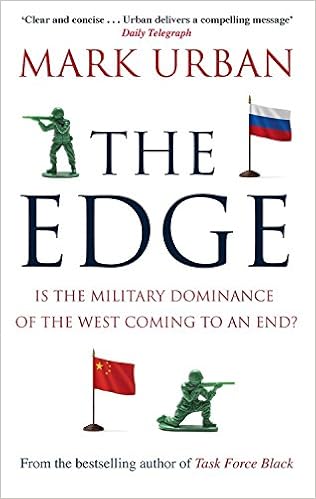
Mark Urban, diplomatic and defence editor on the BBC's Newsnight, wrote "The Edge: Is the Military Dominance of the West Coming to an End?" about six months ago.

Its arguments have been highlighted again by recent Brexit Referendum discussions about the impact of the EU on war between states in Europe.


Here is an excerpt from The Telegraph's review.
"How many American tanks are permanently stationed in Europe? At a time when Vladimir Putin has invaded Ukraine and grabbed 10,000 square miles of his neighbour’s territory, you might be surprised to learn that the answer is none.

"With impeccable timing, the last American main battle tank left Europe shortly before the onset of Ukraine’s crisis in 2014. During the Cold War, the United States Army kept 5,000 tanks in Europe to defend its Nato allies; today, not a single one remains.

"Surely the world’s only superpower could rustle up some heavy armour pretty quickly in the event of an emergency? Don’t be so sure. General Sir Richard Shirreff, formerly Nato’s deputy supreme allied commander, thinks that America would need between six and 12 months to deploy one armoured division in Europe.

"Russia, meanwhile, has no fewer than 2,300 tanks, most of them already positioned in the European theatre.

"In The Edge, Mark Urban sounds the alarm over the scale and pace of the West’s disarmament since the collapse of the Soviet Union. Back in 1979, Urban, now the diplomatic and defence editor of Newsnight, was “for a short heady time” the “commander of one of the British Army’s 900 Chieftain tanks”.

"The era when Britain could field hundreds of the heaviest machines of war now seems impossibly distant. By way of comparison, the Army was down to 36 operational tanks for much of last summer.

"The picture at sea or in the air is little better. Year after year, every country in Nato – including America – has been paying off warships and decommissioning fighter squadrons.

"Even the forces that remain have been hollowed out by a shortage of spare parts and trained personnel. On paper, the Spanish Air Force has 39 Typhoon fighters, but only six are actually ready for combat. Of Germany’s 109 Typhoons, only 42 are in any condition to defend the country’s airspace.

"In clear and concise prose, Urban lays out the way in which an entire continent has chosen the path of wholesale disarmament. It is impossible to read this authoritative book without feeling a deep sense of alarm, indeed of wonder, that our leaders have chosen to take such breathtaking risks.

"The assumption behind the shredding of Nato’s defences is that warfare between European countries is no longer conceivable. In military jargon, “state-on-state” conflict is now irrelevant; the sole purpose of the tattered remnants of our armed forces is to fight “non-state actors” like terrorists and insurgents.

"Russia, however, was never so foolish as to make such an assumption. After the Cold War, the Kremlin was at first compelled to disarm for the simple reason that Russia’s economy had collapsed. For the last decade, however, Russia has been rearming on a huge scale – and its generals take the ruthless business of “state-on-state” conflict very seriously indeed. In Georgia in 2008 and now in Ukraine, those are precisely the kind of wars that Putin has chosen to fight."
Mark Urban paints a disturbing portrait of a "hollowed out" Western military. After the end of the Cold War, investment in classic state-on-state military systems was throttled right back. We have ageing ships and aircraft, and if they were destroyed in combat, the factories which could replace them have long since ceased production.

Urban contains his irritation at his colleagues in the media 'commentariat' - pacifist, consumed by imperialist guilt, united in a belief that interstate conflicts will never again transition to violence, at least as far as EU nations are concerned.

It's not true that pacifism has won a bloodless victory amongst Western elites. Urban observes that there is substantial funding for spooks and drones. And some UK investments, notably the carriers and the aircraft to fly off them, should come good after 2020 (we trust).

Absent an existential threat, the military was always going to fare badly in the tight budget wars after the Cold War. It's still possible to argue that Russia is simply sorting out historic anomalies as to where its borders should lie, and that the level of middle-eastern inspired conflicts outside of the middle-east are far removed from conventional warfare. Urban discusses these points.

Fundamentally, however, Western Europe is prosperous and disarmed. Historically states which have placed themselves in such a posture ended up as easy pickings for anyone with a military who felt sufficiently acquisitive.

It seems hard to believe that such a fundamental truth is now entirely behind us. Or that America will always save us (at potentially huge cost to itself).

---

It might be argued that we would have warning and could re-arm fairly quickly. But our weaponry is getting more and more complex and expensive with ever longer lead times.

It's been a cliche for a long time that an adversary with cheap and cheerful weapons (guns, fighter aircraft, bombers, ships, missiles) which can be produced quickly and in bulk, and who has a readiness to accept losses can beat a much higher-tech opponent who finds it difficult to develop, deploy and maintain its super-advanced systems .. and is loss-averse.