Showing posts with label European Union. Show all posts

Thursday, January 22, 2026

What the Confederacy teaches the EU


What the Confederacy teaches the EU

One reason the South lost the American Civil War, it is said, was 'States' Rights'. The southern states, in their overriding desire for autonomy, could not agree on funding, budgets or military strategy. The parallels with the European Union seem almost too exact.

In fact, the Confederate States of America did not lose the American Civil War because it believed in states’ rights, but because it believed in them too much to fight a modern war effectively. The ideology that justified secession also crippled central authority once war began.

Southern governors routinely resisted Richmond’s attempts to raise troops, impose conscription, requisition supplies, or coordinate railways. Each state wanted victory, but not at the price of yielding control. The result was chronic underfunding, logistical chaos, and strategic incoherence. War is the ultimate collective-action problem. The Confederacy failed it.

Weak central finance is fatal in prolonged conflict. The Confederacy could not tax effectively, could not borrow credibly, and could not impose budgetary discipline across states. Inflation ran wild. Armies starved while states hoarded resources. The North, by contrast, built a centralised fiscal-military state almost in real time.

The EU’s position is not identical, but the structural resemblance is obvious. The EU has fragmented fiscal authority, no unified defence budget of consequence, no centralised military command, and no shared willingness to impose sacrifice. And no unified political-military strategy. In peacetime, this looks like pluralism; in crisis, it looks like paralysis.

Ideology substitutes for capacity until it doesn’t. Southern elites believed moral legitimacy and local autonomy would compensate for industrial inferiority and weak coordination. They assumed that because their cause was “right”, the machinery would somehow follow. It didn’t.

The EU exhibits a softer version of the same error: an implicit belief that norms, procedures, and moral language can substitute for hard power and decision speed. That works only while someone else guarantees the security envelope.

Confederations struggle against centralised adversaries. The Union was not just larger; it was more decisive. It could concentrate force, absorb losses, and pursue long strategies despite political noise. Confederations are bad at that. They argue while the other side acts.

The EU was never designed to fight a war. It is designed to prevent one internally. That design choice carries a price in a world where external coercion has returned.

The Confederacy’s ideology was not merely decentralised; it was internally contradictory. It demanded autonomy for states while requiring unified sacrifice. The free-riding narrative writes itself.

The EU’s ideology is different: it deprecates sovereignty rather than worships it. But the functional outcome in extremis can be similar - reluctance to centralise power even when survival arguments are made.

So the thesis is best stated like this. The problem is not “states’ rights” per se. It is the refusal to subordinate autonomy to survival. That is a lethal trait in wartime systems.

If Europe ever faces a genuine existential crisis - not a managed proxy conflict, not a sanctions regime, but a direct strategic threat - it will discover very quickly whether it is a union or merely a committee. Most likely the EU will do what it usually does: fracture into competing, antagonistic allegiances.

This post follows on from: Preparing for War.

The next post, The failure to create a 'United States of Europe', explores why the EU can't become a unitary state.


 

Thursday, April 27, 2017

Ode to Joy


There is a special character to Europhilia. The hushed, reverential tone of voice, those shining eyes. You see it with the apostles of Globalism: Tony Blair, Nick Clegg .. and Emmanuel Macron.

If only I had the literary technique to characterise such foolishness. I bow instead to the superior writing skills of  Phil Burton-Cartledge.
"The problem is for these folks, remainiacs if you will, the European Union is more than a trading bloc with an opaque bureaucracy. It's their Soviet Union, their City on the Hill, their Jerusalem.

"In their minds, the EU condenses Enlightenment values and liberal internationalism. It's an achievement standing above the nationalisms and tribalisms of old, that proves we can all get along on the basis of common humanity.

"And they have the nerve to look down their noses at Leave voters and call them deluded. It's stop-the-world-we-want-to-get-off, liberal-style. "
I rather wish I'd said that.

Monday, July 25, 2016

The EU: when Asabiyyah goes wrong

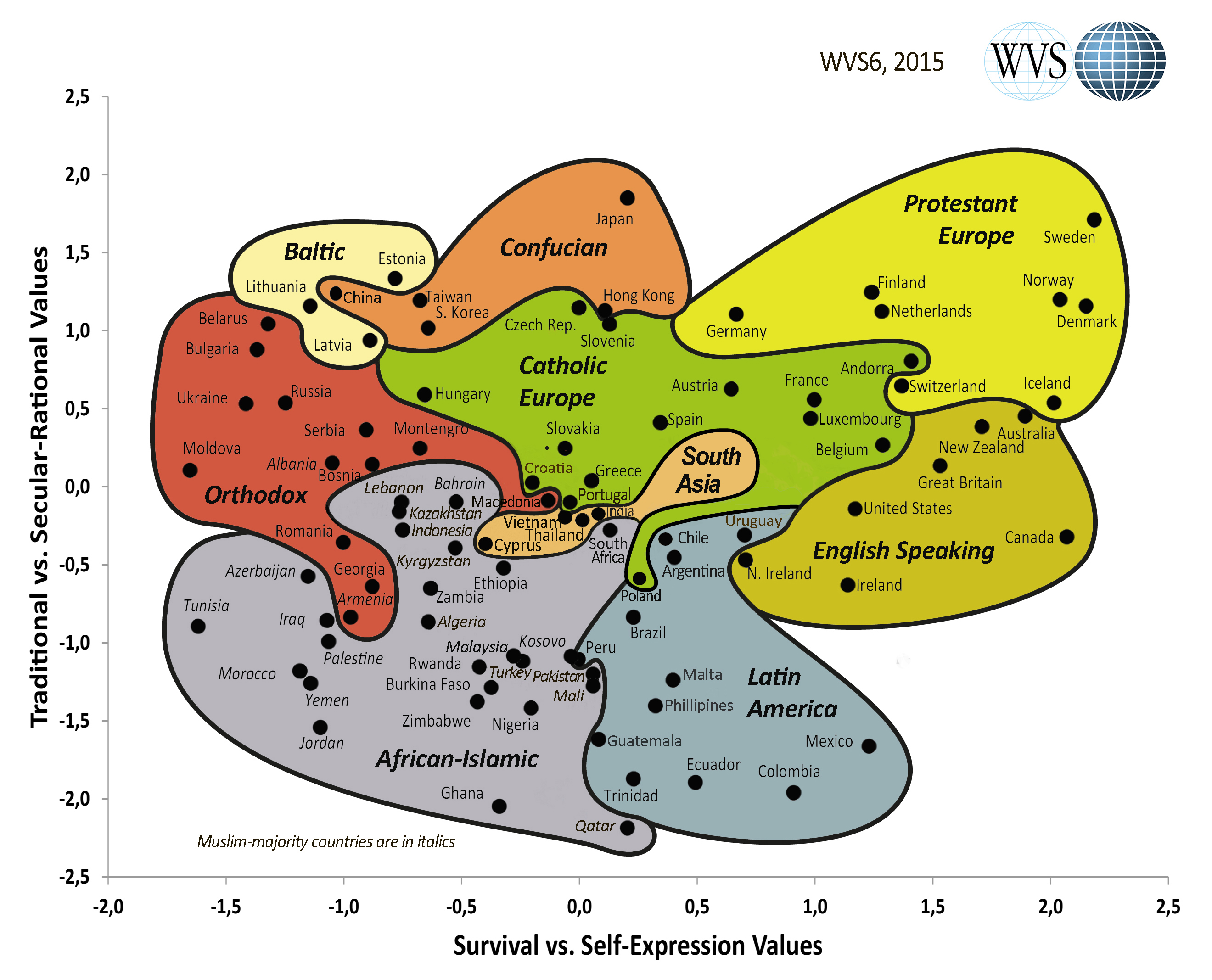
"The World Values Survey (WVS) is a global research project that explores people’s values and beliefs, how they change over time and what social and political impact they have. It is carried out by a worldwide network of social scientists who, since 1981, have conducted representative national surveys in almost 100 countries."


According to the Wikipedia article, the survey is carried out through questionnaires, and the results can be usefully compressed to the two-dimensional representation shown above, which repays some study (click on the image to make it larger).

The labelling of the two axes is less than clear: I suspect that:
  • the horizontal axis measures clan/group conformity - individualism
  • the vertical axis is capturing religiosity - secularism.

Decide for yourself: here is what the article says:
"Traditional values emphasize the importance of religion, parent-child ties, deference to authority and traditional family values. People who embrace these values also reject divorce, abortion, euthanasia and suicide. These societies have high levels of national pride and a nationalistic outlook.

"Secular-rational values have the opposite preferences to the traditional values. These societies place less emphasis on religion, traditional family values and authority. Divorce, abortion, euthanasia and suicide are seen as relatively acceptable.

"Survival values place emphasis on economic and physical security. It is linked with a relatively ethnocentric outlook and low levels of trust and tolerance.

"Self-expression values give high priority to environmental protection, growing tolerance of foreigners, gays and lesbians and gender equality, and rising demands for participation in decision-making in economic and political life."
This would be quite interesting in itself, but Peter Turchin's recent post applies it to the evolution of the European Union. First he notes:
"As I have said on numerous occasions (in this blog and in my other writings), it is hard to get people to cooperate, especially in large social groups. Successful cooperation requires that people share values and institutions. Values tell us why we want to cooperate: what is the public good that we collectively want to produce? Norms and institutions tell us how we are going to organize cooperation. Mismatched values and institutions may doom a cooperative effort even before it has a chance to get going.

"In my opinion, the expansion from the original six nations (Benelux, France, Germany, and Italy – I will refer to them as the “core” EU nations) to the current 28 was a big, big mistake. We can use the data collected by the World Values Survey (WVS) to visualize just how bad this mistake was."
Here is his key insight:
" I am interested to look at this mapping from a different point of view. Accordingly, I color-coded all countries into the following categories:

  • Core (red): the original 6 countries of the EEC

  • EU (brown): the other 22 members of the European Union

  • Europe (green): two Western European countries that are not in the EU

  • Candidate (yellow): current candidates for the EU

  • World (grey): rest of the world (country names omitted for clutter).

"Note: the reason Italy* has an asterix is because, for some reason, it was not included in the sixth wave, so I used its values from the fifth wave data."
Dr Turchin continues,
"The pattern is so striking it almost doesn’t require commentary, but let’s spell it out anyway. The original six (“Core Europe”) group together very closely. There are only two other countries that are part of the same cluster, Austria and Switzerland.

"Remarkably, the modern territories of both of these countries were encompassed by the boundaries of the Carolingian empire (see Is this the Beginning of the End for the European Union?). It looks like the “ghost” of Charlemagne’s empire has more influence on today’s cultural values than such later distinctions as Catholicism versus Protestantism.

"The current 28 members of the European Union, on the other hand, don’t cluster at all. On the contrary, they span three-quarters of world variation in values. Only African-Islamic countries and central America end up outside the ellipse that encompasses all 28 EU members."
You can see where Turkey is. And as for the absence of 'African-Islamic countries', the EU is doing its best to resolve that particular anomaly even as we speak.

If only they had understood Asabiyyah as well as the British Foreign Office, back in the days when it could still do realpolitik.

Monday, May 16, 2016

European pacifism won in practice, if not in theory

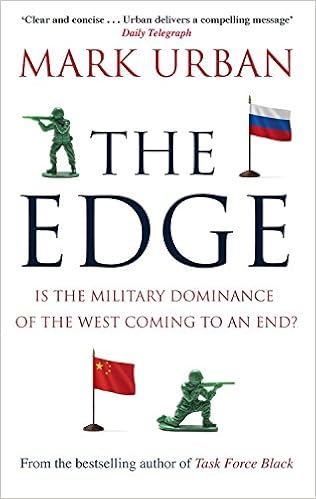
Mark Urban, diplomatic and defence editor on the BBC's Newsnight, wrote "The Edge: Is the Military Dominance of the West Coming to an End?" about six months ago.

Its arguments have been highlighted again by recent Brexit Referendum discussions about the impact of the EU on war between states in Europe.


Here is an excerpt from The Telegraph's review.
"How many American tanks are permanently stationed in Europe? At a time when Vladimir Putin has invaded Ukraine and grabbed 10,000 square miles of his neighbour’s territory, you might be surprised to learn that the answer is none.

"With impeccable timing, the last American main battle tank left Europe shortly before the onset of Ukraine’s crisis in 2014. During the Cold War, the United States Army kept 5,000 tanks in Europe to defend its Nato allies; today, not a single one remains.

"Surely the world’s only superpower could rustle up some heavy armour pretty quickly in the event of an emergency? Don’t be so sure. General Sir Richard Shirreff, formerly Nato’s deputy supreme allied commander, thinks that America would need between six and 12 months to deploy one armoured division in Europe.

"Russia, meanwhile, has no fewer than 2,300 tanks, most of them already positioned in the European theatre.

"In The Edge, Mark Urban sounds the alarm over the scale and pace of the West’s disarmament since the collapse of the Soviet Union. Back in 1979, Urban, now the diplomatic and defence editor of Newsnight, was “for a short heady time” the “commander of one of the British Army’s 900 Chieftain tanks”.

"The era when Britain could field hundreds of the heaviest machines of war now seems impossibly distant. By way of comparison, the Army was down to 36 operational tanks for much of last summer.

"The picture at sea or in the air is little better. Year after year, every country in Nato – including America – has been paying off warships and decommissioning fighter squadrons.

"Even the forces that remain have been hollowed out by a shortage of spare parts and trained personnel. On paper, the Spanish Air Force has 39 Typhoon fighters, but only six are actually ready for combat. Of Germany’s 109 Typhoons, only 42 are in any condition to defend the country’s airspace.

"In clear and concise prose, Urban lays out the way in which an entire continent has chosen the path of wholesale disarmament. It is impossible to read this authoritative book without feeling a deep sense of alarm, indeed of wonder, that our leaders have chosen to take such breathtaking risks.

"The assumption behind the shredding of Nato’s defences is that warfare between European countries is no longer conceivable. In military jargon, “state-on-state” conflict is now irrelevant; the sole purpose of the tattered remnants of our armed forces is to fight “non-state actors” like terrorists and insurgents.

"Russia, however, was never so foolish as to make such an assumption. After the Cold War, the Kremlin was at first compelled to disarm for the simple reason that Russia’s economy had collapsed. For the last decade, however, Russia has been rearming on a huge scale – and its generals take the ruthless business of “state-on-state” conflict very seriously indeed. In Georgia in 2008 and now in Ukraine, those are precisely the kind of wars that Putin has chosen to fight."
Mark Urban paints a disturbing portrait of a "hollowed out" Western military. After the end of the Cold War, investment in classic state-on-state military systems was throttled right back. We have ageing ships and aircraft, and if they were destroyed in combat, the factories which could replace them have long since ceased production.

Urban contains his irritation at his colleagues in the media 'commentariat' - pacifist, consumed by imperialist guilt, united in a belief that interstate conflicts will never again transition to violence, at least as far as EU nations are concerned.

It's not true that pacifism has won a bloodless victory amongst Western elites. Urban observes that there is substantial funding for spooks and drones. And some UK investments, notably the carriers and the aircraft to fly off them, should come good after 2020 (we trust).

Absent an existential threat, the military was always going to fare badly in the tight budget wars after the Cold War. It's still possible to argue that Russia is simply sorting out historic anomalies as to where its borders should lie, and that the level of middle-eastern inspired conflicts outside of the middle-east are far removed from conventional warfare. Urban discusses these points.

Fundamentally, however, Western Europe is prosperous and disarmed. Historically states which have placed themselves in such a posture ended up as easy pickings for anyone with a military who felt sufficiently acquisitive.

It seems hard to believe that such a fundamental truth is now entirely behind us. Or that America will always save us (at potentially huge cost to itself).

---

It might be argued that we would have warning and could re-arm fairly quickly. But our weaponry is getting more and more complex and expensive with ever longer lead times.

It's been a cliche for a long time that an adversary with cheap and cheerful weapons (guns, fighter aircraft, bombers, ships, missiles) which can be produced quickly and in bulk, and who has a readiness to accept losses can beat a much higher-tech opponent who finds it difficult to develop, deploy and maintain its super-advanced systems .. and is loss-averse.

Saturday, May 07, 2016

War and Peace and War in Europe

People say that the European Union has prevented war in Europe for seventy years; in fact, the truth is precisely the opposite - it is the absence of the conditions for war which have enabled the EU to stagger along all these years.

There are two conditions for war (armed conflict between states):
- two or more states experience differences which cannot be resolved peacefully;

- each state must be militarily capable with a belief in the possibility of winning.*
In the United States, a well-honed system of federal conflict resolution + economic unification tends to dampen inter-state conflicts of interest. If that were ever to break down, the US (federal) military would demolish any individual state's armed forces. They did it before.

In Europe, not so much.

Don't underestimate the sheer war-exhaustion and folk-memories of the Second World War in Europe's economically-strongest states as an engine of peace-so-far.

As Peter Turchin observed in "War and Peace and War" there is a generational cycle here:
'...the father’s generation fights bitterly, their sons seek to avoid the mistakes that led to violence, but the underlying pressures still exist, so their grandsons repeat the pattern as memories of the causes and consequence of civil strife fade.'
If the interests of states within the current EU were to diverge sufficiently, then war is perfectly possible - the legally-enshrined authority of the central institutions of the EU would be brushed aside as effortlessly as during the continuing refugee/immigration crisis and the events in Greece.

KALs' cartoon from The Economist this week

Inter-state war in Europe is neither an imminent prospect nor on the horizon, but a generation of young people has grown up who are not that scared of the idea (having not directly experienced the effects on their societies) and might even welcome the excitement, bonding and opportunities for glory. You may be able to think of examples even as we speak, in the middle-east.

In the absence of an EU army and a demilitarisation of its constituent members a la America, a sufficiently deep clash of interests could certainly lead to armed conflict. (The people pushing for an EU army understand this, I think, but that particular boat is never going to sail).

It's not like the 1990s Balkans conflicts (Yugoslavia was once 'for ever') and the recent Ukrainian events don't show viable scenarios.

---

* If two states have irreconcilable differences but one cannot stand up militarily against the other, we have a technical name for what then happens to it: it's defeated.

Friday, February 19, 2016

The Boys in the Bubble

Bagehot in "The Economist" today

Bagehot writes:
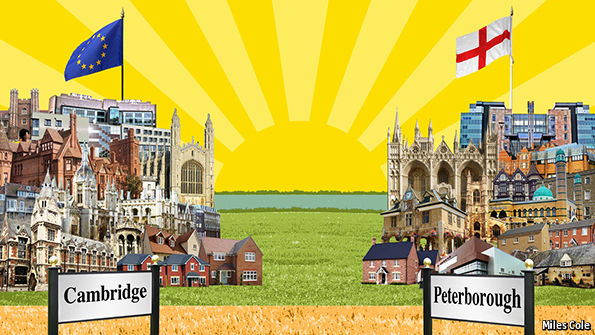
"BEING a Eurosceptic in a university city is a lonely business. In the drizzle outside the Cambridge Union a student in a roll-neck is trying to hand anti-EU leaflets to the cliques hurrying past. Most ignore him. One, having taken a folded piece of card, glances at it and sighs “nah”, shoving it back into the campaigner’s hand.

"Inside, in the neo-Gothic chamber, pro-EU luminaries ply their arguments to cheers. When Richard Tice, an anti-EU campaigner, delivers his speech students bob up and down, machine-gunning him rebarbative questions. Did regulation not exist before Britain joined the union? Why do so many firms support membership? If Britain doesn't control its borders why do foreign students struggle to get visas?

"When Mr Tice quotes “the highly respected economist, Tim Congdon” (a notorious Eurosceptic) the chamber resounds to laughter and sarcastic applause."
Things are different in Peterborough.
"Compare that with Peterborough, a similarly sized city at the other end of Cambridgeshire. At a public debate there locals voted decisively in favour of Brexit. “I asked rhetorically what the audience would put at risk to leave the EU,” recalls Mr Huppert. “They shouted back: ‘Everything’.”
Cambridge and Peterborough are geographically close and in many ways quite similar, so why the different attitudes to the EU?
"Cambridge bears the hallmarks of an economy in which one in two has gone to university, Peterborough is visibly a city of school-leavers.

"When it comes to the EU, this difference is everything. Education levels are “an extremely strong predictor” of an individual’s views on the subject, stresses Robert Ford, an expert on public opinion: the more qualifications someone has, the more pro-European he or she is likely to be.

"According to polls by YouGov, those educated only to 16 oppose EU membership by 57% to 43%, but among graduates it is 38% to 62%. When education is controlled for, other factors affecting an individual’s views on Europe—like income, choice of newspaper and even age—diminish.

What is it about those five years of study between 16 and 21? The answer has two parts. First, the self-interested one. “Having a degree is increasingly a prerequisite of getting on in life,” observes Mr Ford, adding: “Both sides are aware that there is a drawbridge called university and that those who don’t get across it are disadvantaged.”

[...]

"The second, cultural driver mostly concerns immigration. Whereas many in Cambridge see incomers as highly educated Germans and Swedes bringing their expertise to research projects, start-ups and product-development meetings, in Peterborough they are Lithuanian potato-pickers who, if not competing with locals for unskilled work, are at least nipping at their heels."
The Economist has sussed out the underlying trend though:
"University attendance has exploded, which suggests that Britain will become more internationalist and comfortable with EU co-operation. Yet in the meantime it seems the country will be increasingly polarised: liberal, Cambridge-like places on the one side; nationalist, Peterborough-like ones on the other and an ever-shrinking middle ground between the two, as the population bifurcates into those whose skills make them globally competitive and those who must compete with robots and the mass workforces of the emerging economies.

[...]

"Eventually Britain will look more like Cambridge than it does today."
In the year after taking A-level (i.e. at age 18+) 52% of young people were at a higher education institution - with one per cent at Oxbridge and another 8% at other Russell Group universities, according to a Government report.*

So Oxbridge is taking the top 1% of the population age-cohort and inducting them into an international elite bubble. I feel it is unlikely, short of the initiative described in my previous post, that very much more of Britain 'will look more like Cambridge in the future than it does today'.

There are better, more forward-thinking arguments which might speak to Oxbridge undergraduate as to the merits of leaving the present incarnation of the Holy Roman Empire. But that's for another day ... although ironically, The Economist got there before me.
___

Update: (March 18th 2016): see also "Brexit: the issue is Germany".

---

* These figures are interesting. If the 1% admitted to Oxford and Cambridge were selected entirely on merit, the IQ cut-off would be z = 2.33 SD, or 135. If you believe that some get into Oxbridge by not being quite as bright as that, but by having connections, then the merit IQ threshold will be greater than 135.

For the Russell Group  (the top 24 non-Oxbridge including my own alma mater, Warwick), you have to be in the top 9%. This requires z > 1.34, or an IQ of at least 120. In practice, IQ demands are likely to be less for non g-loaded subjects like English and Drama (plus there are those connections again), so this is very much a lower bound for disciplines positively requiring high-IQ (typically STEM subjects and philosophy).

---

We were in the Cribbs Causeway Mall today, pictured below, where I replaced my Primark trousers with softer and more luxurious variants from John Lewis at seven times the price.

The author at Cribbs Causeway Mall

I also popped into my first Apple store. I was expecting style and imagination, but was confronted by six large Formica-like tables upon which were arrayed rows of tethered iPhone 6s and MacBook Air laptops. The whole experience seemed tacky and impoverished; the shop was, however, crowded.

Saturday, May 09, 2015

Handling Nicola

In Scotland we have an anti-austerity party, the SNP, facing a central UK authority determined to clear the deficit. Remind you of anything?

Anti-austerity Syriza in Greece has a mandate to maintain and even increase public spending while its lack of revenues and overarching debts makes this impossible. The European Union is not inclined to continue paying the difference indefinitely. When will this particular can cease being kicked up the road?

Nicola Sturgeon, the SNP leader, will say that Scotland has voted decisively against austerity and that the Scots will not accept any cuts in public spending, especially on welfare. The UK Government will reply that if the Scots were an independent country, their current spending plans would generate an 8% deficit on Scotland's already large share of the public debt and are therefore unaffordable.

How to proceed?

It is tempting to let Scotland see the error of its ways. If it was responsible for raising its own taxes to cover its spending plans, surely the mismatch would be obvious? But the SNP would simply cover the gap by borrowing, as Syriza has done. The deficit would rise (i.e. the public debt would carry on increasing) but Scotland would claim it was 'borrowing to invest' or that repayments would be 'easier down the road' when the economy improved.

It is rarely difficult to find plausible arguments for maxing out the credit card.

If Scotland were an independent state, the markets would respond to repayment worries by increasing interest rates. But Scotland uses the pound sterling and, as part of the UK, its debts are guaranteed by the British state. So there is no downside for the Scottish government to carry on borrowing - it's a form of moral blackmail over the rest of the UK (primarily the English). If the UK Government tries to put a limit to how much the Scots can borrow, the SNP will claim English interference and imperialism and call for the shackles to be released and full independence.

Truly there are no half-way houses between unity and independence if the latter is what you're determined upon. If there were, the Greek situation would have been sorted out long since.

Enjoy your victory, Mr Cameron.