Showing posts with label Populism. Show all posts

Sunday, December 22, 2024

A New and Necessary Leadership Style


The Roman Republic had a keen sense of political dualism. In ordinary times, the Senate served as a theatre for the aristocracy’s disputatious squabbles, each family pursuing its private ambitions under the banner of public interest. But when existential threats loomed, Rome cut through the noise: a dictator was appointed, granted extraordinary powers for a limited term to unify command and save the Republic.

Modern advanced democracies have mirrored this approach in practice if not in theory. In normal times, government operates as managerialism - weak leaders triangulating between a fragmented chorus of competing interest groups, lobbyists, and policy technocrats. Yet, when national survival is at stake, a Churchillian figure may somehow emerge - a previously derided figure capable of galvanizing the nation in the face of war or crisis.

The appointment of Winston Churchill in 1940 exemplifies this dynamic. Weak appeasers were swept aside for a man whose single-mindedness matched the gravity of the moment. Britain’s victory depended not on consensus but on clarity and resolve: "action this day".

Today’s elites - to their dismay - are rediscovering this lesson. Decades of neoliberal globalism and cultural progressivism have widened the chasm between ruling fractions and the non-elite majority. The rise of populist leaders like Donald Trump - dismissed by elites as aberrations - in the first instance signalled an internal 'cold civil war', a backlash from the forgotten majority whose patience was exhausted.

Ironically, these populist leaders, derided as unfit for power, may be precisely what is needed to confront the growing and ominous threats posed by hostile states like Russia, China, North Korea, and Iran.

Just as Rome needed its dictators and Britain its Churchill, arguably the West’s internal divisions might yet produce leaders with the fortitude to face under-realised external dangers.

Sunday, October 06, 2024

Rational Populism: a programme for JD Vance and Kemi Badenoch

In the globalising evolution of capitalism, the divide between areas of prosperity and those left behind has become stark. Advanced technologies and financial capital flow together into global centres - New York, London, Silicon Valley. Wealth accumulates, technology advances: an ecosystem forms where lives are fulfilling.

The flip side of this development is the economic abandonment of deprived regions and social groups, left to grapple with poverty, stagnation, and alienation. 

This combined and uneven development of capitalism is not an accidental byproduct but the inevitable outcome of a clustering economic efficiency.

For those left behind, however, populist discontent has been the result, often directed at the elites and the forces of globalisation. But a reactive, protectionist populism leads only to the cul-de-sac of worse deprivation.

Instead we need a rational populism - a political and economic strategy that accepts the inherently globalised nature of the modern economy while deploying targeted government initiatives to bring marginalised regions and social groups back into the fold of growth and progress as far as is possible. 

Rather than the impossible, reactionary dream of retreating from globalisation, how can we ensure that the forward march of development includes everyone? Here are some ideas.

An often-advocated policy is the government funding of new transport networks, digital infrastructure, and green energy projects not only to create jobs but also make these regions more attractive for future private investment. Reindustrialisation here doesn’t mean a return to old manufacturing models, but rather a focus on sustainable industries that align with global economic developments.

Investment should also fund regional innovation hubs to provide a base for individuals with those portable skills the leading edge of industry requires. We saw some of this ‘migration to the country’ in the COVID epidemic and it’s a trend which is real - and which can be amplified.

In some deprived regions, the existing human capital limitations diminish the pool of labour available for high-skill industries. 

While education and vocational training is always important, there is also a place for near-future government sponsorship of personal cognitive automation systems to help circumvent such employment barriers. Most likely markets will fail to sufficiently invest in these areas.

Government-supported automation in sectors like agriculture, logistics, or light manufacturing can also catalyse efficient production systems that make use of lower-skilled workers while still providing economic returns. By automating key processes, regions with historically lower human capital can still participate in the global economy, with gradual skill-building taking place alongside where possible.

A rational populism must recognize that while government stimulus is crucial in the early stages in these regions, interventions must not become perpetual. The goal is to kick-start self-maintaining economic ecosystems, moving regions and social groups from dependence on state support to active participation in the global economy.

The combined and uneven development of capitalism has left many regions and people behind, but the solution is not retreat. A rational populism must accept the globalised nature of modern economies while ensuring that left-behind regions are actively brought into the forward movement of progress. Through targeted training, infrastructure development, sophisticated worker-centric automation and government-backed enterprises, we can create the conditions for these regions to flourish within the global economy. This is not about protectionism or isolationism, but about ensuring that no one is left out of the future.


So what kind of a point am I making in advocating rational populism here? 

  • A logical point: that the programme I've outlined is in some sense the optimal conclusion of any rational analysis in political-economy?
  • A moral point: that this is the true politics of universal human values? 
  • A pragmatic point: that such a programme is the best way to secure social cohesion and stability? 

In fact orthodox economics would not agree with rational populism. There, the optimising metrics are things like GDP growth or GDP growth-per-head. To secure such outcomes, discretionary spend by government should maximise marginal ROI per marginal unit of expenditure. Does the government get better economic returns from an additional million pounds in London, Oxford or Cambridge - or in Bradford, Huddersfield or Penzance? Plainly ROI follows the clusters of excellence... and the Treasury will look askance at 'wasting money' elsewhere.

But the abstractions of economics hide political interests. If you belong to the elite of London, Oxford and Cambridge or their like across the world, you will naturally benefit from optimal augmentation of the wealth you already partake in: what is it to you if deprivation flourishes in the deindustrialising hinterlands?

If, however, you are part of the 'left-behind' masses - or culturally identify with them, then your values will urge you not to disregard and abandon them.

I would say that the elites, for many decades, have taken the view that their policies are optimal for 'the economy' - which happens to be optimal for their own, personal interests too: such a happy coincidence!

But those good times are over: the natives are restless. Self-interest now demands that concessions be made. I offer rational populism to those worried elites as an insurance policy: pay a little now in transfer charges for intelligent levelling up; see-off le déluge.

Tuesday, October 16, 2018

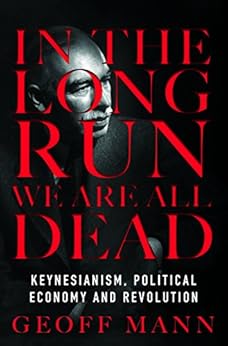
"In The Long Run We Are All Dead" - Geoff Mann

Amazon link

Maddeningly abstract and allusive, Geoff Mann's book situates Keynes within an intellectual arc stretching back to the French Revolution (1789-99) and Hegel's subsequent theorisation of its lessons for modern civilisation. A reminder of the shallowness of contemporary thinking about values, governance and the collapse of the neoliberal project.

Keynes is depicted as taking a stand against delusional neoclassical (and highly mathematicised) theories in which capitalism is assumed to be always at, or returning to equilibrium. Keynes sees the structural instabilities driving boom-bust cycles, highlighting the essential fragility of the 'civilised order'. His vision calls for conscious state action to underpin the conditions of existence of the masses, heading off a revolution of despair after which 'the deluge'.

The author shares many insights into the form elite ideology takes today, as expressed in newspapers, TV, radio and online. For example, the great issue of 'inequality' (a strangely recent concern) is actually a debate within the (bourgeois) middle-class reflecting the relative deprivation of the top 10% as compared to the super-rich 1% or 0.1% due to the neoliberal revolution and specifically the aftermath of 2008/9. The life-history of the broader working class, where unemployment, precarious employment and stagnant, low incomes remain endemic, rarely features in this debate.

Given that the entire history of anti-capitalist revolutions (over, say the last 200+ years) has been one of defeat and/or deeply unpleasant outcomes, the narrative of socialist revolution, the hopeful leap into the unknown, is completely uncompelling. An enlightened Keynesianism, seeking to save (liberal-democratic-capitalist) civilisation - by illiberal political means where necessary - may, in its final inadequacy, open the way to a more profound transformation of social relations. But we cannot assume a blueprint anywhere, and certainly not in the actually-existing Marxist canon.

Mann is too enamoured of fashionable moralistic crusading on climate change for my tastes and fails (as is usual with Marxist analysts) to factor in what we increasingly know about human nature through genomics, psychometrics and sociobiology. These omissions subtract from the force of his final conclusions, which are unnecessarily tentative. But taken as a whole the book is a tour de force of open-mindedness, synthesis and creativity.

See also: "When Keynes comes to town".

Thursday, October 11, 2018

When Keynes comes to town

Amazon link

Maddeningly abstract and allusive, Geoff Mann's book situates Keynes within an intellectual arc stretching back to the French Revolution (1789-99) and Hegel's subsequent theorisation of its lessons for modern civilisation. A reminder of the shallowness of contemporary thinking about values, governance and the collapse of the neoliberal project.

Keynes is depicted as taking a stand against delusional neoclassical (and highly mathematicised) theories in which capitalism is assumed to be always at, or returning to equilibrium. Keynes sees the structural instabilities driving boom-bust cycles, highlighting the essential fragility of the 'civilised order'. His vision calls for conscious state action to underpin the conditions of existence of the masses, heading off a revolution of despair after which the deluge.

I have reviewed the book here: "In The Long Run We Are All Dead" - Geoff Mann.

It prompts this analysis of our contemporary predicament in the spirit of Mann's thinking.

---

Social Justice Warriors vs the Populists

There was a time when I did not regularly throw my shoes at the television set, when the TV and print media had not yet morphed into latter-day Pravdas.

It was the time before neoliberalism’s decline, before the great crash of 2008.

First had come the sixties transition from post-war factory-capitalism, familiar from a thousand Stalinist agitprop posters. No more conveyor-belt mass-production 'on the track'. The new middle-class economy was fragmented, individualistic and complicated. It wanted mass university education and greedily consumed its output. Not that those jobs were particularly well paid.

And so were sown the seeds of elite overproduction.

Neoliberalism took recognisable shape in the 1980s, a pivot away from national industrial capitalisms towards a frictionless world with international just-in-time supply chains and global capital flows. The opportunities to seek profitable investment opportunities and attain economies of scale rewarded some industries more than others: high tech and finance to name two.

Naturally there was an inspiring vision to accompany globalisation. It postulated a world without borders, where all impediments to the free availability of factors of production should be removed: no tariffs and no irritating state/legal restrictions.

The vision ordained that outdated prejudices limiting international access to labour should be abolished. Free migration! No cultural barriers! No acknowledgement could be made that any performance differences due to race, gender, sexuality, age etc might have any biological/genetic causation. Differences in outcome were always and everywhere to be understood as socially-constructed pernicious hangovers - to be abolished in the name of an enlightened neoliberalism!

Thus was born the phenomenon of the social justice warrior (SJW), prepped to fight those dinosaurs who hadn't yet got the memo.

Since 2008/9 global economic growth in the advanced capitalist countries has been anaemic. Profitability has been poor and the neoliberalism project has been fraying. Those never signed up in the first place, most specifically the non-graduate industrial working class were getting restive as their communities, workplaces and personal prospects got trashed. And so arose their inchoate political voice: Populism.

Those who were meant to be the foot-soldiers of globalisation (all those idealistic young social science graduates) were increasingly abandoned by a failing project on the defensive. They formed that new class fraction, the precariat. Of course they doubled-down on the SJW vision, feeling betrayed. They are the scarily militant snowflakes of the Labour Party's Momentum organisation .. and similar movements in other countries.

The SJW programme, increasingly absurd, continues to infiltrate the mainstream media and leftist politics. It has nothing whatsoever to do with anti-capitalism, despite its seemingly leftist credentials. It is the anguished shriek of a decaying neoliberalism.*

The Populist-SJW conflicts are global, though taking different forms and tempos in North America, Latin America and the different countries in Europe. In some cases (France) the neoliberal cause is still somewhat in the ascendant (Macron). In most countries though, the neoliberal elites are on the defensive.

Neither side has a programme which can work. Classical neoliberalism is discredited: its globalist-individualism falters while continuing to cause too much collateral damage. The elites fear disruption; they sense the masses stirring. Yet there can be no return to fifties-style nation-state economies.

There will be no proletarian revolution. Capitalism will find a new modus operandi. It will not be the re-establishment of a resurgent neoliberalism. This is a struggle of years as there is no simple solution, no way forward which does not succeed in defeating powerful vested interests.

Most likely is the theme Mann develops in his book, a Keynesian, somewhat covert counter-revolution. The result: a more hands on, activist state creating institutional forms fostering inclusivity for restive groups currently felt irrelevant and disposable by internationalist capital. Theresa May understood this in her much ignored remark that making Brexit work was the only way of saving the neoliberal project.

In the UK, both Corbynism and May-style conservatism are groping towards this solution. It will place constraints on the free disposition of capital and it will be expensive. You can see why powerful (but short-sighted) forces resist this new direction.

But the re-integration of the 60% plus of the population who are not graduates and that larger part of the more educated 40% who have been abandoned by the real elites requires it. The challenge is to develop a programme which addresses both constituencies: in the UK Labour and Conservatives engage from different directions.

But painfully, in fits and starts, with much conflict and perhaps violence, this is where we will end up, maybe a decade out.

---

* Ideologies take on a life of their own. Ideological 'praxis' exhibits a relative autonomy from the material conditions which elicit it.

Put more plainly, even though the SJW agenda derives from and serves the purposes of the neoliberal project, it occasionally bites the hand that nurtures it. Sometimes its logic undermines that project.

Notice the liberal media indulgently rowing back from episodes of overreach. It's usually a humourous demurral and no general conclusions will be drawn.

Tuesday, July 11, 2017

"Jeremy Corbyn and the bourgeois dream"


Bagehot in this week's Economist:
"One interpretation of Jeremy Corbyn’s rise, popular on the left, is that he is satisfying a pent-up desire for “real socialism”. But this ignores the fact that many people voted for the Islington MP despite his policies, not because of them.

Mr Corbyn is a long-standing critic of the European Union who did as much as he could to ensure that Remain would fail while pretending to support it. Another interpretation, popular on the right, is that his supporters are woolly minded virtue-signallers, determined to prove how compassionate they are while ignoring the fact that Corbyn-style policies have invariably led to disaster.

This ignores the fact that millennials have suffered more from the long stagnation that followed the financial crisis than any other generation. They have reason to be angry.

The most intelligent explanation has been provided by John Gray in the New Statesman. Mr Gray argues that Corbynism is “populism for the middle classes, serving the material and psychological needs of the relatively affluent and the well-heeled”. Far from being a repudiation of Tony Blair’s policies, Corbynism represents the completion of the takeover of Labour by middle-class people who put their own interests (such as free university education) above those of the working class.

But Mr Gray’s strictures miss an important point: most young Corbynistas are not so much settled members of the middle class as frustrated would-be members. Ben Judah, a millennial-generation journalist and author of “This is London”, points out that members of his generation are angry that they have done everything they were told, from studying hard at school to going to university to trying to get a respectable job, but are still holding on by their fingertips. ...

It is getting ever harder for young people to get a foot on the property ladder or find somewhere decent to rent. Thirty-year-old millennials are one-third less likely to own their own homes than baby boomers were at the same age, and spend £44,000 ($58,000) more on rent in their 20s than baby boomers did.

The problem then extends to the workplace. The young have been on the sharp end of two economic shocks: the 2008 crisis, which squeezed living standards, and a technological revolution, which is doing for middle-class jobs what mechanisation did for working-class ones.

Automation is hollowing out entry-level positions as companies use machines to do the routine tasks, such as searching through legal precedents or examining company accounts, that used to be done by junior employees. Companies of every type are cutting costs by ditching long-term perks such as defined-benefit pensions.

These problems reinforce each other. People who are subjected to flexible work contracts find it almost impossible to qualify for a mortgage. They are magnified by the London effect. Young people flock to the capital, where the best professional jobs are concentrated, but exorbitant property prices force them to migrate to the farthest corners of the city or to share with strangers. And they are curdled by generational antagonism.

The Resolution Foundation, a think-tank, calculates that people aged 65-74 hold more wealth than those under 45, a group that is almost twice the size. Browse the Facebook pages where young Corbynistas hang out and you do not find hymns of praise to the workers’ control of the means of production, but laments for the indignities of modern metropolitan life and jeremiads against baby boomers who grabbed all the cheap houses and got free university education into the bargain."
This seems quite consistent with Peter Turchin's "Secular Cycles" theory, where I commented:
"The main driver of the agrarian secular cycle is the Malthusian growth of population past the technological carrying capacity of the land. The gathering overpopulation initially facilitates an unsustainable growth in the numbers of militarily-capable elites while simultaneously undermining their finances.

The ensuing collapse is exacerbated by inter-elite warfare over the ever-shrinking spoils, and the final depression period cannot end until the elites themselves have been more than decimated and are thoroughly exhausted with war. Typical time frames are of the order of a century.

The post-agrarian capitalist world, as Turchin and others have frequently observed, exhibits similarities to the agrarian cycle. But differences are also plain, certainly in the advanced capitalist countries.

We have much more technology, we have many occupational niches for women and we have contraception. As a consequence the Malthusian overpopulation bomb doesn't detonate - more the contrary.

What we do have in plenty is elite overproduction (the new graduate 40%) which can never enter the real elite of the 1% bubble, where power and wealth is concentrated. This disaffected and mostly young middle class today inclines to leftism (Sanders, Corbyn and similar European-continental movements) or more generally the cultural marxism of the SJWs.

A traditional Marxist might say that the leftist 'movement' at present consists in taking bourgeois ideology in a rather literal way at its own face value, its self-valuation as inclusive, globalist, tolerant, equal and individualist. The bubble-elite is then denounced for not living up to its own stated values. Naturally, in its egalitarian utopia of the imagination, the status and influence of 'movement' supporters would be considerably more exalted.

Such an old-school Marxist would also characterise this social layer as petit-bourgeois, febrile and subject to abrupt changes in mood."
Since the mass of entitled young graduates are neither going away nor going up, they will continue to stew in resentment at their "betters", who seem to have effortlessly glided to elite positions through a combination of connections and nepotism.

Razib Khan writes ("Our Civilization’s Ottoman Years"):
"... subordinate peoples had their own hierarchies, and these hierarchies interacted with the Ottoman Sultan in an almost feudal fashion. Toleration for the folkways of these subordinate populations was a given, so long as they paid their tax and were sufficiently submissive. The leaders of the subordinate populations had their own power, albeit under the penumbra of the ruling class, which espoused the hegemonic ethos.

How does any of this apply to today? Perhaps this time it’s different, but it seems implausible to me that our multicultural future is going to involve equality between the different peoples. Rather, there will be accommodation and understandings. Much of the population will be subject to immiseration of subsistence but not flourishing. They may have some universal basic income, but they will be lack the dignity of work. Identity, religious and otherwise, will become necessary opiums of the people. The people will have their tribunes, who represent their interests, and give them the illusion or semi-reality of a modicum agency.

The tribunes, who will represent classical ethno-cultural blocs recognizable to us today, will deal with a supra-national global patriciate. Like the Ottoman elite it will not necessarily be ethnically homogeneous. There will be aspects of meritocracy to it, but it will be narrow, delimited, and see itself self-consciously above and beyond local identities and concerns. The patriciate itself may be divided. But their common dynamic will be that they will be supra-national, mobile, and economically liberated as opposed to dependent.

Of course democracy will continue. Augustus claimed he revived the Roman Republic. The tiny city-state of Constantinople in the 15th century claimed it was the Roman Empire. And so on. Outward forms and niceties may be maintained, but death of the nation-state at the hands of identity politics and late stage capitalism will usher in the era of oligarchic multinationalism.

I could be wrong. I hope I am."
A Marxist would say that what characterises the current 'conjuncture' is that the masses have recovered from the defeats of the 1980s and have a new-found confidence and bolshiness. They refused to be cowed by elites espousing policies they see as attacking their own best interests.

Their immediate political responses - what the elites call 'populism of the right and of the left'  (Trump & Sanders in the States; there are analogues in other countries) - in no way provide longer-term viable political-economic alternatives.

Since  postcapitalist socialism via revolution is ruled out (an ill-defined and unworkable target architecture), the period of instability will persist until Razib Khan's oligarchic multinational bourgeoisie restore order and, more importantly, a rate of profit which justifies renewed investment and therefore higher productivity.

The next decade is going to be extremely rough.

---

You might find "Economics of the populist backlash" by Dani Rodrik well worth reading (h/t Marginal Revolution). Professor Rodrik is an economist who distinguishes between models and reality: I'm currently checking out Kindle samples of his latest two books.