Showing posts with label Revolution. Show all posts

Wednesday, March 11, 2026

The Stalled Successor Ideology: (1/2)


---

The Stalled Successor Ideology

Every revolutionary movement promises not only the destruction of an unjust order but the dawn of a coherent alternative. The slogan of the French Revolution - liberty, equality, fraternity - compressed an entire political cosmology into three words: the overthrow of hereditary privilege, the empowerment of the citizen, and the rebirth of society on rational, moral grounds. The Bolsheviks had their own version: land, bread, peace (with the promise of a secular utopia to come). Even neoliberalism, which posed as pragmatic economics, carried that utopian undertone of liberation through markets and individual choice and freedom.

Today, there is no such story. The contemporary protest milieu - green activism, anti-racism, gender ideology, anti-Zionism - represents a cluster of moral reflexes rather than a movement of aspirational power. It labels enemies but has no plan; energy but no architecture. Its rhetoric is redemptive, but it lacks any eschatology beyond “awareness”.

Antonio Gramsci wrote that “the old is dying and the new cannot be born; in this interregnum a great variety of morbid symptoms appear.” This is precisely the condition of the early twenty-first century: the moral passions of the young surge against the structures of liberal capitalism, yet no integrative countervision commands belief. Protest has replaced revolution as the central form of political expression.

Historically, insurgent ideologies succeed when three conditions align.

First, a mobilising myth must connect moral grievance to a credible vision of collective redemption. The ancien régime, the Tsar, the bourgeoisie - each in their time served as a definable oppressor whose overthrow would, supposedly, unleash human flourishing. Contemporary activists can identify injustices but not their causal mechanisms; the villain is “the system,” a shapeless abstraction immune to decapitation.

Second, there must exist an organised cadre able to translate moral enthusiasm into a disciplined machine for taking power. The Jacobin clubs, the Bolshevik party, the neoliberal think tanks with their political shock troops - each formed the nervous system and insurgent forces of a rising elite. Today’s moral movements are decentralised by design, living on social media’s perpetual outrage cycle. They possess no coherent theory of governance because - crucially - they do not aspire to govern.

Third, insurgent ideology must align with emergent material interests. Revolutions ride the pressure of classes or elite fractions newly capable of wielding power - the bourgeoisie of the eighteenth century, the unionised industrial proletariat of the nineteenth, the globalising managerial technocracy of the late twentieth.

But the post-industrial “precariat” - precarious service workers, freelancers and disoriented graduates - lack both economic leverage and institutional footholds. Their discontented angst is moral, aesthetic, and existential; it can express itself in protest but not rule.

Some commentators, particularly in the United States, have proposed Christianity - often Catholic integralism, the view that political authority should be ordered to the spiritual good as defined by the Catholic Church - as the potential successor ideology.

The appeal is not completely devoid of sense. Religion alone can still articulate an ethical hierarchy stronger than procedural liberalism; it provides fraternity, moral order, and transcendence. A political theology might seem to offer the shared purpose that secular progressivism has lost in its decadent fragmentation.

Yet unlike in earlier epochs, Christianity today is too thoroughly institutionalised within the established order to lead an insurgency. Its clergy form a moral bureaucracy, not a revolutionary vanguard; its antique metaphysics promise salvation beyond history, not transformation within it. The Church can criticise decadence but not overthrow it. In short, Christianity can inspire repentance and an ethical life within the community but not revolution. Most pertinently it has no desire to.

Technology, particularly AI, might seem a more plausible locus for renewal. Yet AI today is infrastructure, not ideology. It offers administration, not deliverance. Its moralisation - responsible AI, fairness metrics, sustainability audits - produces a bureaucratic ethos rather than a revolutionary creed. We may be moving toward the quagmire of a moral-bureaucratic technocracy, in which governance is justified by ethical algorithms, but this is an evolution of managerial liberalism, not its overthrow.

The larger truth is that utopian confidence itself has collapsed. After the ruins of Marxism and the cynicism of postmodernism, no grand narrative of progress is any more credible. The young inherit a world that semi-guarantees safety and self-expression - but not transcendence, not enchantment. Their politics mirrors that void: permanent critique without vision, righteousness without telos - activism detached from an idea of the good society it seeks to create.

A new ideology will emerge only when a movement can again answer that ancient revolutionary question: what comes after the destruction of the old? Until then, we live in a moral interregnum between myths, between elites, between worlds. The energy of rebellion remains, but it circulates without destination; let us pray that it doesn't end up somewhere ugly.


Next part.

Tuesday, July 11, 2017

"Jeremy Corbyn and the bourgeois dream"


Bagehot in this week's Economist:
"One interpretation of Jeremy Corbyn’s rise, popular on the left, is that he is satisfying a pent-up desire for “real socialism”. But this ignores the fact that many people voted for the Islington MP despite his policies, not because of them.

Mr Corbyn is a long-standing critic of the European Union who did as much as he could to ensure that Remain would fail while pretending to support it. Another interpretation, popular on the right, is that his supporters are woolly minded virtue-signallers, determined to prove how compassionate they are while ignoring the fact that Corbyn-style policies have invariably led to disaster.

This ignores the fact that millennials have suffered more from the long stagnation that followed the financial crisis than any other generation. They have reason to be angry.

The most intelligent explanation has been provided by John Gray in the New Statesman. Mr Gray argues that Corbynism is “populism for the middle classes, serving the material and psychological needs of the relatively affluent and the well-heeled”. Far from being a repudiation of Tony Blair’s policies, Corbynism represents the completion of the takeover of Labour by middle-class people who put their own interests (such as free university education) above those of the working class.

But Mr Gray’s strictures miss an important point: most young Corbynistas are not so much settled members of the middle class as frustrated would-be members. Ben Judah, a millennial-generation journalist and author of “This is London”, points out that members of his generation are angry that they have done everything they were told, from studying hard at school to going to university to trying to get a respectable job, but are still holding on by their fingertips. ...

It is getting ever harder for young people to get a foot on the property ladder or find somewhere decent to rent. Thirty-year-old millennials are one-third less likely to own their own homes than baby boomers were at the same age, and spend £44,000 ($58,000) more on rent in their 20s than baby boomers did.

The problem then extends to the workplace. The young have been on the sharp end of two economic shocks: the 2008 crisis, which squeezed living standards, and a technological revolution, which is doing for middle-class jobs what mechanisation did for working-class ones.

Automation is hollowing out entry-level positions as companies use machines to do the routine tasks, such as searching through legal precedents or examining company accounts, that used to be done by junior employees. Companies of every type are cutting costs by ditching long-term perks such as defined-benefit pensions.

These problems reinforce each other. People who are subjected to flexible work contracts find it almost impossible to qualify for a mortgage. They are magnified by the London effect. Young people flock to the capital, where the best professional jobs are concentrated, but exorbitant property prices force them to migrate to the farthest corners of the city or to share with strangers. And they are curdled by generational antagonism.

The Resolution Foundation, a think-tank, calculates that people aged 65-74 hold more wealth than those under 45, a group that is almost twice the size. Browse the Facebook pages where young Corbynistas hang out and you do not find hymns of praise to the workers’ control of the means of production, but laments for the indignities of modern metropolitan life and jeremiads against baby boomers who grabbed all the cheap houses and got free university education into the bargain."
This seems quite consistent with Peter Turchin's "Secular Cycles" theory, where I commented:
"The main driver of the agrarian secular cycle is the Malthusian growth of population past the technological carrying capacity of the land. The gathering overpopulation initially facilitates an unsustainable growth in the numbers of militarily-capable elites while simultaneously undermining their finances.

The ensuing collapse is exacerbated by inter-elite warfare over the ever-shrinking spoils, and the final depression period cannot end until the elites themselves have been more than decimated and are thoroughly exhausted with war. Typical time frames are of the order of a century.

The post-agrarian capitalist world, as Turchin and others have frequently observed, exhibits similarities to the agrarian cycle. But differences are also plain, certainly in the advanced capitalist countries.

We have much more technology, we have many occupational niches for women and we have contraception. As a consequence the Malthusian overpopulation bomb doesn't detonate - more the contrary.

What we do have in plenty is elite overproduction (the new graduate 40%) which can never enter the real elite of the 1% bubble, where power and wealth is concentrated. This disaffected and mostly young middle class today inclines to leftism (Sanders, Corbyn and similar European-continental movements) or more generally the cultural marxism of the SJWs.

A traditional Marxist might say that the leftist 'movement' at present consists in taking bourgeois ideology in a rather literal way at its own face value, its self-valuation as inclusive, globalist, tolerant, equal and individualist. The bubble-elite is then denounced for not living up to its own stated values. Naturally, in its egalitarian utopia of the imagination, the status and influence of 'movement' supporters would be considerably more exalted.

Such an old-school Marxist would also characterise this social layer as petit-bourgeois, febrile and subject to abrupt changes in mood."
Since the mass of entitled young graduates are neither going away nor going up, they will continue to stew in resentment at their "betters", who seem to have effortlessly glided to elite positions through a combination of connections and nepotism.

Razib Khan writes ("Our Civilization’s Ottoman Years"):
"... subordinate peoples had their own hierarchies, and these hierarchies interacted with the Ottoman Sultan in an almost feudal fashion. Toleration for the folkways of these subordinate populations was a given, so long as they paid their tax and were sufficiently submissive. The leaders of the subordinate populations had their own power, albeit under the penumbra of the ruling class, which espoused the hegemonic ethos.

How does any of this apply to today? Perhaps this time it’s different, but it seems implausible to me that our multicultural future is going to involve equality between the different peoples. Rather, there will be accommodation and understandings. Much of the population will be subject to immiseration of subsistence but not flourishing. They may have some universal basic income, but they will be lack the dignity of work. Identity, religious and otherwise, will become necessary opiums of the people. The people will have their tribunes, who represent their interests, and give them the illusion or semi-reality of a modicum agency.

The tribunes, who will represent classical ethno-cultural blocs recognizable to us today, will deal with a supra-national global patriciate. Like the Ottoman elite it will not necessarily be ethnically homogeneous. There will be aspects of meritocracy to it, but it will be narrow, delimited, and see itself self-consciously above and beyond local identities and concerns. The patriciate itself may be divided. But their common dynamic will be that they will be supra-national, mobile, and economically liberated as opposed to dependent.

Of course democracy will continue. Augustus claimed he revived the Roman Republic. The tiny city-state of Constantinople in the 15th century claimed it was the Roman Empire. And so on. Outward forms and niceties may be maintained, but death of the nation-state at the hands of identity politics and late stage capitalism will usher in the era of oligarchic multinationalism.

I could be wrong. I hope I am."
A Marxist would say that what characterises the current 'conjuncture' is that the masses have recovered from the defeats of the 1980s and have a new-found confidence and bolshiness. They refused to be cowed by elites espousing policies they see as attacking their own best interests.

Their immediate political responses - what the elites call 'populism of the right and of the left'  (Trump & Sanders in the States; there are analogues in other countries) - in no way provide longer-term viable political-economic alternatives.

Since  postcapitalist socialism via revolution is ruled out (an ill-defined and unworkable target architecture), the period of instability will persist until Razib Khan's oligarchic multinational bourgeoisie restore order and, more importantly, a rate of profit which justifies renewed investment and therefore higher productivity.

The next decade is going to be extremely rough.

---

You might find "Economics of the populist backlash" by Dani Rodrik well worth reading (h/t Marginal Revolution). Professor Rodrik is an economist who distinguishes between models and reality: I'm currently checking out Kindle samples of his latest two books.

Wednesday, August 03, 2016

Communism would be like - what?

In my previous post, 'Revolution back on the agenda?', I wrote about difficulties in the Marxist concept of post-capitalist society in transition to communism.

We now know so much more about human nature, and specifically how much is genetically-determined; bureaucratisation and elite power-grabbing are endemic in human affairs.

So why doesn't this cause the collapse of 'bourgeois democracy' itself into the kind of 'big-man' kleptocracies we see in the Middle-East and Africa?

The conventional answer looks to the institutions of democracies. But institutions are not things (a reified view, in the jargon) but processes which are themselves composed through habitual and recurring human behaviour.

Bourgeois governments are quite weak and circumscribed in power. In the American case, this was explicitly by constitutional design. The bourgeois state, meanwhile, typically has few direct sources of revenue and has to tax or borrow - disproportionately from economic elites. Due to private ownership of the means of production, in a mature and advanced capitalist society the owners of capital constitute a diffuse and sprawling network of distributed economic power.

There is quite a literature, Marxist and otherwise, suggesting that except in periods of great crisis, the capitalists rather prefer a weakish government as a tool to resolve their differences of interest (plus occasional bouts of unrest from the proletariat), and a state which is not too expensive.

It has also been argued that the dominance of capitalist relations of production cannot be established in the first place without prior evolutionary selection for the kind of human who was "less prone to violence, had an affinity for work, had low time preference, and was individualistic (ie not too clannish) in several ways." Arguably this was the historic outcome of mediaeval feudalism.

In the immediate post-capitalist, post-revolutionary state, we have abolished - by definition - the capitalist class by violent expropriation, and reordered economic activity as conscious 'democratic planning'. Suddenly, those extended sources of countervailing power have all been removed.

Human nature promptly reasserts itself.

---

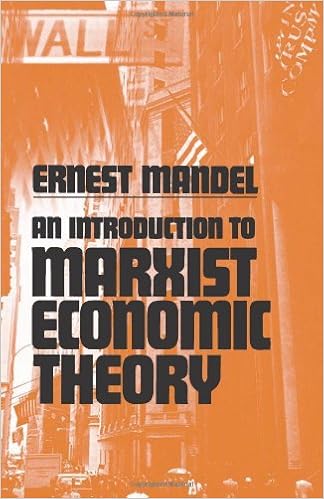
A personal aside. In my revolutionary youth, I read a lot of Trotsky and Lenin; I read Lukács and Korsch. I did not read much Marx except for his more philosophical works and in particular I could never get into Capital: I learned my Marxist economics from Ernest Mandel's textbook instead.


I was not the only one.

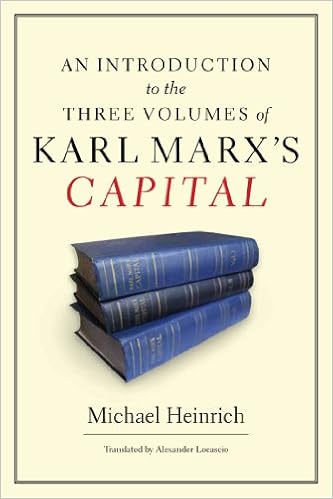
In 2012 Michael Heinrich published "An Introduction to the Three Volumes of Karl Marx's Capital" to great acclaim.


You can buy it from Amazon, but it's available free as a PDF here.

I was struck by the last chapter, (12), where the author summarises what Marx actually thought about communism - and tries to rebut some of the criticisms. It's interesting.

---

From: "An Introduction to the Three Volumes of Karl Marx's Capital" by Michael Heinrich.

Chapter 12. Communism—Society Beyond the Commodity, Money, and the State

Marx’s political aim was to overcome capitalism. A socialist or communist society (Marx and Engels used these terms interchangeably in the 1860s), in which private property in the means of production is abolished and production is therefore no longer carried out with the goal of profit maximization, was to take capitalism’s place.

Marx did not draft an extensive concept for such a society, so that even today many readers of Capital are surprised when they find out that it does not contain even a small chapter about communism. However, at various points (both in Capital as well as in earlier writings) Marx attempted to draw conclusions from his analysis of capitalism concerning general determinations of communism.

Since such conclusions depend upon the respective level of analysis, there are widely varying pronouncements that do not, however, add up to a unified conception.

There are two widespread complexes of conceptions regarding what constitutes communism in Marx’s sense. However, neither has much to do with the critique of political economy outlined in the preceding chapters.

Communism as an ideal.

Here it is assumed that communism means a society as it should be for ethical reasons: people should not exploit and oppress other people; they should not seek to gain material advantage, but rather show solidarity and helpfulness, etc. In Marx's early writings, one finds a few pronouncements that can be interpreted in this direction.

Against such a conception, it is often objected that 'humans are not as good as communism requires, that they always seek personal advantage and that communism therefore cannot function'.

On the other hand, people who are ethically or religiously motivated find a point of contact here, since Marx’s ostensible ethics seem to be strongly compatible with Christian ethics, for example.

Both sides do not consider the fact that in Capital, Marx does not criticize capitalism for moral reasons (see section 2.2). Rather, in the course of his analysis, he demonstrates that moral conceptions are socially produced (see section 4.3). It thus follows that morals only exist as the morals of a particular society, but not as a universal morality one can measure individual societies against.

Communism as the nationalisation of the means of production.

The abolition of private property in the means of production is here equated with nationalisation and state planning of the economy. Against this, the objection is raised that state planning is far too cumbersome and slow and includes a tendency toward authoritarian rule. Often, the "really existing socialism" of the Soviet Union is regarded as a more or less direct implementation of this conception of communism.

The collapse of the Soviet Union is then taken as an obvious proof for the inevitable failure of communism.

One finds demands for the nationalization of production both in the Communist Manifesto as well as Engels’s Anti-Duhring but only as a first measure and never as a characterization of communism. Rather, the means of production should pass into the hands of society and the state ultimately “dies out” (MECW, 25:268).

In the few fundamental observations concerning communism that Marx makes on the basis of the critique of political economy, two things are clear.

First, that communist society is no longer based upon exchange. Both the expenditure of labour-power in production as well as the distribution of products (first in their use as means of production and subsistence, then as the distribution of consumption goods among the individual members of society) occur in a manner consciously and methodically regulated by society - not by the market or the state. Not only capital (self-valorising value), but also the commodity and money no longer exist.

Second, Marx is not only concerned with a distribution that is quantitatively different from that under capitalism (this question of distribution was emphasized in traditional Marxism), but primarily with the emancipation from a social nexus that takes on a life of its own and imposes itself upon individuals as an anonymous compulsion.

Not only the capital relation as a specific relation of exploitation that generates bad and insecure working and living conditions for the majority of the population should be overcome; the fetishism that “attaches” to the products of labour as soon as they are produced as commodities should also be abolished.

Social emancipation, the liberation from self-produced and therefore gratuitous constraints, is only possible when the social relations that generate the various forms of fetishism have disappeared. Only then can the members of society truly regulate and organize their social affairs themselves as an “association of free men” (Capital, 1:171).

Marx is concerned with this comprehensive emancipation, and not merely with the question of distribution.

In contrast, it was a central tenet of traditional worldview Marxism and Marxism-Leninism that socialism or communism would lead to another mode of distribution that would offer individuals a foundation for other and better possibilities for development. According to this distribution-centric conception, an authoritarian welfare state that retains certain structures of the market economy can be regarded as socialism or communism.

The “really existing socialism” in Russia, Eastern Europe, and China moved exactly in this direction: the party elite occupied positions of state power and steered the economy in the direction of the greatest possible increase of material output, a somewhat egalitarian distribution of income as well as the greatest possible social security.

In the 'really existing socialist welfare state', the policies of the ruling party were not just imposed in an authoritarian manner against a political opposition striving for the reintroduction of capitalism. The majority of the population also had no actual influence; it was a more or less well taken care of but passive object of the party’s policies. Open discussion could occur only in a very limited way, if at all. The ruling “Communist” parties in the “socialist” countries also did not allow their monopoly of power to be questioned by other communist forces. Society here did not regulate the social process, the party did.

Clear-sightedly, Rosa Luxemburg criticized such tendencies early on. In her uncompleted text The Russian Revolution she writes:
"Without general elections, without unrestricted freedom of press and assembly, without a free struggle of opinion, life dies out in every public institution, becomes a mere semblance of life, in which only the bureaucracy remains as the active element. Public life gradually falls asleep, a few dozen party leaders of inexhaustible energy and boundless experience direct and rule. Among them, in reality only a dozen outstanding heads do the leading and an elite of the working class is invited from time to time to meetings where they are to applaud the speeches of the leaders, and to approve proposed resolutions unanimously—at bottom, then, a clique affair."

 (The Rosa Luxemburg Reader, Monthly Review Press, 2004, 307).
The state in 'really existing socialism', was primarily an instrument for securing the party’s rule over society. The “dying out of the state” was postponed to a distant future.

However, for Marx’s conception of communism, it is precisely this point that is of decisive importance: the state, whether bourgeois or “socialist,” constitutes an independent force standing above society that organizes (to a certain extent) and imposes (by force if necessary) a specific form of reproduction.

Against this, the “association of free men,” Marx’s characterization of communism, regulates its affairs without resort to such an external, independent force; as long as such a force exists, one cannot speak of an "association of free men".

That one can only speak of communism when not only the commodity, money, and capital have been abolished, but the state as well, does not mean that such a society would have no rules. The members of such a society would have to regulate their social life, organize production in individual workplaces, coordinate between workplaces, harmonize their different interests as producers and consumers, find ways of dealing with minority positions, and for a long time will still have to deal with different forms of gender and racial discrimination - such discrimination would not automatically disappear once capitalist exploitation ends.

The enormous effort of coordination that a communist society would have to perform, coordination that occurs today through the market, should not be underestimated in any case, nor should differences of interest and conflicts, as well as the danger of coordinating instances taking on a life of their own and becoming a state structure.

When Engels writes in Anti-Duhring that ‘‘the government of persons is replaced by the administration of things” (MECW, 25:268), this is correct, but one should also add that the administration of things also contains a potential for power that can always lead to the domination of people.

Despite all these difficulties, there is still no immediately apparent argument as to why a communist society should be impossible in principle. However, communism - if it is not to be a “crude” communism (MECW, 3:296) that merely manages scarcity - is tied to certain economic and social preconditions.

Marx emphasizes the massive development of productivity on the basis of science and technology, as well as the comprehensive development of the abilities of the workers as essential preconditions for the transition to a communist society (Capital, 1:616-21, 635, 637-38, 739; 3:958-59), even if both only occur in capitalism upon a narrow foundation, limited by the goal of profit maximization.

Two things are clear in connection with Marx’s considerations.

First, it is not sufficient for the transition to a communist society to conquer and defend state power during a weak phase of bourgeois rule, like in Russia in 1917. Without the corresponding social and economic preconditions, a socialist revolution might be successful as a project to maintain the power of a political party, but not as a project of social emancipation.

Second, a communist society requires a particular development to transform the preconditions created within capitalism. Not until “a higher phase of communist society,” where “the productive forces have also increased with the all-around development of the individual, and all the springs of co-operative wealth flow more abundantly” can “from each according to his abilities, to each according to his needs” apply (MECW, 24:87).

Even when a communist society can only be achieved with difficulty - in light of the social devastation wrought by global capitalism, by crises and unemployment in the developed countries as well as in the countries of the so-called Third World while there exists at the same time a historically unprecedented level of material wealth; in light of the destruction of the natural foundations of life caused by capitalist production, no longer occurring locally but affecting the planet as a whole (clearly visible in climate change); in light of constant wars that also emanate from or are promoted by “democratic” bourgeois states—in light of all that, there are enough good reasons to abolish capitalism and replace it with an “association of free men.”

---

Discussion

Marx's assertion that,
"moral conceptions are socially produced ... . It thus follows that morals only exist as the morals of a particular society, but not as a universal morality one can measure individual societies against."
is well-refuted blank-slatism. But it does seem needed to justify the utopian premises of super-egalitarian communism.

As far as the rest of Heinrich's piece is concerned - interesting as it is - it's more an expression of hope than logical analysis. My final thoughts linger with his observation:
"When Engels writes in Anti-Duhring that ‘‘the government of persons is replaced by the administration of things” (MECW, 25:268), this is correct, but one should also add that the administration of things also contains a potential for power that can always lead to the domination of people."
Sadly or otherwise, these are the people we've got - in all their physical and psychological diversity; ants they are not.

Let me just re-iterate my closing points from the previous post:
"Improving AI-driven automation will increase overall productivity and decrease costs for things like robotic personal assistants (just beyond the state of the art right now).

"This could eventually fund a 'basic income' which, with a mature virtual reality infrastructure, could keep the left-hand side of the bell curve quiescent for ever. They might even tell you they were already in paradise - before returning to 'Call of Duty VR'. No doubt there will be more highbrow versions extending - how far, I wonder? - up the right-hand side.

"In such a process of runaway automation, note that the former working class has in fact been expelled from the process of production. Literally, they are no longer proletarian, but a group wholly parasitic upon the automated economy.

"An analogy would be to imagine a people who inhabited such a benevolent natural environment that all their needs from the most basic (food, shelter) to the most refined were instantly and effortlessly available to hand.

"If such an AI-automation economy is the means by which 'communism' (full abundance) is to be achieved, we should be careful what we wish for.

"As well as the dysgenic dangers of relaxed selection (which we already experience in the West), I suspect that without any meaningful challenges, the population would rapidly disintegrate into chaos, anomie and violence .. unless this utopia provides for omnipresent VR capable of realising any fantasy-endeavour whatsoever.

"And it was for this that the great wheel of human history turned?"
---

Next: "On the Corbyn New Left".

Tuesday, August 02, 2016

Revolution back on the agenda?

Amazon Link

Marxist theory has a 'non-constructive' kind of proof that the capitalist mode of production is not the final form of society. This is simply the fact that capitalism is a class society: private ownership of the means of production (factories, machines, land, raw materials, etc) ensures that the production process replicates a class of capital-owners on the one hand, engaged in commodity production for exchange in the market, and a class of workers on the other, who own only their ability to productively labour and can do so only through employment by capitalists.

Surely this asymmetry in social role between bourgeoisie and proletariat will not echo down the centuries for ever?

So far, so arid. But Marxism also has a seemingly-ethical dimension. It is claimed that capitalism cannot develop the productive forces of society without ongoing oppression of the mass of the people. So it's not only rather inelegant as a social-structuring mechanism, it's also inefficient and bad.

You won't get a good answer from Marxists as to whether capitalism has a built-in failure mode. Some have thought that it will collapse through its own contradictions (Marx's theory of the declining rate of profit is often fingered as the proximate mechanism) but as V. I. Lenin observed,
"... there is no such thing as an absolutely hopeless situation, since the bourgeoisie can – in principle – always find a way out."
No one disagrees however that capitalism is subject to regular cycles of boom-and-bust. In the 'bust' phases the elites are always just fine; it's the masses which end up unemployed and desperate. (I remind you about Peter Turchin's forthcoming book, "Ages of Discord", although I believe Charles Murray's "Coming Apart" would tide you over until September).

Marxist theory suggests that the working class can take advantage of an acute crisis to transcend capitalist relations of production, (this would be the violent revolution, led by a revolutionary communist party), and bring about a post-capitalist society in transition to communism.

With 168 years of research since the publication of the Communist Manifesto (1848) what can we say about the viability of such a post-capitalist society?

Marx very wisely declined to speculate - there simply wasn't the data. This meant of course that his discussion of the target society was very abstract - and in some cases plain weird (Chapter 2):
"... nothing is more ridiculous than the virtuous indignation of our bourgeois at the community of women which, they pretend, is to be openly and officially established by the Communists. The Communists have no need to introduce community of women; it has existed almost from time immemorial.

"Our bourgeois, not content with having wives and daughters of their proletarians at their disposal, not to speak of common prostitutes, take the greatest pleasure in seducing each other’s wives.

"Bourgeois marriage is, in reality, a system of wives in common and thus, at the most, what the Communists might possibly be reproached with is that they desire to introduce, in substitution for a hypocritically concealed, an openly legalised community of women.

"For the rest, it is self-evident that the abolition of the present system of production must bring with it the abolition of the community of women springing from that system, i.e., of prostitution both public and private."
Lenin, having observed workers and peasants councils (soviets) in the Paris Commune and the 1905 revolution in Russia proposed that the politics and economics of the post-capitalist society would indeed be organised by a hierarchy of soviets (local, regional, national, by industry and so forth).

How would this work in detail? I recall Ernest Mandel suggesting that opinion polls might do the work of capitalist speculative investment in new product introduction, although I'm not sure that Apple would ever have happened if it had required a senior soviet to vote the financial resources. The socialist Steve Jobs would have had plenty of oversight in his work, and would not have been permitted remuneration beyond that of any 'skilled worker'.

So here is the heart of the problem. Marxists have supposed that absent capitalist reification - the opacity of social relationships leading to atomisation of society - humanity's inherent social solidarity would emerge and we would all work cooperatively together to eliminate oppression and develop society's productive forces in harmony together indefinitely.

This was the root of E. O. Wilson's famous critique of Marxism, "Wonderful theory, wrong species."

Human nature makes us rather clannish and nepotistic, with sharp clines of empathy. Given that we are not all clones of each other, this makes rational evolutionary sense so will not go away.

What would actually happen in the post-revolutionary state? We know what Oscar Wilde thought about socialism, 'too many meetings', and we know what happened to the post-revolutionary states in Russia, Eastern Europe and China - bureaucratisation and stagnation.

Stalinism was explained away as 'inadequate development of the productive forces' but Marxist blank-slatism is the real villain here. In the end, the people who control resources at the centre of society will make decisions based on their own interests and all the 'delegated powers' and 'rights of recall' will count for nothing, as the mass of society gives up on 'all those endless meetings' and demobilises.

When it comes down to it, we just don't care that much about non family-and-friends.

Is there a form of society which is post-capitalist, freer and more potentially successful? I have no idea, but the Marxist model in its current human-nature-naive form isn't it.

Perhaps a combination of super-automation and widely-spread social ownership of the robots will propel every last one of us, proletarian or bourgeois, to the status of ancient Greek aristocrats with a lifetime of luxury to look forward to.

Sounds as likely as anything else I've heard about the future.

---

This is not as bizarre or speculative as you might think.

Improving AI-driven automation will increase overall productivity and decrease costs for things like robotic personal assistants (just beyond the state of the art right now).

This could eventually fund a 'basic income' which, with a mature virtual reality infrastructure, could keep the left-hand side of the bell curve quiescent for ever. They might even tell you they were already in paradise - before returning to 'Call of Duty VR'. No doubt there will be more highbrow versions extending - how far, I wonder? - up the right-hand side.

In such a process of runaway automation, note that the former working class has in fact been expelled from the process of production. Literally, they are no longer proletarian, but a group wholly parasitic upon the automated economy.

An analogy would be to imagine a people who inhabited such a benevolent natural environment that all their needs from the most basic (food, shelter) to the most refined were instantly and effortlessly available to hand.

If such an AI-automation economy is the means by which 'communism' (full abundance) is to be achieved, we should be careful what we wish for.

As well as the dysgenic dangers of relaxed selection (which we already experience in the West), I suspect that without any meaningful challenges, the population would rapidly disintegrate into chaos, anomie and violence .. unless this utopia provides for omnipresent VR capable of realising any fantasy-endeavour whatsoever.

And it was for this that the great wheel of human history turned?

---

The second part of this article: "Communism would be like - what?".

Click on the link to read it.