Showing posts with label Horizon. Show all posts

Friday, May 05, 2017

Diary: flies + schizophrenia + fasting + reading

The fly menace: net curtains on the landing

A screen fronts the pantry

A dry, chilly, easterly wind gusts from the continent, so what do houseflies do? Seek nooks and crannies to avoid being dehydrated and swept away. Hence the plague of buzzing monstrosities in our bedrooms, bathrooms and kitchen.

New net curtains have gone up, the pantry screen was reattached: nothing seems to work. My latest belief is that they are crawling between the floors and emerging from small gaps around the pipework.

---

Perhaps I was over-influenced by the BBC Horizon documentary on Schizophrenia, "Why Did I Go Mad?".  The programme was interesting throughout: strong on phenomenology though weak/misleading on analysis.

The usual BBC inability to accept that genetics can underlie anything of importance.

In fact schizophrenia is 80% heritable, and triggered by a variety of stress factors.

I was most interested in the schizophrenic's objectification of 'sub-personalities': auditory hallucinations (voices) and visual illusions - often eerily-scary monsters. Somehow the brain's attribution of agency is being misapplied to internally-generated subconscious events.

They say psychosis is like being awake, but living in a dream.

---

Jenni Russell had an interesting piece in The Times yesterday, "It’s worth going hungry for a healthier life". She says,
"Fasting’s complex effects are still being explored but one of its most important mechanisms is that it pushes cells into repair mode, through a process called autophagy. After 12 hours or so of no food, a starving cell starts burning up diseased and damaged proteins, tumours and viruses, in a kind of spring-cleaning that only takes place when there are no alternative sources of energy.

"Autophagy has been known about for 50 years but not until recently has its essential function been widely understood. In past centuries, when food was relatively expensive and scarce, autophagy happened naturally in the long gap between supper and waking up. Now that food is so easily available many of us eat continuously, from breakfast until late-night snacks, meaning that autophagy cannot take place. That is disastrous for our physiology.

"Junk and rubbish build up in our cells and cannot be cleaned out. It is as if we are in a car driving continuously with the accelerator pedal down, never pausing to stop at a garage to have the engine parts, brakes, wheels or oil replaced. ...

"One of fasting’s most exciting consequences is its potential to regenerate the immune system. As I have mentioned on these pages before, I came across this particular research three years ago, just after it was published and just as my own treatment for a long-running auto-immune illness was about to be halted by the NHS because of its tremendous expense.

"Valter Longo, a leading anti-ageing specialist at the University of Southern California, had discovered that when mice fasted for three days at a time they generated new stem cells from their bone marrow. This was astounding. It meant that over six months of occasional fasts they replaced damaged immune cells with perfect ones. Potentially, this had huge implications for anyone with an auto-immune disorder and indeed everyone else, since a major cause of ill-health is the deterioration of our immune systems as we age.

"Dr Longo warned readers not to try this themselves but I couldn’t wait. With considerable scepticism — but more despair — I imitated the mice, started fasting on water-only for three days at a time, was cured within weeks and have never relapsed. It has made me a reluctant convert to fasting since a few days without food have proved more effective than 20 years of medical care by devoted doctors and £200,000-worth of drugs."
Assuming you don't find it paywalled, it's worth reading the whole article. In any event, we're into the recommended 36 hour fast even as I write this.

Here's Jenni Russell's previous (and very popular) article on her fasting.

---

After Charlie Fletcher's final Oversight book, "The Remnant", I started reading Greg Bear's "Quantico" to Clare last night. Alas, the qualities which reward silent reading to oneself do not transfer to reading Bear aloud. In recitation, Quantico is leaden, stilted and confusing. So it's abandoned.



Tonight I'll hope for better with Frederik Pohl's classic "Gateway". The link is Readings to Clare.

Monday, June 13, 2016

The FTO gene

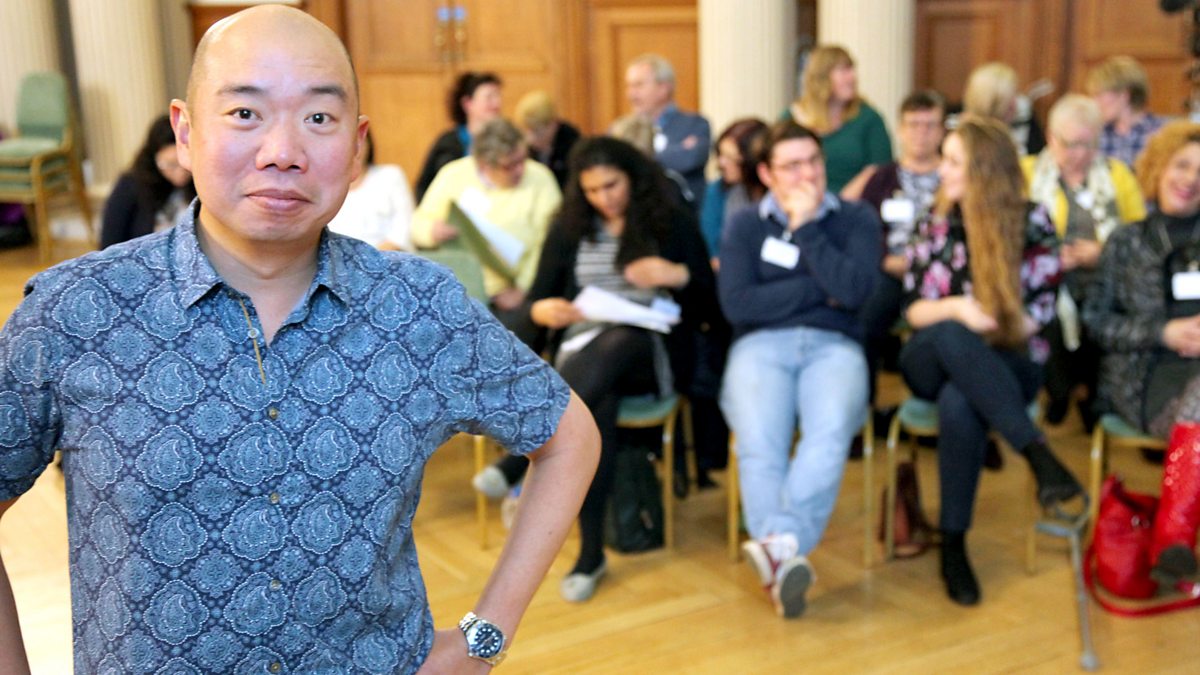
We watched the BBC Horizon programme on genetic causes of obesity, fronted by Dr Giles Yeo (good to see an ethnic East Asian presenter).

Dr Giles Yeo with some of the AA variant folk

There is a gene of quite large effect; here is what Wikipedia says:
"A study of 38,759 Europeans for variants of FTO identified an obesity risk allele. In particular, carriers of one copy of the allele weighed on average 1.2 kilograms (2.6 lb) more than people with no copies.

"Carriers of two copies (16% of the subjects) weighed 3 kilograms (6.6 lb) more and had a 1.67-fold higher rate of obesity than those with no copies.

"The association was observed in ages 7 and upwards. "

...

"In adult humans, it was shown that adults bearing the at risk AT and AA alleles at rs9939609 consumed between 500 and 1250 kJ more each day than those carrying the protective TT genotype (equivalent to between 125 and 280 kcal per day more intake).

"The same study showed that there was no impact of the polymorphism on energy expenditure. This finding of an effect of the rs9939609 polymorphism on food intake or satiety has been independently replicated in five subsequent studies (in order of publication)."
The protective allele is T while the risk allele is A at SNP site rs9939609.

---

Here is what 23andMe says about my late mother, Beryl Seel, and myself.


My mother had the protective genotype, TT, and was never overweight; I'm not so lucky (AT) and had to fight to get my weight down to its current 70-71 kilograms (from 86kg in mid-2012).

We can infer that my late father, who definitely had an expanded waistline, was AT or AA. Based on family history and if pressed, I would guess AT .. and that I got unlucky.

I wrote about this 18 months ago: another Horizon programme.

Tuesday, August 19, 2014

Bacon reduced at Waitrose

Watched "Horizon should I eat meat?" on BBC2 last night (why is it not yet on YouTube?). The bottom line (so many puns) is that processed meats - bacon, sausages - are the killers: the nitrosamines they contain and produce are carcinogenic.

We predicted there would be a lot of half-price bacon and sausage on the shelves at Waitrose this morning!

---

Michael Mosley's self-experiment with extra meat rations was a trifle disingenuous. Presumably he is usually on the 5:2 diet - his physique certainly suggests that. If you then switch to seven day extra-meat-eating for a month, with generous bread rolls, fruit and veg, you are certain to gain 6-7 pounds (3 kg) as he did. Not sure it was the processed meat doing the damage here, doctor!

We got some great shots of a colonoscopy BTW .. I can hardly wait!

---

Steve Hsu has an accessible paper here on progress in identifying the many genes (alleles) of small effect which underlie quantitative traits such as height and intelligence. I've been reluctantly* convinced by his argument that fixing the many negative (dysfunctional) alleles in every person could remarkably increase intelligence. Read the paper, skip the harder maths and see if you agree.

---

* Why reluctantly? There are a number of brain attributes which presumably contribute to increased general intelligence: specific modes of brain modularisation, optimised brain architecture, increased brain size, larger number of neurons, efficiency of neurons, efficiency of neural-interconnect, density of neural-interconnect .. and so on.

Only some of these are capable of significant change - brain size, for example, is hard to increase given birthing constraints. Steve Hsu's linear additive model seems to imply that (in Sky Pro Cycling terms) there is the possibility of 'aggregation of marginal gains' which would impact all of the attributes mentioned above and more.

And so I have become a reluctant convert.

Thursday, January 31, 2013

Michael Mosley on 'Exercise' (Horizon)

Repeated on BBC2 yesterday evening from early 2012, Horizon's examination of the benefits of exercise repaid a second viewing.

The programme featured a distinctly chubby Dr Mosley (these were the days before Intermittent Fasting and the 5:2 diet). His novel message was that three minutes of high-intensity training per week was sufficient to turn your flabby body around.

We saw Michael on his exercise bike: 20 seconds cycling to exhaustion, a rest, then repeat and repeat - one minute in total. Do it three times a week.

This one minute of high-intensity workout depletes muscles of their glycogen stores (glycogen is the precursor of glucose, which fuels our muscles). The body concludes it's under stress and improves insulin-processing performance and maybe (genes permitting) the cardiovascular system. Perhaps in as short a time as one month.

The other key idea is to keep active - walking around - on a regular basis rather than spend hours slumped in a chair in front of a TV or computer. This stops the body from sludging up (Mosley was a little more technical).

Mosley argued that gym hours surely add value - strength, cardiovascular - but you can get good results even without it.

My feeling is that the human body is complex and the research reported tracked relatively few variables. So I think the programme may have under-rated the additional benefits of working out.
---
Some thoughts on intermittent fasting, based on five months experience.

1. On a fast day expect to go to bed hungry. You have had no more than one quarter of your required calories (if you weren't cheating), what did you expect?

2. If you are going to exercise on your fast day (I usually do), have enough carbohydrates the previous day/evening. If you start exercising with glycogen-depletion, then you'll hit a wall pretty sharpish, and this undermines the benefits of exercise.

3. Don't eat too much on the non-fast days. Binge-eating, especially junk food, undermines the process.

4. The point of intermittent fasting is not primarily dieting, it's to give a shock to the body to stimulate cell-repair mode, protecting against cancer and heart disease. There has to be a shock - see 1 above.

5. If you are seriously working out you will be building muscle mass. This - on the scales - will counteract continuing loss of surplus fat. So be prepared to plateau weightwise, for a while.

Saturday, December 08, 2012

Intermittent fasting: month 4

Another month ... and another six pounds lighter.

Date Stone Lb Pounds Kg D(Lb)
07/08/2012  13 8  190  86.4  Start
08/09/2012  12 13  181  82.3   9
06/10/2012  12 7  175  79.5   6
08/11/2012  11 12  166  75.5   9
08/12/2012  11 6  160  72.7   6


This is now month four of intermittent fasting - a scheme whereby three days a week I restrict my calories to around 500 (the normal male requirement is around 2,500 per day). The point of this, as explained in previous months, is to persuade the body to move from 'go-go' mode into cellular-repair mode, with consequent health benefits. Also, of course, because I have been historically overweight.

My belt is a few notches in, my jeans are rather hanging off me and my abdomen has contracted. Losing c. 6 pounds per month is not a process which can be carried through indefinitely - I would guess I have about another six or seven pounds to go. While we were in Paris a few days ago I was checking the torsos of the classical sculptures at the Louvre to see just what the perfect stomach is meant to look like :-).

Should be there by my birthday in January, providing Christmas doesn't blow the whole process apart!