Showing posts with label Ul Qoma. Show all posts

Sunday, April 22, 2018

"The City & The City" on TV: (episodes 3 & 4)

Amazon link

This penultimate episode was better. The series still feels more constricted than necessary (should have been six episodes!) but we're beginning to see the wood for the trees.

About episode 2 I said, " Borlú  is a grumpy, slightly sleazy ESTJ headmaster who could never have pulled his liberal, idealistic ENFJ wife." In this episode the dynamics of a failing marriage are more clearly portrayed: Borlú in his mundane sensor way worships his fey and fragile wife; she, on the other hand, sees him as a clodhopping bear whose unimaginative stolidity imprisons her free spirit.

Could it really have lasted two years?

Isabel Briggs Myers noted ("Gifts Differing") that as you ascend the social scale the proportion of Idealists/liberals (NFs) and Rationals/intellectuals (NTs) increases. This is plainly due to the IQ correlation with N:  a capacity for abstraction is an entry ticket for elite participation with heart-on-sleeve Idealism more prevalent in the arts and media.

Watching ESTJ Borlú blundering his way around as lead character is therefore a bit of a novelty. But the fact that many viewers may find him as irritating as does his wife Katrynia doesn't mean that he's not well acted, or that his personality doesn't fit the role. So I stand corrected, a little.

Borlú's Ul Qoman counterpart, Senior Detective Dhatt, (a more sympathetic figure) was revealed last night to be in a lesbian relationship with a less 'policey' partner - but both are SJs so their prospects are good.

So where do we stand now? The evil American corporation has come into the picture, spouting its vacuous homilies about 'learning from the noble inhabitants of the third world' (very well done, the very lightest touch) while Borlú's Guardian protective instinct for 'his people' has finally and irrevocably clashed with his Guardian respect for the principle that you shall not Breach.

The denouement is next Friday.

---

Update: Sunday 29th April 2018.

The final episode was perhaps the best. The banal, sleazy truth underlying Orciny was unveiled while the denouement flirted with magical realism. I liked it - I understand the sensors switched off in droves.

Throughout the episodes I understood the intellectual salience of 'unseeing' those social realities which power-brokers have made forbidden. What I didn't appreciate enough was the lure of Orciny, the fabulous secret-city soaring above the mundane.

The role of Borlú's wife, Katrynia was to capture that idealistic and utopian longing .. and then to follow the trajectory of Orciny into the abyss. The actress Lara Pulver didn't carry that arc too well: too self-possessed, not quite enough fragility.

Sunday, April 15, 2018

"The City & The City" disappoints (episode 2)

Amazon link

My earlier hopes for "The City & The City" have been confounded. China Miéville's novel gets its power from its setting: the interpenetrating cities unsettle and remould all social relationships. Miéville then overlaid a police procedural to explore this subversion of everyday life.

The TV series, constrained by four episodes, has put the low-key and inert plot centre stage. The setting now has little to contribute beyond needless complexity while the characters mechanically deploy like chess pieces to push things along. The result: actions and motivations aren't authentic while characters are shallow and unconvincing. Corwi is played as an implausible one-dimensional buffoon while Borlú  is a grumpy, slightly sleazy ESTJ headmaster who could never have pulled his liberal, idealistic ENFJ wife.

I wish I could make a deeper ideological critique of the series, link it to crass political-correctness or SJW shibboleths. But it's just that the TV adaptors haven't allocated enough time, have failed to create that deep immersion in the Besźel/Ul Qoma duality which was the point of China Miéville's work.

---

Episode 3 review.


Saturday, April 07, 2018

"The City & The City" on TV - China Miéville

 The cities of Besźel and Ul Qoma

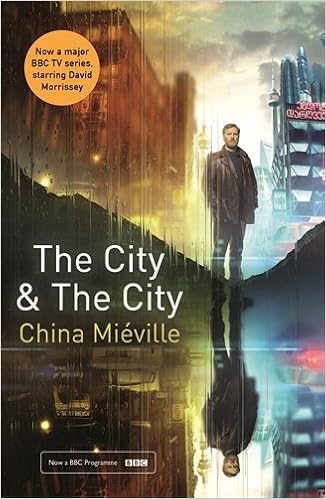
BBC2 showed the first episode of their adaption of China Miéville's "The City & The City" last night. I wrote about it two years ago.

Amazon link

From previous TV adaptations of SF classics, I feared the worst, but this was actually pretty good.

Miéville's book leads with its extraordinary setting, with plot secondary and characterisation a pulp noir third. This doesn't work for TV, where character and action is primary.

The screenwriters therefore beef up the backstory for the lead character, Inspector Tyador Borlú of the Extreme Crime Squad, Besźel, giving him a mysterious vanished wife (not in the novel) who may have vanished into the other city, or who was perhaps taken by - or recruited to - the secret border police Breach. Meanwhile they fill out the character of his sidekick, Lizbyet Corwi, who puts on an aggressive macho schtick to cope with being a female cop in a very traditional man's world.

They've used Liverpool for earthy, seedy, eastern-european Besźel and will perhaps use Manchester as the stalinist, modernist Ul Qoma. We shall see in the next episode.

If you didn't know the book already, the idea of two distinct and hostile city-states occupying the same geography would be a fast learning curve. But overall, I felt they got the mix of plot development, characterisation and exposition about right.

Abigail Nussbaum has a good and characteristically engaged review of the book.

Tuesday, March 15, 2016

BBC Two and "The City And The City" - China Miéville


Something to look forward to later this year. BBC Two has commissioned "The City And The City" in four hour-long episodes. Inspector Tyador Borlú, of the Extreme Crime Squad, Besźel, will soon be investigating the murder of Mahalia Geary.
"The City & the City takes place in the cities of Besźel and Ul Qoma. The precise location of these cities is not described. However, various references in the book indicate that the cities are perhaps in the coastal Black Sea region of south-central Europe: Besź smugglers traffic in goods from Varna, Bulgaria and Bucharest, Romania; protagonist Tyador Borlú enjoys his coffee in the Turkish style.

"These two cities actually occupy much of the same geographical space, but via the volition of their citizens (and the threat of the secret power known as Breach), they are perceived as two different cities. A denizen of one city must dutifully 'unsee' (that is, consciously erase from their mind or fade into the background) the denizens, buildings, and events taking place in the other city – even if they are an inch away.

"This separation is emphasised by the style of clothing, architecture, gait, and the way denizens of each city generally carry themselves. Residents of the cities are taught from childhood to recognise things belonging to the other city without actually seeing them. Ignoring the separation, even by accident, is called "breaching" – a terrible crime by the citizens of the two cities, even worse than murder."
How will they deal with "unseeing"? Perhaps they'll 'fade out' the other city?

"The City And The City" is my favourite China Miéville novel. It has weaknesses in both plot and characterisation, but I have never seen 'the social construction of reality' better realised.

Update: 7th April 2018. They finally showed it - here's my review.

---

In other news, Arthur C. Clarke's 'Childhood's End' comes as a three-part series to Sky 1 at 9 pm this Thursday (repeated a few hours later, deep in the night, on Sky 2).

Mr Clarke's rather clunky fiction has largely gone out of fashion - who reads it any more? - but 'Childhood's End' is clever, has genuine plot surprises and is filled with a galactic sense of wonder.

I do hope they do it justice.