Showing posts with label Fredric Jameson. Show all posts

Monday, October 14, 2019

"It is easier to imagine the end of the world ..."


This quote, "it is easier to imagine the end of the world than to imagine the end of capitalism," has been attributed to the cultural analyst, Fredric Jameson.

It bears deep reflection.

Capitalism is the first mode of production which separated the mass of people from the means of securing their own livelihood. Previous modes of production saw ordinary people as hunters, gatherers, pastoralists or farmers.

Given the economic precariousness of the proletariat, some social organising principle is needed to coordinate actions to secure the reproduction of collective life. This is called an economy.

Historically there have been only two forms of economic organisation consistent with the existence of a proletariat (a class of resourceless labourers): the privately-owned, decentralised means of production constitutive of capitalism; and bureaucratically-owned means of production in a centrally-planned 'socialism'.

We know the track record of both models. In particular we know that a statist centrally-planned economy does not work - it lacks incentives to grow and optimise, and is captured by bureaucratic elites.

There are two further models: the naive Leninist-Trotskyist model of a worker-controlled (soviet) state and economy .. and a fully-automated economy.

The Leninist-Trotskyist model was only ever theorised in the sketchiest form and founders under modern political, industrial and financial complexity .. and human nature.

The fully-automated economy is a limit point of the natural tendency of capitalism to automate (the law of increasing organic composition of capital). However in that limit the last workers are displaced and therefore surplus value can no longer be created. Profits tend to zero as competition equalises prices to costs.

So no more capitalist economy, but that does not mean no economy. A collection of fully-automated companies (perhaps with non-waged human involvement in setting objectives - and certainly in consumption) is rather like a collection of villages each of which has a monopoly of some kind of natural resources (water, fruits, meat, ...) which are essentially not scarce. Such an economy engages in exchange, because human needs straddle the portfolios of the various producers, and it's similar to petty-commodity production, albeit without the involvement of human labour.

The working class may have vanished as a social category (no wage labour) but humans certainly haven't. Provided the machines have not been so badly designed as to eliminate humanity, people experience this world as super-aristocrats: their every feasible, practical need met.

"The future is already here — it's just not very evenly distributed," said William Gibson. And if we look at the super-rich today we see a preview of behaviours which could be open to all in a society of totally-automated abundance.

As expected, the behaviour-set is just what would be expected given the innate nature of the human animal - all drives are exhibited from the most prosocial to the most antisocial.

On a sufficient timescale (a century or two) human nature can itself be engineered and hopefully there will be major speciation events. We will find it easier and more robust to adapt to Mars than to make Mars adapt to current-us, for example.

Capitalism will abolish itself not through socialism but through self-elimination. And the human race will diversify into every possible ecological niche in this awaiting universe.

Unless we're stupid about it.


Thursday, August 23, 2018

"Postmodernism, or, The Cultural Logic of Late Capitalism" - Fredric Jameson

Amazon link

I've just begun reading Fredric Jameson's masterpiece and was struck by this excerpt (page 4):
"As for the postmodern revolt against all that [i.e. modernism], however, it must equally be stressed that its own offensive features from obscurity and sexually explicit material to psychological squalor and overt expressions of social and political defiance, which transcend anything that might have been imagined at the most extreme moments of high modernism—no longer scandalize anyone and are not only received with the greatest complacency but have themselves become institutionalized and are at one with the official or public culture of Western society.

What has happened is that aesthetic production today has become integrated into commodity production generally: the frantic economic urgency of producing fresh waves of ever more novel-seeming goods (from clothing to airplanes), at ever greater rates of turnover, now assigns an increasingly essential structural function and position to aesthetic innovation and experimentation.

Such economic necessities then find recognition in the varied kinds of institutional support available for the newer art, from foundations and grants to museums and other forms of patronage. Of all the arts, architecture is the closest constitutively to the economic, with which, in the form of commissions and land values, it has a virtually unmediated relationship.

It will therefore not be surprising to find the extraordinary flowering of the new postmodern architecture grounded in the patronage of multinational business, whose expansion and development is strictly contemporaneous with it. Later I will suggest that these two new phenomena have an even deeper dialectical interrelationship than the simple one-to-one financing of this or that individual project.

Yet this is the point at which I must remind the reader of the obvious; namely, that this whole global, yet American, postmodern culture is the internal and superstructural expression of a whole new wave of American military and economic domination throughout the world: in this sense, as throughout class history, the underside of culture is blood, torture, death, and terror. "
Postmodernism is surely a liberal project. Jonathan Haidt (Moral Foundations Theory) has highlighted liberal blindness to the moral dimensions of sanctity, respect for due authority and sexual/social propriety. Pussy Riot are rightly postmodernist icons.

Jameson here nails the moral selectiveness of fashionable liberal opinion.

---

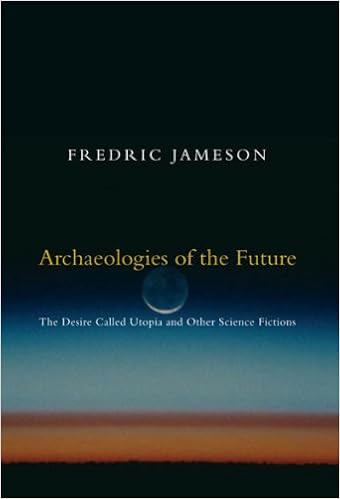
Jameson is undeniably brilliant - his work suffused in the culture of Western Marxism and the Frankfurt School. I'm debating whether to get his later (2005) review, "Archaeologies of the Future: The Desire Called Utopia and Other Science Fictions".

Amazon link

"This is a brilliant study of utopia and science fiction, from Thomas More to Philip K. Dick, by the master literary critic. "Archaeologies of the Future", Jameson's most substantial work since "Postmodernism", investigates the development of the Utopian form since Thomas More, and interrogates the functions of Utopian thinking in a post-Communist age.

The relationship between utopia and science fiction is explored through the representations of otherness...alien life and alien worlds...and a study of the works of Philip K. Dick, Ursula LeGuin, William Gibson, Brian Aldiss, Kim Stanley Robinson and more."      [From the Amazon page].