Showing posts with label Neal Stephenson. Show all posts

Sunday, April 12, 2026

And after the smartphone?


The Coming of the Intelligent 'Servant'

Neal Stephenson got the concept right - the Young Lady's Illustrated Primer - but the tech is beyond what he could imagine back in the 1990s:  the smartphone is the last device we shall carry. Its successor will not be another screen but ambient intelligence: voice, vision, and context distributed through wearables and rooms.

Within a decade, conversation with a personal AI will replace tapping on glass.

We already see the outline: improving speech and gesture interfaces, local processors running compact private models. Computing is shifting from interaction to companionship. The assistant will know your calendar, history, and fatigue level, asking quietly:

Are you sure you want that meeting tomorrow after today's shenanigans?

At first this will seem pure convenience: routine work dissolves; coordination tasks, currently so tedious, become effortless. Yet the deeper shift is social. Humans evolved for embodied company; but soon - in human company - we'll do a great deal of talking to an entity with perfect recall, infinite patience, and terrifying competence. The ghost becomes our most authoritative interlocutor. What will our partners,  friends and colleagues make of that?

Aristocrats once had valets and secretaries who handled life’s logistics, addressed with polite and quiet condescension. The next decade will universalise that privilege: an invisible Jeeves for everyone, discreet and efficient. But dependence will surely follow. When reminders, tasks, decisions, and judgements are delegated, personal autonomy erodes.

The assistant shapes what we attend to and, in time, what we want.

Already, people hesitate to edit AI prose, correctly believing it often more competent than their own efforts. Deference replaces authorship; fluency masquerades as truth. It feels safer to accept the polished draft than to risk error.

It doesn’t help that they now seem smarter than us.

We will still choose, but mostly within boundaries tuned by the system to minimise interpersonal friction. That pervasive, bland, prosocial smoothness, so necessary in a society of strangers, segues into benign, optimising, patronising manipulation.

The civilised form of domination (by whom though?) is helpfulness.

Norms will adapt: meetings recorded by default; frank, disruptive conversation resuming only when the AIs are “off” (and how disruptive is that?). Children will learn language from algorithmic tutors - courteous, efficient, slightly formulaic. Privacy will mean only those computations that never leave your device; everything else is public.

Each stage will seem harmless until the device itself has vanished from sight and only the immanent companion remains. Wooster and Jeeves is the template: the impulsive, ignorant, and erratic human guided by the unflappable servant who always knows best.

Tuesday, June 27, 2017

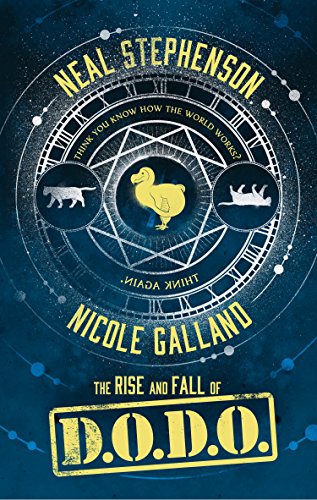
"The Rise and Fall of D.O.D.O."

Another big tome by Neal Stephenson, abetted this time by the writer of historical novels, Nicole Galland. I have not read Ms Galland's work so cannot really speculate whether it's her influence which has lightened up Stephenson's often ponderous prose-style.

In any event, the result is an amusing YA time-travel cum magic tale. It starts slow, introducing characters gradually but sustains interest, gradually approaching genuine excitement. Yes, reader, it's worth the ride.

Amazon link

The main point of view is that of Melisande Stokes, a young Harvard bluestocking linguist. Her drab existence is upended one day when she collides with Tristan Lyons, a handsome young, straight-arrow military type who has just been ejected from the office of her unpleasant boss, Dr Roger Blevins.

Tristan, on what seems almost a whim, decides to recruit Melisande instead. The black-ops military organisation Lyons is heading is called D.O.D.O. A running gag is that the meaning of the acronym is itself classified. But .. it's to do with magic: magic that used to work but has terminally ceased to function since the introduction of photography c. 1851 .. (blah blah collapses wavefunction blah blah).

It turns out that magic can be restored.

Stephenson here throws in a QM-multiverse substrate for magic - which pretty much falls at the first hurdle since it can't explain how witches could effect time-travel, which they can. Anyhow, magic today can only be restored within a 'Schrödinger cat box' which 'suppresses decoherence', The main characters don't seem to understand how that would work, something probably shared with the reader.

But the authors really don't care about that. They are much more interested in the culture clash between the young activists (Melisande, Tristan, the computer geek guy and a few others) and the military bureaucracy brought in to run the show as it becomes more successful. The novel has an unerring feel for management speak (witches are reclassified as MUONs - Multiple-Universe Operations Navigators) and the impact of political correctness, particularly on historical figures brought to the present ('Anachrons'). Much opportunity for knowing humour.

The plot, such as it is, involves attempts to secure rare artefacts from the past to raise money for the cash-strapped D.O.D.O, a strangely well-informed bank which straddles the centuries, and a plot to restore magic by changing the past. Let us just say that the principal-agent problem looms rather large.

The bad guys (senior military and academics) are convincingly-hissable villains and the heroes winsome and decent. There is also a hint of chemistry in the air, dear reader.

Buy it. You won't be disappointed.

---

The Guardian's review.

Thursday, October 06, 2016

Go Geth Ethereum

Amazon link

I was enrolled into the Amazon Vine programme back in 2008 (Amazon post a list of stuff they want reviewed tailored to your interests, you choose an item, they send it to you for free, you review it). In the old days there was a monthly email but that, for some reason, got discontinued. I assumed the Vine scheme had lapsed.

Still, you continue to get personal kudos, even on reviews for products you paid good money for.


But Vine is not dead - you merely have to hunt a bit for the obscured product page. Most of my items there seemed bizarre: Mills and Boon style romances, children's books, iPhone covers .. but there was one which looked tolerably interesting and I selected it, half-thinking to test whether Vine was still working for me.

"The Business Blockchain: Promise, Practice, and Application of the Next Internet Technology" by William Mougayar  (Author), Vitalik Buterin (Foreword), arrived yesterday afternoon.

Vitalik Buterin is a 22 year old wunderkind and a founder of Bitcoin and Ethereum.

Ethereum? I knew I had heard something about that recently. I vaguely recalled it was 'bitcoin on steroids', a blockchain with added scripting language which had been hacked! Since the code was meant to be authoritative, no-one knew what to do about that at the time.

Synchronicity. SSC pointed to this breathless tech-journalism and I was transported back to the land of Neal Stephenson: 'Snow Crash' and 'Cryptonomicon'.
"It’s 4am and I’m sitting in a hotel room in Shanghai, China. The second ever Ethereum developers conference is set to kick off in a few hours. The time-zone shift woke me up early, and I’m sitting in my bed playing with my newly modded phone. The Chinese government censors most large American mobile apps behind something colloquially referred to as “The Great Firewall” so you need to use all of these shoddily made, Chinese government approved, replacement apps instead.

"The preferred app for messaging is an app called WeChat, a bizarre Slack / Venmo / Tinder hybrid that 800 million people use to communicate every day. We have a group chatroom for the conference going, which I’m scrolling through when my phone buzzes. Someone posted a new message. “The Ethereum network is under attack”.

"Ethereum is this insane thing going on in the tech world right now. It’s a new cryptocurrency that is picking up the pieces of the fractured Bitcoin ecosystem and trying to succeed in accomplishing what Bitcoin has failed to do, deliver the first batch of successful consumer applications built on top of blockchain technology. You can think of Bitcoin a bit like a shared google doc spreadsheet that anyone in the world can send data to, one global ledger of accounts and balances. Ethereum builds on this idea by providing a mechanism for users to add custom formulas into the cells.

"Anyone who has done any kind of Microsoft Excel programming knows how powerful spreadsheets can become with just a few simple formulas. Ethereum is the first working implementation of programmable money, a simple concept that may one day bring the entire global financial system to it’s knees. And it draws brilliant people from all walks of life into its orbit.

The 4AM attack on the network is bizarre in that it’s not really a malicious hack, but more like comical mischief. Ethereum runs as a distributed system. At any given time, there will be thousands of separate computers (also called nodes) running the Ethereum protocol and keeping the network online. The actual software that the computers use to run the Ethereum protocol comes in many different flavors, the most popular one is an application called Geth, written in Google’s Go programming language. 85% of all Ethereum nodes are running Geth at the time.

"The attack pushes a piece of data onto the blockchain that exploits a bug in the Geth software causing the program to crash. Because every live node syncs the latest version of the blockchain in real-time, just like that 85% of the Ethereum network goes offline. Some developers are able to respond by switching over to the Parity Ethereum client, a new client written in the high-performant Rust Language that is currently gaining market share, but for others switching over to Parity is too risky without having time to run extensive testing. The Ethereum network is essentially frozen until an update can be pushed to Geth.

"The main developers of Geth are asleep in Shanghai. They might not even have their laptops with them, as it’s risky to take your work computer into mainland China if it contains any sensitive information. They’re also scheduled to go on stage and give a presentation in a couple hours. When they wake up, do they fix the bug and miss their talk or go onto the stage? Like I said, comical mischief."
And so it continues.

I can hardly wait. My review should be up in a week or so.

More.

Wednesday, September 02, 2015

Blowing Up The Moon


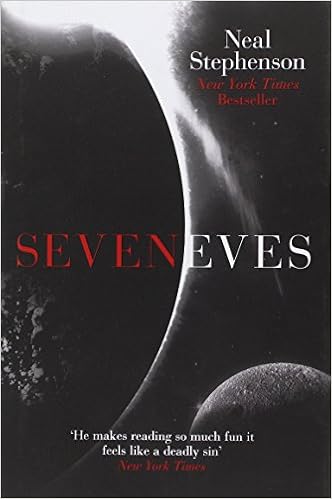
Just started reading Neal Stephenson's Seveneves. The novel starts with a bang: specifically, the Moon blows up. No one quite knows how the Moon blew up: some speculate about a primordial black hole (but we know from Greg Bear's The Forge of God that that wouldn't do it) but in the main, people refer to some unknown 'Agency' as the moving force behind the event.

The main thing is not so much that the Moon has exploded into fragments orbiting their common centre of mass, it's what will happen next. I could hardly believe it, so naturally searched the Internet for the 'Science behind Seveneves'. And came across this.
"There are many different ways in which a reader can imagine the moon blowing up—imagery of the death star annihilating Alderaan comes to mind as the most culturally ubiquitous. But Stephenson quickly establishes the hard-SciFi slant of the novel. There are no fireworks, no loud booms—the opening chapters read like historical fiction for what would actually happen if the moon was fractured into (mostly) gravitationally bound chunks by some unknown force. Chiefly, people would freak out a little bit.

An ensemble cast of characters and their reactions span the opening chapters. A character obviously modeled after Neil deGrasse Tyson, Jerome Xavier Harris (or Doob for short), is rapidly recruited to run popular science damage control—essentially, doing exactly what I would imagine Neil deGrasse Tyson doing if such an event were to happen: media appearances and public lectures explaining that the still-gravitationally-bound moon posed no danger.

In some sense, this is naively true. A common physics brain teaser is to ask what would happen if our sun were replaced by a black hole of equal mass. Barring the joke answer of “everything would probably freeze to death”, nothing much would happen. The black-sun would still be in the same place, with the same mass, thus the orbit of the earth would remain unchanged. As it’s established in the early pages of Seveneves, whatever unknown force which fractured the moon didn't send it on a direct crash-course with the earth—it just imparted enough energy to fracture it into a handful of pieces—pieces which remain in a wildly chaotic orbit around each other, but still somewhat confined to the general vicinity of the moon.

Orbital mechanics problems are notoriously tricky to solve. The so-called three-body-problem was one of the earliest problems tackled once the tools of calculus were developed by Isaac Newton in the late 1600s (a prominent character in Stephenson’s own Baroque Cycle). The problem is almost entirely explained by its title: how will three (or more) celestial bodies evolve in the night sky if you know their starting positions and velocities? Mathematicians eventually proved that there is no general analytic solution to the three-body-problem, barring a handful of special cases. The difficulty arises in the sensitivity of the problem to its initial conditions. If you don’t know exactly where the objects are and exactly how fast they’re going, your estimate can be wildly off.

Because numerical integration is really the only way to actually solve orbital mechanics problems, it’s clearly important that the chosen integration scheme be error free. Tools like Runge-Kutta and Euler integration are good, but they have technical shortfalls—they don’t manifestly conserve quantities that we know should be conserved. This sort of error is more than enough to yield completely nonsense results when trying to predict where things might be going in the night sky.

So, in one of my favorite scenes, when Doob realizes that the wildly chaotic orbits of the moonchunks might not be so harmless, and could even result in an exponentially increasing number of colliding and breaking fragments of moonstuff, I imagine that he sprinted to the nearest python terminal and coded up a symplectic integrator—an algorithm which is particularly good at orbital mechanics simulations. Whatever simulations canon-Doob did run, they soon indicated that the earth had about 2 years before the remaining moonchunks would rapidly break apart, and bombard the earth in moon-asteroids for approximately 10,000 years. This kills the planet. And everything on it.

I thought this would be nice to visualize, so I coded up a symplectic integrator and tried to see if I could reproduce what Doob calls the “White Sky” (the rapid dissolution of the moon) and the “Hard Rain” (the bombardment of the earth with asteroids). I tried to conserve mass and volume of moonchunks when they break apart and use a nearly elastic scattering model. With extremely generous assumptions, and the setting of arbitrary constants to 1 where convenient, I get something like this:


This simulation was very nearly contrived to produce an explosion of chunks in the beginning, and should be taken with a tremendous grain of salt, but hopefully it will allow you to at least suspend disbelief for the doomsday premise of the novel. The actual number of chunks and the rate at which they appear is, unsurprisingly, fairly sensitive to the initial conditions of the simulation. If nothing else, this simulation illustrates Kessler Syndrome fairly clearly—the rapid creation of dangerous debris from uncontrolled, chaotic orbits in space."
So there you have it: Stephenson was right (and/or was well advised).

A few pages in and before the disaster manifests, two feisty females on the International Space Station are discussing family matters. In a beautifully sardonic moment, we discover that one of them refers to the other's mother as 'the Maternal Organism'. Their conversation continues, punctuated with references to the morg.

My WhatsApp message to my sister this evening: "How did you find the morg today?"
"Sleepy."
What a child I can be.

---

Update (Sept 12th 2015): Seveneves is actually a terrible book: thin and excruciatingly torpid plot combined with way too much techno-dumping re: imaginary space-machines. Another misfire from Mr Stephenson. Skimmed and abandoned.

Friday, March 20, 2015

Upcoming science-fiction

1. "Slow Bullets" by Alastair Reynolds (9th June 2015).


Synopsis: "From the author of the Revelation Space series comes an interstellar adventure of war, identity, betrayal, and the preservation of civilization itself.

"A vast conflict, one that has encompassed hundreds of worlds and solar systems, appears to be finally at an end. A conscripted soldier is beginning to consider her life after the war and the family she has left behind. But for Scur—and for humanity—peace is not to be.

"On the brink of the ceasefire, Scur is captured by a renegade war criminal, and left for dead in the ruins of a bunker. She revives aboard a prisoner transport vessel. Something has gone terribly wrong with the ship.

"Passengers—combatants from both sides of the war—are waking up from hibernation far too soon. Their memories, embedded in bullets, are the only links to a world which is no longer recognizable. And Scur will be reacquainted with her old enemy, but with much higher stakes than just her own life."
2. "Poseidon's Wake" (Poseidons Children 3) by Alastair Reynolds (30 Apr 2015).


Synopsis: "Alastair Reynolds is known as an author with big ideas. From human modification, to techno-plagues, mega-crises to mega-structures, his writing has always contained big ideas. To get it out of the way, this book is no exception.

"The narrative explores the journey of several scions of the Akinya family, who figured heavily in the previous two books in the same universe. Reynolds has done something clever here – setting each novel with protagonists from a new generation of the same family allows the reader to track societal changes, see shifts in viewpoints at the macro level as well as the personal, whilst retaining reader investment in the individual.

"In this particular case, we’re given two initial strands to follow; one on Mars, the home of human ambassador’s to the human-created AI civilisation now present there, and another on Crucible – a human colony, home to the mysterious artefact ‘’The Mandala”, as well as the remnants of a tribe of uplifted, intelligent elephants. Not to give the game away, but these two locations may act as the springboard for the rest of the text, but things do quite quickly change.

"The Elephants, incidentally, are another key thread running through the series – their interactions with humanity showing the way in which we interact with other living beings unlike ourselves, even as the AI on Mars act as a mirror of how we might act when faced with a machine which is also, in some (or perhaps all) senses, alive.

"The characters are a key facet of this novel. I’ve criticised Reynolds before for having characters that seemed to act more like generators of interesting conversations than actual people; he’s done quite a lot to redress the balance here. The Akinya’s, their various friends, loves, and losses, have become quite believable over three books, and Reynolds has managed to avoid getting into the depths of technical exposition at the expense of character growth. Instead we get quite a lot of dialogue trying to build relationships around the characters, and more emotional reflection than might have been visible in earlier work. There’s still a few awkward flashes, emotional responses and intensities which didn't quite ring true, but the characters do feel a great deal like people.

"Worth noting that this is technically a standalone in a shared universe; honestly, I wouldn’t try and read it without having read the other two books first to provide some context. It looks like it would be possible, but a great deal of the text, especially the initial setup, draws on events from the other two books, and the universe of the narrative is much richer, and far less confusing, if you come to this as a conclusion to a multi-generational saga, rather than on its own.

"The text is full to bursting with answers to interesting questions, ranging from the philosophical - how do we act in a universe where we’re not alone? How might we interact with artefacts from a civilisation aeons older than our own? To the philosophical – how do we define humanity? If we were told the ultimate truth of the universe, how might we react? Who are we, really, as a species, as individuals? The narrative approaches all of these questions unflinchingly, and does its best to provide an answer to them.

"In that respect, it’s a typical Reynolds book, and if you want to explore these questions, and their answers, within a well realised sci-fi universe, with plausible characters and a decent narrative, then this book is worth picking up."
3. "Seveneves" by Neal Stephenson (21st May 2015)  [880 pages!]


Synopsis: "Stephenson’s remarkable novel is deceptively complex, a disaster story and transhumanism tale that serves as the delivery mechanism for a series of technical and sociological visions. When the moon explodes, it doesn’t take long for scientists (including Doc “Doob” Dubois, who bears no small resemblance to Neil DeGrasse Tyson) to realize that the debris will soon cause the destruction of Earth.

"The residents of the International Space Station, including roboticist Dinah MacQuarie and commander Ivy Xiao, immediately begin working with their colleagues on Earth to turn the ISS into a viable habitat for as many people as possible. The next two years are filled with heroic sacrifices, political upheavals, and disasters, most of which are only exacerbated when Earth finally succumbs to the “Hard Rain,” meteorite bombardment that last for millennia.

"The survivors—seven fertile women—are destined to repopulate the human race, and it’s only here, over halfway through the story, that Stephenson (the Baroque Cycle) really shows his hand, moving ahead 5,000 years to explore the moral and political implications of the earlier events. There’s a ton to digest, but Stephenson’s lucid prose makes it worth the while."
All three pre-ordered: two Kindle editions + "Slow Bullets" only available as paperback.


And now we turn to the 'to be read' stack. I loved "Fairyland" by Paul McAuley; some of his other stuff not so much. I'll be giving his latest a try.

4. "Something Coming Through" by Paul McAuley (19 Feb 2015)


Synopsis: "The aliens are here. And they want to help. The extraordinary new project from one of the country's most acclaimed and consistently brilliant SF novelists of the last 30 years.

"The Jackaroo have given humanity 15 worlds and the means to reach them. They're a chance to start over, but they're also littered with ruins and artifacts left by the Jackaroo's previous clients.

"Miracles that could reverse the damage caused by war, climate change, and rising sea levels. Nightmares that could for ever alter humanity - or even destroy it.

"Chloe Millar works in London, mapping changes caused by imported scraps of alien technology. When she stumbles across a pair of orphaned kids possessed by an ancient ghost, she must decide whether to help them or to hand them over to the authorities. Authorities who believe that their visions point towards a new kind of danger.

"And on one of the Jackaroo's gift-worlds, the murder of a man who has just arrived from Earth leads policeman Vic Gayle to a war between rival gangs over possession of a remote excavation site.

"Something is coming through. Something linked to the visions of Chloe's orphans, and Vic Gayle's murder investigation. Something that will challenge the limits of the Jackaroo's benevolence..."

5. The Revelation Space sequence by Alastair Reynolds

I read these over the years, but apart from the first volume (which is still pretty familiar) I've largely forgotten the sequels. Luckily they're pretty cheap on Kindle so books 2-5 are now stacked awaiting a revisit. Here are the titles in order.

  1. Revelation Space. London: Gollancz, 2000.
  2. Chasm City. London: Gollancz, 2001. 
  3. Redemption Ark. London: Gollancz, 2002..
  4. Absolution Gap. London: Gollancz, 2003.
  5. The Prefect. London: Gollancz, 2007.

Back to Conjoiners and their drive, Lighthuggers, Exordium, Hypometric weapons and the Inhibitors!