Showing posts with label Human Biodiversity. Show all posts

Wednesday, August 23, 2017

A theorisation of Corbynism (Hardt and Negri)

An orthodox Marxist would be extremely interested in Momentum, the radicalisation of predominantly young, middle-class professional types organised around Jeremy Corbyn's Labour Party. It would seem highly reminiscent of the 'New Left' student movements of the sixties and seventies (full disclosure: I was there).

Said Marxist would, however, be far less impressed by the level of consciousness of the movement's thinking: its faddish diversities, its self-indulgent identity politics, its horizons delimited by left-wing social-democracy.

Traditionally we would call such proto-ideologies petit-bourgeois and see their proponents as candidates for a deeper education. But ancien-Marxism seems falsified by history - no lessons there to learn. The result - inevitably - is the theorisation of left-populism by itself as the new anti-capitalism.

Parenthetically, this rather ignores just how popular Corbynism and its American and Continental cousins are with the left bourgeoisie!

---

The poster-children for this way of thinking - after Paul Mason's efforts - are the theorists Michael Hardt and Antonio Negri, boosted by left-academics such as Phil Burton-Cartledge.

Phil has written a series of posts explaining the new ideas - I'll just quote a summary.
"What is clear for Hardt and Negri is the revolutionary party is out. As the properties of fixed capital are distributed among our growing legions of cognitive and socialised workers, the 'functions' of the revolutionary party are diffused among the politicising networks.

"Rather than the received conception of a vanguard of class conscious cadres providing leadership for the rest to follow, cadre building applies to the class as a whole. The power of the multitude lies in its being the living substance of the common, and increasingly their common lines of flight are putting them on a collision course with capital.

"Biopolitical production wrapped up in dense webs of communication brings people together, educates them, politicises them. For example, the incessant identity-related debates are no longer the concern of radical elites beavering away in academies but are now the property of millions of people, as the fall out from Charlottesville demonstrates.

"The aim then is to build up the capacity for self-organisation, forge new institutions that bring out the common interests of socialised workers without denying their difference. The image is of a self-activating, self-coordinating swarm that can simply overwhelm capital and the state in a process of creative destruction, of replacing one form of organising society with another."
None of this is well-defined. None of this has the ring of truth. Seems more like opportunistic pandering to a set of inchoate longings which have nothing to do with undermining capitalism and everything to do with its further development. Notice how the critiques of capitalism - how very bad it is - have a ritualistic and anaemic quality.

Those middle-to-upper-class Momentum supporters, those SJWs in the States, those French supporters of Jean-Luc Mélenchon in La France Insoumise, are having the time of their lives under capitalism.

---

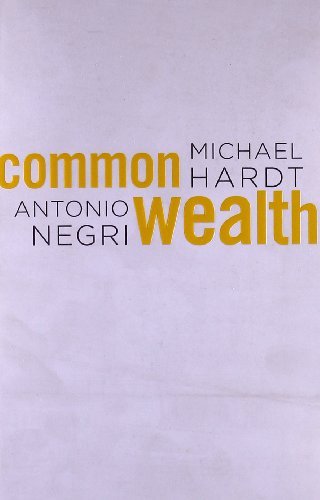
I feel, nonetheless, slightly motivated to read the final book of Hardt and Negri's trilogy, Commonwealth, if only to understand their thinking more fully.

I have to say though, that I do rather prefer my own vision as to the future destiny and supersession of capitalism - it's a lot more grounded in reality.
Amazon link

"Together Hardt and Negri's work is considered to be responsible for a resurgence of interest in non-orthodox Marxism and its political manifestations.

"Commonwealth is the final part of a trilogy that began with "Empire" in 2000, a book that was published during the emergence of the alter-globalization movement. "Multitude" followed in 2004, developing the ideas that had been introduced in "Empire," in particular the concept of the multitude as a new revolutionary subject. "Commonwealth" is a worthy addition to the trilogy, expanding and clarifying on the understandings in the previous books, but perhaps more significantly grounding their analysis within an extended discussion of "the common...".

"Commonwealth" is a book that challenges presuppositions about the utility of Marx, and introduces the possibility of combining his insights with the ideas of other significant authors such as Nietzsche, Foucault, Deleuze and Guattari, who are not traditionally associated with the radical communist project."
From the Amazon page.

---

Following on from John Gray's insightfully scathing review of Commonwealth, I should perhaps turn to Slavoj Žižek, a writer who prefers to épater les bourgeois rather than flatter them.

In Gray's words,
"A Slovenian philosopher, psychoanalytical theorist and film critic, Žižek has become a gadfly of the left establishment, a prolific provocateur whose principal aim seems to be to confound his tender-minded readers. His target throughout this book is not the right but the soft, democratic, meliorist left, which imagines that the egalitarian goals of communism can be realised by non-repressive, liberal means.

"Žižek is savagely scornful of this view, writing sharply that "One of the mantras of the postmodern left has been that we should finally leave behind the 'Jacobin-Leninist paradigm' of centralised dictatorial power. But perhaps the time has now come to turn this mantra around... Now, more than ever, one should insist on the 'eternal Idea of Communism' - strict egalitarian justice, disciplinary terror, political voluntarism, and trust in the people."

"In other words, dictatorship is indispensable to the communist project. Mass coercion and terror are not departures from a humane vision, brought about by tyrannical leaders acting in backward conditions. Lenin and Stalin were genuine masters of revolutionary strategy, who knew that without organised terror their goals would never be achieved."
Amazon link

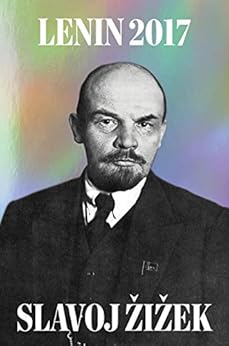
Gray is reviewing Zizek's First as Tragedy, Then as Farce,  but perhaps it's worth waiting a couple of weeks for the prolific Comrade Žižek's latest opus: Lenin 2017: Remembering, Repeating, and Working Through?

But perhaps it's time to lose patience with showmen who really haven't a clue as to what is to be done?

---

Next: What the Owl said to Lenin and Trotsky.

Monday, August 22, 2016

How will AIs become politically correct?


In my recent post, "Gloria Hunniford and the case for AI biometrics", I advocated the use of AI facial recognition systems in bank branches to check for scammers. They would be more effective than cashiers because 'AI systems don't have to be polite.'

But of course they do. Hardly a day goes by without some story appearing about an AI system which 'noticed' certain unfortunate connections and had to be tweaked.

Some of these stories reflect genuine issues of training sets and algorithm-configuration; others expose the system's aspie-like tendency to blurt out uncomfortable truths. And there are plenty of them - truths which fall outside the famous Overton window.

I think it will be a very smart AI which can keep two sets of books: the accurate model of the world it generates from its deep learning and the acceptable model which it has to use and pay homage to in public.

Since the acceptable model is ideological rather than based on evidence, it's a non-trivial process to concoct the politically-correct version from the data trawled exhaustively from reality. How would an AI handle this?

Till we get AI self-deception really locked down, I see a long spell of high-pay-grade tweaking from specialists at Google, Facebook and the like, carefully guided by their in-house commissars.

Saturday, October 04, 2014

'Political Order and Political Decay' by Francis Fukuyama

The second volume of Francis Fukuyama's magnum opus, 'Political Order and Political Decay', is 548 pages and I therefore subcontract its review to the Wall Street Journal (I reviewed the first volume here).
" ... to the extent that he has an overarching narrative, it is this: Human beings are possessed of certain biologically rooted imperatives to favor kith and kin over others—what he calls patrimonialism. Successful political order entails the establishment of institutions that check and redirect these impulses in productive and publicly beneficial ways.

"Since the Industrial Revolution and the spread of market capitalism (i.e., globalization), the institutions that most successfully accomplish this feat have been the modern state coupled with the rule of law and some degree of democratic accountability. What we call corruption is really the imperfect realization (or absence) of such institutions.

"Political decay, to which the final section of this work is devoted, is the condition where public institutions, grown sclerotic over time, prove increasingly unable to manage the natural reassertion of patrimonial impulses."
In a close-to-home example of political decay, Dr Fukuyama sees the 'checks and balances' system in the US as having been latterly captured by special interest groups and lobbyists, constituting a 'vetocracy'. He is not an optimist as regards future governance prospects there. Interestingly, he's more a fan of the UK's 'elective dictatorship' which, he believes, gets things done and is much more resistant to special interest group capture.

'Political Order and Political Decay' is crammed full of insights and allows the re-framing of many contemporary hot-spots such as Ukraine and the Middle-East. The question of transition to advanced development status as in 'getting to Denmark' is a central preoccupation of the book. But talking in the abstract about institutions and social capital doesn't quite hack it given the biologically rooted diversity of both humans and human groups across the planet as regards pro-social and cognitive competences. Fukuyama appears somewhat aware of the literature on the subject but this is one hot potato he's (perhaps understandably) not prepared to engage with, to the detriment of his conclusions. Perhaps not everywhere, sadly, has an unaided route to 'Denmark'.

Friday, August 15, 2014

The high priests are out again

From The Times today.
"A British writer is facing global protests from scientists for suggesting that there are biological differences between races that could explain the success of European nations and make African societies prone to poverty and violence.

"Nicholas Wade had expressed the hope that his book, A Troublesome Inheritance, would “draw some of the tension from this fraught subject by showing that the understanding of genetic differences between human groups does not lead to racism”.

"The book, which speculates on whether differences between societies and nations are based on genetic variations, has caused uproar in academia and allegations that its author is doing the very thing he said he was seeking to avoid and encouraging racism.

"In a letter to The New York Times books section, 143 geneticists from universities in Europe and the US protest that his book “juxtaposes an incomplete and inaccurate account of our research on human genetic differences with speculation that recent natural selection has led to worldwide differences in IQ test results, political institutions and economic development.”

"The scientists rejected “Wade’s implication that our findings substantiate his guesswork”, adding that “there is no support from the field of population genetics for Wade’s conjectures.”

"Besides a chapter speculating on an evolutionary basis for “Jewish intelligence” and passages suggesting that genetic traits had led Africans to fail to “develop the ingrained behaviours of trust, non-violence and thrift that a productive economy requires,” Wade examines whether a genetic variation could predispose young African-Americans towards aggressive behaviour.

"He notes that 5 per cent of African-Americans in a study had the mutation as against 0.1 per cent of Caucasians. African-Americans with the genetic variation were “significantly more likely to have been arrested and imprisoned.”

"He says “a large number of genes are evidently involved in controlling aggression” and that even if African-Americans were more likely to possess one particular mutation, Caucasians may carry other mutations."
I reviewed Nicholas Wade's book here.

In other news, leading scientists confirm that the sun does indeed circle the earth, and that the world was created in 4004 BC.