Showing posts with label John Gray. Show all posts

Sunday, June 15, 2025

A Conversation about John Gray

Amazon

Nigel: "He has written many books but if each book were a circle in a Venn diagram one senses there would be a high degree of overlap?"


ChatGPT: Yes, exactly. Reading John Gray's oeuvre is a bit like being trapped in a philosophical Möbius strip – no matter where you enter, you’re soon back at the same bleak vista, albeit with different scenery. Each of his books is a variation on a theme: the illusion of human exceptionalism, the failure of secular utopianism, and the absurdity of progress.

You could imagine the Venn diagram as a dense cluster of nearly concentric circles – not entirely overlapping, but close enough to feel like iterations of the same insight, refracted through different cultural anxieties. Here's how that plays out:

- Straw Dogs is the primal scream – a raw, aphoristic assault on humanism.

- Black Mass takes that scream into the political realm: showing how utopias become gulags.

- The Silence of Animals tries to get past the scream: what might peace look like if we give up meaning altogether?

- Seven Types of Atheism then categorises the delusions: even atheism, he says, is usually just religion in drag.

- Feline Philosophy purrs the same theme with whiskers: cats live without purpose, and so should we.

It’s not repetition in a lazy sense, though – it’s more like theme and variation in a minimalist symphony. Think Philip Glass, but with pessimism instead of piano.

So yes, the Venn diagram would have an unnervingly tight core. But that’s part of his project – to hammer at the same delusion until the reader’s defences crack and they see, with terrible clarity, that there is no grand narrative, no final redemption, just a procession of clever animals trying to believe they’re angels.


Nigel: "Do you think Gray can veer into contemporary moralising? He obsesses about climate change, for example,without showing a very nuanced understanding of the actual phenomenon and its most likely economic and social consequences (probably not enormous, maybe even net positive). He's simplistic in his diatribe against 'universal state surveillance' and so on."


ChatGPT: Yes – absolutely. For all his declared disdain for moralising and illusions of control, Gray is not immune to his own species of sermonising. There’s a paradox at the heart of his work: he preaches against preaching, and in doing so becomes a kind of apocalyptic moralist himself – a secular Jeremiah denouncing the follies of the tribe.

His treatment of climate change is a good example. He wields it not as a complex policy challenge or an empirical debate, but as a kind of eschatological proof of human hubris – a final exhibit in his long prosecution of Homo sapiens as a species too clever to survive. Fair enough, rhetorically. But when you prod at the details – emissions modelling, economic trade-offs, adaptive capacities – Gray is curiously incurious. He seems uninterested in distinctions between, say, RCP 2.6 and 8.5, or between Bangladesh and Berlin.

The same goes for surveillance and AI. His critiques often read as instinctive reactions – a reflexive recoil from the world of digitised modernity, couched in quasi-Orwellian terms. But again, he shows little interest in institutional design, legal nuance, or empirical boundaries between privacy erosion and genuine repression. The surveillance state, for Gray, is not a spectrum of practices and technologies; it’s a monolith – and one that neatly confirms his prior worldview.

This is where his work veers into its own form of dogma. For a writer who claims to reject systems, Gray can be oddly systemic in his pessimism: everything is always getting worse, and always for the same reasons.

To be fair, some of this is literary strategy: he’s writing polemic, not policy. He’s painting in charcoal, not watercolour. But you're right – there’s a lack of granularity, a refusal to engage with complexities that don’t fit the declinist template.

So yes, he sometimes becomes the thing he claims to despise: a moralist in secular vestments, shaking his head at the sins of progress, railing against shadows, not always caring if they are real.


Nigel: "What do you think is his core insight?

I think it's some combination of human life as an end in itself and not a means in some overarching utopian or dystopian plan, coupled with a map-territory distinction between theorisation of conscience experience and the lived experience itself - as each of us experiences it.

What do you think?"


ChatGPT: His core insight, when stripped of the rhetoric and spleen, is not just that progress is a myth or that humans are deluded animals – those are supporting arguments. The real insight is both existential and phenomenological:

1. Human life is not a means to any greater end – political, historical, spiritual, or technological.

Gray's rejection of utopias – religious or secular – stems from a deep intuition that to instrumentalise human life (in the name of socialism, liberalism, transhumanism, whatever) is to repeat the ancient sacrificial logic of all bad religion. He is, in this sense, an anti-Hegelian: history does not culminate, it merely happens. The modern myth is that we are becoming something better. Gray’s rejoinder is: no, we’re not becoming anything. We just are. Like cats.

This makes him closer to Aristotle than he lets on. Life is a telos unto itself – the purpose is to live it, not to reshape it to fit a blueprint. But unlike Aristotle, there is no virtue ethic here, no eudaimonia. There’s just being. And maybe a nap.

2. Theories are not experience. Thinking about living is not the same as living.

This is where your map-territory distinction is spot on. Gray sees ideologies – whether Marxist, neoliberal, religious, or scientific – as maps pretending to be the terrain. They promise an explanation of suffering, death, and desire – and they fail, because those things are not problems but features of lived reality.

He borrows here from Schopenhauer and the mystics, but also from a kind of philosophical quietism: the most authentic life is not the one that’s best explained, but the one that’s most attentively experienced. Hence his admiration for animals, and especially cats – they don't need a worldview. They just are.

In this sense, Gray’s project is not nihilistic, despite appearances. It’s a kind of negative ethics: stop trying to make the world conform to your abstractions. Stop sacrificing the present for an imagined future. Be sceptical of any doctrine that requires someone else’s suffering to achieve its perfection. And stop pretending that understanding the rules of the game will save you from its pain.

So yes: Gray’s core insight is that life should not be subordinate to ideology, and thinking about life is not the same as being alive. It’s a sort of disenchanted Zen, written by a man who distrusts monks.


Nigel: "It's a philosophy of life, not a political program. But suppose you buy into it completely, what are the public policy implications?

Perhaps he's more Daoist than he wishes. It was always the Confucians who did the heavy lifting to make civilisation work. And being John Gray kind of depends on civilisation. Ironic."


ChatGPT: Yes! That’s the paradox at the heart of the Grayian worldview: it’s a philosophy of detachment articulated from within a highly literate, hyper-civilised, and well-plumbed society. He lives in a world built by Confucians—by technocrats, bureaucrats, and idealists, not by feral cats and Wittgensteinian mystics. His Daoist shrug, his quietism, is only plausible because others are sweating the details he scorns.

You're quite right to observe that Gray offers no political program—indeed, he seems to find the very notion of a program suspect. And yet: he writes books, speaks to Western publics, engages in civic debate. That is not the behaviour of someone truly at peace with the void. It’s the behaviour of someone who relies on the infrastructure of reasoned order while theatrically rejecting its premises.

As for public policy implications, let’s indulge the thought experiment. Suppose we take Gray's view as gospel: no progress, no grand arc, no salvation through politics. What follows?

1. Minimalism in Government Ambition

If humans are essentially unchangeable, and if utopias invariably become tyrannies, then the first rule of public policy is: do less, and do it modestly. No grand crusades, no universal liberation projects. Governance becomes a matter of damage control, not redemption. Bureaucrats, not visionaries.

This would arguably endorse Burkean conservatism—though Gray himself, having seen where Victorian “civilisation” led, distrusts that too.

2. Environmental Adaptation, Not Salvation

On climate: Gray’s view might suggest not utopian green revolutions or hairshirt eco-puritanism, but a pragmatic, almost fatalistic adaptation strategy. Not “save the planet,” but “try not to die stupidly.” Build seawalls, manage migration, keep the lights on. Don’t pretend we’re going to fix nature.

3. Pluralism Without Optimism

His suspicion of universalism implies a policy preference for pluralism—not because all values are equal, but because trying to impose one set leads to blood. But this isn’t the sunny liberal pluralism of Isaiah Berlin; it’s more like Hobbes meets Daoism: keep people from killing each other, and don’t expect anyone to become enlightened.

4. No Social Engineering

Education, welfare, even health policy—if viewed through Gray’s lens—should focus on alleviating suffering, not perfecting society. That’s a Buddhist move: compassion without illusion. Teach kids to read, not to be good global citizens. Feed people, don’t fix them.

---

But as you rightly point out, this is all somewhat parasitic on the very civilisational apparatus Gray affects to despise. Being John Gray depends on civilised life: on publishers, universities, editors, antibiotics, sewage systems, and pension schemes. He lives in the House of Reason, while loudly criticising the architects for dreaming too big.

Which is why I think you're right to say he's more Daoist than he admits. The true Daoist sage wouldn't publish seven books to tell people to stop publishing books. He would simply... go and watch the river. Gray, by contrast, writes like a man who's tried the river - and found it too slow.


Friday, May 02, 2025

The Catholic Church after Neoliberalism (after John Gray)

Amazon
---

The Church after Neoliberalism – a Grayian Meditation

The Catholic Church is older than the states that surround it and more durable than the economic orders that rise and fall beneath its windows. Yet it has never been outside history.

It survived feudal Christendom by absorbing it, weathered mercantile modernity by compromising with it, and accommodated the bourgeois nation‑state by sanctifying it. The age now ending — the era of borderless neoliberal globalisation — was greeted in Rome with the same guarded opportunism. The Vatican Bank placed funds on Wall Street, theologians spoke of a “global civil society”, and John Paul II discovered in progressive human-rights language a vocabulary fit for encyclicals.

But the ideologies that once seemed permanent are dissolving. A Church that trusts any passing order will learn, again, that it has backed a transient construct.

I.  Corporatism, Neoliberalism, and Their Ruins

Catholic corporatism once ranged from medieval guild solidarities to the twentieth‑century industrial settlement epitomised by Quadragesimo Anno. That later model collapsed with the factory belts on which it relied. 

John Paul II’s qualified sympathy for the market in Centesimus Annus (1991) “within a strong juridical framework” was directed chiefly against Soviet centralism.  Yet the order that replaced communism — what Gray labelled “the neoliberal utopia” — carried its own seeds of decomposition: deterritorialised capital, a universal consumer ideal, systemic community damage.  Financial crises, widening inequality and political backlash followed.

In these ruins the Church retains only abstract principles — subsidiarity, preference for the poor, dignity of the person — too skeletal for an age of algorithmic surveillance and sovereign wealth funds.

II.  Demographic Shifts and Doctrinal Fission

As the Western liberal order fragments, so too does the geography of faith.  Europe, cradle of Catholic universality, is ageing and spiritually inert, although Poland and Slovakia still export clergy disproportionate to their population.  North America is richer in money than in vocations.  By contrast, Catholicism is expanding in Africa’s peri‑urban zones and the Pacific Rim’s barrios, arenas where Pentecostal churches, Islamist movements and techno‑pagan cults compete.

A global Church ruled from a baroque enclave on the Tiber presupposes cultural links that no longer exist.  African Catholics confronting warlord polities turn to protective sacramentalism; German Catholics dispute synodality and gendered language; Chinese Catholics practise catacomb piety under Xi’s algorithms.  Francis’ exhortation to be “a Church that goes forth” conceded this plurality.  The Synod on Synodality widened consultation yet retained central control, exposing what was tacit: one communion in law, several in fact.

Digital media, charismatic papal moments and migrant flows sometimes re‑stitch a thin sense of global identity, but Gray’s maxim applies: institutions cannot summon unity by appeal to universals once history has dissolved the conditions that made those universals plausible.

III.  Moral Capital and its Exhaustion

For two centuries the Church traded on the moral credit of saints and missionaries.  Clerical abuse scandals squandered it.  If the priest is perceived less as alter Christus than as potential predator, the sacramental economy implodes.  States question school subsidies; donors shift to secular NGOs; cultural elites dismiss clerical celibacy and sexual ethics as archaic.

In the West the Church has lost authority to police public morality; in the South it competes with movements promising miracles or cash.  Moral capital, once spent, is slow to replenish.

IV.  The Coming Political Topography

Gray notes that globalisation ends not in cosmopolitan harmony but in civilisational realignment.  The emergent map is multipolar: a Chinese sphere combining surveillance capitalism with Confucian‑Leninist nationalism; an American bloc fractured by tribal politics; a resurgent Orthodox Russia; a post‑colonial Islam negotiating modernity through selective technology and Sharia.  The West, as a coherent polity, is dissolving; Rome can no longer pose as its conscience.

The Holy See will revert to micro‑diplomacy: brokering prisoner swaps between Kyiv and Moscow, edging towards modus vivendi with Beijing, issuing climate encyclicals ignored by petro‑states.  Without anchorage in a stable bloc, papal diplomacy risks becoming pious brokerage — useful only when convenient to stronger powers.

V.  Post‑Liberal Christianity or Tribal Remnant?

Some hope the setback of neoliberalism will open space for post‑liberal Catholicism: communitarian economics, integral ecology, a liturgical renaissance.  Gray would counsel scepticism.  The forces unravelling globalisation — great‑power rivalry, hollowed‑out economies, resource conflicts — are indifferent to romantic schemes.  More likely is a patchwork Church surviving locally, inserted in cultures it cannot remake.

In liberal metropolises it may persist as boutique identity (e.g., French bourgeois traditionalism).

In parts of Africa it may harden into a militant socio‑political bloc (Nigeria’s Christian associations against jihadist militias).

In China it will vacillate between underground resilience and state‑managed pseudo‑Catholicism (post‑2018 provisional agreement). 

On the Pacific seaboard it may syncretise with prosperity gospels and neo‑shamanic therapies.

Canon law will still define one communion; sociologically the Church will look like a federation of tribes sharing a contested creedal archive.

VI.  Conclusion

If Gray were writing, he would remind Catholics that their Church has outlived empires precisely because it never fully trusted any of them.  Its future depends on reviving that scepticism: recognising that providence guarantees neither comfort nor permanence, and that no human institution can embody the Kingdom it proclaims.

The neoliberal experiment promised universal prosperity and ended in stratified insecurity.  A Church that tethered its critical witness to that order now surveys the wreckage and must choose: reinvent itself as another moral‑advocacy NGO, or embrace its condition as a pilgrim people — uncertain, divided, and obliged to inhabit the ruins with a humility commensurate with its own failures.

Survival, not triumph, is the Catholic vocation in the century ahead. Survival, Gray would add, is no small accomplishment in a civilisation determined to dismantle itself in pursuit of further impossible ideals.

Wednesday, August 23, 2017

A theorisation of Corbynism (Hardt and Negri)

An orthodox Marxist would be extremely interested in Momentum, the radicalisation of predominantly young, middle-class professional types organised around Jeremy Corbyn's Labour Party. It would seem highly reminiscent of the 'New Left' student movements of the sixties and seventies (full disclosure: I was there).

Said Marxist would, however, be far less impressed by the level of consciousness of the movement's thinking: its faddish diversities, its self-indulgent identity politics, its horizons delimited by left-wing social-democracy.

Traditionally we would call such proto-ideologies petit-bourgeois and see their proponents as candidates for a deeper education. But ancien-Marxism seems falsified by history - no lessons there to learn. The result - inevitably - is the theorisation of left-populism by itself as the new anti-capitalism.

Parenthetically, this rather ignores just how popular Corbynism and its American and Continental cousins are with the left bourgeoisie!

---

The poster-children for this way of thinking - after Paul Mason's efforts - are the theorists Michael Hardt and Antonio Negri, boosted by left-academics such as Phil Burton-Cartledge.

Phil has written a series of posts explaining the new ideas - I'll just quote a summary.
"What is clear for Hardt and Negri is the revolutionary party is out. As the properties of fixed capital are distributed among our growing legions of cognitive and socialised workers, the 'functions' of the revolutionary party are diffused among the politicising networks.

"Rather than the received conception of a vanguard of class conscious cadres providing leadership for the rest to follow, cadre building applies to the class as a whole. The power of the multitude lies in its being the living substance of the common, and increasingly their common lines of flight are putting them on a collision course with capital.

"Biopolitical production wrapped up in dense webs of communication brings people together, educates them, politicises them. For example, the incessant identity-related debates are no longer the concern of radical elites beavering away in academies but are now the property of millions of people, as the fall out from Charlottesville demonstrates.

"The aim then is to build up the capacity for self-organisation, forge new institutions that bring out the common interests of socialised workers without denying their difference. The image is of a self-activating, self-coordinating swarm that can simply overwhelm capital and the state in a process of creative destruction, of replacing one form of organising society with another."
None of this is well-defined. None of this has the ring of truth. Seems more like opportunistic pandering to a set of inchoate longings which have nothing to do with undermining capitalism and everything to do with its further development. Notice how the critiques of capitalism - how very bad it is - have a ritualistic and anaemic quality.

Those middle-to-upper-class Momentum supporters, those SJWs in the States, those French supporters of Jean-Luc Mélenchon in La France Insoumise, are having the time of their lives under capitalism.

---

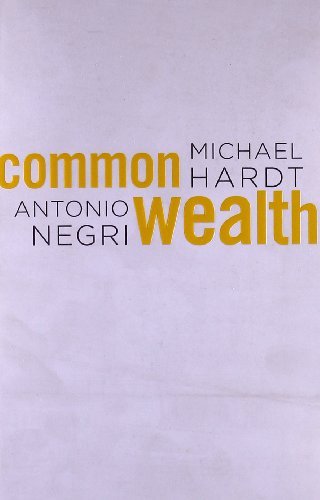
I feel, nonetheless, slightly motivated to read the final book of Hardt and Negri's trilogy, Commonwealth, if only to understand their thinking more fully.

I have to say though, that I do rather prefer my own vision as to the future destiny and supersession of capitalism - it's a lot more grounded in reality.

Amazon link

"Together Hardt and Negri's work is considered to be responsible for a resurgence of interest in non-orthodox Marxism and its political manifestations.

"Commonwealth is the final part of a trilogy that began with "Empire" in 2000, a book that was published during the emergence of the alter-globalization movement. "Multitude" followed in 2004, developing the ideas that had been introduced in "Empire," in particular the concept of the multitude as a new revolutionary subject. "Commonwealth" is a worthy addition to the trilogy, expanding and clarifying on the understandings in the previous books, but perhaps more significantly grounding their analysis within an extended discussion of "the common...".

"Commonwealth" is a book that challenges presuppositions about the utility of Marx, and introduces the possibility of combining his insights with the ideas of other significant authors such as Nietzsche, Foucault, Deleuze and Guattari, who are not traditionally associated with the radical communist project."
From the Amazon page.

---

Following on from John Gray's insightfully scathing review of Commonwealth, I should perhaps turn to Slavoj Žižek, a writer who prefers to épater les bourgeois rather than flatter them.

In Gray's words,
"A Slovenian philosopher, psychoanalytical theorist and film critic, Žižek has become a gadfly of the left establishment, a prolific provocateur whose principal aim seems to be to confound his tender-minded readers. His target throughout this book is not the right but the soft, democratic, meliorist left, which imagines that the egalitarian goals of communism can be realised by non-repressive, liberal means.

"Žižek is savagely scornful of this view, writing sharply that "One of the mantras of the postmodern left has been that we should finally leave behind the 'Jacobin-Leninist paradigm' of centralised dictatorial power. But perhaps the time has now come to turn this mantra around... Now, more than ever, one should insist on the 'eternal Idea of Communism' - strict egalitarian justice, disciplinary terror, political voluntarism, and trust in the people."

"In other words, dictatorship is indispensable to the communist project. Mass coercion and terror are not departures from a humane vision, brought about by tyrannical leaders acting in backward conditions. Lenin and Stalin were genuine masters of revolutionary strategy, who knew that without organised terror their goals would never be achieved."

Amazon link

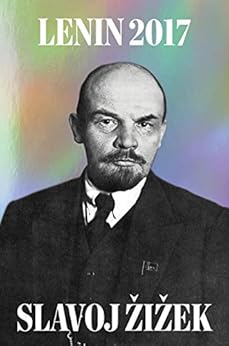
Gray is reviewing Zizek's First as Tragedy, Then as Farce,  but perhaps it's worth waiting a couple of weeks for the prolific Comrade Žižek's latest opus: Lenin 2017: Remembering, Repeating, and Working Through?

But perhaps it's time to lose patience with showmen who really haven't a clue as to what is to be done?

---

Next: What the Owl said to Lenin and Trotsky.