Showing posts with label sex doll. Show all posts

Monday, November 12, 2018

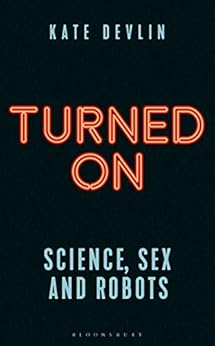
A feminist on sex machines: Kate Devlin

Amazon link

Dr Kate Devlin's Wikipedia entry.

---

The concept of a 'machine for sex’ is a wondrous, powerful one. As the author notes, its arc aligns with all of human history. Devlin describes ‘sex toys’ from prehistory and antiquity right through to the present day.

The term ‘sex robot’ itself is rather reified. Better is the idea of an artefact with which humans may engage sexually. Such an artefact might be genetically engineered, machine fabricated or some hybrid in between. Sex devices interestingly inhabit the intersection of science and technology, genetics and evolutionary biology, and the myriad social sciences.

If a sex robot is defined as a thing, as human property, then they existed once, currently don't really exist and may exist again in the middling future. In antiquity slaves were property and presumed to have no agency. It was routine and uncontroversial for elite slave-owning males to buy and use nubile male and female slaves for sex. As Kyle Harper recounts in his “Slavery in the Late Roman World, AD 275–425”, consequences included masters becoming (stupidly) besotted with their slave sex-objects, wifely jealousy .. and unintended offspring who would join the next generation of slaves.

Antique ‘sex robots’ were, from a functional point of view, poorly implemented. Their inner drives and motivations were not aligned with their 'function’ which made ownership fraught and only manageable through sustained terror.

Devlin’s first degree was in archaeology so she will know all this. It would have been good to read about the social, ethical and even practical implications of the widespread availability of high-functioning ‘sex robots’ in antiquity. Devlin's discussion is however (pp.116-117) superficial, flagging only the usual oppressively gendered roles found in all premodern societies stabilised by male violence. She also notes a pre-Christian sexual disinhibition of which she approves.

“Turned On” is not a book of science with some feminist advocacy. It is instead a feminist tract anchored around the topic of sex-with-artefacts (p.213). What’s this for example - a mocking rebuke to the transgression of equal outcomes?
“Why do we experience things? How do the mechanisms of our bodies and brains give rise to conscious sensations? Where does that consciousness come from? You don’t have to have an answer in the Great Zombie Debate. The philosophers can’t agree on it either, Which is why you have a bunch of very clever middle-aged white men amusingly inventing words like‘ ‘zoombie’ and ‘zimboe’ to put forward their own variations on the theory. “ (p. 102)
My emphasis. It's certainly of the moment, but it jars.

Devlin tells us she is a feminist, an ideology developed to further the interests of liberal professional women like Dr Devlin. Like all ideologies, it’s protean and eclectic, cherry picking arguments which support the cause. A characteristic of ideologies is that they narrate a world their proponents wish they were in but which rarely coincides with actuality or realistic possible outcomes.

Consider objectification, something she takes strong issue with. The discussion is phenomenological: an example might be a builder wolf-whistling an attractive woman in the street; or a bunch of women hooting and laughing at a male stripper at a ‘hen party’.

In the broad-brush triune brain model, primary drives such as lust are associated with the (animalistic) brainstem formation; emotional attachment with the mammalian limbic system; and rational interaction with hominid cortical systems. It’s not much of a surprise that humans can exhibit sexual behaviour dominated by any of these loci.

Objectification (the mode of lust-dominance) would then be a brain-stem determined form of behaviour. In more refined circles we expect cortical inhibition/mediation of primary drives to deliver more measured, prosocial behaviour factoring in social context. Our biology is complicated in social settings.

There isn’t any such framing in Devlin's book. Just normative presumption that objectification is out there (for some reason), that’s it’s wrong and that current sex doll designs play up to it. This is to sell the reader short, replacing analysis with moralising.

Naturally we don't wish to succumb to the naturalistic fallacy; humans with their small group evolutionary history are imperfectly adapted to large scale societies. There are plenty of natural urges we need to regulate and indeed legislate against. There are few easy answers here as Devlin would be the first to argue, in contexts such as the legality and ethics of child sex dolls.

Devlin adopts the fashionable feminist view that phenomenal gender differences are purely social constructs. This despite the enormous weight of hard evidence (evolutionary, neuroanatomic, genomic, physical, psychometric) for well-defined and reproducible biological differences between the sexes. Differences which are hardly obscure, but recognition of which might undermine the claims of her interest group. Public choice theory assumes its usual relevance here.

Devlin interviews the CEO of RealDoll, Matt McMullen, and gives him a hard time about the overwhelming preponderance of hyper-sexualised female dolls and robots. 'Where are the less-sexualised dolls, the male dolls?' she wants to know. Actually this is a point she takes up with all the doll manufacturers she meets. The replies she gets are defensive, framed in terms of male-female differences in sexuality leading to skews in demand. Devlin is having none of it, blaming biased marketing and uncritical social conditioning (pp. 153-154). Time for a quick review of microeconomics (supply-demand equilibria?) then as I reflect on the democracy of markets in probing the world as it actually is.

Then we read this in a meandering discussion of rape fantasies and the claimed lack of any genetic influence:
“If anything, rape would theoretically reduce the reproductive success of our ancestors as it takes away selective genetic choice. “ (p. 233).
Reality is more nuanced. Rape is historically (and currently) commonplace in intergroup conflicts. It's plainly adaptive for males in the absence of draconian ingroup penalties. I suggest a quick read of Dawkins' "The Selfish Gene".

Gendered social roles have historically been oppressive to women. There are biological reasons (eg male physical strength, aggression and paternity-uncertainty) which interlink with social reasons (eg within-family inheritance) which are specific to different kinds of society and which need to be explicitly teased out. If capitalism appears to be intrinsically gender-blind in its desire to free everyone up to maximally work, then the deleterious effects on human self-reproduction also need some analysis.

A perennial science-fictional trope referenced by Tom Whipple, The Times science editor in his review, is that of the perfected sex robot as a kind of sterile mosquito (which has already resulted in some local extinctions of this malaria disease vector).

This is not a problem we'll face anytime soon but is there something to it? Devlin is unworried while Whipple remains concerned. Plainly it’s hard to assess an unknown artefact but with universal and easy access to contraception in the west, perhaps we already have a natural experiment. Check those Total Fertility Ratios.

We are already selecting for women who positively want children (rather than just sex); ubiquitous effective and sterile sex robots would select for men with a similar drive. Let's hope there's that much variability in the gene pool.

In summary Devlin's book is an easy and amusing read: somewhat superficial; an interesting tour of the sex doll/sex toy landscape which will be unfamiliar to many readers; intriguing confessional snippets from the author's private life.

The book is not particularly scandalous or salacious, it's not very conceptual or analytic and its opinions are conventional liberal left. Put aside a slightly sprawling and uneven structure and it reads like an extended New Scientist article.

Incidentally, if Dr Devlin or her co-workers were ever to read this review, they would not be won over. It is in the nature of ideologies to be believed by their adherents and they provide powerful mechanisms of contextualisation and framing to theorise their opponents. This review would be framed as a defence of the patriarchal power structure: discredited gender essentialism.

We are truly the victims of our own axioms.

---

Further reading: "So Beautiful".

Saturday, November 10, 2018

So far: chatty, superficial, confessional, informative, irritating ..

Amazon link

From her introduction:
"There may be a number of reasons you have picked up this book. Perhaps it was the word ‘sex’. Perhaps it was the word ‘robots’. Perhaps it was the two words together: a compelling mainstay of science fiction now becoming science fact. Perhaps you judged the book by its cover? It’s a nice cover.

Or perhaps you bought it as a present for someone to embarrass the hell out of them.

Hello, recipient.

Perhaps, though, you were curious as to how this could possibly be a subject of any scientific merit whatsoever? That’s a perfectly valid starting point and I hope that in the course of the next ten chapters you will allow me to lay out before you the wonderful stories, ideas, science and state of the art technology that show that there is much, much more to a topic that initially seems so trivial."

Here's my review.

Friday, March 23, 2018

Disruptive automation in the sex trade: part 2

In Part 1 we reviewed the recent introduction (in Dortmund, Barcelona, Paris, Gateshead, with planned expansion into London & New York) of 'brothels' populated by sex dolls. The shortcomings of a dumb, passive and inert RealDoll (wikipedia) are fairly well-known. It turns out to be very difficult to add limb mobility, subtly-choreographed movements and intimate vocal interactivity (a la chatbot) to the basic product - although of course people are working on it.

There is a halfway house.

---

Klara used to work the sex lines. She'd lounge in her recliner in her shellsuit in her living room, headset on, daytime TV on mute. Her callers would describe their fantasies, ask intimate questions, pay premium rates. She would string them along, imagination no longer needed, brain in neutral, hackneyed words spilling out.


But now .. her employer had brought her a new business venture. She faced a computer screen, her hand around a joystick. Only the headset was familiar. On screen the life-sized doll lounged provocatively on a king size bed. There were several cameras high on the walls - she could view and zoom from any angle.

The doll was certainly inert although its silicone body, she had been told, would be warm to the touch. More relevantly, the doll had inconspicuous microphones in its ears and a small speaker hidden behind its nose. These were connected to Klara's headset.

Klara would never see the patron's face - some clever AI fuzzed it out - but she could see his body, the patterns of movement, hear what he said. Some of the punters had a fantasy in mind: all Klara had to do was play along, provide audible accompaniment. She was used to to that. In other cases the punters were naive and confused, or positively wanted suggestions. Here Klara was in charge and she enjoyed playing the dominatrix.

And then there were the cases where the customer wanted to play a little rough. Klara wasn't keen on those but she did have a panic button. The sound of the guard's voice interrupting over the internal speakers was a joy. Possibly followed by the guard himself. Other girls were not so queasy; there was some preselection, Klara knew.

Klara was quite aware that the dolls would get better. In future years she could imagine herself as the remote human driver of a self-driving car, there to handle what the onboard systems couldn't yet do. But redundancy wouldn't be an issue for a long time yet.

---

One day, Klara was well into her shift when a new punter entered the room. She couldn't see his face of course but that body, those lithe movements .. were all too familiar.

He had said he would be away at a conference, but there, right in front of her eyes, ... !

---

More: [Endgadget article (NSFW)]:  RealDoll's first sex robot took me to the uncanny valley.

Wednesday, March 21, 2018

Disruptive automation in the sex trade: part 1

This was all over the tabloids in January, when the establishment opened in Paris, but it only came to my attention this morning when the broadsheets carried the story (about attempts to close it down).

She seems rather .. quiet ..

From the BBC:
"Paris councillors are due to decide on the future of a business where clients are charged €89 ($109; £78) to spend an hour with a silicone sex doll, local media report. Communist councillors and feminist groups have been calling for the closure of Xdolls. Currently, Xdolls is registered as a games centre, but opponents argue it is effectively a brothel. Owning or operating a brothel is illegal in France.

Xdolls is located in an anonymous-looking flat in the French capital and opened last month. Clients are mainly men, though some couples also visit, owner Joachim Lousquy, who formerly managed e-cigarette shops, told Le Parisien newspaper. Xdolls has three rooms, each containing a silicone sex doll measuring about 1m45 (4ft 7in) and worth several thousand euros. Customers make their booking and payment online, and the exact address is kept secret. Not even the neighbours are aware of the nature of the business, Mr Lousquy says. ..

Lorraine Questiaux, lawyer and spokesperson for a Paris feminist association, says "that in France, every year, there are 86,000 women raped". "Xdolls is not a sex shop. It's a place that generates money and where you rape a woman," Ms Questiaux, who also wants the centre closed, adds."
Update: 23rd March. The enterprise has been approved by the Council of Paris.

---

It's normal to see business productivity enhanced by increased automation. Admittedly the dolls seem to be far inferior in competence to human operatives but - as with all disruptive innovations - that will surely improve. Assuming no legal obstacles this would seem to be a growth industry, driving innovation by increasing effective demand.

I see the industry developing in two directions.*

At the bottom of the market the trend will be to maximise automation. You book on an app, your credit card gets you entry into a cubicle, you use the doll, you leave. An AI-camera checks to make sure you didn't break anything (they have your credit card details). A human cleaner** to prepare the next session - robots aren't yet good at dexterity.

---

At the top of the market - for the middle-class consumer who needs euphemisms - I see a therapy centre. You make an appointment, you're greeted by a pleasant (human) receptionist-hostess and shown to an interview room where you engage with a smooth chatbot to determine your psychosexual profile.

You are then directed into a well-appointed room where you engage with the doll for your treatment. Afterwards you do a little post-encounter therapy back with the chatbot, perhaps over a drink, and you're done .. until the next session. Two employees on site: hostess and security guard/cleaner.**

The barriers to entry seem low and the business doesn't look a lot different to any other naturalistic, holistic, psychotherapeutic, new-age consultancy - from the outside. And it should only be a few years until the currently passive doll is upgraded into a fully-automated mobile and talkative sex therapist for an even better experience.

NextDisruptive automation in the sex trade: part 2.

---

* My examples are rather introverted. The collective sports/sales/stag/military markets could be served in conjunction with hotels, restaurants, pubs .. and the MoD.

** The guard/cleaner has a covert sideline in DNA samples for the police .. and journalists.

Tuesday, October 24, 2017

"Love in the time of robots" - Alex Mar

This is her first piece in Wired - it's rather personal. Here's an excerpt:
"Around the same time as the department store display, Ishi­guro managed to use the Geminoid F to generate a bond between two humans. Tettchan, then a game designer based in Tokyo, was recently divorced when he met Ishi­guro in 2012, and he mentioned that he was curious about the possibility of a romance with a longtime friend named Miki. Ishi­guro invited them both to his research institute in Nara, where he’d asked his students to have a female android ready for teleoperation.

A Geminoid F

He placed Tettchan at the teleoperation desk and closed the door; he took Miki into the other room to meet the Geminoid F. Then he invited Tettchan (who was listening in) to talk to him and Miki through the robot. As Tettchan spoke, his voice computer-­altered to sound female, the android’s lips moved in sync with his words, the tilt of her head and her long human hair in rhythm with his own movements. “It’s like a real female,” Ishi­guro told Miki, enjoying himself. “This is not Tettchan, this is a new woman, really cute and beautiful.”

And so they “played,” making small talk, Tettchan trying out his new female incarnation. He made Miki and Ishiguro laugh, and watching Miki’s face through the monitor, he could see a change. That was when Ishi­guro, knowing Tettchan’s complicated feelings for Miki, said to her, “OK, you should kiss her.” And Miki, looking hesitant, leaned in toward the android—the android inhabited by Tettchan—and kissed it on the cheek. The feeling, Tettchan said, was “like thunder.” Any boundary between them suddenly vanished.

Not long afterward, Tettchan and Miki decided to live together. Tettchan is still not exactly sure how Ishi­guro’s machine worked on them, but he remains convinced that it made them into a couple."
---

Here's the latest tech from Ishiguro's lab: Erica.

Hiroshi Ishiguro and Erica
"After this story was reported, Hiroshi Ishi­guro unveiled his “most beautiful woman” android, named Erica, at Tokyo’s Miraikan science museum. It operates autonomously, parsing human speech and using neural network technology to fashion replies. Erica models are currently being used for human-robot interaction research in three universities in Japan."
The dream of the walking, talking android is still far away. Current research - as the article suggests - is focused on how individuals react to a humanlike android in social situations. The 'uncanny valley' seems to be an effect whereby the android's overly-crude approximations to ordinary human micro- movements and micro-expressions triggers endless subtle error-flagging alerts in our predictive-processing brain circuitry.

It seems that Ishiguro, who has studied the details intently, would claim that his team has now got the fine-grained interaction style right, that his androids no longer violate our subconscious model-based expectations.

So now it gets interesting.