Showing posts with label Moon. Show all posts

Saturday, June 27, 2026

No Business Case for a Lunar Colony but...


No Business Case for a Moon Colony, But America Should Still Go For It

There is no compelling business case for a permanent Moon colony - private corporations won't pioneer the way.

Tourism? The Moon is not a holiday destination. It is a hostile industrial environment involving radiation, dust, confinement and a three-day journey each way. Orbital hotels around Earth would be easier, safer and cheaper for a very long time - whether enough customers are willing to pay for weightlessness and nausea remains to be seen.

Mining? The Moon contains useful materials, but so does Earth. Most lunar mining proposals require demand from a future space economy that at best will be generations in the making.

Instead, consider Antarctica.

Antarctica is accessible - people do actually live there. There are airfields, research stations and supply chains. Yet there are no cities, no normal economy and no self-sustaining settlements.

The Moon will turn out to be much the same: a place for scientists, engineers, the military and government-funded installations. Antarctica with lower gravity and no air.

So why go?

Suppose China establishes a permanent lunar presence and the United States does not. China gains decades of experience operating people, machinery, communications and logistics beyond Earth. It develops procedures, institutions and technical standards. It learns what works and what doesn't.

Modern military power depends on communications, surveillance, navigation, logistics and industrial capacity. A nation that routinely operates thousands of kilometres beyond Earth acquires capabilities that can't be learned from simulations and clever strategy documents. It also acquires prestige, which is simply another form of power.

Apollo proved that Americans could reach the Moon. It demonstrated a capability but did not create an embedded capability. Artemis may be founded on the belief that the rest of the economy has finally caught up. Perhaps we finally have a space-competent economy which just needs a challenge? 

But the Moon will remain a net cost-centre for centuries.

There is no business case for a Moon colony, but best not let a strategic rival become the only power with a permanent foothold there.


Wednesday, June 03, 2026

Designing Out the Speed of Light Delay...


Designing Out the Speed of Light Delay

The conscious mind inhabits a permanent past. Neurological signals, flashing along axonal pathways, travel at a leisurely pace. By the time a photon striking the retina is translated into chemical flux, processed by the visual cortex, and integrated into conscious awareness, upwards of two hundred milliseconds have elapsed.

If the human brain relied on a simple feedback loop - perceive, decide, act - the body would be a clumsy, staggering thing, perpetually tripping over steps already taken and colliding with hazards already passed. To survive, the brain cannot live a fifth of a second behind actual reality; it must predict.

This deep biological truth provides the exact architectural blueprint for the contemporary frontier of space exploration. As countries race to establish a permanent presence on the Moon, engineers face a scaling up of the brain’s internal dilemma.

A radio signal traveling between Earth and a lunar rover at the speed of light takes roughly one and a quarter seconds to arrive, creating a minimum two-and-a-half-second round-trip latency. After factoring in communications and routing delays, this could amount to six to eight seconds overall lag. Attempting direct, unmediated teleoperation over this distance results in a catastrophic instability known as the move-and-wait problem. Control grinds at a glacial pace.

To navigate this speed-of-light barrier, aerospace architects are explicitly mimicking the neural mechanisms that allow biological organisms to move smoothly through a delayed reality by means of effectual predictive modelling.

The Biological Precedent

In computational neuroscience, the brain resolves its processing lag through a mechanism known as an internal forward model. When the motor cortex issues a command to a limb, it simultaneously transmits an exact duplicate of that signal—an efference copy—to the cerebellum.

The cerebellum then runs a predictive simulation of the body’s physics and the surrounding environment, instantly projecting what the real-time sensory feedback should look like. Consciousness perceives this internal prophecy rather than the delayed perceptions of raw reality, allowing for seamless, real-time movement.

The actual, delayed-by-processing sensory feedback arrives later, used quietly by lower neural circuits to adjust the model’s accuracy and suppress minor noise through precision weighting.

Only when a massive prediction error occurs such as stepping into an unseen hole does the mind's reality-simulation shatter, violently snapping consciousness back into raw, unmediated data processing. 

Anyone who's ever had a sudden, violent and unexpected accident will recall the jagged shards of fragmented perception, as their subjective cohesive predictive model collapses.

The Teleoperative Parallel

To bridge the gulf between Earth and the Moon, artificial intelligence systems are now being deployed to replicate this distributed, dual-loop architecture.

The human operator, wearing a virtual reality headset on Earth, does not interact with the physical Moon. Instead, they drive a local digital twin: a high-fidelity, predictive physics simulation running on terrestrial servers. 

When the driver turns a control wheel, the VR display renders the rover’s response instantly, superimposing a prophetic “ghost asset” over a three-dimensional map of the lunar terrain. This is the robotic cerebellum - the terrestrial simulation model in action.

Meanwhile, the actual command stream arrives on the Moon seconds later, where a secondary, autonomous edge AI handles the immediate physics of reality. This lunar-side system operates like the biological brainstem. If the Earth-side simulation fails to anticipate a patch of loose regolith or a crumbling rock shelf, the on-board AI detects the sudden torque spike or loss of traction. It does not wait for a human command from Earth; it executes an immediate, predictive reflex to stabilize the vehicle.

After a few seconds the predictive model running on terrestrial servers will quietly update (if the discrepancy is unimportant). Perhaps the human operator will not consciously notice the flicker.

The Terrestrial Training Loop

This architecture has transitioned from theoretical cybernetics to active procurement within the United States space programme. In preparation for the Artemis missions, NASA and its commercial partners are developing the Lunar Terrain Vehicle utilizing these exact supervised autonomy frameworks.

Recent testing has moved beyond hard-coded physics simulators toward adaptive systems that learn from experience in real time. Because the unique characteristics of the Moon, such as the behaviour of razor-sharp, electrostatically charged dust under one-sixth gravity, cannot be perfectly replicated in a terrestrial laboratory, the Earth-side digital twin relies on machine learning algorithms to ingest the stream of prediction errors sent back by the rover.

With every discrepancy between the simulated path and the actual lunar telemetry, the AI refines its geological and structural models, rendering the virtual reality on Earth increasingly indistinguishable from the physical truth on the Moon. Basically the operator gets to drive within an increasingly accurate prediction of what will actually be shortly happening on the moon.

Yet, this elegant solution conceals a profound paradox. The very infrastructure designed to make human teleoperation seamless is systematically engineered to render the human operator obsolete.

By inserting an adaptive, predictive AI between the human driver and the machine, we have created a highly sophisticated training loop. The AI is effectively observing the strategic choices of the human operator and mapping them against the messy, reactive physics of the lunar surface. It learns the subtle art of navigation, the nuances of risk assessment, and the translation of high-level intent into low-level mechanical execution.

As these predictive models master the edge cases through rapid, autonomous learning, the necessity of the human element evaporates. The human becomes a scaffolding structure, required only during the system’s infancy to provide the initial data and the intent - and will later transition to higher-level oversight.

Ultimately, the destiny of planetary exploration is not a control room in Houston filled with operators driving virtual rovers through a simulated digital twin. It is an autonomous machine workforce that has outgrown its biological supervisors, requiring nothing from the Earth but a destination. In the years to come this will be an increasingly familiar story across the board.


The Theoretical Limit of the Predictive Horizon

The absolute length of the delay that can be designed out is determined by a strict mathematical relationship: it is bounded by the prediction horizon of the environment.

In a perfectly deterministic, static universe, the delay could indeed be unboundedly large. If you are operating a probe in deep, empty interstellar space where the physics are limited to predictable gravitational fields, a predictive model on Earth can simulate the trajectory years in advance with millimetre precision.

However, in real-world environments, predictability degrades over time due to chaos theory and unmodelled dynamics. The time it takes for a simulation to diverge from reality is the true limit.

High-Chaos Environments (Short Horizon): On a dynamic surface like Mars, with seasonal windstorms, shifting dunes, and unpredictable dust devils, an Earth-side simulation might diverge from reality within just a few minutes.

Low-Chaos Environments (Long Horizon): On the airless, geologically dead lunar surface, the environment is exceptionally stable. The rocks do not move on their own; the craters do not shift. Here, the prediction horizon is much longer, allowing for the management of much larger latencies. All of this will change once human activity starts up.


Sunday, October 19, 2025

'The Moon Through a Quantum Slit: A Tutorial on Decoherence' - ChatGPT


---

The Moon Through a Quantum Slit: A Tutorial on Decoherence

Do you really believe the moon is not there when you are not looking at it?” asked Einstein, not as a joke but as a pointed challenge to the Copenhagen interpretation of quantum mechanics. His question, outrageous on its face, becomes a gateway to deeper understanding when framed in a modern context: what is the quantum state of the Moon, and how does it compare to the far more familiar example of the double-slit experiment with electrons?

1. The Electron: Superposition and Interference

In the classic two-slit experiment, an electron passes through a barrier with two slits and arrives at a screen. If no which-path information is obtained, the electron behaves as if it passed through both slits simultaneously. Its wavefunction can be written as:

ψ(x) = ψL(x) + ψR(x)

Here, ψL(x) and ψR(x) represent the amplitudes associated with the electron taking the left or right path, respectively. Because the total wavefunction includes both paths with a definite phase relationship, the probability of arrival at the screen is:

P(x) = |ψ(x)|2 = |ψL(x) + ψR(x)|2

This leads to interference fringes. The key point: the off-diagonal terms in the corresponding density matrix are non-zero, encoding the ability of different parts of the wavefunction to interfere.

2. Decoherence: Tagging the Path (cf. earlier tutorial)

Now suppose we introduce a detector near the slits that reveals which path the electron took. This need not involve a conscious observer — a passing photon that scatters differently depending on the slit will do. The environment becomes entangled with the electron’s path, and we must describe the system using a density matrix.

Before decoherence, the electron is in a coherent superposition, and the density matrix contains both diagonal and off-diagonal terms:

ρ(x, x') = ψL(x)ψL*(x') + ψR(x)ψR*(x') + ψL(x)ψR*(x') + ψR(x)ψL*(x')

The cross-terms — the last two in the sum — are responsible for interference. When decoherence occurs due to environmental entanglement, these terms vanish:

ρ(x, x') = ψL(x)ψL*(x') + ψR(x)ψR*(x')

This is the density matrix of an incoherent mixture. The result on the screen is two overlapping Gaussians — no interference fringes. The electron has gone from a coherent superposition to a statistical ensemble of alternatives.

3. The Moon’s Wavefunction: Before Decoherence

Now consider the Moon. Its quantum state can, in principle, be described by a wavefunction over position:

|Ψ⟩ = ∫ ψ(x) |x⟩ dx

Before any environmental interaction, this state is a pure superposition over all possible locations — an enormous analogue of the electron's pre-interference wavefunction. It contains the possibility (however implausible) of interference between different Moon positions. But this is not merely philosophical: it is exactly what the formalism demands of an isolated system.

If you were to construct a cosmic interferometer (an absurd idea, but conceptually helpful) that could recombine the Moon’s positional components, you might — in this counterfactual universe — see interference patterns between macroscopically distinct locations.

If you could run identically-prepared copies of the Moon through the interferometer!

4. After Decoherence: The Real Moon

But the Moon is not isolated. It interacts constantly with photons, gravitational fields, neutrinos, and the cosmic microwave background. These interactions entangle the Moon’s spatial wavefunction with vast numbers of environmental degrees of freedom. The result is rapid decoherence.

The Moon's reduced density matrix in the position basis becomes:

ρ(x, x') ≈ 0 for |x - x'| > ℓD

where D is the decoherence length — often far smaller than an atomic radius. This means that the Moon’s wavefunction becomes a statistical mixture of narrow, localised wave-packets — each one a quasi-classical state. The off-diagonal terms responsible for interference have vanished, and with them, any possibility of observing non-classical motion.

This is mathematically and physically different from a coherent quantum superposition. The wavefunction is no longer "wavy" across great distances. It has become a cloud of classical possibilities, each encoded by its own amplitude-Gaussian, each decohered from the others, evolving independently as if in separate worlds or branches.

5. So What’s the Difference?

You might ask: if there’s only one Moon, and we can’t do a million trials like in the electron case, what’s the real difference between pre- and post-decoherence? Isn’t this all semantics?

No — the distinction is real, even if it's experimentally inaccessible. In principle:

  • Before decoherence, interference between locations is possible (though fantastically improbable to observe).
  • After decoherence, such interference is physically impossible. The phase relations have been irreversibly scrambled into the environment.

The Moon has gone from being “quantum-coherent but unrealistically so” to being “effectively classical,” and this transition has nothing to do with human observation. The universe itself, via its environment, acts as the ever-watchful observer.

6. Conclusion

The Moon and the electron are not as different as they seem. Both obey the same quantum rules. What separates them is not metaphysics, but scale and entanglement. The electron lives in a regime where interference is feasible. The Moon lives in a regime where decoherence is overwhelming.

The density matrix shows us this difference with clarity. Where the electron's matrix has off-diagonal terms — the mark of quantum interference — the Moon's does not. And that is why we see fringes on a screen for the one, and lunar eclipses for the other.

Saturday, October 18, 2025

'You really believe the Moon is not there ...?'


The Moon and Measurement: Einstein's Question Revisited

Do you really believe the Moon is not there when you are not looking at it?

Einstein’s famous quip was no mere rhetorical flourish. It was a technical objection to the implications of quantum mechanics, directed at the Copenhagen view that unmeasured observables possess no definite values. He was objecting not just to philosophical idealism, but to the notion that physical entities as massive and permanent as the Moon could, in any serious sense, lack a determinate position until observed. For Einstein, such an idea was a reductio ad absurdum of quantum orthodoxy.

The technical heart of his concern lies in the quantum treatment of position and momentum. Quantum theory does not assign definite values to these quantities simultaneously. The best one can obtain is a wavefunction or density matrix encoding a probabilistic distribution, constrained by the uncertainty principle. So what, then, is the Moon's quantum state when no one is measuring it?

To sharpen the issue, let us consider a thought experiment: imagine a Moon entirely isolated from its environment — no light, no gravity gradients, no cosmic radiation, no air molecules. A true quantum island. Suppose we measure its position very precisely at time t = 0, localising its wavefunction into a very narrow peak in the position basis. We have collapsed it into something close to a position eigenstate.

From this point forward, if the Moon is truly isolated, it evolves according to the unitary Schrödinger equation. But a position eigenstate is not a stationary state of the free Hamiltonian — it contains a wide spread of momenta. The result is that the wavefunction begins to spread over time. The Moon’s centre-of-mass position becomes increasingly uncertain as its wavefunction expands. This is not unique to the Moon — it is observed in experiments with electrons, atoms, and even large molecules like buckyballs in quantum interference setups. It is the standard behaviour of a delocalised quantum object.

If we now wait long enough (in practice way longer than the age of the universe for an object the Moon's size) — again, ignoring all interactions — and perform a second position measurement, quantum mechanics says we could in principle find the Moon almost anywhere compatible with its initial momentum spread. Perhaps on the far side of the Earth from where it was first observed. This is not classical orbital motion: this is pure quantum uncertainty in the absence of localisation, an indication that like bound electrons, in this scenario the moon does not really orbit classically. In effect, the Moon's wave function jumps on observation (to a new positional eigenstate).

Repeated measurements could reveal positions all around its orbital path, disconnected from any classical trajectory. It is absurd, and yet entirely within the predictive structure of quantum theory — if the Moon is isolated and we would wait long enough.

But of course, it never is. The Moon is bathed in photons from the Sun, bombarded by particles from cosmic rays, and continuously interacting with the Earth’s gravitational field. These environmental interactions entangle the Moon’s quantum state with the rest of the universe. This is decoherence.

Decoherence is the process by which the off-diagonal elements of the Moon’s reduced density matrix — representing quantum superpositions between macroscopically distinct positions — decay rapidly. The key result from decoherence theory is that such superpositions do not persist for large systems. The Moon’s enormous mass and surface area make it highly susceptible to environmental measurement. Even photons from the cosmic microwave background — with energy on the order of microelectronvolts — suffice to localise its position in femtoseconds.

If you model the Moon as a sphere of radius 1,700 km exposed to the 2.73 K CMB, you can estimate that over 1030 photons strike it every second. Even if only a minuscule fraction scatter coherently, the decoherence timescale for a 1 cm position superposition is vanishingly small: 10–20 seconds or less. And that is the most conservative estimate, not including solar photons, infrared thermal emission, and gravitational interaction with the Earth. The Moon is, in quantum terms, being continuously measured by the universe.

This constant decoherence dynamically selects a preferred basis — the so-called pointer states — which are robust under environmental monitoring. These states are highly localised in both position and momentum: quasi-classical states. The result is that the Moon appears, and indeed behaves, as though it always has a definite position and trajectory. Decoherence does not require human observers, nor does it invoke collapse. It merely shows that the rest of the universe acts as a measuring apparatus.

Einstein’s rhetorical question still stands, but it has a modern answer. Yes, the Moon is “there” when we are not looking — not because quantum mechanics gives it a determinate position by fiat, but because the environment ensures its continual localisation. The Moon does not jump, because the cosmos is watching.

Saturday, September 13, 2025

The Chaotic Delocalisation of Hyperion - (ChatGPT)


The Quantum Weirdness of Hyperion

The Saturnian moon Hyperion is often cited as a natural example of quantum chaos, and it has played an interesting role in debates about the quantum-classical boundary—especially regarding decoherence and the role of the observer.

1. Classical Chaos in Hyperion's Rotation

Hyperion is a small, potato-shaped moon of Saturn. It rotates chaotically: that is, its axis of rotation wobbles so much that its orientation in space becomes unpredictable, because:

  • It is non-spherical, so torques from Saturn’s gravity are complex and time-dependent.
  • It is in an eccentric orbit, and experiences perturbations from other moons (notably Titan, with which it is in a 3:4 orbital resonance).

These features lead to chaotic tumbling: Hyperion’s rotational phase changes in a way that is exponentially sensitive to initial conditions—the hallmark of classical chaos.

This is a classic example of a "three-body problem" in celestial mechanics, where the interactions between Saturn, Titan, and Hyperion make it impossible to predict Hyperion's orientation more than a few months in advance. The system's "Lyapunov time" (the timescale over which small uncertainties in initial conditions become large, unpredictable differences) for Hyperion's rotation is about 30 days.

So far, all of this is standard Newtonian mechanics.

2. Quantum Analogue: Quantum Chaos

In quantum mechanics, the classical concept of chaos doesn’t apply straightforwardly. Schrödinger’s equation is linear and unitary; it doesn’t permit the divergence of trajectories in the classical sense. Nevertheless, we can still ask: what happens to the quantum state—the wavefunction—of a classically chaotic object like Hyperion?

In 1995, physicists Wojciech Zurek and Don Paz explored this question by modelling Hyperion as an isolated quantum system—neglecting environmental interactions for the sake of analysis.

3. The Argument: Delocalisation of the Wavefunction

In quantum mechanics, a system is described by a wavefunction that evolves deterministically over time. For macroscopic bodies like Hyperion, this wavefunction is typically sharply peaked in configuration space (that is, over classical variables like orientation), which allows us to approximate the system as behaving classically.

But for a chaotic system, Zurek showed that the wavefunction becomes delocalised in configuration space—though the underlying spreading is best understood via the system’s evolution in classical phase space.

Specifically:

  • The wavefunction describing Hyperion’s rotational degree of freedom spreads exponentially over time.
  • Within roughly 20 years (some estimates suggest even less), the quantum state becomes widely spread over many possible orientations.
  • However, this spreading doesn’t lead to any observable interference, because the orientations become effectively non-overlapping in configuration space.

This is counterintuitive: the quantum state of Hyperion does not converge toward a classical trajectory but becomes a superposed, delocalised object. Yet we always observe Hyperion in a definite orientation.

4. The Role of Decoherence

The missing element is decoherence.

In reality, Hyperion is not isolated. It constantly interacts with its environment—sunlight, cosmic rays, thermal radiation, and so on. These interactions entangle the moon’s quantum state with vast numbers of environmental degrees of freedom.

Before continuing, you may wish to review this tutorial on the density matrix.

Decoherence causes the off-diagonal terms in Hyperion’s reduced density matrix (in the orientation basis) to rapidly vanish. In effect, the quantum coherence between different orientations becomes inaccessible—even in principle—because the environment has recorded “which orientation is which.”

This does not collapse the wavefunction or select a unique outcome. The total system—Hyperion plus environment—remains in a superposition of different orientation branches, each entangled with a corresponding environmental state. But from the perspective of any internal observer, each branch evolves as if the others do not exist.

So decoherence explains why Hyperion behaves as if it were in a definite orientation, even though its quantum state remains a superposition. It renders the alternatives mutually non-interfering.

5. Philosophical Bite: Many Worlds or Collapse?

What we make of this depends on how we interpret quantum mechanics:

  • In the Many Worlds Interpretation (MWI), each decohered orientation corresponds to a separate branch of the universal wavefunction. All still exist. Decoherence tells us where the branches are.
  • In collapse models, decoherence helps explain why collapse appears to occur in a specific basis—typically position or orientation—but collapse itself must still be postulated separately.

Either way, decoherence does not explain why one result occurs, but it does explain why we see stable classical behaviour, and why interference between macroscopically distinct outcomes never appears.

6. So, Is Hyperion in a Superposition?

Yes—prior to any observation, Hyperion remains in a quantum superposition of rotational states. Decoherence does not change this. It only ensures that these components are entangled with distinct environmental records and that their interference effects (if any) are physically unobservable.

This is not a superposition that could be revealed by measurement—because there’s no way to prepare an ensemble of Hyperions in the same quantum state, nor to recombine the branches. The superposition is real, but inaccessible.

7. Final Thought: Quantum and Classical Chaos

Hyperion’s case illustrates that:

  • Classical chaos amplifies quantum uncertainty by exponentially spreading the wavefunction in configuration space.
  • Decoherence suppresses quantum interference, producing the appearance of classical spacetime behaviour.
  • The interplay of these two effects is central to understanding how the classical world emerges from quantum mechanics.

It remains one of the clearest examples of where quantum theory touches the macroscopic world—not through spooky paradoxes, but through the subtle mathematics of entanglement, entropy, and environmental indifference. A tumbling moon becomes a case study in the fragility of classicality itself.

In the next post we dig deeper into the role of decoherence in all of this.

Friday, April 12, 2019

Straussian Ethics

This is a post about Straussian ethics. Or, when is it worth dying in a ditch?

Let's start with a typical scenario. Suppose it became a commonplace, but morally-charged, belief that the moon was actually a cube of green cheese.

People who were unwise enough to note that common observation might suggest otherwise would be rebutted with the usual litany. They would be accused of deploying old, discredited stereotypes about heavenly bodies. ‘Scientific Geometry’ would be ridiculed.

And so on.

A prominent astronomer would make an exasperated speech refuting this conventional wisdom about the moon and unwisely ridiculing its proponents. A media firestorm would then ensue, resulting in the scientist being expelled from the community of right-thinking people. He would be fired from his job.

So far, so familiar.

---

Now consider Dr Smith, a software developer who writes a blog on technical topics. Over the years he has posted articles about the spherical geometry of large gravitationally-bound objects. Maybe written about the composition of the lunar regolith.

He feels he should write an indignant post about the disgraceful hounding of this astronomer. A few years ago he would not have hesitated. He would have skewered the green-cheese cubists with glee.

But now he thinks:

'What would be the point? I'm a nobody. No-one cares what I think. My thoughts will have zero effect on history. I'm not part of any organised tribe. There's no decisive battle here to be fought and perhaps won.

'Worse, sticking my head up makes me a target. The howling, tribal mob can find my post on the public Internet. On a whim I'll get the same treatment. No-one will care when my reputation is trashed and I'm fired for my unacceptable values.'

So Dr Smith makes a rational calculation. He doesn't write his incendiary defence of the hapless astronomer. Instead he spends an evening carefully reviewing his blog, deleting any posts about the moon.

And why stop there?

He removes all his posts about astronomy and resolves in future never to touch the topic again.

In addition, he will write henceforth in deliberately abstract, tortuous and obfuscatory language, unlikely to trigger the roving eye of the Inquisition.

He has resolved to become a Straussian.

---

People who take Dr Smith's view are roundly denounced from a safe distance, by liberals not themselves experiencing life-changing pressure. “Stand up for the truth and be damned!” they say.

Dr Smith notes that in history, people who did that were cut-down and left for dead. In the end, in almost every case, their courageous stand made no difference.

The dead hero has generally made a poor, stupid choice, he thinks. Sanity is eventually restored by the pendulum of history, not the blood of forgotten martyrs (although one or two high-profile ones are handy as symbols).

We no longer believe in heavenly credit for bearing witness.

Is the obscure Dr Smith right?

Saturday, December 03, 2016

The Moon and Venus

Pictured a moment ago from our garden here in Wells, Somerset.


Saturday, October 17, 2015

We invade the Moon .. but when?

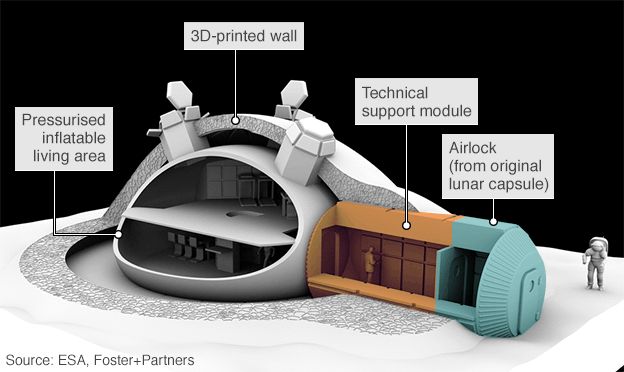
Proposed lunar habitat

According to the BBC,
"The European and Russian space agencies are to send a lander to an unexplored area at the Moon's south pole. It will be one of a series of missions that prepares for the return of humans to the surface and a possible permanent settlement. The spacecraft will assess whether there is water, and raw materials to make fuel and oxygen.

BBC News has obtained exclusive details of the mission, called Luna 27, which is set for launch in five years' time. The mission is one of a series led by the Russian federal space agency, Roscosmos, to go back to the Moon."
The only practicable way to construct a lunar habitat, like the one pictured, would be by using autonomous robots. They couldn't be teleoperated from Earth due to communication delay.

You may have noticed that nowhere on Earth right now are there autonomous robots capable of building a house - even under the benign conditions on our planet. People aided by dumb machinery build houses.

It's often said that the future is already here, just unevenly distributed. Absolutely cutting-edge stuff is very expensive and is solely used by elites (the rich, or priority government programmes). Later, technologies get better, prices come down via economies of scale .. and the future arrives for the masses.


Example: the first mobile phones, clunky things, date back to c. 1975. The mass take-up of mobile phones began in the mid-1990s, twenty years later. This period, twenty years from earliest adopters to mass deployment, seems about right for sophisticated, high-technology systems engineering.

As I noted above, there are no autonomous construction robots at all right now: we're probably ten years from systems which could autonomously build a habitat on Earth and perhaps thirty years from systems which are cost-effective for large scale use.

For a special-project moon base (large budget, customised equipment) I would guess twenty years out. For routine off-planet construction opening the way to significant lunar/martian cities it would have to be at least forty years.

So here's my summary timeline:
2025:  first proof-of-concept complete-house-building robots (autonomous)
2035:  first special-purpose lunar/martian habitat-building robots (autonomous)
2045:  houses routinely built by autonomous robots across the world
2055:  large scale town/city construction on the Moon and Mars by autonomous robots.
These are the earliest dates.

---

On a personal note, which of these events could I expect to see?

I checked an online life-expectancy calculator with this result:

My life expectancy at current age 64 (in 2015) = +25 years

This puts my expected date of death 25 years in the future, to 2040.

I might see the habitat pictured above before I go, with zen-like equanimity, to that good night.