Showing posts with label PhD Thesis agent theories architectures artificial intelligence. Show all posts

Friday, August 22, 2025

Imposter Syndrome


This morning in the library the checkout machines were out of order, so I had to do something retro: speak to a librarian at the desk. I was checking out four books for Clare.

The librarian scanned my library card, addressing me by the title printed on it: “Dr Nigel Seel.” It caught me off guard: no one usually calls me that - I rarely use the title, and when I do, it feels faintly fraudulent, like I’m impersonating some more serious person.

On the walk home, I told Clare how odd it felt. She dismissed it briskly. “They just think you’re a medical doctor,” she said, “and no one likes them anymore - they spend all their time debating pro-Hamas resolutions at their conference.”

This seemed both a little unfair and entirely in character for her.

I did feel faintly important for a second or two; I mentioned that to her as well.

But the encounter set me thinking about the PhD itself. There was a trope back in the mid-1980s, when AI was in one of its episodic summer periods, when languages like Prolog were in vogue and researchers were flushed with optimism. It was said with some truth: “what used to be a PhD thesis ten years ago is now a three-week programming project for a keen grad student and a minor paper in a conference.”

I sometimes feared my own thesis might have fallen into that category.

And yet, it was properly examined by a real logician, Professor Raymond Turner of the University of Essex: a respected name in modal logic, author of several books, an influential presence in the field. He read my thesis closely, and deemed it worthy.

What amused me at the time was that the part he found most interesting - the computational agent model I’d used, inspired by the work we were doing at STL - was something I had considered quite secondary. For me, the substance was in how the research grounded logics of belief, knowledge, perception and action in the world of situated, interacting agents. He, however, was more intrigued by the model-structure than the language-semantics.

In AI circles Turner was seen with a fond detachment. “Oh, Raymond,” they’d say. “A proper logician; he doesn’t really understand AI.” He was viewed as not quite of the community. And yet, because his work was so technically formidable, there was a sort of grudging respect, even awe. That he agreed to examine my thesis gave me a degree of credibility: borrowed gravitas.

Looking back now, I don’t think the work was as intellectually heroic as I believed at the time. But that’s how time works, with its mix of belated sense-of-proportion, misty nostalgia and hard-headed realism.

Tuesday, May 13, 2025

ChatGPT explains my PhD thesis to my wife

Link to thesis

---

Dear Clare, 

Here’s the gist of Nigel’s PhD research in plain English.

Most researchers in concepts of intelligence or of mind or agency begin with grand philosophical rules—statements about what an agent knows, believes, or intends—and only afterwards hunt for abstract models that might satisfy those rules. 

Nigel flips the order. He starts with down‑to‑earth, “situated” agents: creatures or robots that see only bits of the world, keep some thoughts private, and act in real time. 

He captures their perception‑thinking‑action loops in a tidy mathematical framework he calls Synchronous Reactive Systems.

Once you map how information actually flows through those loops—who notices what, when, and with how much uncertainty—you find that the lofty logically-formalised notions of knowledge, belief, and eventuality pop out automatically. 

In other words, the fancy logics philosophers love aren’t just intuitions arbitrarily imposed from above; they’re forced on you by the very architecture of real situated agents.

Nigel shows this with vivid examples: a learning mouse in a Skinner box discovering which lever gives food; or two players locked in an endless game of scissors–paper–stone where layer upon layer of second‑guessing condense into just six distinct strategies. 

Each scene can be told in two equally true ways. One is mechanical—computer-registers flip, motors fire. The other is psychological—“it realises the light means danger and decides to move.” 

Nigel shows how those two stories harmonise perfectly.

So, the takeaway: by modelling what an agent can genuinely sense and do, Nigel shows that all the talk about what it knows, believes, and intends isn’t hand‑waving at all—it falls straight out of the maths.

Hope this helps,

ChatGPT (o3).

Wednesday, September 27, 2017

Why no mathematical models of Marxist economics?

It's been commonplace in recent decades to observe, even decry the extreme mathematization of orthodox micro- and macroeconomics. But Marxist economics - still an active area of research - remains resolutely descriptive and verbal.

Amazon link


If, nevertheless, you search you come across "Mathematical Model of Marxist Economics" (2015) by Wu Yifeng - but that's in Chinese.

Amazon link

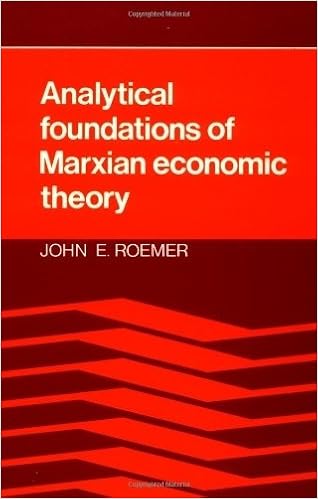
In English we have "Analytical Foundations of Marxian Economic Theory" by John E. Roemer (1989) which is available, partially, as a PDF. Roemer says some sensible things in the introduction about his approach:
"the microfoundations approach consists of deriving the aggregate behavior of an economy as a consequence of the actions of individuals, who are postulated to behave in some specified way. I have taken this approach throughout the book.

For example, in the chapters on the falling rate of profit, it is postulated that a technical innovation is introduced only if it increases profits for a capitalist. This micro approach is different from a macro approach, which might say: We postulate that technical change takes the form of an increasing aggregate organic composition of capital.

From the micro vantage point, one is not allowed to postulate an increasing organic composition of capital unless one can show what individual entrepreneurial mechanism leads to it.

Marxists might question the microfoundations methodology because one of the forceful points of Marx's theory is that the individual is not the relevant unit to examine - it is the class. This might lead one to try and build a model in which classes are the atoms of the system.

I think it should be possible to produce such a model, but I do not believe that model would be contradictory to the ones I have described in this book. The reason is this: that individuals act as members of a class, rather than as individuals, should be a theorem in Marxian economics, not a postulate.

Marx's point is that despite the capitalist's incarnation as a human being, he or she is forced by the system to act as an agent for the self-expansion of capital. Workers, similarly, may have their individual yearnings and habits, but conditions of life force them to acquire a class consciousness and to act, at times, as agents of the working class as a whole and not as their own agent. (This might be the situation, for instance, in a strike, where the striker takes great chances for the good of the strike, which are not personally worthwhile.)

In each case, Marx has claimed that although people exist organically as individuals, we can conclude that they act as members of classes. It is in this sense that class behavior is a theorem and not a postulate of the Marxian theory.

Taking the argument a step further, I would say that it is not only admissible, but important, to take a microfoundations approach in Marxian theory. A common error in Marxian discussions is functionalism: to assume that a mechanism necessarily exists to perform actions that must be performed to reproduce the system.

Put more simply, if the occurrence of X will further the reproduction of capitalist relations, then X occurs. For example, if racist attitudes exist among the working class, then capital will be strong. Therefore, capitalism foments racism.

What is missing here is a description of the mechanism by which this is accomplished. It may be in the interest of capital as a whole to maintain discriminatory wage differentials for black and white workers of equal productivity, but why should the individual, profit-maximizing capitalist respect this differential when he or she can increase profits by unraveling the differential - that is, by hiring only black workers at a slightly higher wage than they are receiving under the racist regime? [For one answer to this question, see Roemer (1979c).]

If we postulate capitalism as a system of anarchic, competitive capitals, each bent on its own expansion, we must face this sort of contradiction from functionalist arguments.

Another example comes from some Marxist-radical theories of education. Capitalism does not require a highly educated working class, so the theory goes, but it does require a well-socialized and docile working class. Schools, then, will serve the role of socializing and channeling people into capitalist society, but not of educating them.

Now, this conclusion may be true, but the functionalist nature of the argument eclipses the mysterious and difficult part of the phenomenon - how does capitalism ensure this role for schools, when teachers try to teach, students try to learn, and so on?

A third example is the role of the state. The capitalist state acts in the interests of the capitalist class - that is the theory. But the theory cannot be convincing unless one can demonstrate the mechanism by which this occurs, especially because capitals do not have a habit of cooperating with each other, as the primary aspect of each capital's existence is self-expansion and competition against other capitals.

What one requires, then, are microfoundations for the role of racism, education, and the state under capitalism. Other examples abound. In the cases when capitalism is guided as if by an invisible hand to coordinate its preservation in the ways mentioned, one requires an explanation of how anarchic capitals produce such a result.

 A second form of functionalism that exists among Marxists is the converse of the first form: If X has occurred, then X must be in the interests of capital. We again can take an example from education:

Because we observe compulsory education, it must be that capital requires such for its reproduction. But this may not be the case: compulsory education may exist because the working class fought for it.

One can find many examples of this form of functionalism in Marxian work: The general consequence of the error is to attribute an omnipotence to the capitalist class that it does not possess in Marxian theory. The capitalist class is pushed along by historical developments: Not everything that happens under capitalism was planned by it, nor is in its best interests. In fact, according to Marx, the general tide of historical development favors the working class. Again, a defense against this form of functionalism is a microfoundations approach.

There is a third form of functionalism among Marxists that, strangely, seems diametrically opposed to the first two forms: If the occurrence of X is necessary for the demise of capitalism, then X will come to pass. We can see the general rule of which these different functionalist forms are special cases if we phrase the general functionalist position this way. We postulate a certain outcome for the social system; functionalism then takes the form of claiming that only events occur which lead to that outcome.

In the first two forms of functionalism discussed, the outcome is the reproduction of capitalist relations; in the third form, the outcome is the transformation of capitalism into socialism. Perhaps the first two forms of functionalism are short-run variants, and the third form is a long-run variant of the general functionalist interpretation of Marxism.

Examples of the third form of functionalism in Marxian economics are prevalent in crisis theory. The system must have crises, because crisis is necessary for capitalist demise. The rate of profit must fall, because only in this way can crisis be brought about. The working class must become impoverished, because otherwise it will never perform its revolutionary task. Bourgeois democracy must transform itself into fascism, because only fascism will heighten the contradictions of capitalism sufficiently to produce revolutionary transformation, which must occur. These arguments are less than convincing; the form of functionalism they involve is similar to that of the utopian socialism of Marx's time, which postulated socialist transformation without a mechanism.

Marx's method was to counter utopian thinking by trying to expose the mechanism that would bring the socialist transformation about. ...

Finally, the equilibrium method has been used in the models in this book. While I have defended the approach of mathematical modeling, and the microfoundations approach, I have less confidence about the equilibrium method. Like many economists of my generation, I am strongly influenced by the power of the equilibrium method: of examining a model when it is at rest, so to speak, in the sense that all the rules that describe how its parts work are simultaneously fulfilled.

What is disturbing about the equilibrium method is that it pictures the typical position of the system as a position the system rarely or never enjoys. Of course, no sophisticated economic model builder would claim that economies are in equilibrium in the sense of a static equilibrium model. A model is only an ideal type.

However, there seems to be a deep contradiction between using models whose main analytical trick is to postulate a position that is precisely at variance with the most interesting and important aspect of capitalist economy as described by Marxian theory - its incessant, contradictory motion.

There is, therefore, the danger that if this intuition is correct, the equilibrium method will prevent one from seeing the most important aspects of the Marxian theory of capital. Knowing no other method, I use the equilibrium method, with the vague thought that, when rereading these pages in twenty years, its obsolescence as a modeling tool for Marxian theory may be clear.

(I might add that there is plenty of precedent in Marx's modeling of his theory for the equilibrium method: Consider, for example, the notion of equalization of profit rates among capitals, or the models of balanced growth designed to show that capitalism was capable of reproducing itself.) ..."
After this thoughtful introduction we encounter chapter 1.
"1 Equilibrium and reproducibility: the linear model

1.1 A brief review

We begin with a discussion of what constitutes an equilibrium, in Marxian terms, of a capitalist economy, and for this chapter we study a linear, Leontief specification of production.

Capitalists all have access to the same Leontief production system {A, L}, where

   A is an n x n input matrix of commodities

   L is a 1 x n vector of direct labor inputs.

If p is a l x n commodity price vector and the wage is normalized at unity so that prices p are interpreted as wage prices, then the usual notion of an equilibrium-price vector in a Marxian system is a vector p for which there exists a nonnegative number π such that

   p = (1 + π)(pA + L)           (1.1)

The vector pA + L is the vector of unit costs of production (assuming that there are no fixed capital costs), and so π may be interpreted as the uniform profit rate for the economy.

There may be, of course, many pairs (p, π) satisfying Equation 1.1.

We add more information to the system by requiring that workers each receive a subsistence vector of commodities b, an n x 1 vector. By subsistence, we mean simply that the wage must be precisely sufficient for b to be affordable, thus

   pb = 1                                 (1.2)

Here, the unit of time that denominates L, which is the same unit of time for which the wage of unity is paid, is to be thought of as one working day.

Combining (1.1) and (1.2), we see immediately that

   p = (1 + π)p(A + bL)         (1.3)

Thus, for a vector p satisfying (1.1) and (1.2) to exist, it is necessary and sufficient that the augmented input coefficient matrix M = A + bL possess an eigenvalue 1/(1 + π) that does not exceed one, to which can be associated a nonnegative eigenvector p.

According to the Frobenius—Perron theorem, if M is an indecomposable matrix, then M has a unique eigenvalue that can qualify; that is, M possesses a unique positive eigenvalue to which can be associated a nonnegative eigenvector. It is, furthermore, the content of Morishima-Okishio's fundamental Marxian theorem (FMT) that if the rate of exploitation e is positive, then the Frobenius eigenvalue of M will be less than one, and so the associated profit rate will be strictly positive. ..."
and so it goes on. One reviewer writes:
"The analytical rigor in treating the subject is among the things that make the book worth buying for anyone interested in mathematical economics: sitting down with paper and pencil for a couple of months in reading the book will be a beautiful intellectual experience, and it will add a whole set of "weapons" to the neoclassically trained economist."
But perhaps we just don't yet have the right (agent-based?) mathematics for Marx.

---

I'm been reading Duncan Foley's excellent primer on Capital.

PDF link

Foley is a clear and creative thinker who is prepared to bring some simple mathematics to the table. He's interested in presenting the conceptual apparatus of Marxism in an orderly manner rather than simply providing a slimmed-down exegesis of the books themselves. His approach is very much rooted in applying Marxism to the present day economy, which informs both his appraisal and his examples.

He reconstructs in mathematical form the circulation of capital and Marx's simple and expanded reproduction equations before moving on to the 'transformation problem', crisis theories and Marx's concept of socialism. Here's the table of contents:
Contents

1 On Reading Marx: Method                            1
2 The Commodity: Labor, Value, Money        12
3 The Theory of Capital and Surplus Value    31
4 Production under Capitalism                       49
5 The Reproduction of Capital                       62
6 The Equalization of the Rate of Profit         91
7 The Division of Surplus Value                   105
8 The Falling Rate of Profit                          125
9 The Theory of Capitalist Crisis                  141
10 Socialism                                                 158
Suggested Readings                                    173
References                                                   177
Index                                                             181
In addition as you can see, this introductory book is quite short.
.
---

When I did my PhD research - the formal theory of intentional agents - I explicitly rejected the framework of differential equations used by the control theorists and the cyberneticists (cf Ross Ashby). For the same reason I am somewhat skeptical about aspects of Peter Turchin's Cliodynamics.

My approach was in the classical AI tradition of modal logics and generalised automata theory where intentional agents (those with perceptions, beliefs, goals, plans, actions) are modelled explicitly. I still think this is the best approach to a twenty-first century formalised Marxist psychohistory where we're interested in history at the simulation level.

Wednesday, May 26, 2010

The Intentional Description of Reactive Systems

Here is the paper where I wrote up my Ph.D. work (PDF file). And here is how it starts.
"This is a revised and more "user-friendly" version of [Seel, 90]* which wrote up my Ph.D. work for publication. The latter has more pictures, and its slightly greater austerity may please the formalist. Still all the math is still here, it's just more clearly explained!

The problem we're looking at is simply stated. Take an example: we can look at intelligent robots operating in trial-and-error mode in a local environment, and accurately describe their behaviour using sentences like "look, it didn't know there was a hole there, that's why it fell over", and "now it knows where the power supply is, it will find a direct route."

In the jargon, this use of words like "knows", along with words like "believes", "wants" to describe and predict the behaviour of agents is called intentional description. It's so natural that it's not even obvious why it should be problematic. But the designers and engineers who constructed the robot have a different story as to how it behaves. They understand the causal mechanisms underpinning its perceptual, information-storage and problem-solving abilities. They can also predict (and alter and fix) the robot's behaviour.

Engineers normally have little time for intentional descriptions, considering them as so much sentimentality and anthropomorphism. Also, they don't see how intentional descriptions could work - the casual observer doesn't, after all, know the engineering. Still, intentional descriptions do work - we use them all the time and not just for robots.

To see how it all fits together, we need to use mathematical models: both for robots and their environments (for which we use automata-type formalisms) and for intentional language (for which we use logic, namely the special modal logics of knowledge, belief and goals).

It then turns out that the relationship between the two kinds of description, intentional and engineering, comes out in the maths as a semantic relationship between formulae in the logic and the appropriate automata-structured model spaces of the logic.

To properly get the details of what follows, you need to know basic propositional modal logic as taught in introductory AI or logic courses. Despite the jargon, the paper is more interested in conceptual clarity than the use of deep or intricate mathematical techniques (in fact I don't use any). If you read the words and avoid the formulae, you still get the gist of what's going on.

A shorter alternative to reading the rest of this paper is to look at (Seel, 1991) at http://interweave-consulting.blogspot.com/2010/05/logical-omniscience-of-reactive-systems.html."
...

* Seel, N. R. (1990). Intentional Description of Reactive Systems. In Y. Demazeau & J-P. Muller (Eds.), Proceedings of the Second European Workshop on Modelling Autonomous Agents in a Multi-Agent World. Elsevier Science Publishers B.V./North-Holland.

This is the main technical presentation of my Ph.D work in an accessible form.

Saturday, May 15, 2010

Nigel Seel CV

Nigel Seel CV

Updated: December 2016.

I was a self-employed telecommunications consultant with 30 years experience of network design; product portfolio, network and systems strategy, and telecommunications architecture.

Now I'm retired and doing a variety of things as documented on my blog.

KEY SKILLS

• Extensive experience of public carrier IP networking and next-generation network design.
• VP-level senior management experience in global corporations.
• Successful strategist and agent of change in large companies.
• Superior analytical, communications and delivery skills.
• The ability to develop a vision and inspire people through to completion.

MAJOR ASSIGNMENTS

Network architecture consultant to international law firm, London -- Jan 2012 - July 2012.

Worked with an international legal firm to define their requirements for a new enterprise network involving multi-site connectivity with data centres. Wrote the RFP and managed the vendor evaluation and selection process through to contract award.

Managed security accreditation (IL2/IL3) at C&W and other clients -- Jan 2010 - Sept 2010.

Network architecture consultant to Peel Media City, Manchester -- Dec 2008 - Jan 2009

Network architecture consultant to Dubai World Central -- Jan 2008 - July 2008

Programme Management - BT Wireless Cities -- May 2006 - Sept 2007

Senior Consultant – Mentor Technology International, working with a number of clients including an MVNO developing a new GPRS-based proposition, a VoIP company moving to SIP, a major multinational bidding into BT's 21st Century Network programme and a leading satellite broadcaster on its IPTV/Video-on-Demand programme. -- April 2004 - Feb 2006

Vice President - Portfolio Development at Cable & Wireless Global -- April 2002 - April 2003

Chief Architect - Cable & Wireless Global -- Jan 2001 - March 2002

Technical Architect - Nortel Networks -- May 1990 - Sept 1999

EMPLOYMENT HISTORY

Independent Consultant Feb 2006 - March 26th 2014
Mentor Technology International Apr 2004 - Jan 2006
Independent Consultant Apr 2003 - Apr 2004
Cable & Wireless Global Jan 2001 - April 2003
Independent Consultant Oct 1999 - Jan 2001
Nortel Networks Sept 1991 - Sept 1999
Standard Telecommunications Laboratories March 1982 - August 1991

EDUCATION

PhD in Artificial Intelligence (“Agent Theories and Architecture”) 1985 - 1989
BA Maths & Computer Science (1st Class) 1984.

Open University 3rd Level Physics courses in Electromagnetism (SMT359, 2008) and Quantum Theory (SM358, 2009) (both with Distinctions).

BOOK

Business Strategies for the Next-Generation Network -- Dec. 2006

PDF available here.

BLOG

http://interweave-consulting.blogspot.com/

Nigel Seel: about me.

Here's a link to my 23andMe genome.

Sciencefiction.com: 2011-2012 I was a contributing writer of science features and reviews.

PUBLISHED PAPERS

1. Seel, N. R. (1984). An Analysis of a Simple Learning System. In Proceedings of the Sixth European Conference on Artificial Intelligence.
2. Seel, N. R. (1986). A formal framework for modelling agents. In Proc. of Cybernetics and Systems 1986. D.Reidel.
3. Seel, N. R. (1988). Modelling Iterated Strategies: a Case Study. In Proceedings of the Eighth European Conference on Artificial Intelligence.
4. Seel, N. R. (1989). A Logic for Reactive System Design. In Proceedings of the Seventh Conference of the Society for the Study of Artificial Intelligence and the Simulation of Behaviour (AISB-89).
5. Seel, N. R. (1990). From Here to Agent Theory. In AISB Quarterly, Quarterly Newsletter of the Society for the Study of Artificial Intelligence and the Simulation of Behaviour, No. 72.
6. Seel, N. R. (1990). Intentional Description of Reactive Systems. In Y. Demazeau & J-P. Muller (Eds.), Proceedings of the Second European Workshop on Modelling Autonomous Agents in a Multi-Agent World. Elsevier Science Publishers B.V./North-Holland. (This is the main technical presentation of my Ph.D work in an accessible form).
7. Lesan, H. & Seel, N. R. (1990). A Conversational Interface to a Constraint-Satisfaction System. In ICL Technical Journal, Vol 7, No. 1.
8. Seel, N. R., Gilbert, G. N and Morris, M. E. (1990). A Project-Orientated View of CSCW. In Proceedings of the Third IFIP Conference on Human Computer Interaction (INTERACT '90).
9. Seel, N. R. and Hughes, P. T. (1990). CSCW for Professional Community Support. Proceedings of the IEE Colloquium on CSCW, 24 October 1990. The Institution of Electrical Engineers, Computing and Control Division, Savoy Place, London WC2R 0BL.
10. Seel, N. R. (1991). The 'Logical Omniscience' of Reactive Systems. Proceedings of the Eighth Conference of the Society for the Study of Artificial Intelligence and the Simulation of Behaviour (AISB-91).
11. Seel, N. R. (1991). Agents in the Human-Computer Interface: Extended Abstract. Proceedings of the IEE Colloquium on Intelligent Agents, 25 February 1991 (Digest No: 1991/048). The Institution of Electrical Engineers, Computing and Control Division, Savoy Place, London WC2R 0BL.
12. Hughes, P. T., Plant, T. A., Morris, M. E. and Seel, N. R. (1991). Collaboration Media: The Problem of Design by Use and the Use of Design. In: Proceedings of the UNICOM Seminar on CSCW "The Multimedia and networking Paradigm", Brunel University, 16-17 July 1991.
13. Seel, N. R. (1991). Perspectives for Distributed Artificial Intelligence.  In AISB Quarterly, Quarterly Newsletter of the Society for the Study of Artificial Intelligence and the Simulation of Behaviour, No. 76.
14. Seel, N. R. (1993). Traffic Management and Routing in SDH Networks. In Proceedings of the ITC Sponsored St Petersburg's Regional International Teletraffic Seminar "Digital Communication Network Management". (Ed.) B. Goldstein, A. Koucherayvy, M. Schneps-Shneppe, LONIIS, St. Petersburg, 15-20 June, 1993.
15. Seel, N. R. (1994). Approaches to SDH Network Design. Networks '94, Budapest, Hungary.
16. Seel, N. R. (1997). Carrier Architecture for IP Services. "Broadband Strategies", 4-5 Dec. 1997, IBC UK Conferences Ltd. , Gilmoora House, 57-61 Mortimer St., London W1N 8JX.
17. Seel, N. R. (2000). The Architecture of SS7-IP Interworking. IBC Workshop "Integrating SS7 and IP in the Network" at the IBC conference: "SS7/IP Interworking"; London, 13-15 March 2000.
18. Seel, N. R. (2000). Carrying IP over Glass. "The 2nd Annual International Optical Networking Forum", 17th-19th April 2000, Rome, Italy. Organised by IBC Global Conferences Ltd.
19. Seel, N. R. (2000). IPv6 Transition Architecture. "Transition To The New Internet".  IBC Global Conferences Ltd. 22nd - 23rd June 2000, Millennium Britannia Hotel, London.
20. Seel, N. R. (2001). Integration Infrastructure Provision. 18th May 2001. OSS Summit, Lake Geneva, Wisconsin, USA. 
21. Garbin, D. A. & Seel, N. R. (2001). Network Service Providers: the Business of Transporting Bits. NGN2001 Conference (Next Generation Networks - McQuillan). November 5-9th, 2001. Boston, USA. 

Agent Theories and Architectures

Click here for the published paper which describes my PhD work. Formerly on my website.