Showing posts with label The Righteous Mind. Show all posts

Saturday, April 16, 2016

Matthew Parris, Brexit and MFT

For the background on Moral Foundations Theory (MFT) (Jonathan Haidt) start here.

The Conservative Right of the Tories

Matthew Parris writes a passionate opinion piece in The Times today, denouncing the Brexiteers in his own party as destroyers of the Tory Party and wreckers of Europe.
"My hunch is that there is a powerful correlation between those Tory MPs who want us to leave the EU, and those whom most people would describe as “right wing” more generally. There is no tick-box way of categorising a rightwinger: you have to look at a range of behaviours:

  • a strong and persistent interest in military matters; 

  • a marked admiration for Republican US presidents; 

  • social illiberalism (look at attitudes towards gay marriage, for example; or some of the church-fuelled reaction to what the rest of us might call progressive social policy); 

  • a certain lack of interest in the state’s role in protecting workers or the active promotion of healthy living; 

  • ... state intervention that such MPs would call “wishy-washy liberalism”. 

"All I can say is that in the Tory party you know a rightwinger when you meet one."

Compare that list of moral values with the standard conservative set I discussed yesterday.

Traditional conservatism - all boxes ticked, but moderately

---

The Liberal-Left of the Tories

I recall reading - I think in the Alan Clark Diaries - the consensus of the Thatcherite high command that for Matthew Parris, it was always going to be about Gay Rights.

And yesterday I also gave you the chart for the classic bien-pensant liberal, to which group Mr Parris is such an adornment.

This is broadly where Matthew Parris sits in the moral spectrum

---

I already wrote about Moral Foundations Theory (MFT) and Brexit here (scroll to the bottom).

Let me add that the Brexit camp combines three moral camps. As well as the traditional conservatives already mentioned - those well-represented in the conservative party - we also have:

The Libertarians

Matt Ridley, Mr Gove and the sole UKIP MP, Douglas Carswell. Here is their chart:

Libertarian Brexiteers dislike the dead hand of European oversight

The Authoritarians

The Nigel Farage wing of UKIP, and continental authoritarian nationalists like Marine Le Pen.

Brexit Authoritarians rally to a nationalist, communalist flag
---

Despite their preponderance in the media and the governing elite, there are only so many left-liberals. How to win over the others? Only fear of the unknown will do it. So Matthew Parris's column is full of fear and foreboding:
"It’s Project Fear that has turned us, and I don’t mind admitting it. Fear of the economic consequences of leaving. Distaste at many of the crew who want us out. Anxiety about the impact on our allies in Europe and worldwide if we kick this huge enterprise in European co-operation in the guts. Alarm at the rise of anger in the world. Shame that we British might come to be judged by history as vandals."
Fear has often been enough, when moral buttons are not being pushed too hard. But heaven help the 'Remain' camp if something bad (morally-speaking) happens EU-wise later this spring.

Friday, April 15, 2016

Jonathan Haidt in pictures (MFT)

This is my third post on Jonathan Haidt's book, 'The Righteous Mind' and his Moral Foundations Theory (MFT).

If you just arrived here you should read my introductory post first.

The first five foundations of morality are described in this table on page 146 of Haidt's book.


You can click on any of the images in this post to make them larger.

The sixth foundation, Liberty/oppression, which generates emotions such as righteous anger when faced with illegitimate authority was introduced later in chapter 8.

The six moral foundations are best understood as evolved psychological adaptations which make scalable, stable societies possible - getting you past the limits of small kin-groups.

---

One of Haidt's major proposals is that different groups in the political spectrum inhabit very different moral universes, ones in which their own 'tribes' seem good and virtuous, while others seem strange and evil. In the book he discusses the liberal left (which includes social-justice warriors), the conservative right and libertarians; authoritarians are analysed in the context of Donald Trump in this article.

See this previous post for more details.

Here are some charts I put together to illustrate the different moral foundations of contemporary political positions.

The six foundations to get us started (refer to the table above)

Liberal-leftists: it's 'caring', 'oppression' and 'equality - not much else

Conservatives care about all the foundations - equality of opportunity not outcome

Libertarians: 'Don't tread on me!' with a side-order of tough-fairness

Authoritarians: Loyalty, Obedience to Authority, Sanctity: No Free Riders!

Authoritarians would include Donald Trump, the UK Independence Party's Nigel Farage and Marine Le Pen in France. Oh, and Vladimir Putin, Recep Tayyip Erdoğan, Abdel Fattah el-Sisi and Jacob Zuma amongst many, many more.

These charts are hand-wavy and suggestive, not at all definitive. For example, I've not said enough about Sanctity which is, of course, big in the States. Haidt links Sanctity with Contamination as polar opposites on an awe-disgust spectrum.

I'm not a big fan of how he treats Fairness, which seems to include in a muddled way:

  • strong elements of compassion on the political left (equality of outcome)
  • reciprocal-altruism on the right (duty) and amongst libertarians (transactional integrity)
  • a tendency towards strong retribution amongst authoritarians.

Incidentally, I observed in a post a while back that the attitude of most societies, traditional societies, towards male homosexuals is not fear ('homophobia' - a piece of politically-correct misdirection), but disgust. Educated liberals have carefully averted their minds from what male gay sexual practices actually involve, but acceptance is a lot easier if you deprecate the 'Contamination' moral foundation - as liberals and libertarians typically do.

If you want to see quantitative details on all the above, read the book and check Haidt's blog and the article I linked to in this previous post.

--

In case these charts are of any use to you - you might want to improve them - here's a link to the PowerPoint.

"Why do they hate us?"

Consider a tough gang. You, an outsider and by yourself, choose to walk up to the gang leader in front of fellow gang members and indulge yourself in a series of choice insults.

What happens to you?

Most countries have (or had) laws of lèse-majesté, which formalise penalties for disrespect to leaders. You may protest you have a right to free speech, but rights do not grow on trees. They're no more than agreements to permit certain kinds of behaviour, backed up by the powers of a State.

Absent such a State .. there are no rights.

And why would different communities agree on what should be morally permitted?

Whether it's Charlie Hebdo or that German comedian and President Erdogan, Jonathan Haidt's Moral Foundations Theory sheds some light.

Here's TheReformedMind post: "Applying Haidt’s Moral Foundations Theory to responses to “The Innocence of Muslims”:

"At a lawyers conference I attended recently, the conversation turned to “The Innocence of Muslims,” the offensive YouTube video that has sparked riots throughout the Muslim world. “Why do they react this way?” a partner at a major law firm asked, referring to Muslim societies.

"The idea that people would take such offense at an inept video, and blame American society in general rather than the individuals who produced the film, was incomprehensible to this American lawyer: “We would never react that way.” The other lawyers agreed.

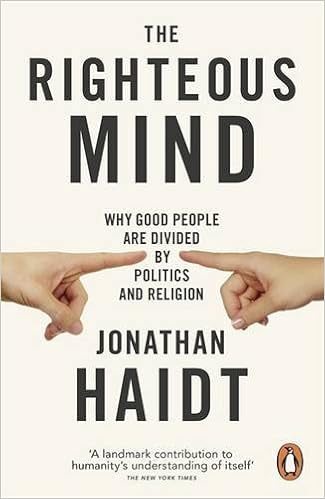
This conversation came back to me this week as I read Jonathan Haidt’s very worthwhile new book, The Righteous Mind. Mostly, the book explores the different moral psychologies of American conservatives and liberals.  (Haidt argues that the differences are largely innate — “pre-wired,” he says — thus confirming Iolanthe’s famous observation that “every boy and every gal/ That’s born into the world alive/Is either a little Liberal /Or else a little Conservative!”).

"One chapter, though, compares American moral intuitions with those of other societies. America, Haidt says, has what psychologists call a WEIRD culture — Western, Educated, Industrialized, Rich, and Democratic. WEIRD cultures have a strong “ethic of autonomy”: they hold that “people are, first and foremost, autonomous individuals with wants, needs, and preferences” which, barring direct harm to others, should be fulfilled.

"In such cultures, as Jean Bethke Elshtain remarked at the annual Erasmus Lecture this week, “loyalty” principally means “being true to oneself.” The First Amendment reflects this ethic: it promotes the widest possible range of individual expression and advises offended listeners to avoid harm by turning away.

Largely through American influence, WEIRD values increasingly dominate international human rights discourse. This is ironic, because WEIRD cultures are global outliers — and America is the farthest outlier of all. Most of the world does not see autonomy as the most important value and does not privilege individual expression to the extent we do. Many cultures, Haidt says, have an “ethic of community” that sees people principally as members of collectives — families, tribes, and nations — with strong claims to loyalty. And many cultures have an “ethic of divinity,” which holds that people’s principal duty is to God, not themselves.

“In such societies,” Haidt writes, “the personal liberty of secular Western nations” — including the unrestrained freedom of expression — “looks like libertinism, hedonism, and a celebration of humanity’s baser instincts.”

Haidt’s account explains much of the incomprehension on display at that lawyers conference. To someone in a WEIRD cultural environment — and the educated upper-middle class in America, Haidt claims, is the WEIRDest environment of all — it is very hard to understand how people could feel morally outraged by an inept video that insults divinity. It seems so counter-intuitive.

"The incomprehension works the other way, too. To someone in a non-WEIRD environment, it is very hard to understand how people could feel morally justified defending sacrilegious expression. Haidt’s account suggests that the differences between these cultures are going to be extremely difficult to negotiate. Intuitions are stubborn things."

Moral parochialism is very tempting. Haidt says, "Morality binds and blinds." We're right and the other guys are wrong. He believes modern democratic states are a better solution to organising society than those that preceded them, and that their organising principle of rule-based utilitarianism is for the best ;-).

However, we should do better than blank incomprehension, let alone gratuitous provocation, when we encounter cultures which are not so WEIRD. And if people choose not to, there will be consequences - even if you personally believe on moral grounds that there shouldn't be. *

---

Further reading:

---

* Very relevant to all this is the incomprehension between honour cultures and dignity cultures. The EU is a dignity culture; the Middle-East and Turkey are honour cultures.

Thursday, April 14, 2016

Jonathan Haidt and Moral Foundations Theory

It's not often that you happen upon a book which reframes the entire way you think about humanity and large complex societies; a book with new paradigms for thinking about religion, politics and psychology.

When that book is beautifully-written and a real page turner you have this:


'The Righteous Mind' by Jonathan Haidt introduces Moral Foundations Theory - six dimensions on which our relationships with our fellow human beings and our environment can be classified. Emily Ekins and Jonathan Haidt explain the basics.
"We'd like to add another psychological tool to the toolbox: Moral Foundations Theory. One of us (Haidt) developed the theory in the early 2000s, with several other social psychologists, in order to study moral differences across cultures. Moral Foundations Theory (MFT) draws on anthropology and on evolutionary biology to identify the universal "taste buds" of the moral sense, while at the same time explaining how every society creates its own unique morality.

"Think of it like this: Evolution gave all human beings the same taste receptors — for sweet, sour, salt, bitter, and umami (or MSG) — but cultures then create unique cuisines, constrained by the fact that the cuisine must please those taste receptors. Moral foundations work much the same way. The six main moral taste receptors, according to MFT, are:
  1. Care/harm: We feel compassion for those who are vulnerable or suffering.

  2. Fairness/cheating: We constantly monitor whether people are getting what they deserve, whether things are balanced. We shun or punish cheaters.

  3. Liberty/oppression: We resent restrictions on our choices and actions; we band together to resist bullies.

  4. Loyalty/betrayal: We keep track of who is "us" and who is not; we enjoy tribal rituals, and we hate traitors.

  5. Authority/subversion: We value order and hierarchy; we dislike those who undermine legitimate authority and sow chaos.

  6. Sanctity/degradation: We have a sense that some things are elevated and pure and must be kept protected from the degradation and profanity of everyday life. (This foundation is best seen among religious conservatives, but you can find it on the left as well, particularly on issues related to environmentalism.)
"As with cuisines, societies vary a great deal in the moralities they construct out of these universal predispositions. Many traditional agricultural and herding societies rely heavily on the loyalty, authority, and sanctity  foundations to create rituals, myths, and religious institutions that bind groups together with a strong tribal consciousness.

"That can be highly effective for groups that are often attacked by neighboring rivals, but commercial societies (such as Amsterdam in the 17th century or New York City today) are far less in need of these foundations, and so make much less use of them.

"Their moral values, stories, and political institutions flow more directly from the liberty and fairness foundations — well suited to a culture based on exchange and production — and are therefore much more tolerant and open to ethnic diversity.

"In recent years, MFT has been used to study political differences between the American left and right. Republicans and Democrats in the United States are now in some ways like citizens of different countries, with different beliefs about American history, the Constitution, economics, and climate science.

"Using questionnaires, text analyses, and other methods, psychologists have found that progressives put more emphasis on the care foundation than do other groups, while social conservatives see more value in loyalty, authority, and sanctity than do other groups. Libertarians, meanwhile, put liberty far above all other moral concerns.

"Fairness, important to all groups, nonetheless has subtypes: The left values fairness more when it is presented as equality, particularly equality of outcomes between groups (which is at the heart of social justice). The right values fairness more than the left when it is presented as proportionality — a focus on merit, which includes a desire to let people fail when they are perceived to have been lazy or otherwise undeserving."

...

"Here's a graph showing how how each candidate's supporters prioritize each of the moral foundations compared with the average American.

"Bars above zero indicate that the candidate's supporters place more emphasis on that particular moral foundation compared with the average voter.

"Bars that dip down below zero do not mean those supporters do not care about the moral concern, only that they gave relatively lower ratings to it compared with the rest of our nationally representative survey sample."

Diagram edited to remove Mike Huckabee and Ben Carson

An explanation of this chart can be found at the article. Suffice it to say that it conforms to a much-replicated finding that:

  • Liberals (ie left-wingers) are motivated almost entirely by the Caring dimension (blue - concern for 'victims of oppression') and Liberty (yellow -  "everyone should be free to do as they choose, so long as they don't infringe on upon the freedom of others.")

  • Conservatives (ie right-wingers) are less 'caring', stronger on no freeloading (green - Proportionality is the desire for people to reap what they sow — for good deeds to be rewarded and bad deeds punished.") and supportive of institutions (red).

  • Libertarians, represented by no-hope candidate Rand Paul, are like Mr Spock in Star Trek: cool and unemotional, detached and strongly autonomous - as shown by the large response on yellow (Liberty - freedom from interference). 

Full disclosure: in tests, I score as Libertarian - even though I know that no such political movement can (or should) ever attain power.

---

In the UK, I think these political results would map smoothly across for the left.

Bernie Sanders presses just the same moral buttons as Jeremy Corbyn; Hillary Clinton could be any mainstream Labour Party machine politician.

Finding UK analogues for the right of the political spectrum is harder.

Trump's moral score makes him a traditional authoritarian, described in the article thus:
"Voters who still score high on authority/loyalty/sanctity and low on care — even after accounting for all the demographic variables — are significantly more likely to vote for Donald Trump. These are the true authoritarians — they value obedience while scoring low on compassion."
In the UK the only similar politician who comes to mind is Nigel Farage, who is not a serious contender for power. David Cameron is most like Jeb Bush, who scored pretty much where the average American was .. and got booted out of a highly-partisan contest for his pains.

---

Moral Foundations Theory also has something to say about Brexit.

Caring

The inflated 'Caring' universality of the left makes staying in the EU a liberal-elite reflex. The usual suspects include the BBC and The Guardian. The Bubble does indeed have a pan-European span. But the more parochial 'Caring' of the masses tends to stop at the Channel.

Fairness/Proportionality

If you're for Brexit it pays to emphasise that our natural loyalty is to the institutions of the British nation state which represents 'our tribe'. The EU violates Fairness/ Proportionality when using our resources in favour of free-riders.

There are plenty of examples, starting with Club Med.

Liberty

Here there are two narratives. The Brexit camp sees EU institutions as oppressive and pushes the Liberty button for freedom from them; the left sees the EU infrastructure (dominated by liberals) as a bastion of support in the battle against the truly oppressive elites (companies, English right-wing politicians).

Loyalty, Authority, Sanctity

Europe is not a demos for the masses: there is no sense of a 'moral us' between the English and the French, Germans, Italians and all the rest. This means that 'Remain' exerts little positive leverage on Loyalty, Authority or Sanctity although it can negatively leverage Authority, pointing out that leaving might lead to chaotically-worse institutional outcomes. Here lies Operation Fear.

---

I hope I've shown you the power of Moral Foundations Theory and I strongly recommend you read Jonathan Haidt's book. He has a blog, too.

---

Further posts on Jonathan Haidt's work: