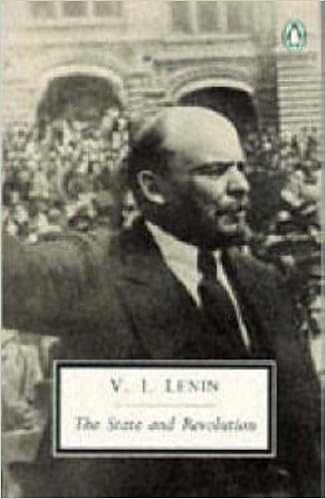
Marxist theory has a 'non-constructive' kind of proof that the capitalist mode of production is not the final form of society. This is simply the fact that capitalism is a
class society: private ownership of the means of production (factories, machines, land, raw materials, etc) ensures that the production process replicates a class of capital-owners on the one hand, engaged in commodity production for exchange in the market, and a class of workers on the other, who own only their ability to productively labour and can do so only through employment by capitalists.
Surely this asymmetry in social role between bourgeoisie and proletariat will not echo down the centuries for ever?
So far, so arid. But Marxism also has a seemingly-ethical dimension. It is claimed that capitalism cannot develop the productive forces of society without ongoing oppression of the mass of the people. So it's not only rather
inelegant as a social-structuring mechanism, it's also inefficient and
bad.
You won't get a good answer from Marxists as to whether capitalism has a built-in failure mode. Some have thought that it will collapse through its own contradictions (Marx's theory of the
declining rate of profit is often fingered as the proximate mechanism) but as V. I. Lenin
observed,
"... there is no such thing as an absolutely hopeless situation, since the bourgeoisie can – in principle – always find a way out."
No one disagrees however that capitalism is subject to regular cycles of boom-and-bust. In the 'bust' phases the elites are always just fine; it's the masses which end up unemployed and desperate. (I remind you about Peter Turchin's forthcoming book, "
Ages of Discord", although I believe Charles Murray's "
Coming Apart" would tide you over until September).
Marxist theory suggests that the working class can take advantage of an acute crisis to transcend capitalist relations of production, (this would be the violent revolution, led by a revolutionary communist party), and bring about a post-capitalist society in transition to communism.
With 168 years of research since the publication of the
Communist Manifesto (1848) what can we say about the viability of such a post-capitalist society?
Marx very wisely declined to speculate - there simply wasn't the data. This meant of course that his discussion of the target society was very abstract - and in some cases plain weird (
Chapter 2):
"... nothing is more ridiculous than the virtuous indignation of our bourgeois at the community of women which, they pretend, is to be openly and officially established by the Communists. The Communists have no need to introduce community of women; it has existed almost from time immemorial.
"Our bourgeois, not content with having wives and daughters of their proletarians at their disposal, not to speak of common prostitutes, take the greatest pleasure in seducing each other’s wives.
"Bourgeois marriage is, in reality, a system of wives in common and thus, at the most, what the Communists might possibly be reproached with is that they desire to introduce, in substitution for a hypocritically concealed, an openly legalised community of women.
"For the rest, it is self-evident that the abolition of the present system of production must bring with it the abolition of the community of women springing from that system, i.e., of prostitution both public and private."
Lenin, having observed workers and peasants councils (soviets) in the Paris Commune and the 1905 revolution in Russia proposed that the politics and economics of the post-capitalist society would indeed be organised by a hierarchy of soviets (local, regional, national, by industry and so forth).
How would this work in detail? I recall Ernest Mandel suggesting that opinion polls might do the work of capitalist speculative investment in
new product introduction, although I'm not sure that
Apple would ever have happened if it had required a senior soviet to vote the financial resources. The socialist Steve Jobs would have had plenty of oversight in his work, and would not have been permitted remuneration beyond that of any 'skilled worker'.
So here is the heart of the problem. Marxists have supposed that absent capitalist reification - the opacity of social relationships leading to atomisation of society - humanity's inherent social solidarity would emerge and we would all work cooperatively together to eliminate oppression and develop society's productive forces in harmony together indefinitely.
This was the root of E. O. Wilson's famous critique of Marxism, "
Wonderful theory, wrong species."
Human nature makes us rather
clannish and nepotistic, with sharp clines of empathy. Given that we are not all clones of each other, this makes rational evolutionary sense so will not go away.
What would actually happen in the post-revolutionary state? We know what Oscar Wilde thought about socialism, '
too many meetings', and we know what happened to the post-revolutionary states in Russia, Eastern Europe and China - bureaucratisation and stagnation.
Stalinism was explained away as 'inadequate development of the productive forces' but Marxist blank-slatism is the real villain here. In the end, the people who control resources at the centre of society will make decisions based on their own interests and all the 'delegated powers' and 'rights of recall' will count for nothing, as the mass of society gives up on 'all those endless meetings' and demobilises.
When it comes down to it, we just don't care that much about non family-and-friends.
Is there a form of society which is post-capitalist, freer
and more potentially successful? I have no idea, but the Marxist model in its current human-nature-naive form isn't it.
Perhaps a combination of super-automation and widely-spread social ownership of the robots will propel every last one of us, proletarian or bourgeois, to the status of ancient Greek aristocrats with a lifetime of luxury to look forward to.
Sounds as likely as anything else I've heard about the future.
---
This is not as bizarre or speculative as you might think.
Improving AI-driven automation will increase overall productivity and decrease costs for things like robotic personal assistants (just beyond the state of the art right now).
This could eventually fund a 'basic income' which, with a mature virtual reality infrastructure, could keep the left-hand side of the bell curve quiescent for ever. They might even tell you they were already in paradise - before returning to '
Call of Duty VR'. No doubt there will be more highbrow versions extending - how far, I wonder? - up the right-hand side.
In such a process of runaway automation, note that the former working class has in fact been
expelled from the process of production. Literally, they are no longer proletarian, but a group
wholly parasitic upon the automated economy.
An analogy would be to imagine a people who inhabited such a
benevolent natural environment that all their needs from the most basic (food, shelter) to the most refined were instantly and effortlessly available to hand.
If such an AI-automation economy is the means by which 'communism' (full abundance) is to be achieved, we should be careful what we wish for.
As well as the dysgenic dangers of relaxed selection (which we already experience in the West), I suspect that without any meaningful challenges, the population would rapidly disintegrate into chaos, anomie and violence .. unless this utopia provides for omnipresent VR capable of realising any fantasy-endeavour whatsoever.
And it was for
this that the great wheel of human history turned?
---
The second part of this article: "
Communism would be like - what?".
Click on the
link to read it.