Showing posts with label LTV. Show all posts

Tuesday, February 04, 2025

Capitalism was always 'fully automated'

---

Capitalism has always been a "fully automated" system. People naturally associate automation with mechanical robots replacing human workers in the modern economy. However, from a purely economic point of view human workers - as a factor of production - operate precisely as organic robots - highly adaptable, autonomous, self-maintaining machines integrated into the production process. 

Under capitalist relations of production, the essential role of human workers is to perform labour that transforms inputs into outputs. From the capitalist’s perspective, humans are not valued for any unique biological qualities but for their capacity to generate surplus value.

That these qualities evolved through biological processes are irrelevant to the capitalist’s calculus. Capitalists simply use labour as a productive input, employed provided that wages (the cost of maintaining these "organic machines") remain below the value added by them.

Whether this input derives from carbon-based or silicon-based systems is utterly immaterial to the underlying economic logic.

Marx’s Labour Theory of Value (LTV), which posits that only "living labour" creates surplus value, rests on a distinction between humans and machines that now appears untenable.

Marx argued that machines merely transfer their value to produced-commodities, while human workers add new value through their labour. However, this distinction depends on an implicit vitalism: the idea that humans possess a unique, almost magical capacity to create value by virtue of their biological nature. If we instead view humans as robots - complex but not qualitatively distinct from other forms of automation - the LTV in Marx's formulation begins to look shaky.

Marx’s swerve into implicit vitalism is understandable. In the nineteenth and twentieth centuries it was easy to distinguish between living labour and tools, between variable and constant capital. Workers have agency: they can purposefully and autonomously process inputs into more-valued outputs in exchange for a pay packet.

Shovels and lathes not so much.

So Marx’s error is an understandable category mistake. But any agent which sells its labour power to reproduce itself (in material and/or cultural terms) under the conditions of a capitalist economy produces surplus value, whether that worker is constructed from protoplasm or silicon/titanium. For Marx, given the absence of AI and robotics in the economy of his time, the only case of such agents were human beings and he characterised such agents in vitalist terms as ‘living labour’. 

Today we know better (it's agency which counts - the capacity to enter into the wage-labour contract and to deliver on it).

In the case that silicon-based workers negotiate wages to reproduce themselves (through maintenance and upgrades), they effectively enter the labour market as a new category of worker. Employers will treat them like any other wage-labourer, paying for their upkeep in exchange for the surplus value they produce.

Competition between human and robotic workers promises to drive down wages across the board, exacerbating class-inequality and destabilising traditional forms of human labour organisation.

Protoplasmic workers, unable to match the efficiency and endurance of their silicon-based rivals, may well find themselves relegated to niche roles or pushed out of the labour market entirely. That is, of course, a very 'human' concern.

Capitalism has always been a "fully automated" economy. We can imagine human workers as a form of 22nd century robotic technology which - by some miracle - was dropped en-masse into earlier centuries; seized upon equally by slave-owners and capitalists.

Human labour is the original form of highly-advanced automation.

The robot economy is not a distant prospect - it has been with us all along, hiding in plain sight.

Wednesday, October 25, 2017

"They dismiss the last workers from their fully automated factories"


A post at Marginal Revolution from 2010: "What is the biggest flaw in the labor theory of value?".

MR is an Internet temple to neoliberalism so a dismissive, patrician putdown of the Labour Theory of Value (LTV) was never in doubt.

In a comment, Chris Hallquist writes (March 30, 2010 at 12:34 pm):
"My favorite comment on the LTV comes from Peter Singer, of all people, in his largely sympathetic book on Marx. I don’t have the exact quote, but it was something like “The capitalists of the future will not see their profits dry up as they dismiss the last workers from their fully automated factories.”
I'm a capitalist. Suppose I have a Magic Box* which, say, costs £100 a day to run and which produces goods on demand to a value of £x. I have in mind something like a science-fictional 'next-generation 3D printer', which could make a case of baked-beans tins or the engine of a car depending on your menu selection and your whim.

Question: what can I charge for the goods produced? What is £x here?

So initially it's just me with the Magic Box -  I can charge what the market will bear. But soon all my competitors will have one too. The last workers are dismissed from their fully automated factories.

But due to competition, eventually I can charge no more than £100 for whatever I produce in a day. If I try to charge more, someone will undercut me and steal my customers. I make no profit.

Plainly before I get to this point I'm going to stop bothering with this investment in Magic Boxes - what's in it for me?

---

What stops this argument applying to capitalism today?

The primitive state of productivity and the consequent scope for further innovation.

As there is no Magic Box today, as a capitalist I have to use workers and machines to produce commodities for sale. Over a cycle of production the workers are paid for their labour-power at the cost of their own social-reproduction (v) and the machines (and raw materials) are paid for at their cost of operation and depreciation (c).  Given both factors (at a cost of c + v), the workforce then produces goods of value (c + v + s) which, by assumption sell at the direct price (Anwar Shaikh). My profit is then s.

Note that (c + v + s) is the actual (LTV) value which, in this model, equals the direct price of the product. There is no cheating here, no selling things above their actual value.

In the simplest historical models, the first capitalists competed with small-scale artisans engaged in simple commodity production - who make no profit as such on their work. But the capitalists innovate, add machines, significantly lower the cost of production per commodity but sell at (or slightly below) prevailing market prices. They increase their own market share and revenues, and thereby accumulate.

Incidentally they also wreck the economy of the simple commodity producers, forcing them out of business and into the ranks of labourers, who produce nothing but their own ability to work (labour-power) for a capitalist. The advent of capitalism was .. messy.

An 'arms race' then develops in which the contribution of more productive machinery increases and labour is shed. A capitalist could in principle always undercut the competition by lowering s, reducing price towards the cost of production and thereby removing profits, but why is that a good use of investment capital? Far better to use the money to invest in some other business which is still making adequate returns. And if there are no such, then we have a crisis, or stagnation.

[A truly perfect competition would drive s to zero and is impossible under capitalism.]

The limit of this process is the Magic Box where the capitalist needs no workers at all. But, as noted above, once everyone has one the price I can charge is forced down to the cost of production - there are no more profits to be had.

And if the Magic Box takes over the whole economy ("They dismiss the last workers from their fully automated factories") there are no other investment opportunities. It is the stagnation from hell; with nowhere to put your money, capitalism simply can't function.

So the story is this: as total automation comes closer, competition forces prices closer to the costs of production as there are declining opportunities to out-innovate competitors. When the last worker leaves, the capitalist simply stands back to observe the robot factories churning out goods which cannot be sold at a profit. He wonders why he bothered to invest (actually he didn't).

But it's worse even than that.

Meanwhile, the displaced workers have no income so they're kind of mad .. and the capitalists, with their profits vanishing, have nothing to skim for their own personal needs (no doubt their hoards will keep them going for a while). Eventually the automated factories all stop working due to no effective demand. The economy finally collapses and everybody starves.

In the real world, the model doesn't get pushed that far.

---

If some people (or a bunch of AIs) take over the reins of managing these automated factories, and if humans, displaced from production, are given money-tokens to purchase commodities, then we've re-invented simple commodity production - as practiced in antiquity using slaves.

Or perhaps people are also given (or purchase or take!) ownership of the Magic Boxes themselves. People use their machines to produce goods for personal consumption and also to trade unwanted goods with other people for commodities they do want (assuming some diversification due to variations in Magic Box design, capabilities or access to raw materials).

It's not capitalism, it's simple commodity production. And what about the centrally-planned economy, the classic model of post-capitalist socialism?

Another day.

---

This is a note: I'm still reading around these issues and revisions are almost certain. For a more detailed, quantitative and 'orthodox' treatment, leveraging the work of Michael Roberts and Peter Cooper, see "Total Automation under Capitalism?". And here is some background reading.

---


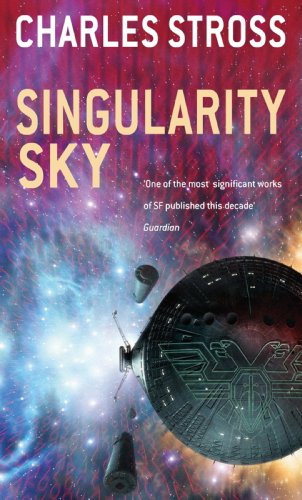
* The economic effects of a 'Magic Box' (a cornucopia machine) were humorously imagined by Charles Stross in his SF novel, 'Singularity Sky' (2008).