"Bitcoin was created by libertarian-minded programmers with a deep suspicion of central banks and the national currencies they issue.Inter-bank settlements and a means to ensure "a financial system that does not go down even if the central bank’s computer systems are temporarily taken offline," seem to be important drivers.
"Yet it is central banks that are doing some of the most ambitious work of late in trying to harness the technology introduced by Bitcoin.
"The central bankers do not want their institutions to own or use Bitcoin itself. Instead, they hope they can use the decentralized method of record-keeping introduced by Bitcoin — known as the blockchain or distributed ledger — to complete and record transactions in the real economy more efficiently, quickly and transparently.
"The most enthusiastic central banks — including the Bank of England and the People’s Bank of China — have discussed issuing their national currencies onto some sort of distributed ledger, a name that comes from the concept of several parties keeping records simultaneously.
"Blockchains allow several players to keep a shared spreadsheet using cryptography and so-called consensus mechanisms that provide a way to agree on which transactions happened at what time.
"For the central banks, the promise of the technology is that it would allow them to track every pound or renminbi on every step of its travels through the financial system in real time — something that is impossible now. The goal would be to make the financial system more transparent, fast, efficient and secure.
"If the central banks succeed, it would be one of the greatest unexpected twists in new technology: An invention aimed at dethroning central banks and making it harder for money to be tracked instead ends up empowering those central banks and making money more easily traceable.
"The Bank of England has produced several research papers on the topic. One suggests that the economic benefits of issuing a digital currency on a distributed ledger could add as much as 3 percent to a country’s economic output, thanks to the efficiency it could offer."
Showing posts with label Blockchain. Show all posts
Showing posts with label Blockchain. Show all posts
Sunday, October 16, 2016
Bitcoin: the suits move in
From The New York Times (Oct 11th 2016) via Marginal Revolution: "Central Banks Consider Bitcoin’s Technology, if Not Bitcoin".

Friday, October 14, 2016
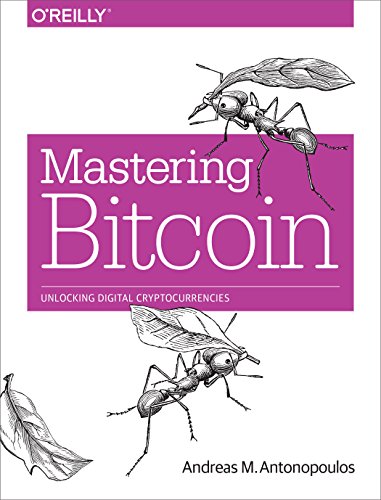
"Mastering Bitcoin: Unlocking Digital Cryptocurrencies"
 |
| Amazon Link |
Anything digital can be copied, indeed duplicated endlessly, while the Internet is full of bad people. It's clear that designing digital money to be exchanged anonymously over the public Internet was never going to be easy.
Bitcoin (and similar digital cryptocurrencies) have to solve a number of problems: security of the contents of your 'wallet', trust between buyer and seller, the integrity of the currency itself. Any robust solution is plainly going to be both complex and counterintuitive.
Bitcoin's key architectural innovation is the blockchain: a list of every transaction which has ever occurred. Transactions - as they occur - are broadcast across the peer-to-peer network, validated by each node, assembled (for a fee) by 'bitcoin miners' into a new block which is then rebroadcast (there's a kind of race to finish a new one), the new block being finally stacked by each full node onto its local copy of the ever-growing blockchain. The protocol provides mechanisms to ensure global consistency as divergences (forks) are quickly damped out.
Transactions are protected (signed) by private keys (permitting you to spend your own coins) and public keys - used to construct bitcoin addresses (like bank account numbers) to which payments are addressed, and also serving to validate signatures.
The mechanism is illustrated by this diagram from Satoshi Nakamoto's original short paper (PDF) which has taken me hours to properly understand.
 |
| The bitcoin chain of ownership |
There are endless overviews of bitcoin which handwave about how it works. You will never understand bitcoin that way, because the reason it works is in the detail. Andreas M. Antonopoulos's book contains that detail and is accessible if you already know about public key cryptography, cryptographic hashing and digital signatures.
The book itself is focused on developers - plenty of code examples - and is weaker on the overall architecture and those essential usage models. However, if you read it alongside Satoshi Nakamoto's original paper and the Wikipedia article on bitcoin, then you will get there -- and be both amazed and impressed.
Monday, October 10, 2016
Diary: blockchain + becoming a hipster
As mentioned in my previous post, I started reading the above thinking it would explain about Bitcoin, Ethereum and the blockchain. Sadly, I was mistaken. It's a business book with the same airy hand-waving that you get in popular science books 'explaining' quantum mechanics to the unwashed.
I decided I had to read this first (always O'Reilly!).
|
| Amazon link |
So far it's excellent although conceptually deep. You need to know about public key cryptography, digital signatures and hashing as prerequisites; I read with Wikipedia open on my other screen-based device (Base58? Remind me).
When I'm done with Mr Antonopoulos I'll return to Mr Mougayar.
Update: here's my "Mastering Bitcoin" review.
Bitcoin and similar have something else in common with quantum mechanics. Many people have a vague semi-familiarity with both topics (shared ledger, peer-to-peer; probabilities, collapse-of-the-wave-function-whatever-that-is) but to get to a proper understanding takes really significant hard work and the assimilation of a number of difficult intermediary concepts.
Finally, the student does 'get it':
"Finally I understand how [the blockchain; quantum mechanics] really works!"
And then they find they can't explain it to anyone who hasn't shared their arduous journey.
---
A Mummer's Farce
Could someone explain why BBC and ITV news presenters are using their facial expressions, tone of voice and body language to indicate the authorised emotional reaction to news items?
- "Donald Trump said ..." - the face contorts into refined distaste;
- "Refugees in 'The Jungle', Calais ..." - the face beams as if an indulgent relative;
- "Britain has just won another Gold medal at ..." - official joy, rejoice!
---
Hipster
"The hipster subculture is composed of affluent or middle class youth who reside primarily in gentrifying neighborhoods. It is broadly associated with indie and alternative music, a varied non-mainstream fashion sensibility, vintage and thrift store-bought clothing, generally progressive political views, organic and artisanal foods, and alternative lifestyles. The subculture typically consists of white millennials living in urban areas."I'm considering becoming a hipster. I already have the physique I think (do you like the new exercise bike?).
 |
| Amazon link |
The concept of 'hipster' is an example of what Wittgenstein called a 'language game'. There is no one set of necessary and sufficient defining conditions: you don't need to have your slim jeans rolled up or to wear a plaid shirt - although these things help. Nor do you need a beard (though that certainly helps!) or serve in an artisanal cafe, or be fascinated by all things wood.

Somehow I have to stop being my father: green Gore Tex anorak, beige trousers, dad-trainers (above). I won't get everything right: I can't imagine doing the rounds of the charity shops.
I think my lunge for full hipsterdom may start at a large Bristol department store.
Subscribe to:
Posts (Atom)