"In the nineties, moved by the new GOO (‘GOOd read’) classification in Camden public libraries, I devised my own classification scheme as follows.Sometimes you just need to switch off your intellect and enjoy a piece of page-turning escapism. If you are a science-fiction fan, you could do considerably worse than turn to B. V. Larson, for example his Undying Mercenaries series of exceedingly good-bad books.
Good-good books – the best of contemporary literary novels, plus classics which were best-sellers in their day and have withstood the passage of time: all engaging with the intellect, if ‘difficult’.
Bad-good books – pretentious and dreadfully boring, yet taken seriously by the occasional reviewer (usually a friend of the author) and funded by the Arts Council.
Good-bad books – intensely readable, unpretentious and seldom reviewed.
Bad-bad books – worthy only to be hurled into the corner or dropped in the bath."
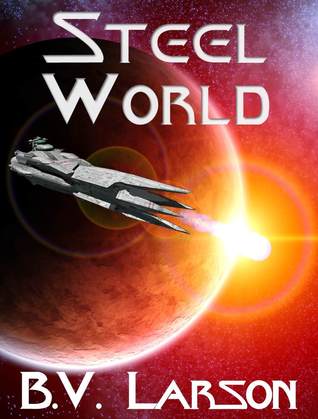 |
| The first volume ... |
Larson also writes insightfully about the craft of successful, self-published writing ("Advice Concerning the Self-Publishing Game ").
---
Steve Hsu has an interesting post on the interpretation of quantum mechanics (PDF here). Basically he does a good job of explaining where the many worlds interpretation comes from, and how decoherence plays a critical role in 'separating branches'. He then sheds a really clear light on the issue of 'where do the Born Rule probabilities come from?' concluding this is still an unresolved problem.
As a bonus, the comments feature the infamous Luboš Motl who is coaxed to clearly explain his own views on quantum reality. As a hard-line 'Copenhagenist', Motl appears to believe that reality is both ill-defined and lacks objective (classical-ish) reality in the absence of sentient observers - a highly counter-intuitive view for sure! Here is how he explains things:
"The conceptually right to describe a world without sentient beings is that an unspecified and unknown initial wave function evolves unitarily according to Schrödinger's equation and never collapses because it's only measurements that may collapse and there are none in your theory. The complete "diffusion" of the wave function (into the linear superposition of dead and alive cats and all objects, small and big, in the most general superpositions of all conceivable states) may be said to be a problem - but another problem is that the initial state is totally unknown, too.This is all accessible to anyone who has taken and understood QM at an undergraduate level.
"It makes no sense to say that the initial wave function is a particular thing because one may only say that the wave function is a particular thing [if] something is [a] measurement - if a sentient being becomes aware of the result of some measurement. This is not happening in a universe without sentient beings. So there's no specific science to discuss in a universe without sentient beings at all. The laws may still be the same as they are in our world but they won't be applied in any particular situation because there are no particular situations or particular special wave functions in a world where no one ever measures anything.
"Einstein asked whether there is any Moon over there if no one looks. In practice, classical physics is a good enough approximation, so one may assume that the Moon is pretty much there even before observers look etc. But conceptually, if you care about similar objects for which the quantum effects are strong, the right answer is that the Moon just isn't at any particular location and has no other particular properties if no one looks. The wave function isn't a real object of any type. Its amplitudes can't be measured in a single repetition of the situation. It is only a template storing information allowing to predict probabilities of things that actually can be measured - the observables."
