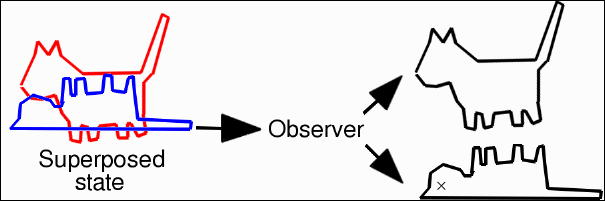
What the two slit experiment tells us about decoherence
1. The set-up: what we actually observe
In the double-slit experiment we send electrons (or photons, or atoms) one at a time towards a screen. Each run gives a single, localised dot on the screen. Nothing like an “interference pattern” is visible in any single event. The pattern is an ensemble fact: if we repeat the experiment many times with identically prepared electrons, the histogram of impacts converges to a stable probability distribution, and that distribution shows fringes.
This is worth stating bluntly because it stops us from talking nonsense about “seeing the wavefunction”. We never do. We infer the correct quantum description from stable statistics across many runs.
2. The state-vector description without which-path information
Let the electron’s relevant alternatives after the slits be the two emerging wavepackets, one associated with the left slit and one with the right. Call these states |L> and |R>. In the ideal symmetric case, immediately after the slits the electron is in the superposition
|ψ> = (1/√2)( |L> + |R> )
Let |x> represent a position eigenstate on the detection screen. Define the two complex amplitudes
The last two terms are the interference (cross) terms. They carry the relative phase information between the left and right alternatives. With those terms present, we get fringes.
3. Add the simplest possible which-path detector: one bit of memory
Now introduce the simplest imaginable which-path detector. Model it as a two-state system (call it a “bit” if you like) with orthonormal basis states |0> and |1>. Assume it starts in |0>. The coupling at the slits is defined as follows:
If the electron takes the left slit, flip the bit. If it takes the right slit, leave it alone.
In symbols, the interaction implements the correlations
|L>|0> → |L>|1> and |R>|0> → |R>|0>
This is entirely unitary: a controlled operation. Now apply linearity to the incoming superposition. The combined system (electron + detector) evolves as
This is the whole mechanism of decoherence in miniature. There is no mysterious “collapse” here. The total state |Ψ> is a perfectly good, pure state. But the electron by itself is no longer in a pure superposition. It is entangled with something that stores which-path information.
4. The exact calculation: how the interference term disappears
We now compute the probability P(x) of finding the electron at position x on the screen without conditioning on the detector. That “without conditioning” clause is crucial. In a normal experiment we do not read out every microscopic environmental degree of freedom. We just look at the screen.
First compute the environment-valued amplitude:
<x|Ψ> = (1/√2)( <x|L>|1> + <x|R>|0> )
So
<x|Ψ> = (1/√2)( ψL(x)|1> + ψR(x)|0> )
This is not a single complex number. It is a vector in the detector’s two-dimensional Hilbert space. The probability of a hit at x, ignoring the detector outcome, is the squared norm of that vector:
But the cross terms vanish because the detector states are orthogonal:
<1|0> = <0|1> = 0
Therefore
P(x) = (1/2)( |ψL(x)|2 + |ψR(x)|2 )
That is the incoherent sum of the two single-slit contributions. No fringes.
The key point is almost embarrassingly simple once you see it: the two “paths” no longer contribute amplitudes that add as complex numbers. They contribute orthogonal vectors in the detector/environment space. Orthogonal vectors do not interfere; their norm squares add.
5. Partial which-path information: fringes fade rather than vanish
A real detector need not be perfectly sharp. Suppose the detector ends up in two (possibly non-orthogonal) states |dL> and |dR>, with overlap
γ := <dR|dL>
The joint state is
|Ψ> = (1/√2)( |L>|dL> + |R>|dR> )
Run the same calculation and the probability becomes
The interference term is suppressed by γ. If γ ≈ 1 (detector states essentially identical) you recover full interference. If γ ≈ 0 (detector states orthogonal) the fringes disappear. This is the precise mathematical meaning of the informal claim that decoherence “washes out” interference.
6. What this does and does not explain
This little model lays bare what decoherence actually buys you:
It shows, in purely unitary quantum mechanics, how creating a record of which path was taken eliminates interference in the local statistics on the screen.
It explains why a macroscopic environment is so effective: overlaps like γ are driven rapidly towards zero when records are amplified into many degrees of freedom.
But it also shows what decoherence does not do by itself. It does not tell you why, in one particular run, the electron hit this pixel rather than the adjacent one. Decoherence explains the emergence of classical-looking probability distributions; it does not, on its own, settle the “single outcome” question. That is a separate interpretive problem, and it’s best kept separate if you want conceptual hygiene.
7. The minimal takeaway
The double-slit experiment doesn’t merely illustrate “wave–particle duality” in the popular-science sense. It gives you the cleanest possible laboratory for the central idea of decoherence:
Interference requires not just a superposition in the system, but the absence of distinguishable records in the environment.
Once a which-path record exists—even a single bit—the cross terms that generate fringes are multiplied by an environment overlap that becomes (effectively) zero. The interference pattern dies at the level of ensemble statistics, even though the total state vector of system plus environment remains perfectly coherent.
Block Time, Many Worlds, and Why Tomorrow Resembles Yesterday - Mostly
If we combine two ideas that are often kept in separate conceptual boxes - the block universe of eternalism, and the Everettian “many worlds” account of quantum uncertainty - a question naturally follows. If the universe is a fixed four-dimensional whole, and if quantum events constantly branch reality into a plurality of decoherent futures, why doesn’t the world look, at the large scale, like a riot of amplified randomness?
Why does the past, looking backwards from here, present itself as overwhelmingly law-governed and almost pedestrian in its Newtonian-style determinism? And if that is what the past looks like, shouldn’t we expect the future, in almost all respects, to have the same look and feel despite its underlying quantum indeterminacy?
On the surface, this seems like a tension. “Many worlds” is habitually sold with a kind of metaphysical euphoria: infinite branching, limitless divergence, cosmic roulette. Yet our lived-history has never felt like roulette.
Most days contain no miracles, no macroscopic quantum surprises, no sudden turn of events caused by a radioactive atom choosing left rather than right. The planets keep their appointments; bridges don’t randomly fail because of a quantum coin-flip; people mostly continue being the sorts of people they were last week. Looking back, the macro-past seems more like a classical trajectory with occasional noise than like a random walk whose steps were decided by quantum dice.
The first thing to say is that, in Everett, the deep story is deterministic anyway - just not in the way we are used to. The universal wavefunction evolves unitarily: nothing “collapses”. There is no fundamental stochastic law picking a single outcome. The branching is not indeterminism in the global dynamics; it is the proliferation of effectively non-interfering sectors. What feels like chance from inside a branch is not a God’s-eye randomness but a self-location problem: which decohered continuation will I find myself in? From 'outside', the entire branching structure is fixed; from within, one experiences merely uncertainty about one’s address inside it.
That already blunts the popular intuition that “many worlds” ought to generate a future that is macroscopically erratic. Branching is constant, but meaningful divergence is not. Most quantum events do not amplify into macroscopic differences; they thermalise, cancel, or remain trapped in degrees of freedom that never climb the ladder of scale. Decoherence does not inject chaos into the classical world; it does almost the opposite. It explains why quasi-classical “pointer states” are stable, why macroscopic objects persist, why a chair remains a chair, why the classical description becomes such a good effective theory for large aggregates. The world looks classical because, for most practical purposes, it is.
It is worth stating an underappreciated symmetry here: what we now call “the past” was once, from some deeper-past vantage point, the future. The difference between “past” and “future” is not that one is ontologically settled while the other is metaphysically open; it is that we are embedded - instance by instance - at particular locations in the block.
In a block universe, every event is future-ward relative to earlier slices and past-ward relative to later ones. So if the world’s quantum branching had a natural tendency to erupt into large-scale caprice, we would already see that eruption when we look backwards - because the macro-history we inhabit has already run the gauntlet of being “the future” for countless earlier observers. The fact that it still reads, at human scale, as orderly is evidence that the branching is mostly hidden by the same structural constraints that will hide it tomorrow.
There is also the brute constraint of low-entropy initial conditions — the Past Hypothesis in its various guises. The universe’s special beginning does not merely explain the arrow of time; it also massively limits which macroscopic histories carry significant weight.
Wild, spectacularly diverging macroscopic histories exist as mathematical possibilities inside the universal wavefunction, but most of them are thin as mist in Born measure. The block is thick where the classical narrative is thick: regularities, stable structures, robust thermodynamic flows. The “tree” branches constantly, but almost all of the branch weight is clustered in futures that differ only in microscopic details and wash out at human scales.
So the rephrased answer is this: the reason the past looks largely deterministic is not that quantum randomness never happened, but that it almost never mattered at the scale we care about.
The macro-world is an emergent attractor: it is what you get when you coarse-grain a quantum substrate under decoherence and thermodynamics. And if that is what happened in the past, then in a block universe the future is not poised to suddenly become a carnival of amplified quantum accidents. The future block is “already there” in the same sense the past is already there - with branching built in, but with most branches differing only in trivial microscopic ways.
None of this denies that amplification can happen - it can: evolutionary contingency, threshold phenomena in neurobiology, chaotic systems near bifurcation points, rare catastrophic events. But even there, the range of viable macrostates is narrow, selection effects prune hard, and the world remains governed by constraints and regularities rather than by caprice.
Everett does not imply a future that is wildly branching in any humanly vivid way.
---
The Moon Through a Quantum Slit: A Tutorial on Decoherence
“Do you really believe the moon is not there when you are not looking at it?” asked Einstein, not as a joke but as a pointed challenge to the Copenhagen interpretation of quantum mechanics. His question, outrageous on its face, becomes a gateway to deeper understanding when framed in a modern context: what is the quantum state of the Moon, and how does it compare to the far more familiar example of the double-slit experiment with electrons?
1. The Electron: Superposition and Interference
In the classic two-slit experiment, an electron passes through a barrier with two slits and arrives at a screen. If no which-path information is obtained, the electron behaves as if it passed through both slits simultaneously. Its wavefunction can be written as:
ψ(x) = ψL(x) + ψR(x)
Here, ψL(x) and ψR(x) represent the amplitudes associated with the electron taking the left or right path, respectively. Because the total wavefunction includes both paths with a definite phase relationship, the probability of arrival at the screen is:
P(x) = |ψ(x)|2 = |ψL(x) + ψR(x)|2
This leads to interference fringes. The key point: the off-diagonal terms in the corresponding density matrix are non-zero, encoding the ability of different parts of the wavefunction to interfere.
Now suppose we introduce a detector near the slits that reveals which path the electron took. This need not involve a conscious observer — a passing photon that scatters differently depending on the slit will do. The environment becomes entangled with the electron’s path, and we must describe the system using a density matrix.
Before decoherence, the electron is in a coherent superposition, and the density matrix contains both diagonal and off-diagonal terms:
The cross-terms — the last two in the sum — are responsible for interference. When decoherence occurs due to environmental entanglement, these terms vanish:
ρ(x, x') = ψL(x)ψL*(x') + ψR(x)ψR*(x')
This is the density matrix of an incoherent mixture. The result on the screen is two overlapping Gaussians — no interference fringes. The electron has gone from a coherent superposition to a statistical ensemble of alternatives.
3. The Moon’s Wavefunction: Before Decoherence
Now consider the Moon. Its quantum state can, in principle, be described by a wavefunction over position:
|Ψ⟩ = ∫ ψ(x) |x⟩ dx
Before any environmental interaction, this state is a pure superposition over all possible locations — an enormous analogue of the electron's pre-interference wavefunction. It contains the possibility (however implausible) of interference between different Moon positions. But this is not merely philosophical: it is exactly what the formalism demands of an isolated system.
If you were to construct a cosmic interferometer (an absurd idea, but conceptually helpful) that could recombine the Moon’s positional components, you might — in this counterfactual universe — see interference patterns between macroscopically distinct locations.
If you could run identically-prepared copies of the Moon through the interferometer!
4. After Decoherence: The Real Moon
But the Moon is not isolated. It interacts constantly with photons, gravitational fields, neutrinos, and the cosmic microwave background. These interactions entangle the Moon’s spatial wavefunction with vast numbers of environmental degrees of freedom. The result is rapid decoherence.
The Moon's reduced density matrix in the position basis becomes:
ρ(x, x') ≈ 0 for |x - x'| > ℓD
where ℓD is the decoherence length — often far smaller than an atomic radius. This means that the Moon’s wavefunction becomes a statistical mixture of narrow, localised wave-packets — each one a quasi-classical state. The off-diagonal terms responsible for interference have vanished, and with them, any possibility of observing non-classical motion.
This is mathematically and physically different from a coherent quantum superposition. The wavefunction is no longer "wavy" across great distances. It has become a cloud of classical possibilities, each encoded by its own amplitude-Gaussian, each decohered from the others, evolving independently as if in separate worlds or branches.
5. So What’s the Difference?
You might ask: if there’s only one Moon, and we can’t do a million trials like in the electron case, what’s the real difference between pre- and post-decoherence? Isn’t this all semantics?
No — the distinction is real, even if it's experimentally inaccessible. In principle:
Before decoherence, interference between locations is possible (though fantastically improbable to observe).
After decoherence, such interference is physically impossible. The phase relations have been irreversibly scrambled into the environment.
The Moon has gone from being “quantum-coherent but unrealistically so” to being “effectively classical,” and this transition has nothing to do with human observation. The universe itself, via its environment, acts as the ever-watchful observer.
6. Conclusion
The Moon and the electron are not as different as they seem. Both obey the same quantum rules. What separates them is not metaphysics, but scale and entanglement. The electron lives in a regime where interference is feasible. The Moon lives in a regime where decoherence is overwhelming.
The density matrix shows us this difference with clarity. Where the electron's matrix has off-diagonal terms — the mark of quantum interference — the Moon's does not. And that is why we see fringes on a screen for the one, and lunar eclipses for the other.
The Moon and Measurement: Einstein's Question Revisited
“Do you really believe the Moon is not there when you are not looking at it?”
Einstein’s famous quip was no mere rhetorical flourish. It was a technical objection to the implications of quantum mechanics, directed at the Copenhagen view that unmeasured observables possess no definite values. He was objecting not just to philosophical idealism, but to the notion that physical entities as massive and permanent as the Moon could, in any serious sense, lack a determinate position until observed. For Einstein, such an idea was a reductio ad absurdum of quantum orthodoxy.
The technical heart of his concern lies in the quantum treatment of position and momentum. Quantum theory does not assign definite values to these quantities simultaneously. The best one can obtain is a wavefunction or density matrix encoding a probabilistic distribution, constrained by the uncertainty principle. So what, then, is the Moon's quantum state when no one is measuring it?
To sharpen the issue, let us consider a thought experiment: imagine a Moon entirely isolated from its environment — no light, no gravity gradients, no cosmic radiation, no air molecules. A true quantum island. Suppose we measure its position very precisely at time t = 0, localising its wavefunction into a very narrow peak in the position basis. We have collapsed it into something close to a position eigenstate.
From this point forward, if the Moon is truly isolated, it evolves according to the unitary Schrödinger equation. But a position eigenstate is not a stationary state of the free Hamiltonian — it contains a wide spread of momenta. The result is that the wavefunction begins to spread over time. The Moon’s centre-of-mass position becomes increasingly uncertain as its wavefunction expands. This is not unique to the Moon — it is observed in experiments with electrons, atoms, and even large molecules like buckyballs in quantum interference setups. It is the standard behaviour of a delocalised quantum object.
If we now wait long enough (in practice way longer than the age of the universe for an object the Moon's size) — again, ignoring all interactions — and perform a second position measurement, quantum mechanics says we could in principle find the Moon almost anywhere compatible with its initial momentum spread. Perhaps on the far side of the Earth from where it was first observed. This is not classical orbital motion: this is pure quantum uncertainty in the absence of localisation, an indication that like bound electrons, in this scenario the moon does not really orbit classically. In effect, the Moon's wave function jumps on observation (to a new positional eigenstate).
Repeated measurements could reveal positions all around its orbital path, disconnected from any classical trajectory. It is absurd, and yet entirely within the predictive structure of quantum theory — if the Moon is isolated and we would wait long enough.
But of course, it never is. The Moon is bathed in photons from the Sun, bombarded by particles from cosmic rays, and continuously interacting with the Earth’s gravitational field. These environmental interactions entangle the Moon’s quantum state with the rest of the universe. This is decoherence.
Decoherence is the process by which the off-diagonal elements of the Moon’s reduced density matrix — representing quantum superpositions between macroscopically distinct positions — decay rapidly. The key result from decoherence theory is that such superpositions do not persist for large systems. The Moon’s enormous mass and surface area make it highly susceptible to environmental measurement. Even photons from the cosmic microwave background — with energy on the order of microelectronvolts — suffice to localise its position in femtoseconds.
If you model the Moon as a sphere of radius 1,700 km exposed to the 2.73 K CMB, you can estimate that over 1030 photons strike it every second. Even if only a minuscule fraction scatter coherently, the decoherence timescale for a 1 cm position superposition is vanishingly small: 10–20 seconds or less. And that is the most conservative estimate, not including solar photons, infrared thermal emission, and gravitational interaction with the Earth. The Moon is, in quantum terms, being continuously measured by the universe.
This constant decoherence dynamically selects a preferred basis — the so-called pointer states — which are robust under environmental monitoring. These states are highly localised in both position and momentum: quasi-classical states. The result is that the Moon appears, and indeed behaves, as though it always has a definite position and trajectory. Decoherence does not require human observers, nor does it invoke collapse. It merely shows that the rest of the universe acts as a measuring apparatus.
Einstein’s rhetorical question still stands, but it has a modern answer. Yes, the Moon is “there” when we are not looking — not because quantum mechanics gives it a determinate position by fiat, but because the environment ensures its continual localisation. The Moon does not jump, because the cosmos is watching.
In a previous post, we explored how the Saturnian moon Hyperion—thanks to its chaotic rotation—provides a vivid case study for how classical unpredictability collides with quantum indeterminacy. But what stops us from encountering Hyperion in a state where it's simultaneously in multiple orientations? Why does it always appear to us as a moon tumbling this way or that, but never in some bewildering quantum blur?
The answer lies in decoherence. And in the context of the Many Worlds Interpretation (MWI), decoherence is not a marginal side effect—it’s the mechanism that gives structure and observational content to the branching wavefunction. Without decoherence, the wavefunction evolves but remains unstructured. With decoherence, the wavefunction evolves into effectively distinct classical histories.
1. Superposition: What It Is and Isn’t
A quantum system is said to be in a superposition when its state vector is a linear combination of eigenstates of some observable. For instance:
|ψ⟩ = α |A⟩ + β |B⟩
This is a statement about the system’s state in configuration space, not a claim about what one sees in any individual measurement. Upon observation, the system yields a single outcome—|A⟩ or |B⟩—with probabilities determined by the squared moduli of the coefficients. There is no such thing as “observing a superposition” in a single event.
Superposition is not a visual phenomenon, nor does it correspond to a macroscopic body appearing in multiple classical states at once. Rather, it is a mathematical descriptor of how the system's amplitudes are distributed across its configuration space.
2. Interference and Its Prerequisites
Interference is a physical phenomenon, not a formal one. It arises when different components of a quantum superposition recombine in such a way that their relative phases affect the probabilities of measurement outcomes. Interference can only be detected through statistical regularities in ensembles of measurements—such as the classic fringe patterns in a double-slit experiment with electrons.
A single electron does not interfere. Only an ensemble of identically prepared electrons, evolving through identical dynamics, can display interference effects.
For a system like Hyperion, there is no physical possibility of preparing an ensemble of identically initialised moons in the same quantum state. We cannot rerun the universe multiple times with Hyperion in the same chaotic quantum configuration. Consequently, even if Hyperion's quantum state becomes a superposition of orientations, there is no operational method by which interference effects between those orientations could be revealed.
3. Decoherence and the Emergence of Classicality
Hyperion is constantly interacting with its environment—sunlight, cosmic radiation, thermal photons, gravitational tides. These interactions cause decoherence: a process whereby phase coherence between components of the system’s wavefunction (expressed in a specific basis) is effectively destroyed by entanglement with environmental degrees of freedom.
This doesn’t collapse the wavefunction. Instead, it causes the system’s reduced density matrix to become diagonal in a preferred basis—typically one aligned with classical observables such as position or orientation. The states in this basis, called pointer states, are those that remain stable under environmental interactions. Because most interactions are local, the environment couples most strongly to position, making position eigenstates the natural classical basis.
In configuration space terms: decoherence suppresses the off-diagonal elements of the density matrix in the basis of classical configurations. This renders the quantum state a statistical mixture of distinguishable macroscopic states—each evolving independently. Hyperion’s rotational state, initially a quantum object, becomes a set of non-interfering classical alternatives, each entangled with a different environment.
4. Many Worlds Needs Decoherence
In the Many Worlds Interpretation, the universal wavefunction never collapses. All components persist. But without decoherence, there is no way to carve that wavefunction into meaningful branches—no structure of “worlds” that match the experienced classical order.
Decoherence solves this by defining the dynamical conditions under which different components of the wavefunction become mutually inaccessible. It ensures that each branch contains a consistent classical history, unpolluted by phase interference from others. In short: decoherence provides the effective disconnection that makes classical-looking worlds emerge from a fundamentally quantum substrate.
5. What We Don’t See
So when we say “we don’t see macroscopic superpositions,” we do not mean that there are such things which evade our detection, nor that a superposition is something you might glimpse like a ghost. What we mean—more precisely—is this:
We never observe interference effects between macroscopically distinct configurations, because we cannot prepare ensembles of systems like Hyperion in the same quantum state, and because environmental decoherence renders such interference physically inaccessible, even in principle.
The wavefunction may formally contain many such components—different orientations of Hyperion, for instance—but those components no longer interact. Their relative phases are scrambled into environmental degrees of freedom, never to return. In effect, the branches of the wavefunction become autonomous classical narratives.
6. Final Reflection
Hyperion is not both “this way” and “that way” until observed. Its quantum state evolves as a linear combination of possibilities, but decoherence ensures that these possibilities become mutually opaque long before any observation is made. There is no mystery in why we observe it in a single orientation. The mystery lies in how classicality emerges at all from the linear formalism of quantum mechanics—and decoherence is the key that makes that transition intelligible.
So the moon tumbles on, a chaotic fragment of ice and rock, participating silently in the cosmic branching of possibility. And yet, each time we train a telescope on it, we find a world that has—reliably and quietly—made up its mind.
The Saturnian moon Hyperion is often cited as a natural example of quantum chaos, and it has played an interesting role in debates about the quantum-classical boundary—especially regarding decoherence and the role of the observer.
1. Classical Chaos in Hyperion's Rotation
Hyperion is a small, potato-shaped moon of Saturn. It rotates chaotically: that is, its axis of rotation wobbles so much that its orientation in space becomes unpredictable, because:
It is non-spherical, so torques from Saturn’s gravity are complex and time-dependent.
It is in an eccentric orbit, and experiences perturbations from other moons (notably Titan, with which it is in a 3:4 orbital resonance).
These features lead to chaotic tumbling: Hyperion’s rotational phase changes in a way that is exponentially sensitive to initial conditions—the hallmark of classical chaos.
This is a classic example of a "three-body problem" in celestial mechanics, where the interactions between Saturn, Titan, and Hyperion make it impossible to predict Hyperion's orientation more than a few months in advance. The system's "Lyapunov time" (the timescale over which small uncertainties in initial conditions become large, unpredictable differences) for Hyperion's rotation is about 30 days.
So far, all of this is standard Newtonian mechanics.
2. Quantum Analogue: Quantum Chaos
In quantum mechanics, the classical concept of chaos doesn’t apply straightforwardly. Schrödinger’s equation is linear and unitary; it doesn’t permit the divergence of trajectories in the classical sense. Nevertheless, we can still ask: what happens to the quantum state—the wavefunction—of a classically chaotic object like Hyperion?
In 1995, physicists Wojciech Zurek and Don Paz explored this question by modelling Hyperion as an isolated quantum system—neglecting environmental interactions for the sake of analysis.
3. The Argument: Delocalisation of the Wavefunction
In quantum mechanics, a system is described by a wavefunction that evolves deterministically over time. For macroscopic bodies like Hyperion, this wavefunction is typically sharply peaked in configuration space (that is, over classical variables like orientation), which allows us to approximate the system as behaving classically.
But for a chaotic system, Zurek showed that the wavefunction becomes delocalised in configuration space—though the underlying spreading is best understood via the system’s evolution in classical phase space.
Specifically:
The wavefunction describing Hyperion’s rotational degree of freedom spreads exponentially over time.
Within roughly 20 years (some estimates suggest even less), the quantum state becomes widely spread over many possible orientations.
However, this spreading doesn’t lead to any observable interference, because the orientations become effectively non-overlapping in configuration space.
This is counterintuitive: the quantum state of Hyperion does not converge toward a classical trajectory but becomes a superposed, delocalised object. Yet we always observe Hyperion in a definite orientation.
4. The Role of Decoherence
The missing element is decoherence.
In reality, Hyperion is not isolated. It constantly interacts with its environment—sunlight, cosmic rays, thermal radiation, and so on. These interactions entangle the moon’s quantum state with vast numbers of environmental degrees of freedom.
Before continuing, you may wish to review this tutorial on the density matrix.
Decoherence causes the off-diagonal terms in Hyperion’s reduced density matrix (in the orientation basis) to rapidly vanish. In effect, the quantum coherence between different orientations becomes inaccessible—even in principle—because the environment has recorded “which orientation is which.”
This does not collapse the wavefunction or select a unique outcome. The total system—Hyperion plus environment—remains in a superposition of different orientation branches, each entangled with a corresponding environmental state. But from the perspective of any internal observer, each branch evolves as if the others do not exist.
So decoherence explains why Hyperion behaves as if it were in a definite orientation, even though its quantum state remains a superposition. It renders the alternatives mutually non-interfering.
5. Philosophical Bite: Many Worlds or Collapse?
What we make of this depends on how we interpret quantum mechanics:
In the Many Worlds Interpretation (MWI), each decohered orientation corresponds to a separate branch of the universal wavefunction. All still exist. Decoherence tells us where the branches are.
In collapse models, decoherence helps explain why collapse appears to occur in a specific basis—typically position or orientation—but collapse itself must still be postulated separately.
Either way, decoherence does not explain why one result occurs, but it does explain why we see stable classical behaviour, and why interference between macroscopically distinct outcomes never appears.
6. So, Is Hyperion in a Superposition?
Yes—prior to any observation, Hyperion remains in a quantum superposition of rotational states. Decoherence does not change this. It only ensures that these components are entangled with distinct environmental records and that their interference effects (if any) are physically unobservable.
This is not a superposition that could be revealed by measurement—because there’s no way to prepare an ensemble of Hyperions in the same quantum state, nor to recombine the branches. The superposition is real, but inaccessible.
7. Final Thought: Quantum and Classical Chaos
Hyperion’s case illustrates that:
Classical chaos amplifies quantum uncertainty by exponentially spreading the wavefunction in configuration space.
Decoherence suppresses quantum interference, producing the appearance of classical spacetime behaviour.
The interplay of these two effects is central to understanding how the classical world emerges from quantum mechanics.
It remains one of the clearest examples of where quantum theory touches the macroscopic world—not through spooky paradoxes, but through the subtle mathematics of entanglement, entropy, and environmental indifference. A tumbling moon becomes a case study in the fragility of classicality itself.
In the next post we dig deeper into the role of decoherence in all of this.
Take a very simple physical system exhibiting decoherence. Perhaps involving the beta decay of an unstable nucleus in vacuum and its subsequent detection at a screen. I'm assuming that decoherence occurs as the electron interacts with the atoms (electron shells) of the screen.
Could you describe the situation, showing and explaining all logical steps?
How did the electron screen interaction vs non-interaction induce decoherence? How, in physics terms, was the superposition lost?
Gemini:
You might want to start by watching Sabine Hossenfelder's excellent video tutorial about decoherence. And then resume reading.
---
---
Let's break down in words how the electron-screen interaction, versus non-interaction, leads to decoherence and the apparent "loss" of superposition in physical terms.
The Essence of Decoherence in This Scenario
Imagine the electron is initially in a quantum superposition of "arriving at the screen" (∣A⟩) and "not arriving at the screen" (∣N⟩). Think of this like being in a quantum "both/and" situation regarding its path to the detector.
Before Interaction (Coherent Superposition)
Quantum Coherence: In the initial superposition (1/√2)(∣A⟩+∣N⟩)the electron is in a coherent superposition. This means the ∣A⟩ and ∣N⟩ components are not just alternatives, but they are quantum mechanically interfering with each other. If we were to perform a measurement that's sensitive to this superposition (not just measuring if it's in ∣A⟩ or ∣N⟩ individually, but something that probes the phase relationship between them), we would observe interference effects.
Environment is Ignorant: At this stage, the environment (the screen atoms) is in its initial state ∣E0⟩. It's essentially "ignorant" about whether the electron is in state ∣A⟩ or ∣N⟩. There is no correlation or entanglement between the electron and the environment yet.
During Interaction with the Screen (Entanglement and "Measurement")
Interaction as a "Measurement-like" Process: The interaction of the "arriving" electron (∣A⟩) with the screen atoms is crucial. Think of the screen as performing a kind of "measurement" on the electron. It's not a conscious measurement, but physically, the screen atoms are sensitive to the electron's arrival.
Environment Gets "Informed" (Entanglement):
If the electron is in state ∣A⟩ (arriving), the interaction changes the state of the environment from ∣E0⟩ to ∣E1⟩. This change could be excitation of atoms, ionization, momentum transfer, etc. Importantly, ∣E1⟩ is a different physical state of the environment compared to ∣E0⟩. The environment has now become "aware" that an electron in state ∣A⟩ interacted with it.
If the electron is in state ∣N⟩ (not arriving), we assumed for simplicity that the environment remains in ∣E0⟩. The environment stays "unaffected" or in its initial state.
Correlation is Created (Entanglement): Because of this state-dependent interaction, the system and environment become entangled. The final total state (1/√2)(∣A,E1⟩+∣N,E0⟩) shows that the electron's state is now correlated with the environment's state. If you know the environment is in state ∣E1⟩, you know the electron must have been in state ∣A⟩. If the environment is in ∣E0⟩, the electron must have been in state ∣N⟩.
After Interaction (Decoherence and Loss of Observable Superposition)
"Which Path" Information Leaks to the Environment: The crucial point is that the environment now contains "which path" information about the electron. The environment's state (∣E1⟩ vs. ∣E0⟩) effectively tells you whether the electron was in the "arriving" or "not arriving" path.
Observable Superposition for the Electron is Lost (Relative to Us Ignoring the Environment): When we perform the partial trace over the environment, we are mathematically averaging over or ignoring the environment's state. From the perspective of an observer who only looks at the electron and does not measure the environment, the electron's state appears to have changed from a pure superposition to a mixed state.
No More Interference (in the Reduced System): The off-diagonal elements in the reduced density matrix, which represented quantum coherence and the potential for interference, vanish. If we try to perform interference experiments on the electron alone (without measuring the environment), we will no longer observe the interference patterns we would have seen with the initial pure superposition.
Classical Mixture Emerges: The reduced density matrix
ρS=(½)(∣A⟩⟨A∣+∣N⟩⟨N∣)=(½)I
represents a classical statistical mixture. It's as if the electron is either in state ∣A⟩ with 50% probability or in state ∣N⟩ with 50% probability, but not in a quantum superposition of both for any observation we make that only involves the electron.
Analogy: "Quantum Spies"
Think of it like this:
Initial Superposition: The electron is like a secret agent who is in a superposition of two possible missions (state ∣A⟩ and ∣N⟩). As long as no one "observes" the agent's mission, it's truly in both possibilities simultaneously (quantum coherence).
The Screen as "Quantum Spies": The screen atoms are like "quantum spies" that are designed to interact differently depending on which mission the agent is on.
Entanglement = Spies Learn the Mission: If the agent is on mission ∣A⟩, the spies get "activated" and their state changes (to ∣E1⟩). If the agent is on mission ∣N⟩, the spies remain in their "dormant" state (∣E0⟩). Now, the state of the spies (environment) is correlated with the agent's mission.
Decoherence = We Ignore the Spies: If we, as observers, only look at the agent and completely ignore the "spy network" (the environment), the agent now appears to be in a mixed state. It's as if the agent has randomly chosen one mission or the other. We've lost the ability to observe the quantum interference that was present in the initial superposition, because the "which mission" information has leaked out into the environment ("spy network"), which we are ignoring.
In summary, the superposition is "lost" not in the sense that it disappears from the universe, but in the sense that the quantum coherence, and the associated interference effects, become unobservable when we focus solely on the system (the electron) and ignore the now-entangled environment (the screen). The "quantumness" of the superposition effectively bleeds out into the vast, uncontrolled degrees of freedom of the environment.
Nigel:
In this example of exactly one electron we could not measure an interference effect which, surely, would only show up in a pattern of repeated experiments? Does that suggest your response should be slightly nuanced or am I misunderstanding something?
Gemini:
You are absolutely right to point that out! My explanation, as it stands, is indeed slightly nuanced and needs further clarification regarding the role of single versus repeated experiments and how interference manifests.
Let me refine and nuance my response to address this correctly:
The Nuance: Interference and Repeated Experiments
Interference is inherently a statistical phenomenon, observed in patterns that build up over repeated experiments (or in ensembles). You are correct that a single electron, in isolation, will not produce an interference pattern. Interference patterns emerge from the collective behavior of many identically prepared quantum systems or from repeated measurements on systems prepared in the same initial state.
However, the quantum state (including superposition and coherence) exists for each individual electron. Even for a single electron in a superposition, say (1/√2)(∣A⟩+∣N⟩), that electron is in a superposition state.
The density matrix:
ρS(0)=(½)(matrix 1 1 1 1)
1/2
1/2
1/2
1/2
describes the state of this single electron. The off-diagonal elements indicating coherence are properties of this single electron's quantum state.
Decoherence acts on the quantum state of each individual electron. When we talk about decoherence due to the screen interaction, we are saying that for each electron that interacts with the screen in this way, its quantum state evolves from a coherent superposition towards a mixed state.
The loss of interference we discuss with decoherence manifests in the statistical pattern that would emerge over many repeated experiments. If we were to perform an experiment designed to reveal interference between the ∣A⟩ and ∣N⟩ paths (even in our simplified model), we would need to repeat the experiment many times with electrons prepared in the initial superposition.
Clarifying the Role of Repeated Experiments and Ensembles
Let's imagine we could design an experiment to test for interference between the "Arriving" (∣A⟩) and "Not Arriving" (∣N⟩) states. Think of it analogously to a double-slit experiment, but in our abstract "arrival state" space.
Without Decoherence (Ideal Scenario): If we could prepare many electrons in the initial superposition state ∣ψS (0)⟩=(1/√2) (∣A⟩+∣N⟩) and then perform a measurement designed to detect interference between ∣A⟩ and ∣N⟩, we would observe an interference pattern over many repeated trials. This pattern would be a consequence of the off-diagonal elements in ρS(0). The probabilities of different outcomes in our interference-sensitive measurement would be influenced by the coherence in the initial superposition.
With Decoherence (Screen Interaction): Now, let's introduce the screen interaction that causes decoherence. After each electron interacts with the screen and we trace out the environment, the state of each electron is described by the decohered density matrix
ρS =(1/2)(matrix 1 0 0 1):
1/2
0
0
1/2
If we now perform the same interference-sensitive measurement as in step 1, but now on electrons that have undergone decoherence, we would not observe the same interference pattern. The pattern would be washed out or disappear. This is because the off-diagonal elements, responsible for interference, are gone in ρS.
Analogy with Classical Coin Flips vs. Quantum Superposition
Think about flipping a coin many times:
Classical Mixture (like Decohered State): If we have a box of coins where half are pre-set to heads and half to tails, and we randomly pick a coin and flip it (without knowing beforehand if it's a "heads-set" or "tails-set" coin), and repeat this many times, we'll get roughly 50% heads and 50% tails. This is analogous to a mixed state. There's no interference, just statistical probabilities.
Quantum Superposition (like Coherent State): Imagine something more quantum. We prepare each electron in a true superposition state. Now, in our hypothetical interference experiment, we observe a pattern over many trials that is not just 50/50 for some measurement outcomes. It deviates from classical probabilities due to quantum interference. This is analogous to the initial coherent superposition.
Key Nuance Summary:
Decoherence affects the quantum state of each individual system, shifting it from a coherent superposition towards a mixed state.
Interference is observed in patterns that emerge from repeated experiments (or ensembles) because these patterns reveal the underlying probability distributions dictated by the quantum state.
Decoherence leads to a change in these statistical patterns. Interference patterns that would be present for coherent states are lost or diminished when decoherence creates mixed states.
Therefore, my initial response wasn't wrong in saying superposition is "lost," but it lacked the nuance that this loss is observed in the statistical patterns of repeated experiments, and that decoherence is a process acting on the quantum state of each individual system within such an ensemble. The density matrix formalism precisely captures this shift from a state capable of producing interference (coherent, pure) to one that is not (mixed, decohered) within an ensemble description, while being relevant for the quantum state of each individual system as well.
Nigel:
Thanks, but I'm still a little puzzled. If we kept track of all the environmental changes (or no change) - we might suppose the detector or screen was just a single atom - what changes? I'm guessing you're going to say that the electron and screen would together remain in a combined superposition (as they, in fact, do anyway).
I suppose my confusion is that keeping track of is not well-defined here. We don't want to add some third element, some macroscopic observer looking at both the electron and the screen and therefore themselves entering a superposition like an endless chain of Wigner's Friends!
I guess the core of my question is: what does it mean in this example, in physical terms, to disregard the possible changes in the environment? But I'm confused, so you are invited to straighten me out!
Gemini:
You've correctly identified a potential for confusion and are asking for a deeper physical interpretation of "disregarding the environment." Let's unpack this carefully:
1. System + Environment Remain in Superposition (Jointly)
You are absolutely right. If we consider the entire system – electron and screen (even if it's just a single atom) – they remain in a joint, entangled superposition after the interaction. In our example, this is the state:
∣Ψ(t)⟩=(1/√2)(∣A,E1⟩+∣N,E0⟩)
The total wavefunction is still a coherent superposition. No quantum superposition has been fundamentally destroyed in the universe. If we could, in principle, perform measurements on the combined system (electron and screen atom), we could still see interference effects that reflect this joint superposition.
2. "Keeping Track" = In Principle Measurable Correlation
"Keeping track" of the environmental changes means, in principle, having the ability to distinguish between the environmental states ∣E0⟩ and ∣E1⟩ and to correlate these environmental states with the system states ∣A⟩ and ∣N⟩.
If we could measure the environment perfectly: We could perform a measurement on the screen atom to determine if it's in state ∣E0⟩ or ∣E1⟩. If we found it in ∣E1⟩, we would know with certainty that the electron is in state ∣A⟩. If we found it in ∣E0⟩, we'd know the electron is in state ∣N⟩. In this ideal scenario, we could restore the "pure state" description, but it would be a correlated pure state of the combined system.
3. "Disregarding" = Choosing Not to Measure/Consider the Environment, Leading to Partial Trace
"Disregarding" the environment means we are consciously choosing not to perform measurements on the screen atom and are only interested in describing the state of the electron itself. This is a very common situation in physics. We are often interested in a particular system (like an electron, a molecule, a qubit) and its properties, without needing to track every single detail of its surroundings.
Mathematical Tool: Partial Trace: The mathematical operation of the partial trace (TrE) is the precise tool to describe this situation. It's designed to give us the quantum state of a subsystem when we are ignoring or averaging over the degrees of freedom of the rest of the system (the environment).
4. Physical Interpretation of Partial Trace: Loss of Local Information and Emergence of Mixed State
When we perform the partial trace, we are essentially:
Averaging over possible environmental states: We are considering all possible states of the environment that are consistent with our lack of measurement on it.
We don't know if the environment is in ∣E0⟩ or ∣E1⟩ (or some more complex state in a more realistic scenario). So we are averaging over these possibilities.
Losing the Off-Diagonal Coherences for the System Alone: The partial trace operation mathematically eliminates the off-diagonal terms in the system's reduced density matrix that were responsible for quantum coherence and interference relative to measurements on the system alone.
Analogy to Classical Probability and Ignorance
Think of classical probability. If you have two coins, and they are entangled in the sense that if coin A is heads, coin B is tails, and vice versa (perfect anti-correlation). The joint state is a pure, correlated state.
If you know the outcome of coin A, you know the outcome of coin B.
However, if you only look at coin A and ignore coin B, coin A will appear to be in a mixed state of 50% heads and 50% tails. You've lost the perfect correlation information by disregarding coin B. The "mixedness" reflects your ignorance about the state of coin B and the correlations.
Decoherence is analogous, but in the quantum realm. The electron becomes entangled with the environment. When we "ignore" the environment, the electron appears to be in a mixed state. The "mixedness" of the reduced density matrix for the electron reflects our ignorance of the environment's state and the electron-environment correlations.
5. No Wigner's Friend Paradox
The process of taking the partial trace and "disregarding the environment" does not lead to an infinite regress of Wigner's Friends. It's a well-defined mathematical operation that provides a consistent description of a subsystem of an entangled system.
Objectivity (but relative): The reduced density matrix ρS is an objective description of the state of the electron given that we are not measuring or considering the environment. It's not dependent on a "macroscopic observer" or consciousness. It's about the physical situation of entanglement and the choice of which degrees of freedom we are focusing on for our description.
Consistent Quantum Mechanics: Partial trace is a standard operation within quantum mechanics. It's not introducing any new interpretations or paradoxes. It's a tool to describe subsystems within the standard quantum formalism.
6. Physical Meaning of Disregarding – Information Leakage
Physically, "disregarding the environmental changes" means:
Information has leaked from the system to the environment: The interaction has caused "which path" information about the electron (was it ∣A⟩ or ∣N⟩?) to become encoded in the state of the environment (∣E1⟩ vs. ∣E0⟩).
We are choosing not to access this information: By tracing out the environment, we are effectively erasing our access to this "which path" information. For any measurements we perform solely on the electron, the outcomes will be consistent with a mixed state (no interference).
Classicality Emerges (Apparent): For the system alone, classical probabilities emerge. The quantum superposition, from the viewpoint of the system alone, has effectively "decohered" into a classical mixture.
Decoherence is not about destroying superposition in the universe. It's about how entanglement with an environment and our choice to focus on a subsystem leads to a relative loss of coherence for that subsystem. The "disregarding" of the environment, mathematically implemented by the partial trace, reflects our limited perspective and the leakage of information into unobserved degrees of freedom, resulting in the system appearing to behave more classically.
Your confusion touches on the core interpretation of decoherence. It's not about wavefunction collapse in the measurement sense, but rather about the practical disappearance of quantum interference for a system when it becomes entangled with a large, complex, and typically unmeasured environment.
A year ago I promised myself that I would continue chipping away at decoherence. During the last couple of days I reviewed "Demystifying decoherence and the master equation of quantum Brownian motion" by John King Gamble and John F. Lindner .. and I finally get the drift. My February resolution is to take up pen and paper and work through the details seriously rather than just superficially reading around it.
This is how Gamble and Lindner introduce their paper:
"The details of decoherence theory are sufficiently complicated to discourage students and physicists from other fields to pursue a basic understanding of decoherence. The available literature is aimed at an advanced audience and contains significant gaps for most physicists.
"In this paper we attempt to rectify this situation by making the underlying concepts associated with decoherence accessible to a more general audience. We begin in Sec. II by introducing the concept of a state operator, an object of central importance to quantum decoherence theory, through a simple example first developed by Bernstein. We consider a rudimentary universe consisting of quantum particles and an “environment” randomized by a roulette wheel, and show that this randomization leads to diagonalization of the state operator and the emergence of classical behavior."
Now that I have immersed myself in outer products, projection operators, density matrices and expected values, the wood is finally emerging from the trees.
---
My other resolution for February is to revisit "The Vital Question: Why is life the way it is?" by Nick Lane. Universally acclaimed as groundbreaking and brilliant (which it is), this book is not an easy read and has defied concise summarization.
Nick Lane explains how the first cell might have got going from inorganic precursors. This involves a detailed review of the most elementary mechanisms of cellular operation: membrane metabolism, protein synthesis, bioenergetics and cell-replication. In computer terms, it's like microprocessor analysis at the sub-gate level.
I am determined to internalise it sufficiently to write a proper review.
---
Clare and myself walked to Wookey Hole this morning under bright sunshine and a pure blue sky, accompanied by a chilly wind. On arrival at an empty Wookey Hole Inn we asked for hot chocolate. In my case this is always more in hope than expectation: the drink almost invariably arrives lukewarm.
And so it was to be. The young woman who made the drinks was interesting: Barbie looks - very slim; tight trousers with tucked-in top; an over-made-up, rather pinched face. She made an art form of failing to meet my eye, studiously talking in a peremptory fashion to points adjacent to my head. I said to Clare afterwards, "I doubt she'll last."
---
The Amazon elves have done their work and a big parcel arrived this morning. After the Xylitol chewing gum, perhaps the smallest entity in the box was this.
Julian Barnes' new novel recounts how Shostakovich survived Stalin (review). The book is for Clare, who studied the composer during her OU arts unit.
By far the heaviest constituent was the package of six large jars of sauerkraut you see above. I had watched one of those cute medical programmes featuring that doctor who is a twin and who has that beard and who tries stuff out .. and sauerkraut is apparently a superfood for your gut biome. Well, we here just love our gut biomes and so I decided they needed a treat.
I am waiting for Clare's smile of delight once she gets in from the garden and has had a chance to absorb (sic) this addition to our already rather over-stuffed pantry. A side-dish of sauerkraut, anybody?
---
This Zika virus never used to be so bad; it might have mutated. I was all doom and gloom over Ebola and yet, thankfully, the epidemic burned itself out before it hit Europe. Let's hope we get lucky again.
"In the nineties, moved by the new GOO (‘GOOd read’) classification in Camden public libraries, I devised my own classification scheme as follows.
Good-good books – the best of contemporary literary novels, plus classics which were best-sellers in their day and have withstood the passage of time: all engaging with the intellect, if ‘difficult’.
Bad-good books – pretentious and dreadfully boring, yet taken seriously by the occasional reviewer (usually a friend of the author) and funded by the Arts Council.
Good-bad books – intensely readable, unpretentious and seldom reviewed.
Bad-bad books – worthy only to be hurled into the corner or dropped in the bath."
Sometimes you just need to switch off your intellect and enjoy a piece of page-turning escapism. If you are a science-fiction fan, you could do considerably worse than turn to B. V. Larson, for example his Undying Mercenaries series of exceedingly good-bad books.
Steve Hsu has an interesting post on the interpretation of quantum mechanics (PDF here). Basically he does a good job of explaining where the many worlds interpretation comes from, and how decoherence plays a critical role in 'separating branches'. He then sheds a really clear light on the issue of 'where do the Born Rule probabilities come from?' concluding this is still an unresolved problem.
As a bonus, the comments feature the infamous Luboš Motl who is coaxed to clearly explain his own views on quantum reality. As a hard-line 'Copenhagenist', Motl appears to believe that reality is both ill-defined and lacks objective (classical-ish) reality in the absence of sentient observers - a highly counter-intuitive view for sure! Here is how he explains things:
"The conceptually right to describe a world without sentient beings is that an unspecified and unknown initial wave function evolves unitarily according to Schrödinger's equation and never collapses because it's only measurements that may collapse and there are none in your theory. The complete "diffusion" of the wave function (into the linear superposition of dead and alive cats and all objects, small and big, in the most general superpositions of all conceivable states) may be said to be a problem - but another problem is that the initial state is totally unknown, too.
"It makes no sense to say that the initial wave function is a particular thing because one may only say that the wave function is a particular thing [if] something is [a] measurement - if a sentient being becomes aware of the result of some measurement. This is not happening in a universe without sentient beings. So there's no specific science to discuss in a universe without sentient beings at all. The laws may still be the same as they are in our world but they won't be applied in any particular situation because there are no particular situations or particular special wave functions in a world where no one ever measures anything.
"Einstein asked whether there is any Moon over there if no one looks. In practice, classical physics is a good enough approximation, so one may assume that the Moon is pretty much there even before observers look etc. But conceptually, if you care about similar objects for which the quantum effects are strong, the right answer is that the Moon just isn't at any particular location and has no other particular properties if no one looks. The wave function isn't a real object of any type. Its amplitudes can't be measured in a single repetition of the situation. It is only a template storing information allowing to predict probabilities of things that actually can be measured - the observables."
This is all accessible to anyone who has taken and understood QM at an undergraduate level.
What problem does the "many worlds interpretation" try to solve? The core idea is captured by the infamous Schrödinger's cat thought-experiment. The cat ends up in a superposition:
but in reality we never observe such a superposition. What we see is either that the Geiger counter has triggered, releasing the poison and the cat is dead or there was no particle-emission and the cat remains alive. Making the act of measurement explicit, the observer becomes entangled with the cat-box on observation and joins the superposition thus (with updated amplitudes α' and β') :
α'∣Live cat> ⊗ ∣Observer sees live cat> + β'∣Dead cat> ⊗ ∣Observer sees dead cat>.
The overall situation is still a superposition, but an Everettian would say that since the observer has 'split', each 'copy' doesn't see a superposition but just one outcome. If world-splitting is not your thing, then you have to postulate (as an extra axiom) that 'measurement' somehow causes the superposition to collapse to one or the other outcome according to the probabilities |α'|2 and |β'|2.
We now focus more precisely on how the process of 'measurement' destroys superpositions - a topic called 'decoherence'. The formal treatment of decoherence involves graduate-level concepts and is formidably inaccessible, while analogies such as 'phase information leaking into the environment' are unhelpful at best. I will say more about a 'simplest possible model' another day.
"In theoretical QM, we usually focus on perfect systems, and pure states. We frequently say that a measurement “collapses” the quantum state vector to one agreeing with the measurement, and this is often a useful simplification of the measurement process. However, in practice, the measurement process is more complicated than that, because most measuring equipment, and all observers, are macroscopic. The “decohered” state is the norm; you must work hard to achieve even an approximately pure entangled state.
We show here that elementary QM can explain some of the features of real measurements, however, the full explanation of decoherence is beyond our scope. (The term “decoherence” has a specific meaning: the process of a system becoming entangled with its environment in irreversible ways, resulting in the loss of a consistent phase relationship between components of the system state. We therefore use the more general term “loss of coherence” for both decoherence and other processes.)
Most macroscopic measurements do not show quantum interference [as in the two-slit experiment]. Why not? One reason is that macroscopic bodies suffer unknowable, and unrepeatable energy interactions, i.e. they gain or lose an unknowable amount of energy due to uncontrollable interactions with their environments. In other words, they are subject to simple “noise.” This results in the loss of a consistent phase relationship between components of a superposition state. We discuss below how such a loss of consistent phase leads to classical probabilities.
Let us walk through a plausible measurement, and consider the elementary quantum mechanics involved. [The system pictured below shows the famous Stern-Gerlach experiment, which first demonstrated the quantization of angular momentum.]
Suppose we start with a particle which can be in either of two states, |s1> or |s2>, such as polarization
(horizontal or vertical), or spin (up or down). A general particle state is then:
|ψ> = a|s1> + b|s2> where a,b are complex coefficients and |s1>, |s2> are basis states.
This is called a coherent superposition, because a and b have definite phases. (This is in contrast to a
mixed state or incoherent mixture, where a and b have unknown phases.) All that is required for loss of
coherence is for the relative phases of a and b to become unknown. For simplicity, we take |s1> and |s2> to be energy eigenstates, and the particle is spread throughout our measurement system [i.e. it is in a spatial superposition].
According to the Schrödinger equation, every state time-evolves with a complex phase determined by its energy, then our 2-state system time evolves according to:
|ψ(t)> = ae-iE1t/ℏ|s1> + be-iE2t/ℏ|s2>.
Since the energies E1 and E2 are quantized, the complex phases multiplying |s1> and |s2> maintain a precise (aka coherent) relationship, though the relative phase varies with time.
When we measure the particle state, the state of the measuring device becomes entangled with the
measured particle. Let |M1> and |M2> be states of the whole measuring system in which either detector 1 detected the particle, or detector 2. If we look directly at the indicator lights, we will observe only state 1
or state 2, but never both. This means |M1> and |M2> are orthogonal. As the measuring system first detects
the particle, the combined state of the particle/measuring-device starts out as a coherent superposition: [this is the same as the Schrödinger's cat case above]
|Ψ> = c|M1>|s1> + d|M2>|s2> where c, d are complex coefficients.
The combined system time evolves according to its new energies:
If the energies of the two measuring device states fluctuate even a tiny bit, the two components of the
superposition will rapidly wander into an unknown phase relation. They will lose coherence.
Every macroscopic system suffers unrepeatable and unknowable energy fluctuations
due to its environment.
We estimate a typical coherence loss rate shortly.
[So what does this loss of phase coherence mean in practice?]. Let us examine the effects of various kinds of energy transfers between a system and its environment.
In our two-path experiment, [I think he means thatthis is a variant experiment where we don't 'look at' (i.e. measure) the indicator lights 1 and 2 so allowing the interference pattern to emerge on the screen in the figure to the right] the interference pattern is built up over many trials, by recording detections on
film. Now suppose one path suffers an energy transfer to/from its environment before recombining and
interfering. There are four possibilities:
The energy transfer is knowable and repeatable. Then one can predict and see an interference
pattern in the usual way.
The energy transfer is unknowable, but repeatable. Then we can record an interference pattern,
and from it, determine the relative phases of the two paths (mod 2π), and therefore the relative
energies (mod 2πħ/t) from (ΔE/ℏ)t.
The energy transfer is knowable for each trial, but not repeatable. Essentially, each trial has its
own position for the interference pattern. One can then divide the detection region into intervals
of probability calculated for each trial, and then show consistency with QM predictions, but
contrary to classical probability.
The energy transfer is unknowable and unrepeatable. Then there will be no interference pattern,
and repeated trials do not allow us to measure any quantum effects, since the phase is unknown on
each trial. Therefore, the measurements are equivalent to classical probabilities: it is as if a single
path was chosen randomly, and we simply don’t know which path it was.
This fourth condition, of unknowable and unrepeatable energy transfer, causes loss of coherence, the
randomization of phase of components of a superposition. Loss of coherence makes measurements look
like the system behaves according to classical probabilities, with no “wave” effects. Loss of coherence
destroys the interference pattern when we try to measure through “which slit” a particle passes. Full loss of coherence leads to classical probabilities.
Our example process leading to loss of coherence follows directly from the Schrödinger equation and
unknown energy transfers. There is no need to invoke any “spooky” quantum effects.
Note that even accounting for loss of coherence, quantum theory still requires the axiom of collapse of
the wave-function upon observation. When a particle’s wave splits, then passes through both detector 1
and detector 2, and then loses coherence because of entanglement with a macroscopic measuring device,
the system is still left in a superposition of both slits:
|Ψ(tafter)> = f|M1>|s1> + g|M2>|s2>
we just don’t know f or g. We can’t generate an interference pattern from multiple trials, because each trial
has a different phase relation between f and g, putting the peaks and valleys of any hoped-for interference
pattern in a random place on each trial. These shifts average over many trials to a uniform distribution.
Nonetheless, each trial evolves in time by the Schrödinger equation, which still leaves the system in a superposition. Once we “see” the result, however, the unobserved component of the wave-function
disappears, i.e. the wave-function collapses.
Collapse of the wave-function is outside the scope of the Schrödinger equation, but within the scope of
QM, because collapse is a part of QM theory. It is one of our axioms. Some references confuse this issue:
they try to avoid assuming such a collapse as an axiom, but cannot derive it from other axioms. From this,
they conclude that QM is “incomplete.” In fact, what they have shown is that the axiom of collapse
completes QM.
Note that once the measuring system fully loses coherence, we could just as well say that the wavefunction
has then collapsed, because from then on the system follows classical probabilities (equivalent to a
collapsed, but unknown, wave-function). However, we now show that a binary model of “collapse or not”
cannot explain partial coherence.
Partial coherence: What if we start with a microscopic system but replace
our microscopic atoms with mesoscopic things: bigger than microscopic, but smaller than macroscopic? Mesoscopic things might be a few hundred atoms. These are big enough to lose coherence much faster
than single atoms, but still slowly enough that some amount of interference is observed. However, the
interference pattern is weaker: the troughs are not as low, and the peaks are not as high. A superposition
leading to a weak interference pattern is called partially coherent. We describe partial coherence in more
detail in section 8.4. The simple model that the wave-function either collapsed or didn’t cannot describe
the phenomenon of partial coherence.
The larger the mesoscopic system, the more uncontrollable interactions it has with its environment, the
faster it loses coherence, and the less visible is any resulting interference pattern. We can estimate the
time-scale of coherence loss from our example energy fluctuations as follows: a single 10 μm infrared
photon is often radiated at room temperature. It has an energy of ~0.1 eV = 1.6 x 10⁻²⁰ J. This corresponds
to ω = E/ħ ~ 2 x 10¹⁴ rad/s. When the phase of the resulting system has shifted by an unknowable amount >
~2π, we can say the system has completely lost coherence. At this ω, that takes ~ 4 x 10–14 s. In other words,
thermal radiation of a single IR photon causes complete loss of coherence in about 40 femtoseconds. In
practice, other effects cause macroscopic systems to lose coherence in dramatically shorter times.
Summary: A measurement entangles a measuring device with the measured system. The entangled
state of device and system time-evolves according to the Schrödinger equation. Macroscopic devices lose coherence, due to interactions with the environment. Lack of coherence prevents any interference pattern within the system.
Therefore, measurement by a macroscopic device produces subsequent results that are classical, as if the
system collapsed into a definite state upon measurement, but observers only “see” which state when they
look at the measuring device. Any observation by a person is necessarily macroscopic, because people are
big. Such an observation collapses the (incoherent) device/system/world state to that observed. Quantum
interference can only be seen if it occurs before any entanglement with a macroscopic system (and
therefore before any loss of coherence in the system).
The model of “collapse of the wave-function” is a binary concept: either the wave-function collapses
or it doesn't. Such a model cannot account for the phenomenon of partial coherence. Loss of coherence is
a continuous process, taking a fully coherent state through less and less partially coherent states and
eventually to incoherent (aka “mixed”) states. Continuous loss of coherence fully explains partial
coherence and the varying visibility of interference patterns.
Some quantum effects, such as the spectrum of atoms, do not rely on interference, and are therefore
macroscopically observable. In fact, measurement of such effects led to the development of QM."