Showing posts with label Russia. Show all posts

Wednesday, January 21, 2026

Preparing for war: the next decade


Preparing for War

The social and political order that prevailed from the 1960s through to the end of the twentieth century was always going to break down. It rested on an historically exceptional configuration of power, one that was never sustainable. What many people mistook for a stable - almost natural - world order was in fact a temporary suspension of normal history.

For most of the twentieth century, China was effectively supine. Its economy was crippled by catastrophic policy choices, and it lacked the institutional and technological capacity to project power beyond its borders. Russia, meanwhile, stagnated, then collapsed outright at the end of the century, losing not just ideological coherence but its imperial structure. Europe emerged from the Second World War exhausted and strategically neutered.

The result was the American century: a brief period of uncontested global hegemony. The United States became the organising centre of the world system, militarily dominant, technologically pre-eminent, and economically indispensable. Europe was folded into this system as a subordinate but useful adjunct: politically compliant after the destruction of the Reich, economically productive, and strategically dependent. The so-called Pax Americana was not a peace between equals but an order held together by overwhelming asymmetry.

What later came to be described as the “rules-based order” was essentially a protocol for managing economic and political interactions under conditions of American dominance. It was never a neutral or universal framework. It worked because there were no peer competitors capable of challenging the United States at scale. That was its hidden precondition.

This situation was never going to last. Once China abandoned ideological economics and adopted policies aligned with growth, capital accumulation, and technological development, its rise to peer-competitor status was close to inevitable. A civilisation with 1.3 billion people, deep historical continuity, technological competence, and a disciplined state apparatus was always going to reassert itself once the self-inflicted constraints were removed. That point has now been reached.

Russia’s trajectory was different but equally predictable. Once the post-Soviet collapse stabilised and a degree of economic recovery occurred, Russia was bound to attempt to reassert control over what it regards as its historical sphere. Empires do not forget themselves easily. Revanchism was not an aberration; it was the default setting once weakness gave way to capacity.

We are therefore no longer living in a post-historical world. We are reverting to normal history: great powers competing over security, territory, resources, and strategic depth. The anomaly was the late twentieth century, not the present.

The United States appears to have internalised this paradigm shift. America no longer assumes it can manage the entire world. It is increasingly concerned with its own survival as a great power in a multipolar system. From this perspective it is “girding for war” in the classical sense: securing the homeland, consolidating its strategic perimeter, and prioritising its responses to existential threats. The renewed focus on the continental United States, on the Arctic, and on hemispheric security reads less like paranoia than a return to strategic realism: walls and moats rebuilt because the landscape has changed.

At the same time, America’s overriding geopolitical objective is to prevent the formation of a unified Sino-Russian bloc. A coordinated challenge from two continental powers would be genuinely dangerous. Decoupling Russia from China is therefore a higher priority for Washington than preventing Russian consolidation in parts of Eastern Europe. In this hierarchy of threats, European territorial disputes become secondary.

There is also a logical pressure built into Russia’s own position. If Russia succeeds - to its own satisfaction - in securing its western borders and reasserting control over its near abroad, it should then look east with a cold jolt of recognition. The real demographic and economic mass on Russia’s frontier is not Poland or the Baltics but China: 1.3 billion people, an industrial colossus, sitting beside a vast, thinly populated Siberia rich in resources. A Russia that has “won” in the west may find itself newly and seriously exposed in the east, and the spectre of that imbalance should haunt any serious Russian strategist. From Washington’s point of view, the potential is obvious: that Moscow, once it has banked its western gains, will begin to fear its dependency on Beijing more than it fears Europe, or American power.

This helps explain the apparent oscillation in American policy over Ukraine. What looks like incoherence is better understood as tactical manoeuvring in service of a larger strategic goal: preventing Russia from becoming a permanent junior partner to China. From an American point of view, it is brutal arithmetic rather than moral theatre.

Europe, by contrast, has failed to adapt. European elites remain ideologically invested in the idea that the rules-based order is a natural and permanent state of affairs, akin to the laws of physics rather than a contingent outcome of power relations. They remain nostalgic for a world in which free trade, moral suasion, and multilateral institutions function - quietly underwritten by implicit American supremacy. America no longer believes in that vanishing world. Europe still does.

This mismatch explains much of the current confusion. European elites tend to interpret Trump as a personal aberration rather than as a symptom of a deeper structural shift. In reality, Trump is better understood as a battering ram: an instrument used by sections of the American establishment to smash through internal resistance, entrenched interests, and outdated commitments that no longer serve a threatened national survival. When existing elite networks are too powerful to be reformed from within, they have to be broken. Disruption is not a bug of this process; it is its mechanism.

European leaders, however, lack both the clarity and the courage to articulate the new reality to their populations. To do so would require admitting that Europe is militarily weak, strategically fragmented, and dangerously exposed. It would mean acknowledging that the long holiday from history is over, and that hard choices lie ahead. They also know that telling the truth would demand radical domestic disruption - and they do not see, at present, the social forces that would support such a transformation. Absent that support, honesty on the part of any serious politician becomes politically suicidal.

Yet Europe’s strategic choice should not be mystified or glossed over. In a global power struggle between America, China, and Russia, it would be folly for Europe to imagine it can float above the fray. If Europe wishes to retain its economic model, its civil liberties, and the broad civilisational inheritance it claims to value, then it must side with America. Not because America is saintly, but because the alternatives are worse: a Chinese-led order in which Europe would become a subject civilisation of the Middle Kingdom, permitted to trade and to remember its past, but expected to kowtow on issues of strategic importance; or a Russian sphere of influence that treats smaller nations as resources for its oligarchy and its Imperial state. If Europe will not defend its own autonomy and values, it will not keep them.

Most likely Europe instead drifts - clinging to an expired paradigm while the strategic environment hardens around it. Unless something forces a reckoning, Europe is likely to remain a strategic basket case for the next decade or two: increasingly irrelevant, increasingly vulnerable, and increasingly the victim of decisions made elsewhere .

History has a habit of delivering such reckonings brutally. One can only hope that Europe is jolted awake by events less catastrophic than the wars that have traditionally marked the return of reality as practised by human beings.

They say that if you want peace, then prepare for war.


Wednesday, August 06, 2025

Why the Stalemated Equilibrium in Ukraine?


The Treadmill: Why the Russo-Ukrainian Front Won’t Budge

Every few months there are claims of a transformational breakthrough - Iranian Shaheds, Western ATACMS, Russian Lancet drones, AI-generated target decks, you name it. Yet the 1,200-kilometre front line still remains static. How can all these years of technological innovation produce nothing more decisive than First World-War fixed positions and an equilibrium of murderous attrition?

One answer might be that defence has outrun offence but that isn’t quite true. What’s happening instead is a frenetic evolutionary race in which every advantage is neutralised before it ripens into a war-winning coup. It looks like stalemate; in reality the treadmill is spinning so fast that both armies run flat-out merely to stay in the same place.

1   Total transparency kills surprise

Cheap satellites and quad-copters give both sides a god’s-eye view. Mass any armour and it is spotted, geolocated, and gift-wrapped for artillery within minutes. Breakthrough manoeuvre used to hinge on concealment; but in 2025 the battlefield is one enormous fish-bowl.

2   Cheap lethality makes defence dominant

A £400 FPV drone can slip through a T-72’s engine deck and do the work of a forty-grand anti-tank missile. Add kilometre-deep minefields, Ukraine is now the most heavily mined country in the world, and you have reinvented Ypres, only with thermal cameras on every fencepost.

3   Electronic warfare eats drones until drones adapt back

Russian jammers spoof Ukrainian quad-copters; Ukraine homes HIMARS on the jammer; Russia bolts the jammer onto a light jeep and drives off; Ukraine rewrites the autopilot to target-select or fly home through the resulting GPS blackout. The loop is measured in weeks, not procurement cycles.

4   Force-to-space mismatch

Even after Moscow’s partial mobilisation and Kyiv’s successive drafts, troop density rarely exceeds one battalion per kilometre: too thin to defend everywhere yet too thin to mass a spearhead without being noticed (point 1) and then shredded (point 2).

5   Industrial and political ceilings

Russia cranks out shells but is sanction-starved for optics and chips; Ukraine receives Western kit only as fast as governments vote the money and Rheinmetall spools up new 155 mm lines. Neither side amasses enough precision munitions to sustain a rolling offensive, so they default to artillery grinds punctuated by local jabs.

6   A nuclear shadow boxing ring

The Kremlin mutters about “existential stakes”; Washington and Berlin drip-feed weapons lest they tip Moscow over the edge. Kyiv therefore fights with one diplomatic arm tied, while Moscow dares not mobilise fully for fear of regime instability. Strategic restraint reinforces operational stalemate.

7   The feedback loop outruns doctrine

Successful offence demands a symphony: breaching, de-mining, air support, EW suppression, rapid exploitation. Both armies are improvising the score in real time, but every rehearsal is filmed by hostile drones and countered before the next act. Innovation is permanent; exploitation is elusive.


So yes, defence has the upper hand but not by virtue of a single impregnable technology. It is the collision of cheap sensors, cheap shooters, and instantaneous adaptation that tilts the cost curve. Each offensive toy breeds its counter-toy before any general can write the field manual. Until one side manages to slow that feedback cycle, by blinding the opponent’s recon-strike complex, or by mass-producing autonomous swarms faster than the jammers can mutate, expect the treadmill to keep spinning, grinding steel and lives without ever delivering the clean breakthrough the nineteenth-century textbooks promised.

Wednesday, April 16, 2025

Automated War is Still War

---

A few years ago I read that a Chinese PLA general had predicted that, by 2025, there would be no soldiers in the battlespace - the fighting would be conducted wholly by machine systems. A bit of techno-optimism there, but based on contemporary Ukraine drone-warfare, not so far out.

So we can all relax: war has lost its sting; who cares if the drones get mashed?

Not so fast!

We need to look more deeply into war - politics by other means. The purpose of war is not to kill and destroy - these are means, not ends. The purpose of war is to change the other guy’s mind; or to obliterate him.

As Stalin is reputed to have said: “No man, no problem.”

We may have to get through a lot of drones to get to the other guy, but in the end our human adversary has to feel sufficient pain that they give up, submitting to our will. Until they feel the pain, they will not stop fighting us.

How much pain?

They have to believe that we are about to hurt or kill those they care about. They have to accept we will destroy their economy, their state, and eject them from power into ignominy or worse.

When the Russian elite, in the Ukraine ‘Special Military Operation’, send hundreds of thousands of troops into the mincing machine of the front, and succeed in inching forward, they are treating those soldiers (who are not their own children) as biological drones.

When Israel uses precision strikes and AI systems to kill its enemies en masse with few own-force casualties, it demonstrates the allure of war-automation when you have it and your opponent does not. Their decision makers suffer extreme pain; you do not because your people are not taking casualties and you are not existentially threatened; not in the slightest.

However, if both sides have peer-capability in automated warfare, then the drones will destroy each other until one side runs out of matériel. Then the other side will come after the human decision makers and offer them that classic choice: submit or die.

Forget complacency. Automated war is still war. Eventually one side will win and one side will lose.

Winning is much, much better.

Friday, January 12, 2018

British military strategy will converge to Russia's

In The Times today Edward Lucas writes about the dire state of British defence spending ("We can’t afford to rule the waves any more").
"Britain faces a £20 billion budget gap between what we want and what we can pay for. Worse, we do not know what our armed forces are for.

For decades, we tried to match America across the military spectrum in quality, if not in quantity. Anything our ally wants to do we aim to help with, from special forces to nuclear weapons.

That approach may be good for morale in Downing Street, where politicians enjoy looking like a superpower or at least strutting in the shadow of one. But it does not lead to sensible decisions. Our armed forces are expected to do everything but increasingly fail to do it properly. ..."

" .. we have broadly two options. One is to stay global and retain the ability to fight expeditionary wars, albeit mostly alongside the Americans and against weaker, poorer countries. We will devote the Royal Navy to protecting the two new aircraft carriers. We may maintain our token deployment in Estonia (where our force lacks air defences, naval backup or logistical support). But we will no longer be able to fight land wars against Russia. If things go wrong, we will hope, along with the rest of Europe, that the Americans can deter a military attack or, failing that, that they turn up in time to prevent defeat. ..."

"The opposite choice is to shed our global ambitions and concentrate on properly defending ourselves and our allies from Russia. That will mean a smaller but more heavily equipped army, most likely based in Poland (otherwise our troops will arrive too late for any likely conflict). It requires scrapping our amphibious warfare capability, which cannot operate against an advanced threat like Russia. The Royal Marines will be repurposed and probably slimmed down. The navy’s main task will be dealing with Russian submarines, meaning that the aircraft carriers will be white elephants. They can be lent to the Americans (who will be grateful, and have the fleet to protect them). Or they can fill some glorified trade-promotion and disaster-relief role.

The east European allies will be thrilled. So will non-Nato Finland and Sweden. None of these countries relishes being dependent on France. None views with equanimity a Europe in which Germany might eventually become the military as well as the economic hegemon. Moreover, the Trump administration has cast a grave shadow over the Atlantic alliance, and the Americans yearn in private for us to do one job properly rather than lots of them badly. ...

"My preference is for the second option. The Continent is our neighbour whether we like it or not, so we had better be involved as much as possible. Defending our own shores (not least against Russia’s nosy, quiet, modern submarines) is the top priority. Better ties with European allies could help."
Lucas concludes that there is not a chance in hell that the British Government will take his advice.

---

The problem we face is that, as with medical care, outfitting a first-world high-tech military is getting exponentially more expensive. The British economy simply can't afford it.

Does it matter? Well yes. As the Americans demonstrated in the Gulf, a state-of-the-art military can obliterate any adversary with anything much less.

Those states with leading-edge high-tech militaries include the US, Russia, China and - at a pinch - the UK and France, (the five permanent members of the UN Security Council).

---

We are not the first state to be torn between the desire for a first-class military and the reality of a second-class economy.
"The Soviet Union was famously described as "Upper Volta with rockets", a catchphrase that was updated by the geographically precise to become "Burkina Faso with rockets". It was a powerfully succinct description. The United States was rich and space-age powerful; the Soviet Union was poor and space-age powerful."
The Russians may have invested in their military in recent years, but their GDP is still only about the size of California. How do the Russians deal with this problem? They use a lot of people in the ranks (we can't do that) .. and their doctrine says 'go nuclear' pretty early.


The Russians perceive themselves to be encircled. They have inimical states to their west (NATO) .. and (hush!) they have a populous and competent rising-superpower on their depopulated eastern frontier.

I'd be worried too.

We Brits don't apparently have proximate enemies of any real capability right now, so our middle-tech military serves for anti-terrorism and police actions. But let's get real. If ever a first-class power were to move against us, on the current doctrine we'd be toast.

The really smart move in the upcoming defence review would be to follow the Russians. Work up a rich portfolio of multi-role nuclear options: to be deployed early and deployed often.

---

A lifetime ago, when I was in the International Marxist Group, I asked a senior comrade whether we really did support CND (The Campaign for Nuclear Disarmament) at all those demos.

"Hell no," he replied, "When we take power, we'll need those nukes - it's the only way we'll ever stop the Americans!"

Monday, September 25, 2017

Preobrazhensky's lessons for Corbyn?*

PDF

With the Labour Party possibly, or even likely, to form the next UK administration, attention turns to how seriously to take their economic programme. I mentioned the Marxist economist, Michaels Roberts's views in my previous post. He reflects the Marxist orthodoxy: that attempts to implement socialist policies within the framework of a capitalist economy and state create a protracted economic and political crisis. Either the workers movement will transcend capitalist relations of production (OK, this is a euphemism for socialist revolution) .. or there will be a catastrophic defeat for the labour movement ushering in a period of reaction and a new rise in the capitalist economy.

I agree those are the alternatives and would expect the latter outcome with overwhelming probability.

It is, however, interesting to think about the nature of the economy after a successful socialist revolution. Unfortunately, the only example we have is the extremely atypical case (as regards 21st century advanced capitalism) of Soviet Russia in the 1920s.

Yevgeni Preobrazhensky was
"... a member of the governing Central Committee of the Bolshevik faction and, its successor, the All-Union Communist Party, Preobrazhensky is remembered as a leading voice for the rapid industrialisation of peasant Russia through a concentration on state-owned heavy industry.

"Closely associated with Leon Trotsky and the Left Opposition movement of the 1920s, Preobrazhensky fell afoul of the secret police during the decade of the 1930s, suffering expulsion from the Communist Party and internal exile in 1932 and a new arrest ending in execution in 1937 during the Great Purge. ...

"He argued in The New Economics that the USSR had to undertake the "primitive accumulation" that early capitalist societies had had to. That is, the peasants' agricultural surplus had to be appropriated to invest in industry. Thus the Soviet Union had to undertake by planning in "socialist primitive accumulation" what England had undergone by happenstance in the 17th century.

"This theory was criticized politically and associated with Trotsky and the Left Opposition, but it was arguably put into practice by Stalin in the 1930s, as when Joseph Stalin said in a speech that the Soviet Union had to accomplish in a decade what England had taken centuries to do in terms of economic development in order to be prepared for an invasion from the West. This argument is disputed by Trotskyists and Soviet historians."
I'm interested to understand his theoretical analysis of economics in a society no longer based on generalised commodity production so have added Preobrazhensky's book to my reading stack (already way too big). Given the current revival of interest in Marxism - as the ideological foundations of neoliberalism continue to fray - perhaps it's time to issue a new edition on Amazon and Kindle?

There are some hard-liners in the Corbyn leadership (McDonnell and Milne) but I suspect that in office they would behave more like a traditional European Socialist Party. But who knows?

---

* What are the lessons? I haven't read the book yet, but perhaps that he should refrain from at least the gratuitous killing of the kulaks?

Monday, January 16, 2017

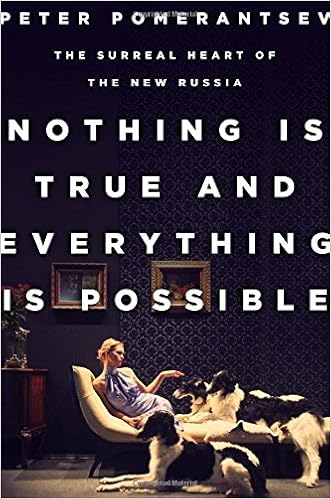
"Nothing Is True and Everything Is Possible"

Dominic Cummings said that no-one should 'pontificate on Putin’s mafia government' before reading this book.

Amazon link

Here are some excerpts from The Guardian's review.
"Pomerantsev, born in the UK to Russian émigré parents, spent almost a decade in Moscow working as a TV producer, making documentaries and reality shows for Russian audiences. He arrived in the early 2000s, in the midst of an oil boom that brought a measure of prosperity to many and huge wealth to a select few, creating a tidal wave of glitz and extravagance, especially in the capital.

Nothing Is True and Everything Is Possible is an entertaining if at times bleak chronicle of these years, depicting a world “where gangsters become artists, gold‑diggers quote Pushkin, Hells Angels hallucinate themselves as saints”.

...

"We also meet Vitali Dyomochka, a Siberian hoodlum turned cineaste. Dissatisfied with the quality of crime dramas on Russian TV – “it was all fake” – he took to making his own series, giving starring roles to several of his henchmen. There were no scripts, stuntmen or makeup: “all the blood you saw on the screen was real”, Pomerantsev writes, adding that “the guns and bullets were all real, too; when they filmed a shoot-’em-up in a bar the place was wasted”.

Djomochka allegedly got the series broadcast by getting his goons to threaten local TV stations; needless to say, it was a huge hit."

...

"Putinism itself is built on an ideology of all ideologies at once: liberalism; nationalism; conservatism; Orthodox tradition; an “anti-hegemonic” foreign policy.

As Pomerantsev points out, one key to the success of this new authoritarianism is that “instead of simply oppressing opposition, as had been the case with 20th-century strains, it climbs inside all ideologies and movements, exploiting them and rendering them absurd”.

The clearest example of this is the creation of a political system that has the appearance of democracy – regular elections, multiple parties, a free media – without any of the substance: the elections are rigged; the parties are all under the president’s control; the media do what their owners tell them, and the owners obey the Kremlin.

It’s this mismatch between form and content that has earned the Putin regime the name “virtual” or “imitation democracy”.

...

"Corruption, which affects almost every sphere of life, from major corporations to visits to the doctor, has taken root in the vast juridical twilight zone that emerged during the 1990s, and which the authorities have an active interest in maintaining.

Among the many other stories Pomerantsev follows is that of Yana Yakovleva, a businesswoman suddenly arrested for “illegally” trading in chemicals she has been selling perfectly legally for years. She’s the victim of “state raiding”, a widespread phenomenon in which government officials put the squeeze on businesses – finding owners to be in breach of fire-safety regulations, say, or in arrears with taxes they never owed; or, as in Yakovleva’s case, charging them retroactively with having broken a brand-new law.

She spends several grim months in prison before coming to trial; astoundingly, she wins and is released – but less because of her actual innocence than because her campaign has made her a useful pawn in a battle between two powerful Kremlin factions. “To make something happen in Russia,” Pomerantsev concludes, “you have to be both valiant protester and Machiavellian.”

"By the summer of 2010, when Moscow was wreathed in suffocating smoke from peat-bog fires, Pomerantsev had become increasingly frustrated by the constraints he faced in his work. His channel only wanted “positive” stories, and there were clear limits on what could be said and shown: he had to cut all the high-level politics out of Yakovleva’s story, for instance.

But on returning to the UK, he encountered the beneficiaries of the system he thought he had left behind – the oligarchs and bureaucrats turned businessmen who have siphoned wealth out of Russia and into London, the gilded post-Soviet youth who spend their time surrounded by their peers in an exclusive network of Mayfair nightclubs."
The words we use are value-loaded. In most historical societies, what we call corruption is the normal operation of 'big man' factional political economy. The Romans would have understood.

There is an economics literature on corruption, conceptualising it as rent-seeking and adding gratuitously to transaction costs. However, liberal democracies also have expensive mechanisms for arbitrating differences and setting priorities. The difference is more about stability and predictability: in a sense, liberal democracies have nationalised corruption and rebranded it.

The main thing I get from Peter Pomerantsev's book is that in today's Russia, society-wide trust does not exist and most state institutions do not work as such, being merely facades for powerful and arbitrary interest groups.

This so accords with history and natural human psychology that it jarringly reminds us again just how unlikely the relatively non-corrupt western model of bourgeois democracy actually is. The rule of law and the effectiveness of institutions requires elites to inhibit their emotions and personal drives, subordinating them to the rules.

Who knows how much of this is cultural and how much genetic? What we do know is that corrupt, clannish societies have enormous historical inertia, southern Italy being a case in point. The Russians haven't had much luck with their history in this regard, unfortunately.

As a root-and-branch picture of modern Russia, I'm with Mr Cummings. We should not be seeing Putin's state as a 'more vigorous capitalist society with more traditional values and less politically-correct nonsense'.

No, Russia is more like a capitalist version of Game of Thrones.

As a piece of writing, "Nothing Is True and Everything Is Possible" is mostly fascinating, but could have benefited from the attentions of an editor to cut out the occasional longueur.

Tuesday, May 17, 2016

Two stories on a Russian theme

Frequent visitors here will I know how often I give op-ed writers on The Times a hard time for PC-inspired nonsense. Today, however, Hugo Rifkind recounts an amusing story in his piece: "Russia lost Eurovision but won the mind games".
"My absolute favourite anecdote about modern Russia comes from the British author, Edward Docx. At a dinner with the cream of Russian literary society, he happened to mention that the panel of the Man Booker Prize of 2011 was headed by Dame Stella Rimington, the former director-general of MI5.

"Docx recalled: “They guffaw ‘Oh, the West! Oh, England! Oh, hypocrisy! You mean,’ they splutter, ‘that the winner of your most famous literary prize is judged by the security services?’ ” Startled, Docx protested that Dame Stella was retired now, and wrote thrillers herself. Sure, his hosts chortled. Like Vladimir Putin is retired from the KGB! And the more Docx blushed and stammered, the more they laughed and laughed."
---

From Wikipedia:
"Korean Air Lines Flight 007 (also known as KAL007) was a scheduled Korean Air Lines flight from New York City to Seoul via Anchorage. On September 1, 1983, the airliner serving the flight was shot down by a Soviet Su-15 interceptor, near Moneron Island west of Sakhalin in the Sea of Japan.

"The interceptor's pilot was Major Gennadi Osipovich. All 269 passengers and crew aboard were killed, including Larry McDonald, a Representative from Georgia in the United States House of Representatives.

"The aircraft was en route from Anchorage, Alaska, to Seoul when it flew through Soviet prohibited airspace around the time of a U.S. aerial reconnaissance mission."
I was thirty two when this happened, and it was a big, scary deal. In the story which follows (comment #24 from here) you should recall that the SAC is the US Strategic Air Command, their nuclear bomber force.
"I was in college when KAL 007 happened; we were all shocked but it was pretty clear it was a mistake. But a few weeks later, I was in my room listening to the college radio station (it was a really good station BTW) when the Emergency Broadcast System activated; I figured it was the standard test of the system, but when the alert tones stopped, instead of the typical “this is only a test” statement I heard “Attention: Please stand by for an official statement from Washington D.C.”…my pulse spiked and I immediately jumped to the window to look in the general direction of the SAC base about 30 miles away, then just as quickly tore my eyes away from the window and shut the curtain – after all, you really don’t want to be looking at the bomb when it goes off.

"After a few seconds, my rational mind began to assert itself, thinking “this has got to be a mistake.” And after another few seconds, the message on the radio cut off, the DJ said, “Woops, I’m probably in big trouble now,” and the standard “this is only a test” recording came on. I decided that escaping near-certain nuclear annihilation was worthy of a shot of whiskey, even at 10am; fortunately my first class that day was after lunch.

"The DJ was right; I never heard him on the station again."

Tuesday, November 24, 2015

The last four minutes


It must be a generation thing. I heard the newsflash of the Russian jet being downed by Turkish air defences and grimaced at Clare:
"Remind me, where's the entrance to our fallout shelter?"
I have few vivid memories of my early youth but I do recall the Cuban Missile Crisis of October 1962, when I was eleven. My parents were extremely worried (as was everyone else): we really thought we were all going to die.

I find it scary, too, contemplating a generation which has never experienced the visceral sense of immanent thermonuclear incineration.

There are some risks it really isn't macho to play fast and loose with.

---

There will always be another moonrise

A good few years ago there was another scare along these lines.
"On October 5, 1960, the North American Aerospace Defense Command's central defense room received a top priority warning from the Thule, Greenland, Ballistic Missile Early Warning System station indicating that a missile attack had been launched against the United States. The Canadian Air Marshal in command undertook verification, which after some 15 to 20 minutes showed the warning to be false. The radars, apparently, had echoed off the moon."
I remember Clare and myself discussing the latest 'worrying false alarm' with her practically-minded brother, James. He dismissed our worries about nuclear war by accident as in - 'it'll never happen.'

I thought he couldn't lose with this opinion:

'I hope you're right, because global thermonuclear war is a fearful price to prove you wrong!'

Thursday, March 12, 2015

On Thermonuclear War

I read excited prose in the newspapers, that the resurgent Russians are conducting endless war games in Eastern Europe which routinely simulate nuclear strikes, both tactical and on cities such as Warsaw.

As a teenager, I studied jaw-dropping books such as "On Thermonuclear War" by Herman Kahn (1960) (Wikipedia).


During the Cold War, NATO forces in Europe relied on nuclear weapons to address their numerical inferiority against a mass conscript Red Army. Allied war games had a curious deficiency: it was almost impossible to persuade officers to 'go nuclear'. And for good reason.

Doctrines were tweaked and special orders were given. What they found was that when the simulated conflict was forced to go nuclear, even if only tactical (kiloton) weapons were initially used, things rapidly escalated into Kahn territory .. and all out thermonuclear war. Count those megadeaths!

I really hope folk haven't forgotten all that.