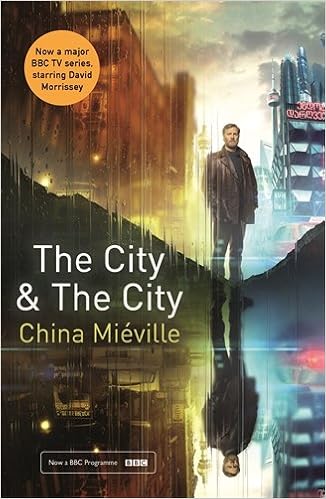
From previous TV adaptations of SF classics, I feared the worst, but this was actually pretty good.
Miéville's book leads with its extraordinary setting, with plot secondary and characterisation a pulp noir third. This doesn't work for TV, where character and action is primary.
The screenwriters therefore beef up the backstory for the lead character, Inspector Tyador Borlú of the Extreme Crime Squad, Besźel, giving him a mysterious vanished wife (not in the novel) who may have vanished into the other city, or who was perhaps taken by - or recruited to - the secret border police Breach. Meanwhile they fill out the character of his sidekick, Lizbyet Corwi, who puts on an aggressive macho schtick to cope with being a female cop in a very traditional man's world.
They've used Liverpool for earthy, seedy, eastern-european Besźel and will perhaps use Manchester as the stalinist, modernist Ul Qoma. We shall see in the next episode.
If you didn't know the book already, the idea of two distinct and hostile city-states occupying the same geography would be a fast learning curve. But overall, I felt they got the mix of plot development, characterisation and exposition about right.
Abigail Nussbaum has a good and characteristically engagedreview of the book.
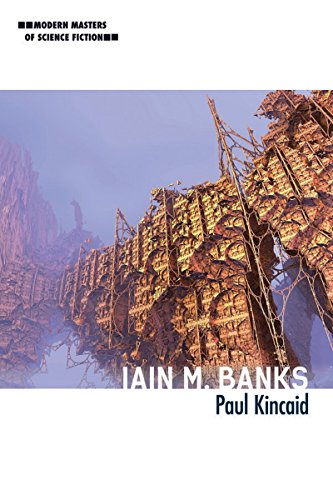
I bought this on the strength of Abigail Nussbaum's positive review. Russell Letson also has a review, which includes this:
"Kincaid outlines how the Culture was devised as a deliberate counter to earlier (particularly American) space-adventure conventions that Banks saw as militarist and imperialist and infected with “grandiose superhero thinking that has no place in the communal, socialistic approach that Banks takes in his fiction.”
He also argues for a break in that group of books – that the Culture sequence was essentially finished before the last three books (Matter, Surface Detail, and The Hydrogen Sonata, 2008-2012) were written – that the project was complete and that the later books represent a kind of retreading of old ground.
The job of the first set of Culture novels would seem to be to deconstruct not only the political notions behind traditional space opera, but also notions of utopia – to push at the contradictions in the Culture’s own view of itself. Excession, for example,
'is about presenting the Culture with barriers it is reluctant to cross…. We begin to get a picture of the Culture as a deeply conservative society, too attached to its comforts and plenty to be easy with the idea of risk or change…. we see that it is far less a utopia, far less perfect, than it likes to present itself.'
Like the Culture itself, Banks’s thinking about attempts to square the circle of power, freedom, and ethical behavior in an imperfect world results in unresolved contradictions."
I've read all of Iain Banks's science-fiction (I abandoned Feersum Endjinn) but I do find the novels curiously unmemorable. Partially this is to do with their complex structure, the large cast of characters with indecipherable names, and detailed and baroque settings which can overwhelm the storyline. Sometimes it's hard to see the wood for the trees.
The first great service Paul Kincaid offers in this impressive piece of literary criticism is to confirm these complexities and to summarise the novels for the floundering reader. More than this, Kincaid dives deep into each book's thematic unconscious, distilling what he believes to be motivating the author.
He does a pretty good job. Kincaid sees Banks as eternally wrestling with his ideal society. If utopia is post-scarcity communism where oppression is definitionally absent, then how do people spend their time? If the Culture is about freedom, how does it deal with cultures which don't share the Culture's value system?
Perhaps in Banks's earliest formulations, these seemed distant and rather easy problems to solve. Yet the more he engaged, the more problematic the Culture became. In the end, utopia seems smug, boring, shallow, selfish, cowardly - even imperialistic.
Banks was a smart guy but he was also a proud bien-pensant liberal, a world-view which is curiously unreflective of the true roots of its value-system. In that spirit, Banks never quite resolved the contradictions at the heart of his own philosophy.
This is a mature, comprehensive and above all interesting take on all of Iain Banks's work and it's recommended.
I have abandoned reading "The Legacy of Heorot" (Niven, Pournelle, Barnes) to Clare after three or so nights. The build-up is way too slow, the characters uninteresting and the writing too clunky.
I've taken the easy option and resorted to Lee Child's latest:
If I may be permitted spoilers, the novel is about the aftermath of a Dark Ages genocide in an imagined post-Arthurian, Briton-Saxon co-mingled England. Peace between the races has been artificially maintained by an ageing dragon, whose misty breath fills the land, inducing forgetfulness.
Axl and Beatrice, an old Briton couple, leave their hobbit-like village residence to visit their dimly remembered son. Through various adventures the amnesiac-fog is finally lifted and memories begin to return. Can the peace survive the recall of earlier wrongs? Can Axl's and Beatrice's relationship survive the recall of ancient infidelity and revenge?
Ishiguro is pessimistic.
I felt the book - highly stylized in manner and dialogue - was well-done. As to whether, Guardian-style, it was really telling us anything we didn't already know: well, not so much.
"... underneath The Buried Giant's polite surface, there is a genuinely misanthropic heart, that sees the flaws in its characters as a reason to hate and punish them, not pity them. The point of the novel isn't that war and conflict are inevitable, or that no love is perfect, but rather that it is foolish to hope otherwise, and that people who do--both the characters and the readers--are to be derided.
The only good thing that has come from my choice to read this novel is that I no longer have to wonder if I was wrong about Ishiguro ten years ago, and hopefully I won't make the mistake of picking him up again."
Opinions on Amazon seem to be mixed but I am more optimistic.
In any event, it's the next book to be read to Clare, starting tomorrow.
Clare has had a vision these last days of a walk in the autumnal woods surrounded by the glowing colours of the falling leaves. In the last of the year's sun, we would stroll in a kaleidoscope of natural beauty.
And then there is the inevitable collision with the English climate.
In a short weather window, after a stroll in Stockhill Wood
I've been quite impressed by Ian McDonald's work so have just ordered 'Luna: New Moon' ; apparently a sequel is scheduled for publication next year and yet another volume in 2017. I particularly enjoyed his 'Brasyl', set in an alternate reality of the Latin-American country:
"A story that begins in the favelas, the slums of Rio, and quickly expands to take in drugs, corruption, and a frightening new technology that allows access to all the multiple worlds that have slipped into existence in other planes every time we make a decision."
I remember McDonald being a target of 'social justice warriors' for his temerity in placing his densely-imagined novels in developing countries (India is another favourite of his). This from Abigail Nussbaum's review of his earlier 'River of Gods'.
"It's a positive, vibrant, and persuasive description, but also one that gives rise to a feeling of unease when one recalls that McDonald is, after all, a white man from Belfast. What right does he have to write about India, much less to pretend to have captured its essence, much much less to imagine its future? When Nic Clarke of Eve's Alexandria reviewed River of Gods, a commenter disdainfully replied that the novel sounded to her like yet another cliché-ridden attempt by a Western writer to fetishize a nation that has become synonymous with exoticism.
"This was not long after the genre blogosphere became embroiled in what's become known as The Great Cultural Appropriation Debate of Doom, an offshoot of a WisCon panel discussing the depiction of cultures by authors foreign to them, and specifically non-white cultures by white authors, and the combination of these two discussions got me seriously reconsidering River of Gods and my, at that point, uncomplicated affection for it.
"McDonald's India feels like a real place, but I have no idea whether he's truly captured the country's spirit and described its driving conflicts with fidelity. He may very well have fictionalized a truth more complicated and nuanced than he was interested in depicting. What's kept me feeling positively towards River of Gods in spite of this realization is the fact that, as I noted above, his India is so strong and independent, so clearly its own entity directing its own fate. River of Gods may be a novel about India told by an outsider, but within the novel India is writing its own story."
"Ian McDonald was born in 1960, in Manchester, to a Scottish father and Irish mother. He moved to Belfast when he was five and has lived there ever since." (Wikipedia).
Deep-Learning has swept all before it in AI, with Facebook, Google and Microsoft competing to hire the smartest researchers. I watched a good introductory video (below) yesterday (~ 40 minutes) by Andrew Ng, who heads up things at Baidu. Delved a bit into backpropagation which is intricate but comprehensible with a little application - figuring it out has been on my 'to-do' list for years.
Despite all the successes, this hierarchical neural-net approach is still modelling perception (something which apparently occupies 60% of most animals' brains). The higher-level stuff - meaning, comprehension, conversation, intentionality still seems a mystery both in paradigm and performance. Much as I would like an AI personal assistant who 'really understands me' and 'how to fix things in the world', it really isn't going to happen anytime soon (unfortunately).
I remember nostalgically when I used to travel Europe and the world as a technical consultant for Nortel. I had scarcely a care in the world as my rather large employer could be relied upon to sort out problems with transport, hotels, illness or any of the other mischances of travel in foreign cultures. If you're rich, you can buy a concierge service which provides a similar level of wraparound care. It will take Google or similar to democratise this for the masses - once they get the AI sorted out.