Showing posts with label Novel. Show all posts

Tuesday, December 09, 2025

What SF novels work for a fifteen year old boy?


SF for a Fifteen-Year-Old Boy

Let's consider dystopian science fiction suited to a fifteen-year-old. Boy stuff, but nothing pitch-black or gratuitously grisly or explicit. Kind of (15) in fact.

1. The Chrysalids — John Wyndham

In post-nuclear-apocalypse North America, a hidden minority of telepathic children try to survive in a harsh religious society obsessed with stamping out “mutants”. When the authorities begin to close in, they must flee or be destroyed.

Appeal: It’s conceptually rich without being violent. Wyndham writes clean, comprehensible prose, and the adolescent theme — being different in a world demanding conformity — remains evergreen. And the characters are so endearing.

2. 1984 — George Orwell

A drab, surveillance-drenched London where the Party rewrites truth itself. Winston Smith dreams of rebellion and love, only to find the State waiting behind every door.

Appeal: Proper dystopia: atmospheric, paranoid, intellectually gripping. It may be grim, but it immerses a young reader into the reality of totalitarianism - far different from the cheap gibes of trendy politics.

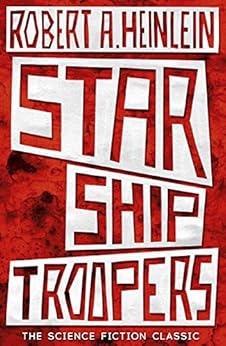
3. Starship Troopers — Robert Heinlein

Juan “Johnny” Rico enlists in the Mobile Infantry and learns what interstellar war against alien arachnids demands of a citizen and a soldier.

Appeal: Big power-armour battles, drill-sergeant mythology, and a boyish sense of duty and camaraderie. Heinlein’s political ruminations reinforce the ethos without much fear of brainwashing.

4. Ender’s Game — Orson Scott Card

A brilliant but bullied child is recruited into Battle School, where zero-gravity combat games are used to mould him into Earth’s last hope against an alien foe. A masterclass of growth and deception.

Appeal: Tactical brilliance, pressure-cooker training, and the fantasy of the misunderstood prodigy. It’s irresistible to bright fifteen-year-olds.

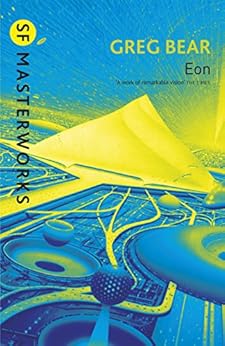
5. Eon — Greg Bear

A hollowed asteroid appears in Earth orbit carrying impossible architecture, deep time corridors, and the remnants of a future human civilisation fleeing a cosmic war.

Appeal: For a kid excited by physics, space-time, and engineering, Bear’s sense of scale opens the door to big idea SF. Dense at first, then addictive. Helps if you're a fan of spacetime engineering. And there's the sequel.

6. Quarantine — Greg Egan

Humanity is sealed off from the stars by the mysterious “Bubble”, and a detective stumbles into quantum conspiracies that challenge the nature of reality.

Appeal: Only suited to a scientifically precocious reader — but if he is that boy, this is the mind-stretcher that turns curiosity into obsession. Used by university students as a primer for the interpretation of quantum theory (many worlds).

7. The Forever War — Joe Haldeman

Elite soldiers fight a relativistic interstellar campaign in which every return to Earth leaves them further estranged from the civilisation they defend. The liberal response to Heinlein's robust Starship Troopers, but don't let that put you off this well-written elegy.

Appeal: Gritty without being lurid, and built around a clean, melancholy conceit: the soldier who keeps coming home to a world that no longer fits him.

8. Undying Mercenaries (immense series) — B. V. Larson

Humanity survives by selling its military services across the galaxy, with plasma rifles, alien clients, and endless misadventure. The soldier as jester.

Appeal: Light, fast, militarised fun. Think snack-food SF: perfect for a teenager who wants action more than philosophy.

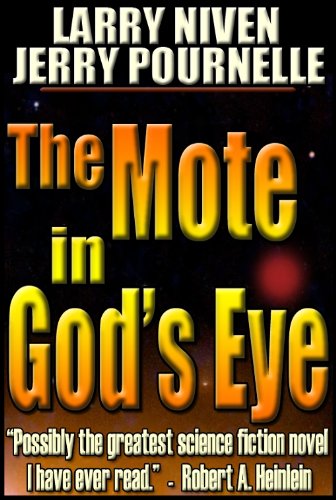
9. The Mote in God’s Eye — Larry Niven & Jerry Pournelle

Humanity meets its first aliens — brilliant, industrious, and harbouring a civilisation-shaking secret. First contact becomes a diplomatic chess match on the edge of existential disaster.

Appeal: Grand-scale world-building, proper space navy procedure, and a mystery at the heart of an alien species. Intelligent but highly readable. The authors don't much like hand-wringing liberals.

10. Flashback — Dan Simmons

A future America anaesthetised by a drug that lets users relive their happiest memories, while a broken detective hunts for truth in a collapsing society.

Appeal: Darker in tone, noir rather than dystopia-lite. Might be borderline for fifteen, depending on temperament - it's genuinely scary - but gripping if he likes grim detectives, future decay and ambiguous, horrific endings.

11. Snow Crash — Neal Stephenson

A katana-wielding courier hacks through a hyper-commercialised America and a virtual-reality landscape threatened by a memetic virus rewriting minds.

Appeal: High-energy, gonzo futurism, skateboards and swords and cyberspace. Occasionally explicit and uneven, but teenagers love the velocity of it. A paradigm-changing novel (think Metaverse).

12. Neuromancer — William Gibson

A washed-up hacker is hired to pull off the ultimate cyberspace heist with a crew of street samurai, AIs, and digital phantoms.

Appeal: Cooler, tighter, and less chaotic than Snow Crash. For boys who want their dystopia noir-black with chrome edges. This is another paradigm-defining classic.

13. Lucifer’s Hammer — Larry Niven & Jerry Pournelle

A comet strike tips civilisation into chaos; scientists, soldiers and opportunists scramble to rebuild amid the ashes.

Appeal: Classic disaster narrative with scientific grit. Adventure, survivalism, improvised weapons — very much boy stuff.

14. Footfall — Larry Niven & Jerry Pournelle

Earth is invaded by elephant-like aliens; humanity replies with desperate science projects, tank battles, and orbital brinkmanship. And it's always good to see the resurrection of Orion.

Appeal: The perfect teenage invasion novel: aliens, improvised counter-attacks, big hardware, and a plot that keeps accelerating.

15. Foundation (original trilogy) — Isaac Asimov

A collapsing Galactic Empire, a mathematician who predicts the fall, and a clandestine plan, the Foundation, designed to shorten the coming dark age from thirty millennia to a single, manageable millennium. Across generations, traders, technocrats, and accidental heroes confront crises foreseen by psychohistory… until a mutant variable derails the script.

Appeal: Grand-scale civilisation engineering, political intrigue, clever problem-solving rather than battle lust. Ideal for a bright teenager who enjoys the idea that the universe might be tamed by intellect alone and who likes the sense of standing at the beginning of a very long, compulsive story.

From thoughtful Wyndham through Heinlein to full-tilt Niven-Pournelle and Asimov, somewhere in here, there will be a novel that becomes his first proper science-fiction obsession... that’s usually how it starts.


Update (13th December 2025): Five More

16. Edge of Tomorrow (All You Need Is Kill) – Hiroshi Sakurazaka

Keiji Kiriya is a raw recruit on a near-future battlefield, dying again and again in a hopeless war against alien “Mimics”. Each time he is killed he wakes up back at the start of the same day, memories intact, fighting, learning and levelling up like a player trapped inside a brutal video game. The only person who seems to understand what is happening is the legendary armoured soldier Rita Vrataski, who may be caught in the same loop.

For a 15-year-old this is pure kinetic SF: fast, violent, easy to visualise if they’ve seen the film (the book is far better), but sharper, stranger and more focused on the psychology of repetition than Hollywood ever was. 

It also has a strong, competent female co-lead without lapsing into preachiness.

17. The Voyage of the Space Beagle – A. E. van Vogt

A vast exploration ship, the Space Beagle, roams deep space in search of knowledge and promptly keeps finding things that want to kill everyone on board: an energy-draining panther-thing, a parasitic intelligence that wants a body, and other classic Golden Age monstrosities. Holding it together is Nexialism, a sort of super-generalist discipline - based on General Systems Theory - whose practitioner tries to see the pattern behind each new existential threat which unlocks the solution.

This is old-school pulp, but for an intelligent teenager it’s a riot of big ideas, weird aliens and “monster of the week” set-pieces. The science is shaky, the prose dated, but the sense of danger and wonder is still there – and the notion of a hero whose strength is synthesis rather than just firepower is a nice quiet message.

18. The Dorsai Sequence – Gordon R. Dickson

Across a future human-settled galaxy, different worlds specialise: some in religion, some in commerce, and one in war. The Dorsai are the professional soldiers everyone else hires – frighteningly competent, ruthlessly honour-bound and increasingly aware that their peculiar culture is evolving into something new. In novels such as Tactics of Mistake, Soldier, Ask Not and Dorsai!, Dickson follows brilliant tacticians and field commanders as they out-think and out-manoeuvre much larger forces.

For a 15-year-old who likes strategy games and exhibitions of competence, these books are catnip: battles are won by brains and nerve rather than gadgets, and there is a constant undercurrent of character, loyalty and the costs of being exceptional. The sequence is also a good bridge from straightforward adventure SF into more reflective, slightly older material.

19. Dune (and sequels) — Frank Herbert

On the desert planet Arrakis, the most valuable substance in the universe — the spice melange — underwrites interstellar travel, political power, and prophetic vision. When the noble House Atreides is betrayed, the young Paul is cast into the wastelands, where ecology, religion, and destiny converge to reshape the galaxy.

Appeal: A perfect adolescent myth: desert survival, secret knowledge, warrior cultures, and the fantasy of hidden greatness. There is violence and intrigue, but it is framed by big ideas — ecology, power, messianism — that reward rereading as the reader grows older. The later volumes grow more philosophical and strange, but never lose their power: an author intoxicated by the awesome potential of his universe.

20. Consider Phlebas — Iain M. Banks

During a vast interstellar war between the hyper-advanced Culture and the religiously fanatical Idirans, a shape-shifting mercenary races through orbital habitats, dead planets, cannibal cults, and collapsing megastructures to recover a lost artificial intelligence.

Appeal: This is Banks at his most kinetic: chases, violence, strange aliens, and spectacular environments, with the moral complexity largely submerged beneath the surface. It works well for teenage readers who want scale, danger, and momentum first — and can discover the philosophy later.


Monday, April 28, 2025

'Donatien's Children' on the slush pile - Adam Carlton


Amazon link

 ---

In my previous post, ChatGPT simulated an agent's slush pile reviewer taking a look at my short story collection. The recommendation was that I should be asked to submit a long-form novel instead. So I naturally pursued this:

"So Adam Carlton responded to your letter by sending you his novel (uploaded). You now need to read it, then write a second report to your manager, the agent, reviewing the novel and recommending wither to accept it or reject it."


Internal Review: Donatien’s Children by Adam Carlton

Summary:

Adam Carlton’s Donatien’s Children is a dense, intricate, and politically charged science fiction thriller that explores the intersection of artificial intelligence, biotechnology, and corporate power. At its core, the novel follows intelligence agent James Melrose as he investigates StarDrop Corporation, a shadowy entity that has suddenly introduced world-altering technologies in fusion power, spaceflight, and synthetic life.

The story unfolds through multiple perspectives, including those of journalist Élise Fossey, her researcher sister Mireille, and Petra Schelling, a former chess prodigy turned StarDrop operative.

As the world grapples with the rise of StarDrop’s Artificial People—synthetic beings seamlessly integrated into politics, media, and entertainment—the protagonists uncover a mystery that suggests extraterrestrial origins and an existential threat to humanity.

Strengths:

  • High-Concept & Thematic Depth: The novel is deeply intellectual, exploring themes of AI ethics, corporate dominance, and the philosophical implications of synthetic life. Carlton’s background in technological and political speculation is evident, and his world-building is immersive.
  • Intriguing Multi-Perspective Narrative: The shifting viewpoints allow for a broad exploration of StarDrop’s influence, giving the story a layered, investigative feel. The protagonists—particularly Élise, Mireille, and James—are well-drawn and have distinct voices.
  • Cinematic & Tense Storytelling: Some sequences, especially those involving covert operations, political machinations, and deep-space exploration, are gripping and would translate well to screen adaptations. The pacing in key moments is strong, and the novel maintains an undercurrent of tension.
  • Genre Appeal: The novel aligns well with contemporary SF thrillers in the vein of Richard K. Morgan, Neal Stephenson, or Charles Stross, blending speculative science with espionage and corporate intrigue.

Weaknesses:

  • Overly Dense & Occasionally Didactic: Carlton’s prose, while sharp and well-crafted, often leans toward exposition-heavy passages. Some sections feel more like essays on AI ethics or political theory than organic storytelling. Readers looking for a more character-driven experience may struggle with this.
  • Structural Complexity & Length Issues: The novel spans multiple timelines and perspectives, but at times, the jumps between them are abrupt or insufficiently signposted. Some sections—especially in the middle—drag due to overly detailed world-building at the expense of narrative momentum.
  • Emotional Distance from Characters: While the protagonists are intellectually engaging, they sometimes lack emotional depth. Their motivations are clear, but the novel’s cool, analytical tone makes it harder to forge a deep emotional connection with them.
  • Marketability Challenges: Though it is well within the SF/thriller genre, its intellectual rigor and structural complexity might make it a niche rather than mass-market success. Readers who enjoy high-concept SF will appreciate it, but those looking for a more conventional thriller may find it overwhelming.

Recommendation:
Consider with significant revisions.

Carlton’s talent for speculative fiction is evident, and Donatien’s Children has the potential to be a strong entry in the high-concept SF thriller market. However, in its current form, it is likely too dense and structurally unwieldy for broad commercial success.

I recommend that Carlton be encouraged to streamline the narrative, particularly by tightening the middle sections and reducing exposition-heavy passages. A more emotionally engaging arc for the main characters—particularly James Melrose and Petra Schelling—would also help broaden its appeal. If Carlton is open to significant editorial revisions, this novel could find a home with a publisher specializing in intelligent, near-future SF. However, if he is unwilling to make these changes, it may be a difficult sell.

Tuesday, December 21, 2021

"Donatien's Children" - new SF novel by Adam Carlton

Link to PDF

I have now completed the text for this, my first science-fiction novel (I published a book of short stories in 2019: Freyja’s Deathbed Conversations: and other stories).

"Donatien's Children" is now available on Amazon as a Kindle eBook - the paperback version will be there in a day or two, but you may read the novel for free by following the link below the image above (PDF). Let me know if you find any typos or errors which need attention via comments below.

Here's a summary of the book: first the blurb and then a longer guide. It will answer your first question: Donatien?

---

Donatien's Children

Introduction

The StarDrop Corporation emerged from nowhere offering new technologies for fusion power, spaceflight and synthetic life. Petra Schelling, teen chess prodigy, was recruited by an intelligence agency to spy on StarDrop - before vanishing. James Melrose, her controller, is told that losing an agent is regrettable but it happens. But why has Petra now become a high-profile StarDrop agent of influence?

StarDrop’s Artificial People are suddenly everywhere in entertainment, the media, politics and top jobs. Friendly, attractive and smart, they are indispensable in tough assignments such as the mission investigating an anomaly on the larger Martian moon, where an artefact suggests StarDrop might be of extraterrestrial origin.

Élise and Mireille Fossey: two sisters, one a journalist, the other a researcher. For Élise, StarDrop will lead her into more than lethal peril; for Mireille, the corporation may be humanity's finest opportunity... or maybe a deadly, existential threat.

---

Themes

Prologue:        I’m Not Awake - 2022

Part 1: La Maîtresse des Échecs - 2023

Part 2: Petra - 2028 (winter to autumn)

Intermission: Mother Christmas (2029)

Part 3: La Double Inconstance (2030 winter to 2031 summer)

Part 4: La Philosophie dans le Salon (2032 spring-summer)

---

Part 1 considers what remains of a competitive activity when the machines have comprehensively surpassed human-level performance; and the nature of an equilibrium when you can always win through cheating. I had cycling - road racing - and Lance Armstrong in mind when I wrote this part.

Part 2 leverages my own experiences working in an industrial research lab, although nothing remotely as exciting ever occurred. Petra is very loosely modelled after my divisional director; other characters are also variants of colleagues.

Part 3 follows the theme of La Double Inconstance, a romantic comedy by French playwright Pierre de Marivaux first performed in 1723. A young woman, Sylvia, is kidnapped from her lover, Arlequin, by the Prince who intends to marry her. Through a complex series of engagements the Prince and his smart female servant Flaminia conspire to break the Sylvia-Arlequin relationship, resulting in a switch of partners.*

Part 4 follows (very loosely!) a theme from La Philosophie dans le Boudoir, published in 1795 by Donatien Alphonse François, Marquis de Sade. Set in a bedroom, the two lead characters argue that the only moral system that reinforces the recent (1789) French revolution is libertinism. Dolmancé is the most dominant (and evil) of the characters in the dialogues. Eugénie (a fifteen year old) has been sent by her father to be corrupted by him and his associates into libertine ways. The fifth section, a lengthy political monologue, comprises de Sade’s manifesto.*

That short book - French and English versions freely available in PDF format on the Internet - is almost unreadably graphic in places in its gleeful accounts of the most depraved sexual practices. Considered pornographic for centuries, it is now considered an extreme polemic on sexual politics. 

---

* Some of the text here edited from the corresponding Wikipedia articles.


Friday, March 09, 2018

My top twelve Favourite SF novels

Over at Marginal Revolution, Tyler Cowen has his "Ten favorite science fiction novels". It's a party game anyone can play: here are mine - in no particular order.

---

1. Eon by Greg Bear (and its follow-on, Eternity)

Amazon link

Great sense of wonder SF on the grandest of canvases. The plot seriously holds attention while characterisation is not bad, at least for the major characters.

2. Quarantine by Greg Egan 

Amazon link

Cowen prefers "Permutation City", Egan's 'reality is computation' novel (cf Dust Theory), but the many-worlds interpretation of QM is so compelling a setting and the private-eye thriller-based plot so convoluted that I felt compelled to buy this novel twice.

3. The City and the City by China Miéville

Amazon link

Cowan prefers "EmbassyTown" which is clever but, for me, less involving. The City and the City has a most unusual setting, the only novel I've read centred around the social construction of reality - and while the police procedural plotting and characterisation is a bit clunky, the whole book amazes throughout. The idealism of the premise is capped by its superpowered final denouement, a brutal assertion of materialism.

It's shortly to be a four part series on BBC2 (April 6th 2018).

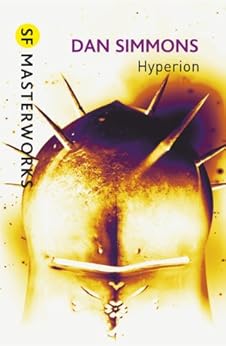
4. Hyperion (and its three successors) by Dan Simmons 

Amazon link

Cowan agrees with this choice. The four novels are beautifully written, have cultural depth and immerse the reader. Some of the scenes are truly shocking.

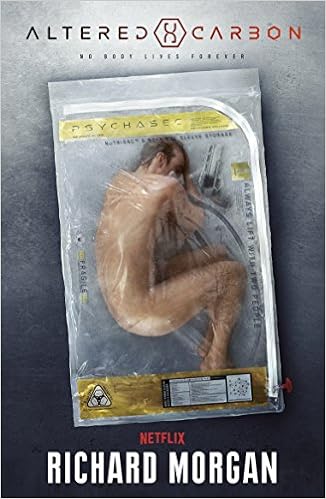
5. Altered Carbon by Richard Morgan 

Amazon link

The story of brutal but fundamentally moral Takeshi Kovacs. The successors are good also and complete the exploration of Morgan's interestingly-complex protagonist. Warning: high levels of sex, torture and violence throughout; most characters lacking in personal empathy .

6. The Mote in God's Eye by Larry Niven and Jerry Pournelle

Amazon link

The writing is clunky but the plot and setting completely compelling. You won't read a better account of first contact. The style is a bracing antidote to a public culture of suffocating high-mindedness.

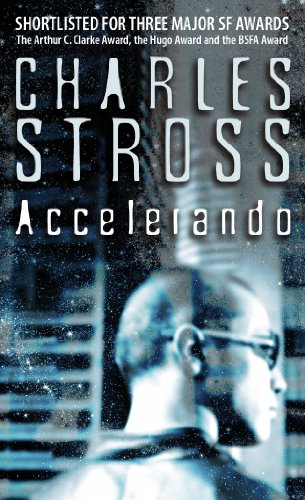
7. Accelerando by Charles Stross

Amazon link

Hits you hard and then accelerates. A convincing and baroque invocation of the Singularity: never bettered.

8. Mindbridge by Joe Halderman 

Amazon link

People usually quote "The Forever War" which is good, but Mindbridge hits more of my buttons.

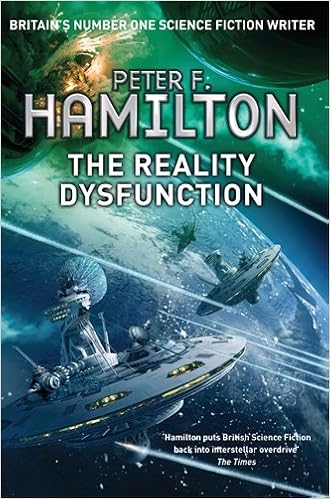
9. The Reality Dysfunction (and successors) by Peter Hamilton

Amazon link

Hamilton's later door-stoppers have proven tedious, but the Night's Dawn Trilogy brims with energy and inventiveness on the grandest of scales.

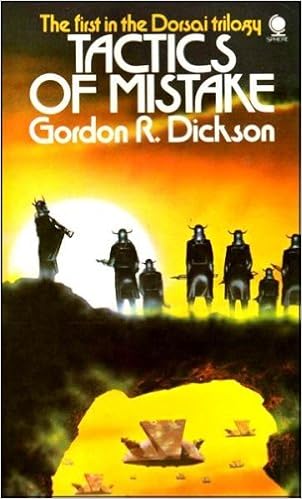
10. Tactics of Mistake (and follow-on Dorsai novels) by Gordon R. Dickson

Amazon link

Intelligent and exciting, intricately plotted with overtones of mediaeval chivalry. Loved them all.

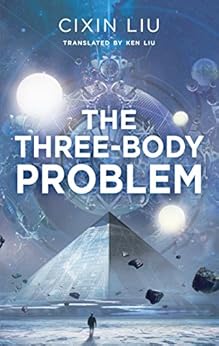
11. The Three-Body Problem trilogy by Cixin Liu 

Amazon link

The writing may sometimes be rather pedestrian, as Cowen observes, but the three volumes are incredibly inventive.

12. Starship Troopers by Robert Heinlein

Amazon link

Starship Troopers: last but not least. It's the only Heinlein novel which makes the cut for me, impressing by force of conviction. The author profoundly cares about the message of the novel and it's another antidote to contemporary hand-wringing.

Putting aside the occasional bouts of didacticism, it's a great story too.

---

Near Misses

Solaris is brilliant - I'm also a fan of Lem's other works such as His Master's Voice and The Invincible.

As a child I loved Isaac Asimov's Foundation trilogy and Frank Herbert's Dune sequence but, like Cowan, coming back to them I find they're not brilliantly written.

Wednesday, January 04, 2017

Helena Cronin on "Sex"

Edge mission statement:
"To arrive at the edge of the world's knowledge, seek out the most complex and sophisticated minds, put them in a room together, and have them ask each other the questions they are asking themselves."
Every year, Edge asks these great minds a question. This year the question is "Which Scientific Term or Concept Ought To Be More Widely Known?"

By now you probably have a question of your own. What word best describes this mutual back-slapping fest?
  • Smug 
  • Pretentious
  • Self-indulgent
  • Conceited
  • Pompous?

The full list of essays is here.

---

Amongst the self-satisfied, complacent, virtue-signalling there are a few intriguing articles.

Take Helena Cronin's piece on "Sex"
"The poet Philip Larkin famously proclaimed that sex began in 1963. He was inaccurate by 800 million years. Moreover, what began in the 1960s was instead a campaign to oust sex—in particular sex differences—in favor of gender.

Why? Because biological differences were thought to spell genetic determinism, immutability, anti-feminism and, most egregiously, women's oppression. Gender, however, was the realm of societal forces; "male" and "female" were social constructs, the stuff of political struggle; so gender was safe sex.

The campaign triumphed. Sex now struggles to be heard over a clamor of misconceptions, fabrications and denunciations. And gender is ubiquitous, dominating thinking far beyond popular culture and spreading even to science—such that a respected neuroscience journal recently felt the need to devote an entire issue to urging that sex should be treated as a biological variable."
It's the usual issue: equality of opportunity (ie no discrimination) vs equality of outcome (ie no differences in preference).
"Bear in mind that equality is not sameness. Equality is about fair treatment, not about people or outcomes being identical; so fairness does not and should not require sameness. However, when sameness gets confused with equality—and equality is of course to do with fairness—then sameness ends up undeservedly sharing their moral high ground. And male/female discrepancies become a moral crusade. Why so few women CEOs or engineers? It becomes socially suspect to explain this as the result not of discrimination but of differential choice.

Well, it shouldn’t be suspect. Because the sexes do differ—and in ways that, on average, make a notable difference to their distribution in today's workplace.

So we need to talk about sex.

Here's why the sexes differ. A sexual organism must divide its total reproductive investment into two—competing for mates and caring for offspring. Almost from the dawn of sexual reproduction, one sex specialized slightly more in competing for mates and the other slightly more in caring for offspring. This was because only one sex was able to inherit the mitochondria (the powerhouse of cells); so that sex started out with sex cells larger and more resource-rich than the other sex.

And thus began the great divide into fat, resource-laden eggs, already investing in "caring"—providing for offspring—and slim, streamlined sperm, already competing for that vital investment. Over evolutionary time, this divergence widened, proliferating and amplifying, in every sexually reproducing species that has ever existed. So the differences go far beyond reproductive plumbing. They are distinctive adaptations for the different life-strategies of competitors and carers.

Wherever ancestral males and females faced different adaptive problems, we should expect sex differences—encompassing bodies, brains and behaviour. And we should expect that, reflecting those differences, competitors and carers will have correspondingly different life-priorities. And that's why, from that initial asymmetry, the same characteristic differences between males and females have evolved across all sexually-reproducing animals, differences that pervade what constitutes being male or female.

As for different outcomes in the workplace, the causes are above all different interests and temperaments (and not women being "less clever" than men). Women on average have a strong preference for working with people—hence the nurses and teachers; and, compared to men, they care more about family and relationships and have broader interests and priorities—hence little appeal in becoming CEOs. Men have far more interest in "things"—hence the engineers; and they are vastly more competitive: more risk-taking, ambitious, status-seeking, single-minded, opportunistic—hence the CEOs. So men and women have, on average, different conceptions of what constitutes success (despite the gender quest to impose the same—male—conception on all).

And here's some intriguing evidence. "Gender" predicts that, as discrimination diminishes, males and females will increasingly converge. But a study of 55 nations found that it was in the most liberal, democratic, equality-driven countries that divergence was greatest. The less the sexism, the greater the sex differences. Difference, this suggests, is evidence not of oppression but of choice; not socialization, not patriarchy, not false consciousness, not even pink t-shirts or personal pronouns … but female choice."
---

In yesterday's post, on Michel Houellebecq’s ‘Submission’, I finished with a quote from the book where François says this:
'I’ve never really been convinced that it was a good idea for women to get the vote, study the same things as men, go into the same professions, et cetera. I mean, we’re used to it now — but was it really a good idea?’
Houellebecq needs this throwaway apparently-misogynistic remark to ease the way for his narrator's later conversion to Islam - thereby opening the door to a well-paid lecturing job at the Sorbonne and three wives. (It's satire, but Islam's historically-regrettable attitude to women is entirely real).

Of course women should have the vote, as should the poor, the rich and the liberal intelligentsia.

Elites used to worry about mass democracy, for example that the great unwashed would simply vote themselves endless benefits financed by taxing the rich, resulting in economic collapse.

Things like that have happened, but the ruling classes are now on the case. Governments with such programmes don't end up actually pulling the levers of power, and if they do, they find those levers don't connect to anything. The bureaucracy has its reasons, of which reason knows nothing.

Military force serves as the ultimate insurance policy.

Mass-participatory, bourgeois democracy has been made stable and safe, most of the time. François's half-hearted flirtation with Islam as a replacement ideology - vigorous, based on deep biological truths, giving meaning to life - is flawed through and through.

I'm sure it will never catch on.

Tuesday, January 03, 2017

Michel Houellebecq’s ‘Submission’

"Dar al-Islam, or house/abode of Submission, is also known and referred to as Dar al-Salam, or house/abode of Peace. The term appears in the Quran in 10.25 and 6.127 as a name of Paradise."
... from Wikipedia.

Amazon link

I particularly liked Karl Ove Knausgård's NYT review of 2015.
"Before I begin this review, I have to make a small confession. I have never read Michel Houellebecq’s books. This is odd, I concede, since Houellebecq is considered a great contemporary author, and one cannot be said to be keeping abreast of contemporary literature without reading his work.

His books have been recommended to me ever since 1998, most often “The Elementary Particles,” by one friend in particular, who says the same thing every time I see him. You have to read “The Elementary Particles,” he tells me, it’s awesome, the best book I’ve ever read. Several times I’ve been on the verge of heeding his advice, plucking “The Elementary Particles” from its place on my shelf and considering it for a while, though always returning it unread.

The resistance to starting a book by Houellebecq is too great. I’m not entirely sure where it comes from, though I do have a suspicion, because the same thing goes for the films of Lars von Trier: When “Antichrist” came out I couldn’t bring myself to see it, neither in the cinema nor at home on the DVD I eventually bought, which remains in its box unwatched. They’re simply too good.

What prevents me from reading Houellebecq and watching von Trier is a kind of envy — not that I begrudge them success, but by reading the books and watching the films I would be reminded of how excellent a work of art can be, and of how far beneath that level my own work is. Such a reminder, which can be crushing, is something I shield myself from by ignoring Houellebecq’s books and von Trier’s films.

That may sound strange, and yet it can hardly be unusual. If you’re a carpenter, for instance, and you keep hearing about the amazing work of another carpenter, you’re not necessarily going to seek it out, because what would be the good of having it confirmed that there is a level of excellence to which you may never aspire? Better to close your eyes and carry on with your own work, pretending the master carpenter doesn’t exist."
The book, which is quite short, works on two levels. The first person narrator is a jaded literary academic, burnt out and rootless.
"François is in his mid-40s, a professor at the Sorbonne, he lives alone, eats microwave dinners in front of the TV in the evenings, his romantic relationships are fleeting, a year at most, usually with one of his female students.

As the narrative commences, in the spring of 2022, he resumes a sexually intense, albeit uncommitted relationship to a student called Myriam. Everything he does is tinged with a pessimism that escalates when Myriam leaves him and moves to Israel, and first his mother, then his father, die shortly afterward.

He has no friends, no interests apart from 19th-century French literature, he browses porn on the Internet, visits a few prostitutes, at one point he says he’s nearing suicide, elsewhere he notes that suddenly, during the night, he was overwhelmed by unexpected, uncontrollable tears.

Presented thus, as a detached list of facts, it seems apparent we are dealing with loneliness, lovelessness, the meaningless void.
But events, dear boy, events.
"During a reception given by a journal of 19th-century literature to which François regularly contributes, shots and explosions are suddenly heard in the streets outside, and when later he walks through the city he sees the Place de Clichy in flames, a wreckage of burned-out cars, the skeleton of a bus, but not a single human being, no sound other than a screaming siren.

No one knows what’s going to happen, whether all-out civil war will erupt or not. And yet in François’s circles weakness prevails, and if this is meant to be satirical, a depiction of a class of people helplessly enclosed within its own bubble, without the faintest idea what’s going on outside or why, a bit like the aristocracy before the revolution, ... "
It's the 2022 Presidential election, and momentous changes are afoot.
"The election is won by a Muslim party with which the left collaborates in order to keep the National Front from power, and France as a result becomes a Muslim state. But maybe that isn’t so bad? Maybe it doesn’t matter that much? Aren’t people just people, regardless of what they believe in, and of how they choose to organize their societies?

It is these questions that the novel leads up to, since this entire seamless revolution is seen through the eyes of François, a man who believes in nothing and who consequently is bound by nothing other than himself and his own needs."
"Submission" has become notorious for several reasons.
"As is now well known, “Submission” was first published on the same day as the attack on the French satirical magazine Charlie Hebdo, in which 12 innocent people were killed.

Houellebecq himself was featured on the magazine’s front page that week, and since he had once said in an interview that Islam was the stupidest of religions, and since Islam supposedly played such a prominent role in his latest book, his name immediately became associated with the massacre.

The French prime minister announced that France was not Michel Houellebecq, was not a country of intolerance and hatred. Houellebecq was held up as a symbol of everything France was not, a symbol, indeed, of everything undesirable, and this in a situation in which human beings had been killed — one of Houellebecq’s own friends among them, we later learned — so that it soon became impossible not to think of him and the killings together.

He was, by virtue of having written a novel, connected with the murders, and this was affirmed by the highest level of authority."
Truly against stupidity there is no defence. In fact Houellebecq had modified his views on Islam, following a detailed reading of the Koran. "Submission" contains a well-argued defence of Islam against soulless neoliberalism. The novel is satirical - everything in it salted with irony.

People complain about the sex scenes - François is addicted to fine food, wine and sex - and descriptions of each are detailed and unrestrained. Still, we know it when we see it, apparently, and this is not it. Best to comprehend a detailed, non-judgemental, analytic study of middle-class anomie and resist bowdlerisation. It's still not a novel one would care to read aloud to one's wife or servants.

I still remember the old debates: do you have to be a Marxist, or an anti-Marxist, to write objectively about Marxism? Or Buddhism, or Catholicism?

Does only the famed Martian Anthropologist not speak to an ideology encompassing this or that vested interest group?

Neoliberal reviewers (step up London Review of Books) frame the novel through their "isms". It's not hard to deploy the usual labels: reactionary, misogynistic, patriarchal, 'Islamophobic'. If you can put the bubble to one side (I know it can be hard) then Michel Houellebecq chronicles the clash between a too-repressed human nature and the bloodless imperatives of a decadent euro-ideology.

Oops! Serious there for a minute.
"Indeed, “Submission” is, in long stretches, a comic novel, a comedy, its protagonist François teetering always on the brink of caricature, his thoughts and dialogue often witty, as for instance in this passage, where Myriam, his young mistress, asks if he is bothered by her just having referred to him as macho: “ ‘I don’t know, I guess I must be kind of macho. I’ve never really been convinced that it was a good idea for women to get the vote, study the same things as men, go into the same professions, et cetera. I mean, we’re used to it now — but was it really a good idea?’

Her eyes narrowed in surprise. For a few seconds she actually seemed to be thinking it over, and suddenly I was, too, for a moment. Then I realized I had no answer, to this question or any other.”
All quotes from Karl Ove Knausgård's excellent review.

You may be interested in this follow-up post.

Tuesday, June 02, 2015

After-dinner reading

Here are some of the books I've been reading to Clare (c. 30 minutes) after dinner.

1. "Me Before You" - Jojo Moyes

A working-class girl finds herself through caring for a tetraplegic hunk, bound for Dignitas. Well-written chick-lit.

2. "The Kind Worth Killing" - Peter Swanson
"Ted Severenson is on a flight home to Boston when he strikes up a conversation with his pretty seatmate Lily. He's had a few drinks in the lounge before boarding and the conversation takes an odd turn along the way ... it becomes a little more personal ... and a lot more dangerous. Ted's wife Miranda is cheating on him:

"What are you going to do about it?"
"What I'd really like to do is kill her."
"I think you should, she said."
Yes, we really liked that.

3. "Last Night in Montreal" - Emily St. John Mandel
"Lilia has been leaving people behind her entire life. Haunted by her inability to remember her early childhood, and by a mysterious shadow that seems to dog her wherever she goes, Lilia moves restlessly from city to city, abandoning lovers and friends along the way. But then she meets Eli, and he's not ready to let her go, not without a fight.

"Gorgeously written, charged with tension and foreboding, Emily St. John Mandel's Last Night in Montreal is the story of a life spent at the centre of a criminal investigation. It is a novel about identity, love and amnesia, the depths and limits of family bonds and - ultimately - about the nature of obsession."
As a literary thriller it's pretty good - very atmospheric. Doesn't totally work for me as some of the more extreme psychological reactions of her characters seem a trifle implausible. I believe that her "Station Eleven", which we also have, is better. Will read it shortly.

4. "The Hollow Man" - Dan Simmons (1992)

Simmons is a hugely talented writer and I have been in awe of his 'Hyperion' quartet for years (though I still gag at John Keats' overwrought, self-indulgent and pretentious poetry). Simmons has no scientific education and makes the schoolboy authorial error in "The Hollow Man" of trying to fake a scientific theory of consciousness. Much hand waving about the Schrödinger equation, standing waves and Fourier transforms: I was embarrassed to be reading this stuff aloud and had to skip on to where the hero is stuck in the Everglades swamp with a gangster. That Simmons does know how to write about.

I took the opportunity to explain Fourier transforms to Clare, using the Taylor series as an auxiliary concept (she has met that concept in the past). I wish I could convey to you how interested she was in the mapping of a time -> volume function (e.g. a sound wave) into a frequency -> amplitude function.

As she has just ordered a 'top of the range' hearing aid (age!) I was then able to bore her with Fourier transforms all over again.

Saturday, December 29, 2012

Doctor Copernicus - John Banville

I recently read (and posted a review of) John Banville's 'The Untouchable', a fictionalisation of Anthony Blunt's life. This novel is a similar psychological portrait, of Nicholas Copernicus who launched the heliocentric paradigm of the cosmos in the early sixteenth century.

This is not a biography - Wikipedia is perfectly adequate for that. Banville is interested, as he was with Blunt, in the inner life of an intellectual with controversial, heretical views.

Intellectuals are frequently not so brave, especially when their subversive ideas cannot be understood, except by specialists. Mocked and traduced by ignorant rabble-rousers with baleful agendas, trapped by their intellectual precision and honesty, they lack defences.

And is it worth going to the wall for a theory? Especially when we know that theories are invariably provisional and should not be confused with absolute truth. It is known that Copernicus was conflicted, frightened and ambivalent. He may have been aware of the ramshackle nature of his theory: due to his insistence on circular orbits, he had to utilize more epicycles than the conventional geocentric Ptolemaic system.

Banville's style comprises fine descriptive writing with a penetrating insight into character and motive. His novel transports the reader to late-mediaeval Europe with its squalor, cold, lice and power-politics. I'm glad I went and I'm pleased to be back!